
Translated material
From ecology to migrant phobia
On February 8, 2024, DOXA was added to the register of “undesirable organizations.”
If you are in Russia or planning to return to it, you cannot repost our materials on social networks, link to them or publish quotes.
Read more about what is and is not possible in the cards .
On the day when the whole world watched Donald Trump's victory in the US presidential election, the ruling coalition of Social Democrats, Greens and Liberals finally collapsed in Germany. The “coalition of progress,” helping refugees and saving the climate is being replaced by remilitarization, migrant phobia and austerity. And this is in Germany, the first economy of the European Union, whose political system remained the preserve of centrist normality, and whose economic model was considered a successful compromise between the free market and concern for society. Let's try to figure out why the German political scandal is an important symptom of the crisis of democratic capitalism and what systemic reasons are behind it.

Editor
Editor
Armen AramyanIllustrator
Illustrator
Vitya ErshovPublication
November 27, 2024
Why liberals refused to allocate a budget to save the climate and support Ukraine
The “traffic light” parliamentary coalition assembled following the 2021 Bundestag elections was called for the colors of the parties that made it up. The Reds are representatives of the Social Democratic Party of Germany (SPD), they have the majority of seats in parliament and ministerial portfolios, including Chancellor Olaf Scholz. Yellows are liberals from the Free Democratic Party (FDP), they are for the market and security. Well, the Greens are Soyuz90/Greens, a party with an environmental agenda. By the way, the participants themselves preferred to be called a “coalition of progress,” which makes its collapse even more symbolic.

Support us so that we can agree on the annual budget!
The coalition was doomed from the very beginning. Even between the conventionally “left” Social Democrats and the Greens there have always been enough disagreements: the former traditionally represent the interests of industrial workers, and the latter advocate for its speedy decarbonization Measures to reduce hydrocarbon emissions, implying a transition from fossil fuels to renewable energy sources in both the industrial and consumer sectors. (and hence reduction). Free Democrats, on the other hand, lobby for business freedom from environmental regulations, taxes and obligations towards employees. As a result, the FDP and SPD jointly sabotaged the Greens’ agenda, at the last moment blocking the European Union initiative to ban internal combustion engines by 2035. Earlier that same month, the Greens' climate reform plan was leaked to the press, implying a transition Replacing traditional fossil fuel heating with a system that uses electricity to extract heat from the air, water or earth, making it more environmentally friendly. from gas boilers to heat pumps. This project could cost each German household 13 thousand euros. The icing on the cake was the FDP's proposal to limit the number of bike lanes and reduce the cost of parking in the center so that Germans would use their cars more often.
But the coalition collapsed a year before the end of its mandate, not because of the climate, but because of money. Scholz failed to reach an agreement with the liberals on the federal budget for 2025. The Minister of Finance and concurrently the head of the FDP Christian Lindner refused to include in the budget additional expenses for investments in the rather worn-out infrastructure and financial support for Ukraine. Scholz allegedly personally asked Lindner to increase the line item for supporting Ukraine by 3 billion euros in the new budget, but he once again referred to the “debt brake,” limiting the annual budget deficit to 0.35% of GDP.
This mechanism (German: Schuldenbremse ) was enshrined in the country's Basic Law in 2009, when Germany's public debt in the wake of the global financial crisis exceeded 70%. In 2020, at the end of the covid pandemic (Scholz was then finance minister), the Bundestag suspended the debt brake for two years, citing an emergency. Then the government was able to allocate an additional 60 billion euros to fight the coronavirus. The pandemic is over, but the money remains, but the new government - the same traffic light coalition - agreed to send it to a special fund to spend on the green transition. However, in 2023, the German Constitutional Court found that this ploy was unconstitutional and the money should be returned.
And on November 1, 2024, Lindner’s work plan for reforming the German economy was leaked online. In it, the head of the FDP proposed banning any new economic regulations for three years, simplifying business environmental reporting to the European Union, reducing taxes for corporations and government subsidies for renewable energy sources. And also force the Germans to work more, or rather, remove legal restrictions on the number of working hours per day or week. Such proposals do not really compete with the political programs of the Greens and Social Democrats, but the head of the CDU and, probably, the future Chancellor Friedrich Merz praised Lindner’s ideas. Olaf Scholz relieved the finance minister of his duties on the evening of November 6, thus initiating the collapse of the coalition.
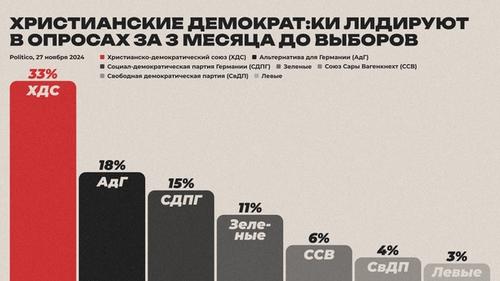
Early elections to the Bundestag will be held on February 23, 2025. The absolute favorite is the CDU: right now polls give the party 32% of the vote. For the first time in history, the SPD (16%) risks losing the status of one of the two largest parties, and not to someone, but to the far-right AfD (18%). The Greens (11%) will not lose as much from the collapse of the coalition, but the Free Democrats may not even pass the electoral threshold of 5%. It seems that the Germans did not appreciate Lindner's reform ardor and fiscal discipline. It is very likely that for the first time since its founding, the “Left Party”, which polls so far predict only 4%, will not enter the lower house of parliament. But once one of the most prominent representatives of the Left, Sarah Wagenknecht, will lead a new party in the Bundestag under her own brand.
How all political parties in Germany moved to the right
The Sarah Wagenknecht Union (SWA) was founded by her and three other people from the Left, convinced that the party was too carried away by completely “irrelevant” topics for the working class such as pronouns, racism and veganism. The new project combines completely left-wing economic initiatives, for example, state investment in infrastructure, additional taxes for the richest and the fight against digital giants like Amazon, with reactionary slogans of limiting migration and gender-sensitive spelling in schools and universities. SSV advocates ending military support for Ukraine, lifting sanctions on Russia and dissolving NATO. At the same time, its founder calls Israel’s aggression in Gaza a “barbaric war” and the sector itself “the largest open-air prison.” The party has already managed to be among the leaders three times in all the regional elections where it has participated, and, judging by the polls, it claims 7% in the upcoming elections to the Bundestag.
If for the “Left” the success of the Wagenknecht project threatens failure to enter parliament, then the “Alternative for Germany”, competing with the SSV in the field of anti-migrant, anti-war and anti-vouk rhetoric Conservative critics like to refer to increased public attention to issues of race, class, and gender justice as “woke rhetoric.” , is still doing well. The party was not greatly hindered even by last year's revelation of the secret convention in Potsdam. At the meeting, representatives of the AfD, businessmen sympathetic to it and simply far-right activists discussed a plan to deport from the country all asylum seekers, “non-Germans” with residence permits and “unassimilated” German citizens. Major parties still united over cordon sanitaire against AfD In the electoral politics of Western European countries, this is usually the name given to the consensus of mainstream parties on the inadmissibility of cooperation with radicals. Both the CDU and the SPD declaratively refuse to form a coalition with the Alternative for Germany. , but even in the role of the main opposition force, the “Alternative” will shift the country’s migration policy to the right. More precisely, it has already moved.
The right-wing agenda in Germany will be implemented not by terrible radicals, but by centrists
Regardless of who the Christian Democrats take into the future coalition - it could be the SPD, or it could be the Greens - their junior partners will have to make concessions . Representatives of the CDU have already hinted at a desire to abandon the unemployment benefit just adopted by the traffic light coalition: in their opinion, the initiative does not motivate recipients to look for work. The Christian Democrats' new platform includes tax cuts, limiting green transition measures to purely market mechanisms and further privatization of health insurance. And also unconditional support for Israel and an increase in the number of cameras and police on the streets. In its return to “conservative values,” the CDU has not forgotten about migration: for example, the party promises to lobby for a change in the international asylum system so that asylum seekers await decisions from migration authorities in third countries.
As often happens, the right-wing agenda in Germany will be implemented not by terrible radicals, but by centrists. The tightening of migration policy has already become a commonplace: only the Left, which most likely will not get into the Bundestag, and the Greens, whose popularity in the country is rapidly declining, are against it. Migrant phobia is perfectly complemented by the rhetoric of remilitarization. Three days after the Russian Armed Forces invaded Ukraine, Olaf Scholz proclaimed a “turning point” for the country and the continent, to which Germany must respond by increasing its military power - at least to the level of 2% of GDP per year required by NATO. The country reintroduced Veterans Day and began opening new memorials to German soldiers who died in relatively recent armed conflicts. The Minister of Education spoke about the benefits of school defense lessons together with representatives of the Bundeswehr. And the CEO of the arms manufacturer Rheinmetall, whose shares soared with the start of the war in Ukraine, called from the pages of the largest tabloid to introduce compulsory military service. By the way, the gradual return of the annual conscription is also contained in the CDU election platform, as, for example, the term “dominant culture” Dominant culture (German: Leitkultur) is a term popularized since the early 2000s in conservative circles as a critical alternative to the multiculturalist consensus. The dominant culture means Christian European culture. . All applicants for citizenship will now be required to be checked for compliance with its values, which include Germany’s “special responsibility” to the State of Israel.
How Germany plans to revive the economy
The current crisis is unfolding against the backdrop of Trump’s crushing victory in the United States, the potential triumph of Marine Le Pen in neighboring France, and the failure of the Greens, Social Democrats and Liberals in the recent elections to the European Parliament. Until recently, Germany remained a showcase of centrist normality, where no one (well, almost no one) proposes leaving the European Union, the police do not have to use ultra-violence to suppress mass protests, and the executive branch does not ignore legislative decisions when carrying out unpopular reforms. Once in power, the CDU will try to preserve this showcase. But even according to her program, it is clear that the country is facing a transition from the “progressive”, green-cosmopolitan neoliberalism of the times of Angela Merkel to its reactionary-identitarian form - as elsewhere .
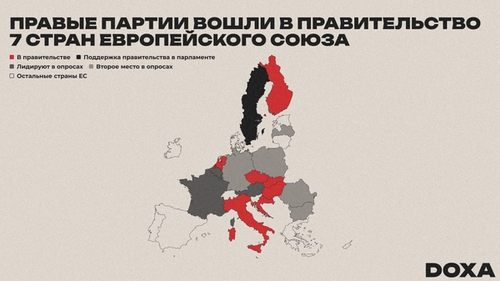
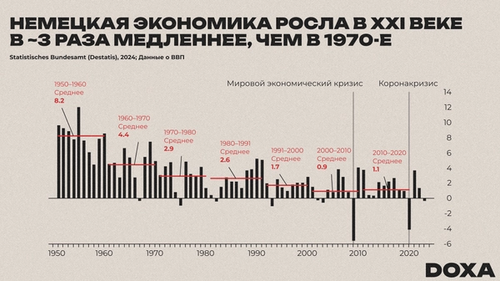
The creeping capitulation of German “normality” is due to the same economic reasons as in other countries of the core of industrial capitalism In world-system theory, core countries are the first established industrial capitalist economies (Europe, USA, Japan, Australia), which maintain a global advantage through privileged access to resource markets and the sale of their high-tech goods. . In the 21st century, the growth rate of the German economy did not exceed 1.1% of GDP in average annual terms. This is almost two times slower than in the 1990s, and three times slower than in the 1970s, not to mention the times of the post-war “economic miracle”, when the country’s economy recovered and grew by an average of 8% per year. Things have gotten worse in the last few years. The global decline in consumption during the coronavirus pandemic, the rejection of cheap Russian gas and trade wars between the United States, China and the European Union have resulted in an export-oriented In Germany, industry accounts for almost a quarter of GDP. The country exports high-tech industrial products around the world, such as machine tools and cars. The German economy has barely returned to its pre-Covid level (0.2% growth compared to 2019). Over the same period, Italy's GDP grew by 5.5%, the Eurozone by an average of 4.6%, and the US by 11.4%. Last year, the Institute for Economic and Social Research in Dusseldorf recorded a record number of labor conflicts in the country in almost ten years, and Volkswagen announced plans to close several German production facilities for the first time in its century-long history.
Reducing spending on social services and climate change is unlikely to help. Because the German unemployed will have to quickly accept low-paid positions, German cars, the demand for which has begun to fall around the world, are unlikely to fall in price to the level of Chinese electric vehicles. At the same time, the dependence of the German economy not only on foreign markets, but also on global supply chains is so great that last summer, auto industry lobbyists literally called on the European Commission not to introduce protective duties on cars assembled in China. Firstly, some of them are produced by German companies. Secondly, Beijing's retaliatory measures could hit both German exports and imports of components. The bad news for the German economic model is that the demand for its technologies, machines and machines in China will continue to fall in any case: the Chinese economy is gradually slowing down, and at the same time local companies are already competing with Western manufacturers. According to Cyrus de la Rubia, chief economist at the Hamburg Commercial Bank, exports of Chinese cars have grown by 600% since 2021 - ten times more than German ones.
But according to economists at the International Monetary Fund (IMF), dependence on industrial exports is not yet the main problem of the German economy. It has two other critical vulnerabilities. Firstly, the aging population. According to current forecasts, the number of working-age citizens in the country will decrease by at least 0.6% over the next five years - three times more than the EU average. It is migrants that Germany needs more than other European countries, the IMF is confident. Well, or at least to actively put more work into women, who are now 2.3 million fewer in the German labor market than men. The second problem is outdated infrastructure. Costs have stagnated since the early 1990s, making German railways a meme. In terms of investment in public infrastructure relative to GDP, Germany is twice as bad as neighboring Poland. In 2020, the Hans Böckler Foundation estimated that the country needs at least 457 billion euros to upgrade its transport system, telecommunications, schools, etc. This is approximately one year's budget.
For decades, Germany not only underinvested in its own infrastructure, but also used its leading position in the European Union to prevent other European countries from spending too much money. It was Berlin that did not allow the European Commission in 2023 to weaken too much the budget deficit limits for the bloc countries, adopted in the late 1990s. Germany's public debt does not exceed 63.4% of its GDP - this is several times less than that of France (110.8%) or the United States (122.3%), not to mention the other leading export economy - Japan (263%). ). Theoretically, this gives the country an impressive reserve in order to, by increasing it, make the necessary investments and accelerate the economy, points out Peter Bofinger, an economist at the University of Würzburg. But this, most likely, will not happen due to the sacred belief of the parties of the right spectrum in the debt brake. While other rich countries have in recent years increasingly returned to the practice of large public investment to boost the economy, Germany stubbornly clings to neoliberal prescriptions: when there is no growth, cut the burden on businesses and let them figure out how to make more money. That it is Germany that demonstrates this old-fashioned dogmatism is not really surprising.
The Myth of a Social Market Economy, the Truth of a Defensible Democracy
Post-Soviet people associate market fundamentalism with a liberal superstructure - competition, entrepreneurship, white men in expensive suits - with America. But the first Western state after the Second World War, which officially adopted the liberal economic model, was precisely the Federal Republic of Germany. Michelle Foucault even called the country the “first radical economic state”: in the absence of the opportunity to refer to sovereignty after Hitler, the West German government deliberately put a successful economy in place of the national idea.
At the turn of the 1940s and 1950s, the ideas of the free market seemed frank archaic: the USA, Great Britain and European countries restored the economy by Keynes's methods John Meinard Keynes is a British economist, author of the General Theory of Employment, interest and Money. For a while, he convinced the economic mainstream of the importance of aggregate demand, to maintain a high level of which it is necessary to maximize employment and improve public infrastructure. , and the labor movement inspired by the triumph of the Soviet Union everywhere confidently fought for its labor rights, social guarantees and raising salaries. Therefore, the first Minister of Finance of the New State Ludwig Erhard had to fight the leaders of the occupation zones for his radical reforms at that time. For example, the denomination of the old currency, during which the Germans lost 90% of the accumulations stored in it, and the rejection of price control that has inflated the cost of consumer goods. By the way, does not remind anyone?
Communists in the country were persecuted with great enthusiasm than the Nazis
The formation of a German market economy was not so smooth. Outraged by rising prices and freezing salaries, workers went to the first and so far the last universal strike in the country's history. The allies urgently had to throw clothes and other goods from military warehouses at fixed prices to the free market. And in the first elections, there were every chance to defeat the Social Democrats. But this did not happen, and the CDU ruled the country for the first twenty years of its history, and Erhard is listed in Wikipedia as the father of the German “social market economy”.
This phrase often confuses: as if the liberal founding fathers of Germany chose the path of compromise between the market economy and the concern for the population consciously, from an heightened humanistic feeling or great wisdom. In fact, as the historian Uve Furmann well reminds , for the most “social” structures of the German model - for example, the obligatory representation of employees in the board of directors of large companies - the German working class had to fight more than once. It is thanks to this struggle in the Constitution adopted in 1949 that the social character of the state, the right to trade unions, and even the wording “property implies responsibility”, are enshrined.
The term “social market economy” (Nem.soziale Marktwirtschaft) was invented by the liberal Erhard, but Alfred Müller-Armak, a conservative economist and a member of the NSDAP, who wrote about a national oriented economy with a strong leader at the head of Hitler. Inspired by Catholic prime (the idea of a compromise between different confessional and social groups), he dreamed of a company of corporatic peace, in which workers simply had no reason not to trust his superiors.
In practice, the participation of employees in enterprise management was limited mainly to the defense of their own labor rights. At the same time, the density of trade unions in the country was almost twice as lower than in neighboring Austria, which was led by social democrats for most of the century. And the maximum income tax rate The highest income is subject to the maximum rate. 53–56% floundered in the corridor in those days when in the UK and the USA the tax reached almost 100%.
By the way, the Federal Republic of Germany also did not differ by political freedoms. The denazification process was largely sabotaged . The Communists in the country were persecuted with much greater enthusiasm, and people of “radical” people - primarily left -wing - were forbidden to occupy public office or teach at universities. Even today, in the country, events such as the Palestinian Congress are dispersed or refused to enter Nancy Fraser Nancy Fraser is an American philosopher, a professor of a new school in New York. In 2024, the University of Cologne annulled the planned cooperation with Fraser after she, along with hundreds of other academicians, left her signature under the letter in defense of Palestine. And to Janis Varufakis Janis Varufakis is a Greek economist in left -wing views, a former Minister of Finance of Greece. In 2024, in response to the planned participation in the Palestinian Congress, he was banned from entering Germany, and German institutions - any cooperation with him. . And article 129 on the organization of the terrorist community recently used in court cases against climatic activists - the German branch of Amnesty International even officially published a call for its revision .
Welfare crisis or the end of democratic capitalism?
In the 1980s, German leaders (then the country led the Helmut from the CD) did not arrange a war with miners or civil servants and privatize industry following the example of Margaret Thatcher or Ronald Reagan. Largely because the economy was slightly less affected by stagflation Typically, the decline in the economy leads to a drop in prices (deflation). However, since the 1970s, Western economies have encountered both unemployment and prices at the same time. , and the trade unions were ready to give a powerful rebuff and at the same time agreed to a compromise Sociologist Wolfgang Strack called the German version of the pact between capital and labor "corporatism of the proposal." With the “corporatism of demand”, more characteristic of the middle of the twentieth century, employees are more actively required by the growth of salaries from employers, and the state believes in the growth of the economy due to the growth of the consumption of “rich” workers. In Germany, employees, large companies and the state most often converged on the need to increase the competitiveness of German products around the world, and only then adapt salaries to the growing income of companies. . However, already in the 1990s, the Federal Government sold the key packages of shares of Lufthansa, the Deutsche Telekom telecommunications giant and Germany’s post office. In the early 2000s, it reduced unemployment benefits and deregulated working hours, allowing “flexible” labor contracts. The German society did not like it so much that the Chancellor from the coalition of the SPD and the Green Gerhard Schreder had to announce the early elections in which his party could no longer win. And liberal critics soon announced that the reforms carried out are not enough and salaries in other countries of the European Union are still lower, which means that there is where to fall.
Nothing new has been invented since then. Christian democrats and liberals (as, by the way, AFD) offer a little more to dismantle the remnants of “social” in a market economy, so that the business has more opportunities to hire employees for less money: presumably, as a result, German companies will interest international investors and foreign consumers. It is possible that the future coalition will even consider the possibility of adjusting the debt brake, primarily in order to raise defense costs: the CDU leader marks in an additional 300 billion euros for the re -equipment of the German army. The rhetoric of the militarization goes well with ecoscutzcecism, migrantophobia and a dream to take away unemployment benefits from 1.7 million people.
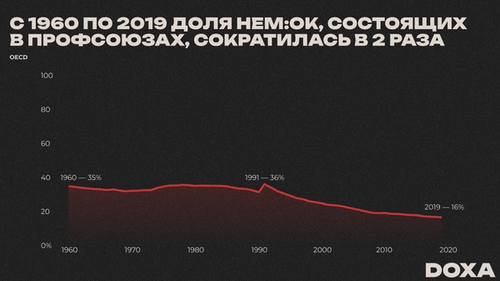
In some structural differences, the German political economic model is approaching the same point as the rest of the “democratic capitalism” modes - a slowdown in growth, deindustrialization, a drop in the standard of living of the poorest population groups and return frustration, which are skillfully used by right -wing politicians. Moreover, her still high share of social expenses is not a bug, but a feature. It was unemployment benefits, as well as generous, state -subsidized retirement options, that employees protested, allowing business to reduce the number of jobs, but not the level of salaries. But by the beginning of the 21st century, the same thing happened with the German trade unions as with the rest: their base - industrial workers - was reduced several times. If in the early 1980s almost every second able-bodied German was in the trade union, then by 2004-only one of four. This means that the reasons to comply with their agreements from business and the state have decreased. If in 1999 the largest IG Metall trade union could still afford to demand a decrease in the retirement age to 60 years, then in 2007 the ruling social-democratic coalition without any negotiations announced its increase to 67 years. During the same period, the level of financial inequality in the country increased by 20%.
The crisis of the social state is experienced by all leading industrial economies in the world. When the economy ceases to grow, capital is rapidly losing a desire to share the remaining profit with the employees. The state comes to the aid of people whose salaries do not keep up with rising prices, or even disappear along with jobs. It takes over the growing pension costs and unemployment benefits. Burns, since no one likes tax increases. When this is not enough, credit cards are used-the liberalization of banking legislation at the turn of the 1980s and 1990s was no coincidence: the ability to buy new equipment or even a debt apartment perfectly masks the decline in real purchasing power. For more than ten years, mature capitalist economies have been at the next stage, when the owners of capital, including state debt papers, forced their debtors, that is, government, to reduce debts, and therefore social expenses.
The liberal exhortation that the business exempted from “unnecessary” obligations and taxes will surely come up with and restart the economy, is almost convinced of anyone. Then traditional values, cultural wars with vegans, migrants and Childfri are used. Well, police batons, where without them. The first liberal economy in Europe, Germany, with a little delay, joins this “new normality”, where a compromise between democracy and capitalism looks less likely.
We talk about why the right forces seize power around the world. Support us to keep abreast.