Translated material
Stop, car
The head of the Russian Orthodox Church took a new height in constructing his religion of war. He called not to be afraid of the nuclear Apocalypse and to thank - not God, but scientists! - for the “fantastic weapon “Oreshnik””
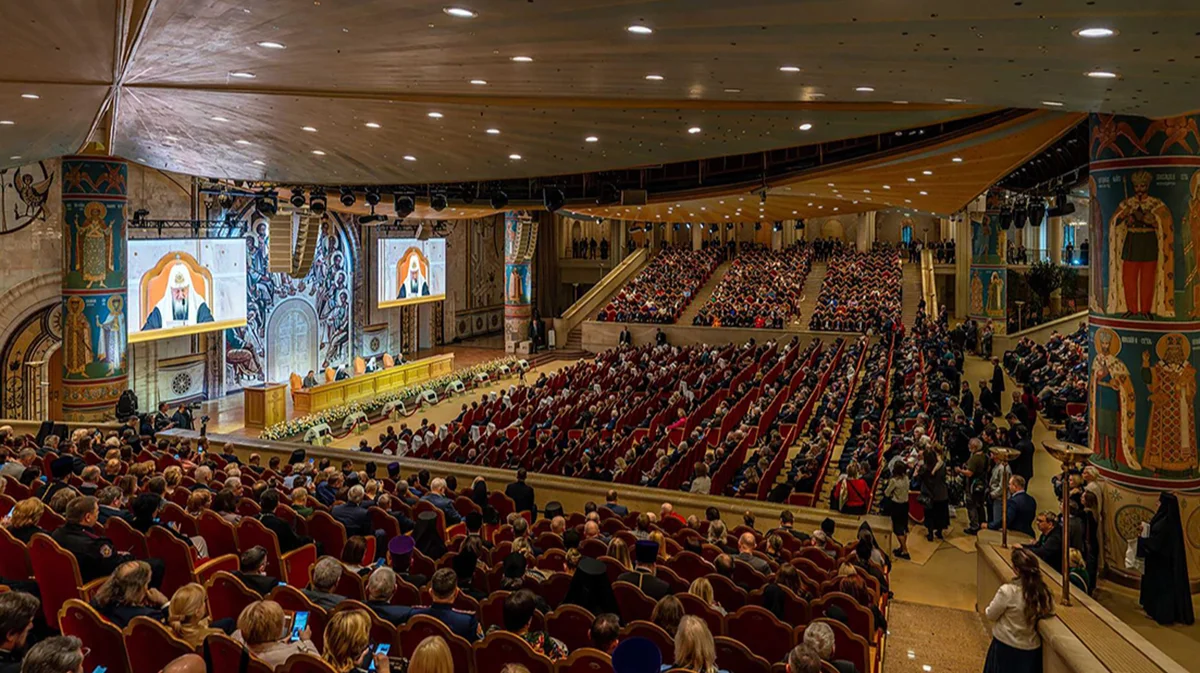
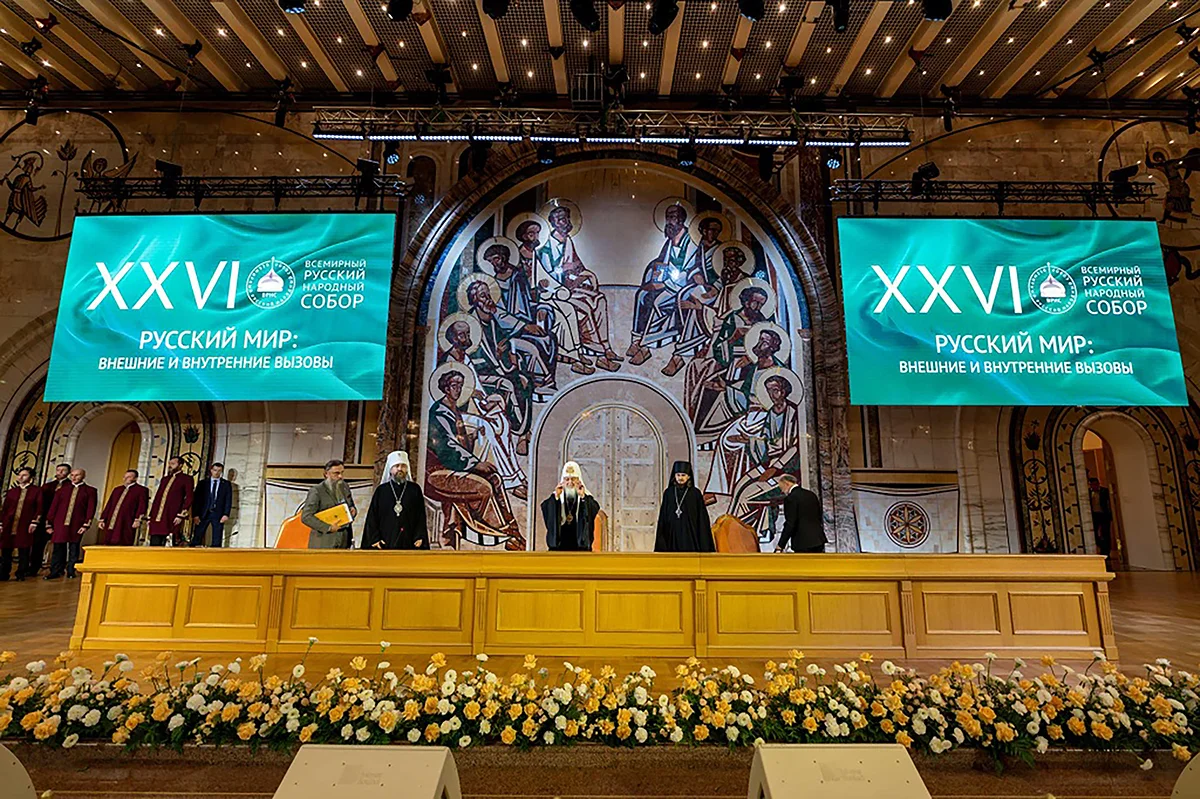
Plenary session of the XXVI World Russian People's Council . Photo: Oleg Varov / vrns.ru
It's amazing how years of service together make people similar to each other! Patriarch Kirill (Gundyaev), who comes from the same department as Vladimir Putin, literally beamed with happiness, telling officials and bishops who gathered on November 28 at the XXVI World Russian People's Council (VRNS) in the Cathedral of Christ the Savior that Russia was practically saved by a new miracle weapon. “We place all our trust in nothing…” The more experienced and restrained Putin also had difficulty hiding his joy when he savored the “analogue quality” of Oreshnik at a meeting with military and industrialists on November 22.
The deadly power of the miracle rocket, which the head of the Russian Orthodox Church christened “The Nut” in an old man’s way, caused the patriarch to literally laugh enthusiastically: “This is a stop machine! While they figure out what we thought of and do what we did, time will pass. We need to thank our scientists - the Kulibins (sic!), who create incredible weapons, fantastic weapons, causing bewilderment and some kind of nightmare, heh, to those Western strategists who think of defeating Russia by military force.”
"The so-called end of the world"
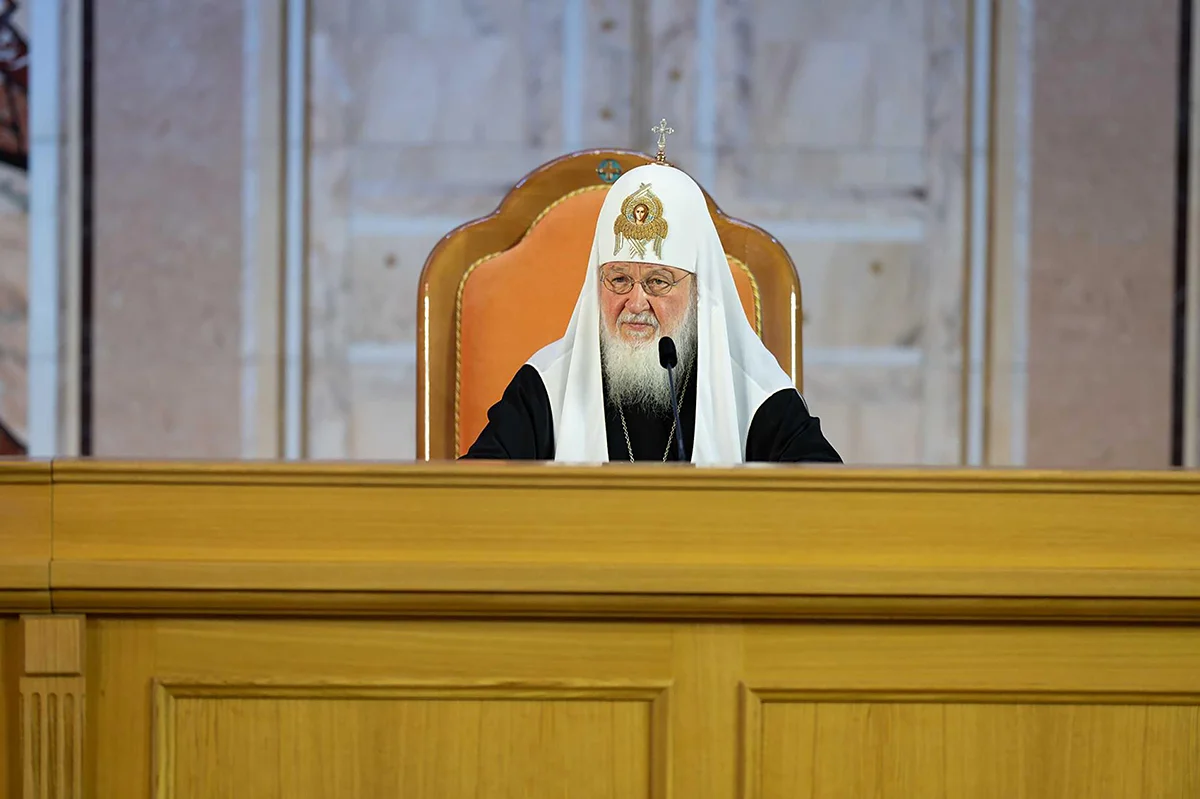
The first (and most resonant) statement of the patriarch at the council sounded somewhat ambiguous - against the backdrop of the recent adoption of the new nuclear doctrine of the Russian Federation. “Excessive alarmism and speculation on the nuclear topic are not useful from a spiritual point of view,” Kirill declared authoritatively, slightly distorting his words (out of excitement?). According to him, the fear of the Apocalypse paralyzes the will of people and deprives them of the courage that is so needed in the “NWO”. “Christians are not afraid of the so-called end of the world,” the patriarch confidently assured, but doubt was visible on the faces of some of the bishops listening to him. At the seminary, this question was interpreted a little differently... “A person who waits for the end of the world,” the patriarch developed his psychological theology, “weakens from within and always needs external support, and external support is often a factor of manipulation.” And again, ambiguity: is relying on Putin, faith in him, which inspires Russians who have chosen loyal obedience, is manipulation?!
And that's not all! Kirill actually called for the closure of the SVO: “Of the obvious external threats to the Russian world, the most pressing today is the continuation of military operations.” Further, no less strange statements poured out from the patriarchal lips about the “brotherhood” of the peoples of Russia and Ukraine, that Russia, Ukraine and Belarus together are “a bone in the throat of the Western world” because they adhere to common “values.” However, the speaker quickly moved on to the topic of the “inevitable reunification” of Ukraine with Russia, following the example of Donbass. At the same time, contradicting himself, he called the decision of the Soviet authorities to transfer Donbass to the Ukrainian SSR “terrible.”
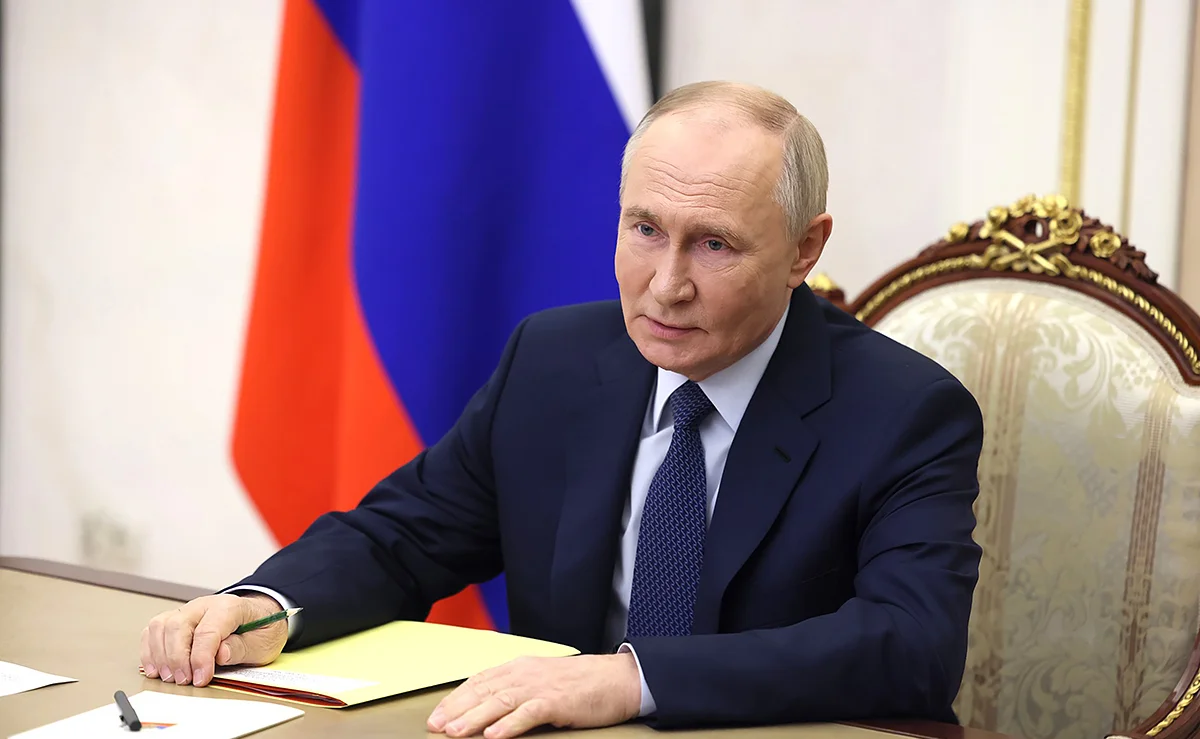
Apparently, the Kremlin is not happy that the head of the Russian Orthodox Church began to talk. This is evidenced by the sharp decline in the status of the cathedral: last year it was held in the Kremlin, in the Palace of Congresses, Putin personally addressed the cathedral members from the big screen between two icons of the Savior, followed by the heads of the chambers of the Federal Assembly and ministers. This year the cathedral was not allowed into the Kremlin, and the heads and ministers were represented by deputies or even ordinary clerks. Putin’s greeting was announced by Sergei Kiriyenko, and the highest in the “table of ranks” among the officials who spoke were St. Petersburg Governor Alexei Beglov and Energy Minister Sergei Tsivilev.
REFERENCE
The status of the World Russian People's Council is quite contradictory: it is formally a public organization that unites officials and “system” politicians of different directions, but at the same time it operates under the auspices of the Russian Orthodox Church and claims to be the national representative of the entire Russian people. As Novaya Gazeta wrote , the goal of the cathedral is “to unite all Russian people, regardless of their country of residence and political views.” The First World Russian Council (its name did not yet contain the word “people’s”) was initiated by then Metropolitan Kirill at the end of May 1993. Starting from the third All-Russian Council, which was held in the Danilov Monastery at the end of the election campaign to the State Duma in December 1995, participation the cathedrals are received by the leaders of the “system” parties, and formally it is headed by the patriarch. In December 2001, Putin spoke at the council for the first time, and in 2005 the organization received consultative status with the UN Economic and Social Council. The current composition of the presidium of the cathedral, where officials and security officials meet with hierarchs and functionaries of the Russian Orthodox Church, reflects Kirill’s desire to unify state and church power in the Orthodox Russia of the future.
The search for meaning is endless
For a long time and painfully, for 26 years now, Russian people's councils have been searching for the meaning and purpose of Russia. And at each cathedral they offer new options. This time, the patriarch defined “Russia’s goal setting” as follows: “To be warriors of the Lord, to resist evil and to defend high moral ideals.” Not too original. In the “Order” adopted by the VRNS on March 27, the wording was more interesting and radical. Having declared the Russian Federation’s claims to restore the borders of the Russian Empire and even expand them, the cathedral then called Russian civilization and “great Russian culture” the “meaning of life”, and endowed the “SVO” with the status of a “holy war”. It was to that document of the VRNS that the Parliamentary Assembly of the Council of Europe responded on April 17 in the resolution “The death of Alexei Navalny and the need to counter the totalitarian regime of Vladimir Putin and his war on democracy.” “The hierarchy of the Moscow Patriarchate of the Russian Orthodox Church, including Patriarch Kirill,” the document says, “defends the ideology of the “Russian world,” declaring the war against Ukraine and the “satanic” West a “holy war of all Russians,” calling on Orthodox believers to sacrifice themselves for the sake of their country. The Assembly is appalled by this abuse of religion and the distortion of the Christian Orthodox tradition by the regime of Vladimir Putin and his proxies in the hierarchy of the Moscow Patriarchate. The Assembly condemns such rhetoric and emphasizes that incitement to commit the crime of aggression, genocide and war crimes is a crime in itself.”
But the patriarch calls it differently: Vladimir Putin’s policy, he assured on November 28, “is aimed at establishing freedom, independence, the true independence of our Fatherland and at the same time preserving those traditional values that underlie our civilization.” Giving deepest gratitude - not to God! — and “to our president,” the head of the Russian Orthodox Church praised his “immense responsibility, wise prudence, composure and calm in these difficult circumstances.” Well, how can one not recall the immortal lines from the punk prayer “Pussy riot” in the same Cathedral of Christ the Savior in 2012: “Patriarch Gundyai believes in Putin...”, and so on. Naturally, such a patriarch does not protest purely pagan declarations, such as “Our Motherland is God and Russia” performed by ex-Prime Minister of the Russian Federation Sergei Stepashin at the same council meeting.
Clear the army of obscenities
But the time has come again to descend from heaven to earth. It turns out that the same Russia, which takes upon itself the mission of Keeping the world from evil, is the bearer of the highest “traditional values” and the greatest culture, which is generally God, is dying from alcoholism, completely affected by foul language and is rapidly being captured by foreign migrants. Such “revelations” are also contained in the Patriarch’s report at the XXVI VRNS. Kirill admits that the more successfully his country challenges the world’s evil and moves from victory to victory, the more its residents consume alcohol (“in some types - by 60% over the past year”) and swear. Apparently, from unprecedented happiness, which, according to a recent VTsIOM survey, embraced 79% of Russians. From the point of view of the Orthodox tradition , swearing is a tool for introducing oneself to Satan, to the demonic world. According to the patriarch, today even seven-year-old Russians actively use this instrument! “We must cleanse this spiritual poison from the life of our people,” he urges.
Is it possible to imagine the Russian army without swearing? Probably, on the front line (and in the barracks) this is the most popular vocabulary. And the greater the senselessness of what is happening, the more in demand it is. The leadership of the Russian Orthodox Church again and again demands funding for the development of the institution of military clergy, but the corresponding bill, prepared by the Patriarchate a year ago, lies without movement, despite the replacement of the “shamanistic” minister Shoigu with the faithful parishioner of the Russian Orthodox Church Belousov. The Patriarch described the behavior of a priest on the modern front in this way: “He should be where people are preparing to stand up to their full height and go on the attack... A priest should not get up and go on the attack - he will be demolished right away. But he must be where they are attacking from. And where ( and if. - Author's note ) they return after hostilities." The priests of the Russian Orthodox Church who find themselves in the combat zone are not given the benefits and privileges granted to contract soldiers; the Minister of Defense only introduced the positions of assistant commanders of military districts to work with believers, who are replaced by clergy of the patriarchy. Voluntarily priests do not want to go under bullets and shells in the steppes of Ukraine, and the head of the “military” department of the Russian Orthodox Church, Metropolitan Kirill (Pokrovsky), complains about a five-sixfold shortage of military clergy. According to him, today there are approximately 300 priests in the Russian Armed Forces with the “necessary” 2 thousands. Since this academic year, military training courses have been introduced in all religious educational institutions of the Russian Orthodox Church - the Moscow Patriarchate seems to be dreaming of becoming one of the divisions of the military department. Gundyaev’s new theology asserts this: his church is “fighting the spirits of evil in high heaven, including through military” means ( from Cyril’s response to the report at the All-Russian Revolutionary Council by Leonid Slutsky. - Author’s note ).
The future belongs to Rodnoverie
Finally, the patriarch could not pass over in silence the problem of his new confessional competitor, who emerged in full view precisely against the backdrop of the “SVO”, one way or another containing the idea of the superiority of the Russian people and their special right to expand the “living space” (Lebensraum). This competitor is neo-paganism, the ideas of which are objectively more in tune with the “goals and objectives of the Northern Military District” than Christianity, even as strongly dissected as in the Russian Orthodox Church. “The rhetoric of neo-pagans,” said Kirill, “is usually built around the ideas of personal heroism, valor and feat, which are supposedly not inherent in Christianity. The falsity of this thesis is absolutely obvious. You have to be completely ignorant of the history of the Russian people to assert such nonsense.” But the more the patriarch swears and is indignant, the more amulets, amulets and pagan runes there are in the army: they even penetrated into the recently approved symbols of the “North” group of Russian troops in Ukraine. “Any flirtations with paganism are dangerous,” and fear can be heard in the patriarch’s voice. “We know well what they lead to.” Just look at the neighboring warring state, in which the neo-pagans, with the connivance of the authorities, acquired such strength that they created their own paramilitary units based on Nazi ideology.” Kirill hints at the Azov group, but purely pagan formations such as the Rusich group also fought on the side of the Russian Federation, pagan practices were recorded in the Wagner PMC...
At the front, the formidable names of pagan gods and toasts in honor of the legendary warrior-heroes are more organic than the gospel preaching of reconciliation and forgiveness. Obviously, the Russian Orthodox Church, if it wants to continue to remain in the trend, will have to drift even more towards the pagan paradigm, from which it has borrowed a lot over these three years. And in the rhetoric of the patriarch, confrontational language addressed to the growing paganism will gradually be replaced by respectful - “patriotic”. At least, the militant creed of the “Russian world” leads precisely in this direction.