
Translated material
I went to fight for Ukraine as a volunteer
Before the invasion of Ukraine, Yaroslav Belozerov (name changed), who will soon turn 60, lived in a small town in central Russia, occasionally going out on one-man pickets against government actions. The scale of the Russian invasion shocked him and left him in despair. Out of hopelessness and a sense of guilt before the Ukrainian people, he decided to become a volunteer and fight on the side of Ukraine, although before he could not imagine himself with a weapon in his hands. Belozerov told Kholod about how he went on missions near Avdeevka, was wounded during an operation by Russian volunteers in the Belgorod region, and why Ukrainians cannot defeat Putin’s army on their own.
I'm almost 60 and I'm from Russia. I couldn’t do otherwise, but I couldn’t cope with the constant fear and quit
Some details from the hero's life have been changed for safety reasons. Russians who fought on the side of Ukraine are being persecuted by the authorities, accused of terrorism and treason, and they are threatened with criminal punishment up to life imprisonment. “Cold” verified the identity and part of Yaroslav’s story, which concerns his biography. The editors confirmed the fact of his participation in the volunteer unit in Ukraine.
On the eve of February 24, 2022, I set my alarms 10–15 minutes before dawn. I understood that if war started, it would happen at night. I didn’t want to miss this and was guided by what time it was light in Kyiv. Western intelligence predicted several times when Putin would attack Ukraine, but I thought that, out of principle, he would do it a day earlier or later than the predicted date.
But it was on February 24 that I overslept. I woke up and saw the news that the war had been going on for more than an hour.
All my friends in Russia said that they were against the war, but very soon I realized that our people were not ready to fight to stop it. This made me despair. I felt shame and guilt before people in Ukraine. I have a lot in common with this country: my relatives and friends live there, several acquaintances went to the military registration and enlistment offices on February 24 and became volunteers. One of them called me to fight. The thought of this terrified me: I could not imagine myself with a weapon in my hands, but at the same time I did not see any other way out for myself.
I rose from the very bottom. My husband died of an overdose in my arms, I served time in prison and almost lost my daughter. But I was able to change myself and my life Society 19 min read
I had planned to leave Russia before, but on February 24 I realized that I needed to do this as soon as possible. I was preparing to leave, stocking up on food and medicine for my elderly relatives, and in the evenings I went to anti-war rallies in my city. I wanted to show that not only young people are against the war and Putin’s policies, but my generation too.
At one of the protests, they detained me and began to threaten me with the “Dada” article ( punishment for repeated participation in protests. - Kholod’s note) : I had protested before, until 2022. That evening I was released from the police department, because in the second week after the invasion, special detention centers in our city and even in the region were already overcrowded with opponents of the war. I was told to return the next day to draw up a report. I realized that if I stayed in Russia and continued to protest, I could be imprisoned for five years, and that same night I flew away. This was at the beginning of March.
I won’t say which country I went to for security reasons. I thought that I could almost immediately go further to Ukraine, but for a very long time nothing worked out for me.
My Ukrainian friend, who initially called me into the army, could not help me with the transfer. Then I went to the Ukrainian embassy. I told them, I want to fight for the Ukrainian Armed Forces, give me a visa so that I can become a volunteer. I was refused. I started writing to Ukrainians on Facebook, to the military people I found. He explained that I was Russian, but I was against the war and wanted to defend their country, and asked to help me get into the army. But nothing came of it.
There is nowhere else to exile generals The end of Bashar al-Assad calls into question the fate of the Russian military, who were sent to Syria after the failures in Ukraine Politics 3 minute read
I didn't want to fight. The option of working at a factory in Ukraine, producing shells, digging trenches, or doing anything else, but in the rear, would be more suitable for me. But there was no such option at all. Becoming a volunteer is the only way I have seen to really help Ukraine.
The Russian units - RDK and the "Freedom of Russia" legion , which appeared in 2022, did not accept me. They said that I was not suitable for them because of my age and insufficient physical training - then recruitment was carried out only for assault positions. I kept up and wrote to them that I could be useful in the rear, but they still didn’t take me.
At the end of 2022, they announced the creation of the “Civil Council” - a project that helped Russians get to the front in Ukraine, and I immediately turned to them. They assured me that they would help, and promised that I could become a driver. I was able to get to Ukraine only in the fall of 2023.
The commander did not spare us
I was very happy and inspired when I went to Ukraine, because I had been working towards this for so long. The commander who met us immediately said: “Congratulations, now you are all attack aircraft.” This shocked me. I couldn't imagine myself as a stormtrooper.
I immediately wrote to the “Civil Council”, and the people from there reassured me, promising that there would be many Russian volunteers in Ukraine in the next few months, because they have a huge queue of people willing to fight, and rear positions will appear in any case. I calmed down. They really started training me to be a driver: they taught me how to drive a jeep off-road.
The first few months, due to intense training, there was no strength left for anything. Every morning I woke up and thought only about how I could get through this day. We rested only on Sundays, but even then I continued to train on my own, because I thought that if I stopped, I would not be able to meet the level of my colleagues.
The camp in which we lived was located deep in the rear, it was quiet and calm. Sometimes we saw rockets overhead. The sky of Ukraine now is not like the sky in other countries: there are no planes there at all, and if some kind of rocket or drone suddenly flies, they can be heard and seen very well. At times we watched Ukrainian air defense shoot down missiles and drones.
While we were still preparing, we were taken on excursions to Kyiv several times. During one of these trips we visited the Holodomor Museum. At the end of the excursion, the employee who told us about the exhibition in pure Russian burst into tears. She realized that we were Russians who had come specifically to defend their country. I then encountered this kind of attitude more than once: when the Ukrainians thanked us and treated us to food, and it was clear how touched they were. The Ukrainian military and commanders also treated us with respect and recognized that we had an even more difficult fate and choice than they had in defending our homeland from enemy attack.
Our preparation lasted about five months. The commander did not spare us, constantly complicating the tasks: during training, he said that we could not even imagine what war was, and that after the first battle, 20% of the volunteers would write reports and leave. This is approximately what happened, but not after the first release, but later.
First combat mission
We were sent to the front suddenly, with a warning literally a couple of hours before departure. This was in February. The urgency was due to the fact that the Ukrainian military was leaving Avdiivka, and Russian units were holding the “road of life” - a safe corridor so that they would not be attacked from the sides. From the description of the task, I realized that I would not be a driver, but an attack aircraft, along with everyone else. But there was no time for arguing anymore.
Due to my nervous state on the bus, I could not sleep, although we had been traveling for a very long time. As soon as we arrived at the given point, we almost immediately got into an armored personnel carrier and went on a mission: by that time I had not slept for almost a day. The mood was high: finally the first fight for which we had been preparing for so long.
While I was driving to the front, it wasn’t scary - but only until the moment I got out of the armored personnel carrier. They immediately opened fire on us, and I ran very quickly on all fours to the forest belt. I don’t know how I did it: in normal life I would never have run so fast. When I looked around, I saw that three of my comrades had already been wounded, including our commander. All this happened in 10–20 seconds. The wounded colleagues were quickly evacuated, and we went on our mission.
The catch was that only the commander knew the details of the mission. The task given to us was only tentative: we had to walk one and a half kilometers from the place where we were dropped off, and strengthen the group of military men who were holding the defense “at zero” (on the line of contact where the fighting is taking place. - Note by “Cold”) . We had three radios, but we lost one while disembarking from an armored personnel carrier due to unexpected shelling, and the other was damaged. The third was with the commander, but he was evacuated after being wounded, and we were left without contact. I had to go almost at random.
They were shooting at us all the time, drones were flying over us. We were prepared for this during training: noise grenades were exploded next to us, there were training shooting ranges, but at the front it feels completely different. You feel like they always want to kill you. One or two drones hang above you all the time, they buzz next to you, sometimes it seems that you can grab them with your hand, they are so close. And you constantly feel in danger. The drones' cameras weren't very good, and they only knew approximately where we were. But this still helped the enemy direct fire at us from mortars and other weapons. In addition to reconnaissance drones, there were FPV drones - they actually played the role of a flying artillery shell and crashed a meter or two from us.
Help Kholod tell human stories
We put people at the center of our journalism and talk about people who face injustice, but do not lose spirit and continue to fight for their rights and freedoms. To continue covering people's stories, we need the support of readers - thanks to your donations, we continue to work, despite government pressure.
- Foreign card
- Map of the Russian Federation ↘︎
- Patreon ↘︎
- Translation
- Crypt
Monthly
One-time
5 €
- 10 €
- 20 €
30 €
5 €
- 10 €
- 20 €
- Other
- Bank of the Russian Federation
- Foreign bank
Card number:
5536 9138 6472 8742
Copied!
Recipient:
Taisiya Bekbulatova
Copied!
Recipient:
Projektas Šaltis
Copied!
Account number:
LT613500010016198323
Copied!
SWIFT BIC:
EVIULT2VXXX
Copied!
Bank:
Lietuvos Bankas (Bank of Lithuania)
Copied!
Comment - purpose of payment:
Parama įstatymų numatytais tikslais (be konkretaus tikslo)
Copied!
We ask you to provide a comment so that we can accurately determine the receipt of funds. The phrase is translated as follows: “Support for statutory purposes (without a specific purpose).”
Amount: €
Donate
By making a donation, you accept the privacy policy
We were taught to walk in “paired steps”: two steps is about one and a half meters, you walk and count. When we had covered the required distance, we realized that the group of fighters we were going to help was not there. Two of our guys went further to investigate, but they didn’t find anyone there either. Then we decided to retreat.
When we heard someone’s voices, we quieted down and entered into a dialogue to find out if people knew about the unit we were going to, but no one knew anything. When they heard the sound of exploding mines and shells, they scattered to the sides, fell to the ground, waited, collected themselves and moved on. It was all very slow.
Six or eight hours passed from the armored personnel carrier landing until we found a group of Ukrainians with walkie-talkies who contacted our commanders: we were told to retreat. As we found out later, we were left not one and a half, but five kilometers from the group that we were supposed to reinforce - that’s why we couldn’t detect them. When we reached the commanders, we were immediately sent to the next mission.
Second exit
At that moment I no longer had any inspiration, I was scared: something was exploding everywhere, they wanted to kill you all the time, and while you were trying to understand something, your comrades were being wounded. And besides, I was already very tired, because by that time I had not slept for almost two days.
On the second mission, we had to help five Ukrainian soldiers who were defending themselves from the Russian assault. They were helped by a group of other Russian volunteers whom we relieved. The Ukrainians sat in the trenches in the center and defended the position, and we were located on the sides and helped them.
For the first time I saw with my own eyes what “meat assaults” were: Russian soldiers walked point-blank into several machine guns, from which the Ukrainians shot them. They fell to the ground , the wounded tried to crawl away, and after 15–20 minutes a new group of Russian soldiers attacked, and they were also shot. I don’t understand how they were forced to carry out such attacks.
I worked as a dancer in a strip club. Guests treated us like sex workers, and even my boyfriend called me a whore. It was terrible Society 7 minute read
In addition to machine guns, the Ukrainians used cluster artillery shells - they scattered up to 72 rounds of ammunition: thus, one shot covers a large area. If such a projectile falls somewhere near you, it is death. It is impossible to survive. The Ukrainians fired all night at the place where the Russians were coming from; every 15–20 minutes there was a cluster munition shot. And they kept going and going. There were many assaults - they merged into one.
My friend, who had a thermal imager, counted about 50 bodies of dead Russians in the small area where we were: these are only those who were not yet cool enough to be seen through the device. Only five Ukrainians fought off these attacks. They did it calmly, confidently and well. It seemed to me that they despise death and are not afraid of anything. But they were very tired. As we heard, they sat in the trenches for the third day and were not replaced, even when we came to help.
Then I realized that the war between Russia and Ukraine, which I had previously thought of as mass clashes, is actually a war of small groups.
That is, five people sit on the front line and fight off attacks, and no more than 10-15 people go on the assault at a time. It was then that I learned what the phrase “bullets whistling at my temple” means: because during the battle I really felt the bullets flying a few centimeters from me. They stuck into the ground next to the trench in which I was sitting, and it was not a very pleasant feeling.
A tank was shooting at me, drones were flying above me, bullets were whistling nearby, but compared to the first day, I felt that I was in comfort: because I had a well-equipped, deep enough trench in which I could hide. The second combat exit was not as stupid as the first: we certainly did not interfere, and perhaps helped the Ukrainians on the front line a little. In this battle, a comrade died in my arms.
"Taboo" on discussing death
The colleague was in the same trench as the Ukrainians, who held the defense in the center. Someone shouted that he was the “three hundredth” - that is, he was wounded - and I ran to him.
At that moment, the moon hid, and this was, on the one hand, good: the shelling fell silent, the drones did not see us. But, on the other hand, I could not examine my comrade and understand what kind of injury he had, and using a flashlight in such a situation was prohibited. During training, we were taught tactical medicine: the first step was to diagnose what kind of wound he received.
I saw blood coming from my comrade’s mouth and bubbling. We were told that this could happen with a damaged lung, and I decided that my friend had a pneumothorax. He could still be helped if he sealed the wound with a special sticker that lets air through only in one direction, but I couldn’t do this in the dark. I felt my comrade, but could not find the entry hole from the bullet.
Then I dragged him out of the trench deeper to the rear. It was very difficult. To make the task easier, I first pulled off his bulletproof vest and then cut off some of his clothing. He muttered something, but it was impossible to understand what he was saying. I pulled it, stopped, we waited until the drones above us fell silent, and pulled it again. This lasted about an hour.
At some point I realized that the blood was flowing not from his mouth, but from the back of his head. It was not an easy matter at all. Nothing could be done with such a wound. Soon he died, right in my arms. I covered him with clothes.
When other soldiers replaced us, together with other colleagues we decided to carry out our dead comrade, but it was dangerous. It was already dawn, and without the body we could get out unnoticed through the forest belt, but with it we could only walk in open areas. When three or four people are carrying a wounded or dead person, they become an obvious target for the enemy. Several colleagues said that we should leave it and try to pick it up later, so as not to risk it ourselves. I was one of those who argued and shouted that it was impossible to leave the body of a colleague.
Already in the following battles, there were cases when, during shelling, panic began and people abandoned their wounded and dead comrades at the front, without picking them up. I cannot blame my colleagues for this, because I myself experienced this horror, panic and fear of death, but I want to record that such transformations happen to people in war. There were other examples: two of my comrades in different battles stayed to help the wounded. And both died. It was in this situation that Ildar Dadin died .
Want to tell your story to Cold? Write to us!
I am a believer, but I consider my faith to be specific. I think that God is good and all good people are like a collective god, regardless of what religion they consider themselves to be. I have long had this idea in my head that the devil cannot defeat good, but he can make many good people bad. It was only during the war that I understood what this idea was about: when I realized that good people can leave their comrade to save their lives. My biggest fear was that I would become such a person.
When I left the second mission, we were put in an armored personnel carrier. I saw that my pants, jacket, boots - everything was covered in the blood of my dead comrade. Then I had to wash my clothes five or six times, and each time the water was red. This was the only person from my colleagues whose funeral I attended. He was cremated, as he himself wanted.
When we entered Ukraine, we filled out a form indicating our wishes in case of death. But before the first battles, we had an unspoken “taboo” on discussing death. However, after the death of a comrade, everything changed: we made wills, discussed with each other who we should call or write in the event of our death, who to give our things from the front.
God saved me
When a colleague was dying before my eyes for an hour and a half, and bullets, drones, and missiles were flying overhead, I turned to God and mentally said that if I stayed alive, I would no longer fight.
I take such promises seriously, and when our unit was told that in two months we would go on our next mission, I went to my relatives in Ukraine and asked them to take me to church. I told the priest about my vow not to fight again and asked permission to break it.
Father decided that I was Ukrainian: in the region where my relatives live, everyone speaks Russian. He said: “You are defending your homeland and you are afraid - this is normal. We are all afraid” - and blessed me.
I was very afraid and all my free time I said three prayers that I knew. I've probably repeated them a billion times. Living with the feeling that they always want to kill you is unbearable.
Passed by A woman left the house to take a break from the children, and in the morning her body was found on a bench in the park. The police did not immediately understand what happened to her
Crime 8 minute read
I tried to understand why my colleagues were less afraid than me. I discussed this with them. They said that they also experience fear and realize that they could be killed at any moment, but they manage to control their feelings. I couldn’t do this: my heart was pounding and aching, thoughts about death were spinning all the time, I felt as if it was always somewhere near me.
We had time to prepare before the next task. I had a notebook where I wrote what I needed to pack for the next battle. I put pluses on the list. Experienced comrades said that it was pointless, but I thought that if we were going to die, it was better to go prepared. Maybe there was no need to gather so carefully: whether you survive or not is sometimes just a lottery. You can be fully equipped and still die, or you can be completely unprepared and survive. But the preparation process calmed me down.
We were informed that we would have to make a raid deep into Russian territory . When we arrived at the place and they began to tell us the details of the mission, it turned out that I, along with four other oldest colleagues, were being sent to storm a building in front of which there was a two-meter concrete fence.
They put us in an armored personnel carrier and told us that we had to break down the fence gate, drive in and storm the building, and other groups would come in after us.
The armored personnel carrier that was intended for us was Soviet - and it’s just a coffin on wheels. The American armored personnel carriers that we used before can withstand if they run over mines or if they are shot at. And a Soviet armored personnel carrier can be penetrated by a machine gun bullet.
And the worst thing was that no one knew whether there was anyone inside behind this two-meter fence. I saw on the map that a company strong point was marked next to it - which means there could be a platoon on duty there, that is, at least 20 Russians who have not only machine guns, but also grenade launchers, mortars, and maybe something... something more serious. If we can't drive into that gate at full speed and knock it down, then they'll have time to fire at us with everything they have.
I realized that going on such a mission was suicide, but it was assigned by a big commander, and it was impossible to refuse. We loaded ourselves into this armored personnel carrier and drove off. I sat near the window, prayed and kept thinking that a bullet or something else would come and we would all burst into flames. I thought that I would have to try to jump out, and it would be very difficult, because during the three hours that we were driving, my legs became numb: sitting in this armored personnel carrier was very uncomfortable. But God saved me. Our column walked into a minefield and we were turned around.
Paralyzed with fear
We drove back and temporarily stopped in some kind of cowshed while the commanders thought about what to do next. We were put in jeeps and taken to two helicopters, which were supposed to take us to the right place, avoiding a minefield. I look at the helicopter and think: that’s it, here it is, my death. I didn’t doubt for a second that I wouldn’t be able to survive. Because if a shell hits a flying helicopter, everyone will die.
But it turned out that there were only 18 seats in the helicopters, and there were 20 of us. It was necessary to decide who would not fly. Our commander told me and another guy that we would not fly.
I felt such great horror before this suicidal operation, but at that moment I told the commander that I wanted to participate on a general basis and would not accept exceptions. I didn't want to fly in that helicopter, but I couldn't bear the thought that I would look like an asshole in the eyes of my colleagues. After all, they were also scared, they also understood how dangerous it was.
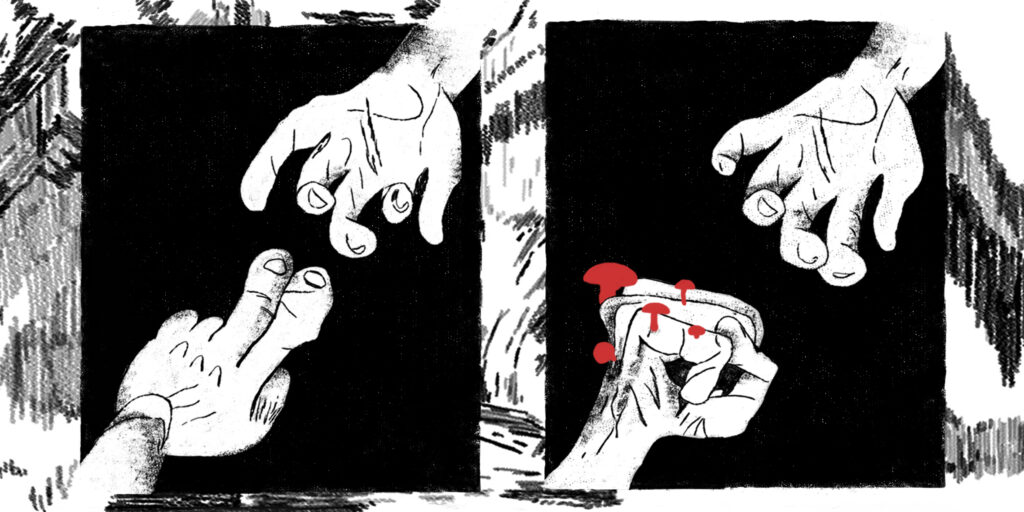
Then the commander told us to cast lots: rock, paper, scissors - in order to determine who would not fly. At that moment, I seemed to be paralyzed with fear, and my hand seemed to be petrified, it kept showing “paper”, and everyone saw it. The colleague with whom I had to draw lots showed the “stone”. He could easily show scissors, win and not fly. But he saved me.
My comrades boarded the helicopters, I waved to them and waited. Of the 18 people who went on that mission, four were killed and five more were wounded. At that time, these were the largest losses among Russian volunteers in one operation, as far as I know.
When our colleagues returned, we learned that the three dead remained on neutral territory - that is, on land that was not controlled by either Russia or Ukraine. And we went there to try to remove their bodies. It took us a long time to get there and arrived only in the morning, and this made us too visible a target for the enemy. We were fired upon and I was wounded.
We chose the most unnecessary ones
I heard the sound of a shot and managed to lie down on the ground. A few seconds later it was as if I was hit in the back with a hammer. If I had been on my feet at that moment, I would have been killed. The blast wave tore off my body armor and threw it to the side. I received multiple shrapnel wounds: I was concussed, my facial bone was broken, both ear drums were torn, I had wounds on my back, two cervical vertebrae were injured.
A friend ran up to me. I heard him ask if I could move, but I couldn't answer him. When the commander soon approached me and shouted for me to go to the rear, I don’t know where from, but I gained strength: I stood up and ran to the rear.
I staggered from side to side and felt sick, but I was able to get to the armored personnel carrier. Then I felt that after being wounded I wanted to live even more than before. You feel lucky and cling to this life very much.
I was taken to the hospital, where I spent about a month. And although the physical damage was not so severe to me and I could continue to fight, I could no longer imagine how to force myself to go into battle again.
Zoomers have become uninterested in life. Young people around the world are massively refusing to work and study. But Gen Z's idleness could threaten the rest of us World 10 minute read
When I discussed with an experienced comrade the operation for which I was initially sent along with other older colleagues, I asked him: “Did they really want us to do reconnaissance in force? They chose the most unnecessary ones and sent them forward.” He told me that I had answered my own question. That’s when I first thought about writing a resignation letter.
It is customary to talk about Russian units in Ukraine as “Tiktok troops,” but I don’t agree with this. On the one hand, there is an element of “Tiktok”: something is actually being done to take a spectacular photo or video. But on the other hand, Russian units are involved in the most dangerous operations: they fought near Avdeevka and near Volchansk , where the heaviest fighting took place, they attacked Kozinka in the Belgorod region , and participated in the operation on the Kinburn Spit . As far as I know, these were the most dangerous missions and the Russians took great risks in them and suffered heavy losses.
I personally know about 15 Russians who died who fought for Ukraine. But at the same time, many, and probably almost everyone, who took part in the battles received injuries of varying degrees of severity, just like me. But many, no matter what, remain there, but I decided to quit. By the summer of 2024, from the unit in which I served, approximately 15-20% of volunteers wrote reports, as our commander predicted.
Third Front
In 1985, during the celebration of the 40th anniversary of the Victory, I stood at the eternal flame in my city. I was a teenager. I remember how the veterans rejoiced when they met each other, hugged and discussed something with each other. But when I asked them to talk about the war, they turned away. I saw their tears. They said: “If only there was no war.” I couldn't understand it then.
When I was a schoolboy, I very much regretted that I did not witness the Second World War and become a hero. Almost 40 years later, I found myself in another war. But he didn’t become a hero anyway. I am very ashamed that I could not cope with my fear.
I was afraid that my colleagues would judge me. The day I wrote the report, I went out in front of the line and told everyone about it. I asked forgiveness from everyone who remains.
One of my colleagues, who always scolded those who net, came up to me and said that he did not despise me personally. He later died.
My colleagues reacted well to my decision, and so did the commanders. I was offered other positions: car driver or boat skipper. But I realized that if the command changed, any of us could still be sent to the assault.
I realized that I could no longer stand waiting for death. Cynically speaking, I was less valuable among the other volunteers due to my age and physical fitness, and could more easily be sent on dangerous missions. I understood that I would die, if not today or tomorrow, then within a few months. I couldn’t live with such a thought—it’s an indescribable feeling. The word "fear" does not describe reality.
When I went to visit my Ukrainian relatives, on the way back I found such a scene. A soldier, his wife and daughter got into the minibus, apparently escorting him back to the front. The daughter was about 16 years old. All three of them smiled, joked and discussed something lively. But when the driver turned on the engine to warm up the minibus, their facial expressions changed dramatically: the smiles disappeared. My wife and daughter began to cry. I was amazed how a human face could show emotions so clearly. I don't think even the best actors in the world could have played such a powerful experience. The wife and daughter of that soldier got out of the minibus, we drove off, they waved to him, tears rolled down the man’s face. This farewell scene still stands before my eyes.
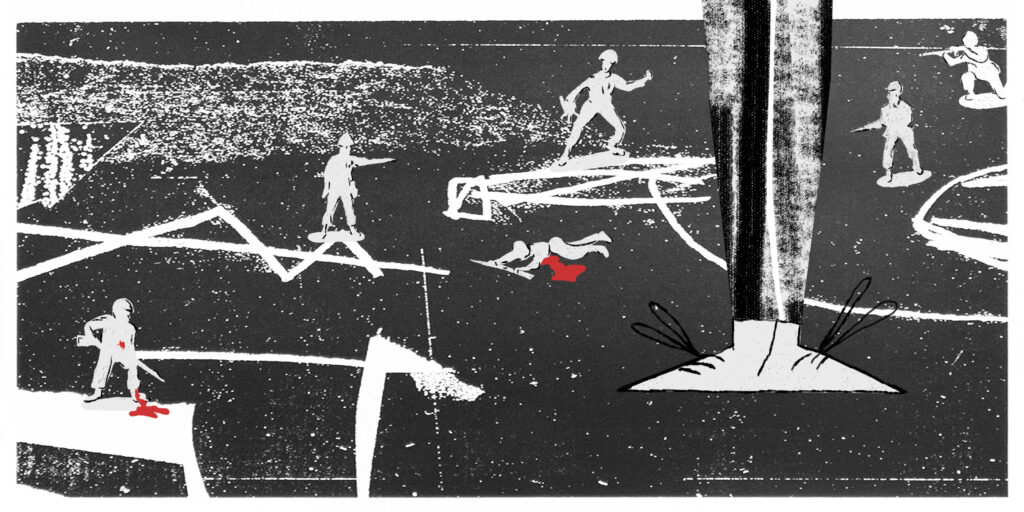
I decided to tell you about this damned war in detail because I see that many Europeans and even anti-war Russians think that it will end somehow on its own. But this won't happen . The way I saw the war was a wild nightmare. And I want to convey the idea that the people who defend Ukraine are heroes, but many of them are fighting with all their might. They continue to fight, having several wounds, some are fighting with prosthetics. They could commission, but they don't. I feel a huge debt and guilt to those who stayed to fight, both among the Russian volunteers and to the Ukrainians - and I always think about what I can do to save their lives.
But it seems to me that it is not the Ukrainians, who are fighting with their last legs, who can stop this war, but all of us. All those hundreds of millions of people who sympathize with Ukraine. You may think that I'm crazy, but I have my own understanding of how to stop this war. I think that there is a first front - these are, in fact, the soldiers on the front line, a second front - the Ukrainian allies, the heads of NATO countries and the United States, and a third front - these are all the other people who sympathize with Ukraine. And it is on the third front that we must help.
I taught first graders in a private school. War destroys even them For a year and a half I watched how “we will bomb them” and “for ours” break through in conversations about Greek myths Society 12 min read
Putin needs money to stay in power and continue the war. He buys military personnel, shells and components for weapons, he buys the FSB and the police who carry out repression in Russia, he buys politicians, he influences elections in other countries - and he does all this with the money he receives from the sale of oil. And we can all make a small difference to make a difference.
In 2022, shortly after the invasion, when Western countries feared being left without Russian oil and gas on which they were highly dependent, the International Energy Agency issued recommendations on how to reduce energy consumption. We, ordinary people, could adapt some advice from there to our lives: if there are a lot of such people, then it will really work. If you have a car with an internal combustion engine and use it every day, you can drive it, for example, twice a week less by using a bicycle or public transport.
In addition, it is necessary to boycott the goods of those countries that buy oil from Russia - these are China, India and Türkiye - and the goods of those companies that remain in Russia.
This is inconvenient, but compared to the price Ukrainians pay, it is negligible. I am sure that if those hundreds of millions of people who sympathize with Ukraine did something every day, it would significantly interfere with Putin.
We all hope that Ukrainian soldiers will fight off the Russian army on their own, but this is not happening. The front is moving. But Ukraine will not give up: people there will fight to the last. And the world will lose a lot if Ukraine loses. If evil wins, it will certainly spread further throughout the world.
In order not to miss the main materials of “Cold”, subscribe to our social networks!


Kholod needs your help to continue working
We continue to work, resisting bans and repression, to preserve independent journalism for the Russia of the future. How do we do this? Thanks to the support of thousands of caring people.
What do we dream about?
About the simple and at the same time complex - the opportunity to work further. Life will change beyond recognition many times, but we, the editors of Kholod, want to stay close to you, our readers.
Support Kholod today so we can continue to do what we do best - be independent media. Thank you!
Author: Yulia Selikhova Illustrations: Masha Grishina