
Translated material
Between theater and death
The exhibition “The Case of Meyerhold, or “The Inspector General” I always want”, which opened at the Theater Museum in St. Petersburg, became the finale of the celebration of the 150th anniversary of the director’s birth
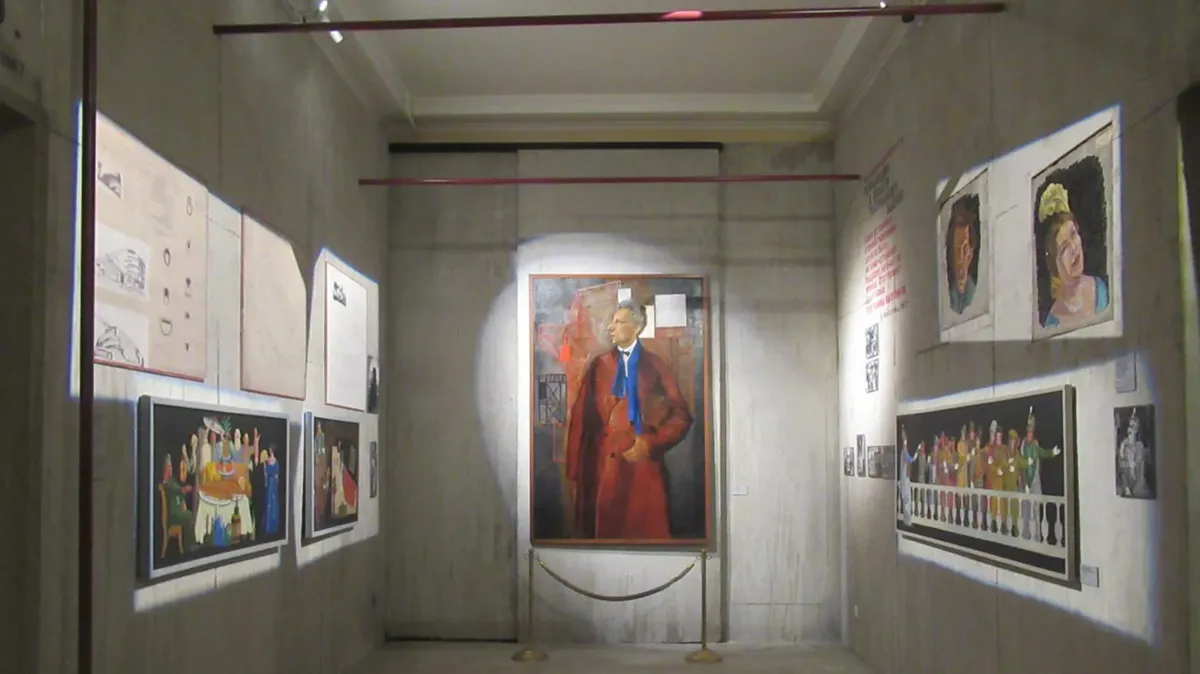
Exhibition “The Case of Meyerhold, or “The Inspector General” I always want.” Photo: Natalya Shkurenok
The exhibition, as it was conceived by its authors, is dedicated to Meyerhold’s construction of a new building for his theater - GosTIM, which was supposed to be erected on Triumfalnaya Square in Moscow. But it turned out that the exhibition, modest in scale, housed in only three halls, conveys with meager and very expressive means all the drama of Meyerhold’s fate and the tragedy of the entire country. The tragedy of people inspired by the revolution, who created it and who became its victims.
The exhibition “The Meyerhold Case” was prepared by the St. Petersburg Museum of Theater and Musical Art together with the Bakhrushin Museum, the International Festival of Arts “Diaghilev PS” with the participation of the Tretyakov Gallery, the Hermitage, the Shchusev Museum of Architecture, and the Academy of Arts. Its exhibition, as conceived by the authors (curators: Irina Klimovitskaya, Natalya Metelitsa), is built on combining three important themes for Vsevolod Meyerhold into a common plot: construction, the production of Gogol’s “The Government Inspector” and St. Petersburg.
The first room is called “Attraction to Construction”. This is exactly what Meyerhold said about St. Petersburg, all his life obsessed with the idea of building a new theater:
“The city of Peter - only it, only its air, its stones, its canals are capable of creating such people, with such an attraction to construction... To live and die in St. Petersburg!”
This is what happened in reality: here he, the director of the imperial theaters, greeted the revolution with delight, became the head of the Theater Department (TEO) of the People's Commissariat for Education, and staged the first revolutionary performances based on the poems of Mayakovsky and Blok. And here, almost 20 years later, he is arrested, sent to Moscow, where six months later he is killed.
The entire exhibition, with its gray walls, monochrome coloring, dim lighting and broken structures, resembles an unfinished construction site (artist Yuri Suchkov). But upon entering the “Attraction to Construction” hall, large bright spots of color attract attention. In perspective is a portrait of Meyerhold by Peter Williams, painted by the young artist in 1925. The director in a bright red leather coat is depicted against the backdrop of the theatrical scenery of Lyubov Popova, one of the “Amazons of the avant-garde,” for the play “The Earth Stands on End.” Meyerhold dedicated this production, dedicated to the fifth anniversary of the revolution, to the Red Army and “its heroic leader and organizer Leon Trotsky.”
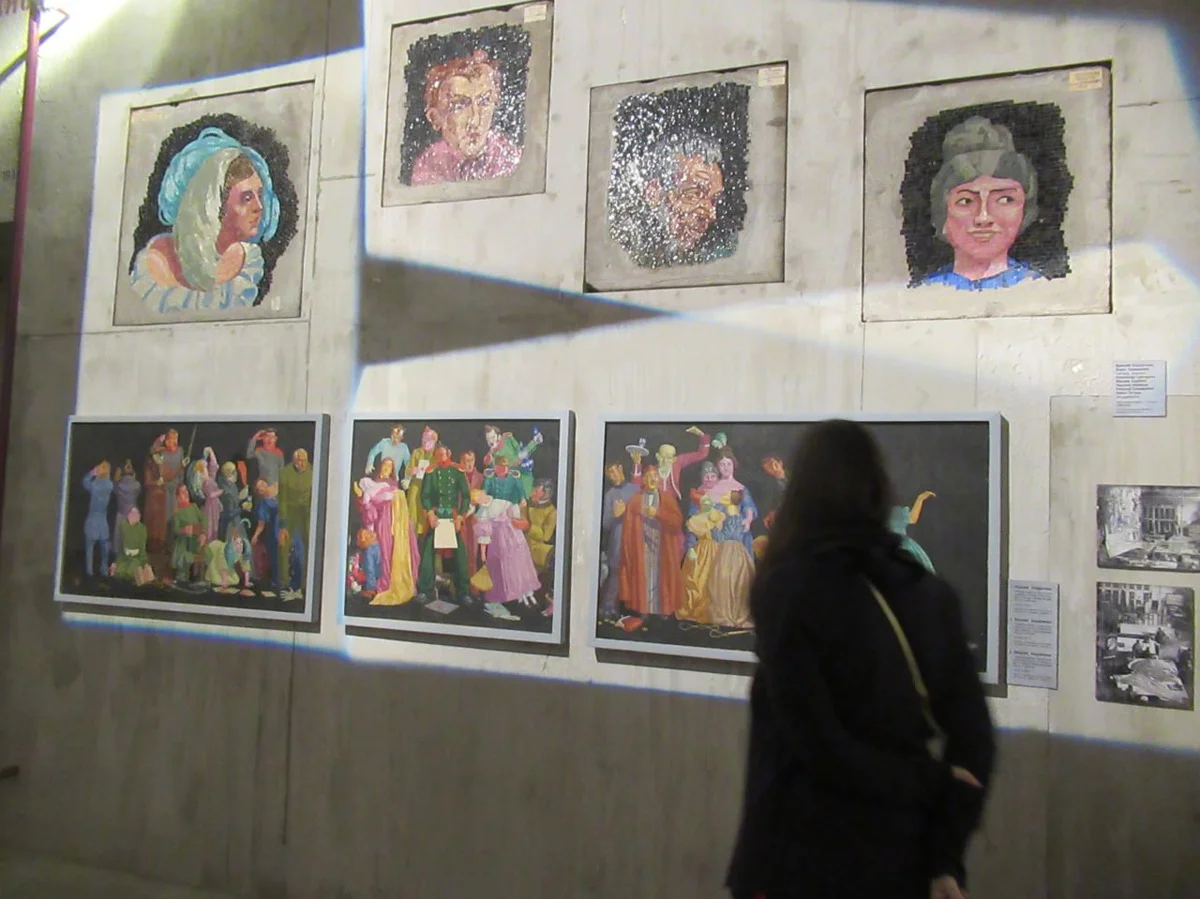
A real sensation awaits visitors here. According to Meyerhold’s plan, the central fragment of the theater was to be the multi-story “Creative Tower”, decorated with huge mosaic panels with scenes from Vsevolod Emilievich’s most famous performance - Gogol’s “The Inspector General”. The tower was not allowed to be built, but there is a version that mosaic friezes were made for it, although their fate is unknown. Only six test mosaics with the faces of the characters from The Inspector General have survived, which were kept in the Mosaic Workshop of the Academy of Arts all this time. Now viewers can see them for the first time at an exhibition at the Theater Museum, along with picturesque sketches.
In this room you can see drawings, drawings, and diagrams of the future theater, incredible at that time: Meyerhold came up with a rotating stage without wings, spectator seats surrounding the stage on three sides, a transparent ceiling and even special chairs for smokers (with fans in the backs of the chairs to remove smoke). Architects Alexei Shchusev, Mikhail Barkhin, Sergei Vakhtangov took part in the birth of such an avant-garde theater - their drawings and drawings are presented in the exhibition.
But the fate of the theater, like the fate of its author and creator, turned out to be just as sad: in January 1938, GosTIM was closed as “lost contact with the Soviet public.” Later, the building was completed as a venue for concerts - now it is a concert hall named after. Tchaikovsky. Meyerhold, left without work, is invited to his theater by Stanislavsky. But he soon dies of heart disease, and Vsevolod Emilievich runs his theater for almost a year. In the summer of 1939, he was arrested in Leningrad and brought to Moscow. And two weeks after the director’s arrest, his wife, actress Zinaida Reich, was killed in Moscow.
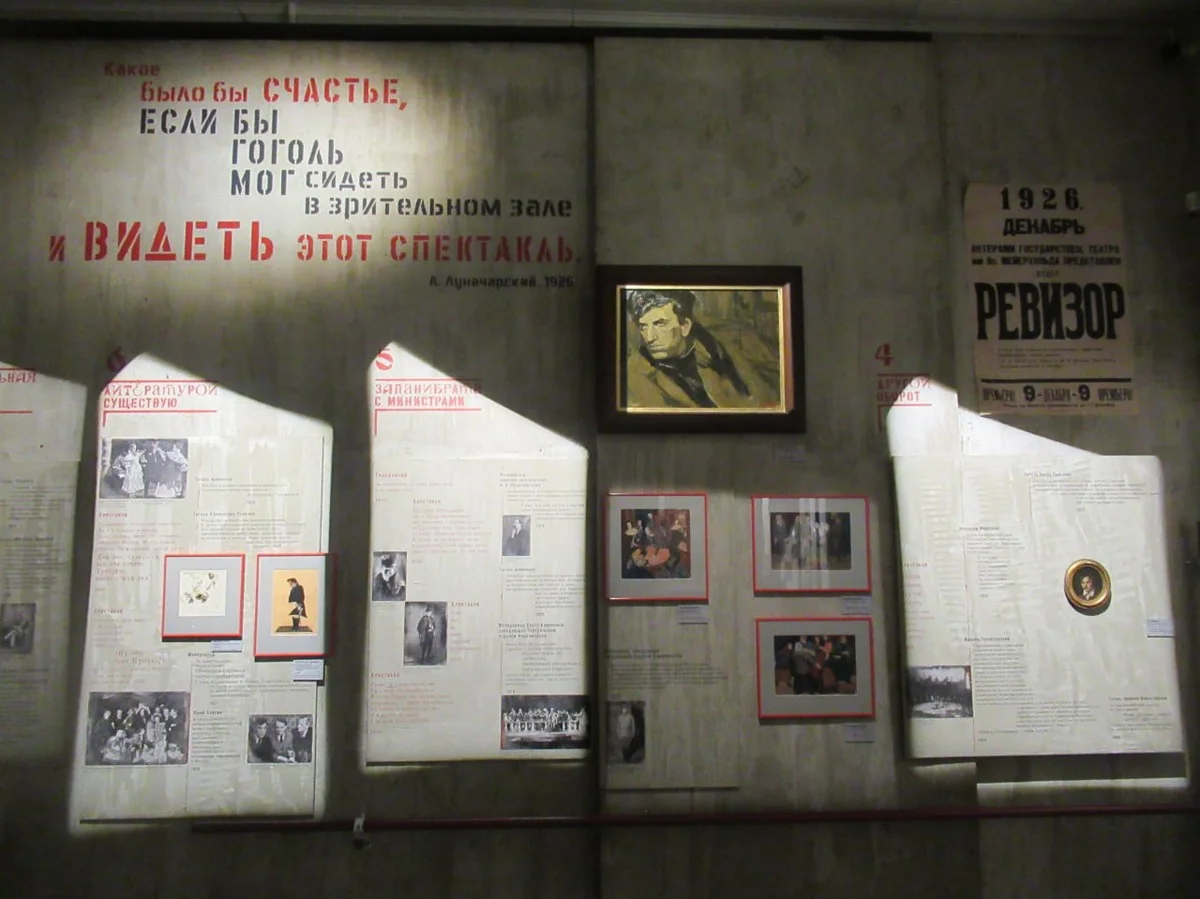
The theme of “The Inspector General” is central to Meyerhold’s work, and the second hall of the exhibition is dedicated to it. The premiere of his most famous performance based on Gogol’s comedy took place on December 9, 1926, exactly 90 years after the first showing of “The Inspector General” on the stage of the Alexandrinsky Theater. The final silent scene staged by Meyerhold made a stunning impression on the audience: these were not just the figures of comedy characters frozen in amazement, it was the embodiment of a universal tragedy, fate. The authors of the exhibition invite viewers to experience similar sensations, connecting “The Inspector General” and famous disasters of the past: on one of the walls there is a video installation of photographs with scenes from the play, the construction of a new theater and moving characters from Bryullov’s painting “The Last Day of Pompeii” (media artists Anna Frantsuzova and Katarina Chokrlic).
There is a painting of the “Tower of Babel” by an unknown Dutch artist, and another tower is built nearby. On the top of the head is a black cylinder, reminiscent of Khlestakov’s cylinder from Meyerhold’s production. On the floor below on the tower is an authentic general's uniform of Nicholas I, the most important spectator of Gogol's comedy. Below is the first edition of The Inspector General, published in 1836: it was sold at the Alexandrinsky Theater on the day of the premiere.
On the walls of the hall are photographs of scenes from the play, portraits of Gogol and Meyerhold. Fragments of the text of the play, quotes from the diaries and letters of Gogol, Meyerhold, documents from the era of Nicholas I and the 30s of the 20th century seem to emerge from gray concrete, reminiscent of wall inscriptions in abandoned catacombs.
Particularly highlighted are clippings from Soviet newspapers from the middle of the last century. At the end of December 1937, Platon Kerzhentsev, a politician, diplomat, journalist, wrote an article in Pravda, and in fact a denunciation of Meyerhold and his theater: “In those days when our theaters showed dozens of new works that reflected the greatest problems of construction socialism, the fight against the enemies of the people - theater named after. Meyerhold turned out to be a complete political bankrupt. He made himself a foreign body in the body of Soviet art. Does Soviet art and Soviet audiences really need such a theater?” And almost two weeks later, already in January 1938, Pravda published an order from the Committee for Arts under the Council of People's Commissars of the USSR “On the liquidation of the Theater named after. Sun. Meyerhold." That day, the play was played for the last time on the GosTIM stage - it was the 440th production of The Inspector General.
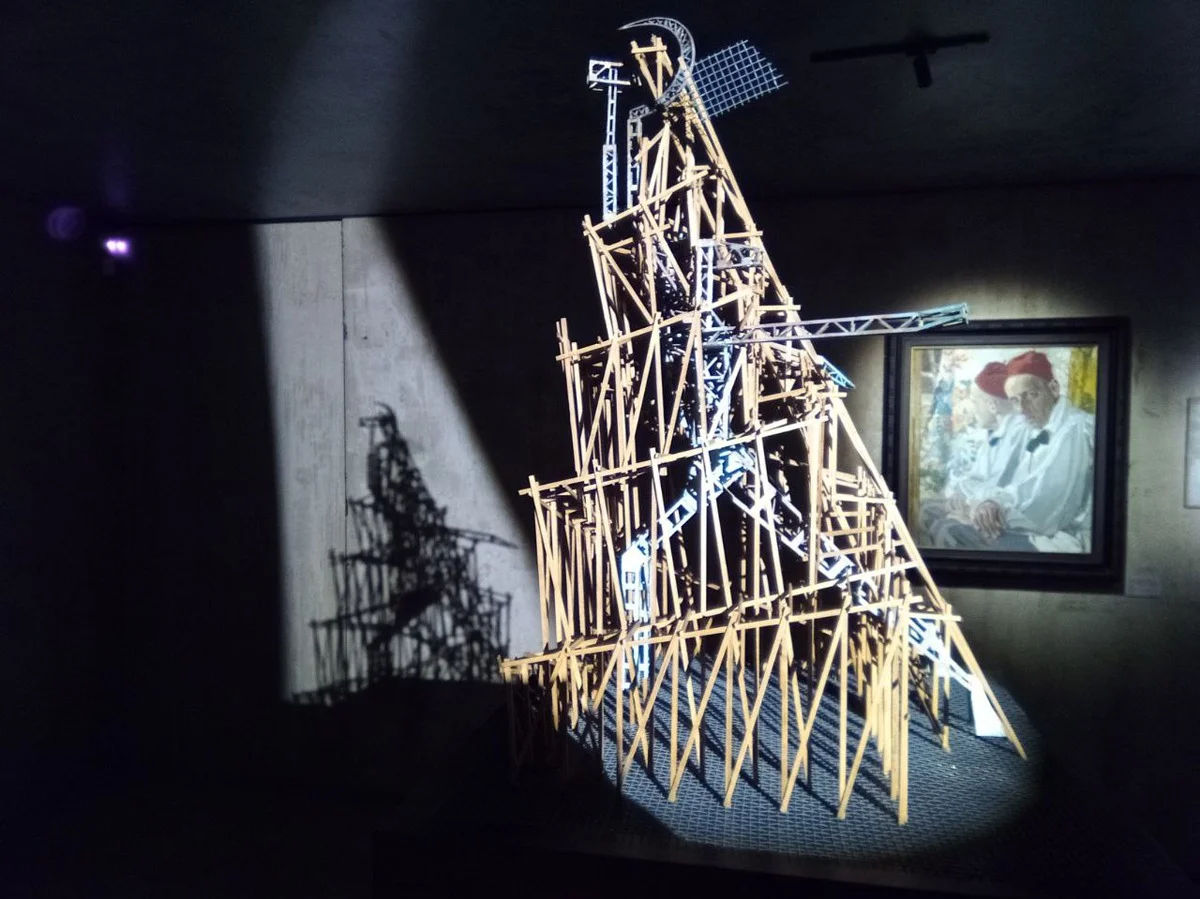
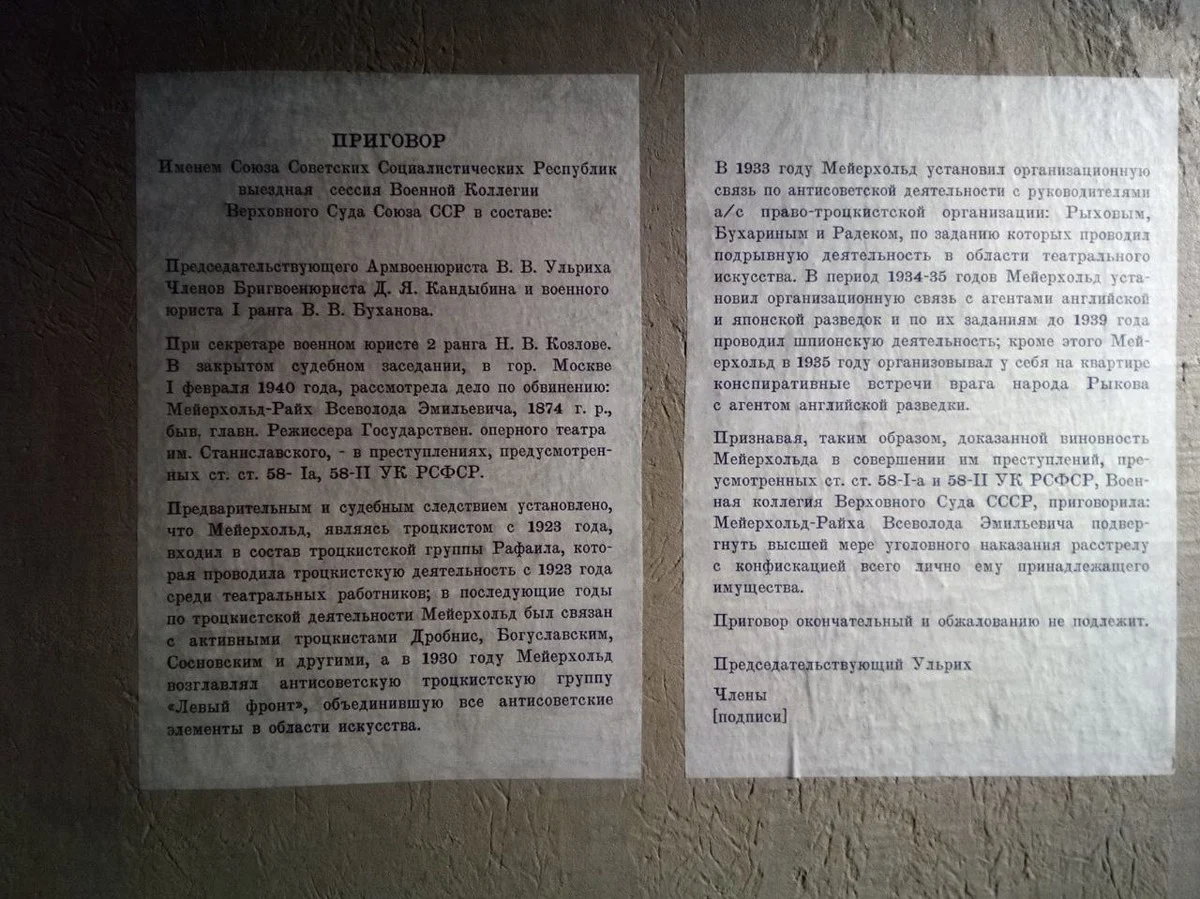
The third part of the exhibition is “Epilogue”. The theater is over, the Creative Tower has turned into a prison cell. On one of the walls is a painting “Hell” by an unknown artist from the early 16th century. Two portraits look at each other from opposite walls. One is the work of Alexander Golovin, made by him in 1917, the second is prison photographs taken in 1939 in Butyrka prison. Apparently, even before the interrogations, because there are no signs of terrible beatings or torture on his face. Between the two portraits is Yuri Avvakumov’s installation “Worker and Collective Farm Woman”: a model of Tatlin’s “Third International” tower, from within which the famous Mukhina sculpture breaks through, smashing the top of the structure with a hammer and sickle. Here on the wall is the text of the Supreme Court verdict: “the verdict is final and cannot be appealed.” It says, in particular, that Meyerhold had been a Trotskyist since 1923 - that’s when the comrade artist was reminded of his dedication to Trotsky. And the earth truly stood on end.