
Translated material
Is it a sin to smoke ashkudishka?
The Russian Orthodox Church was and remains very conservative - everywhere, but not on Instagram. Now Orthodox priests across the country are fighting the algorithms of the “extremist” social network, filming videos for Guf, “Glamour, Blondes” and the soundtrack of the horror film “Substance”, calling on young people to come to faith and “become the best version of themselves.” “Kholod” talked to the insta-fathers about why they are doing this and what the Russian Orthodox Church thinks about it.
Priests attract zoomers to church through banned Instagram. They're joking on the edge, but the Russian Orthodox Church doesn't mind
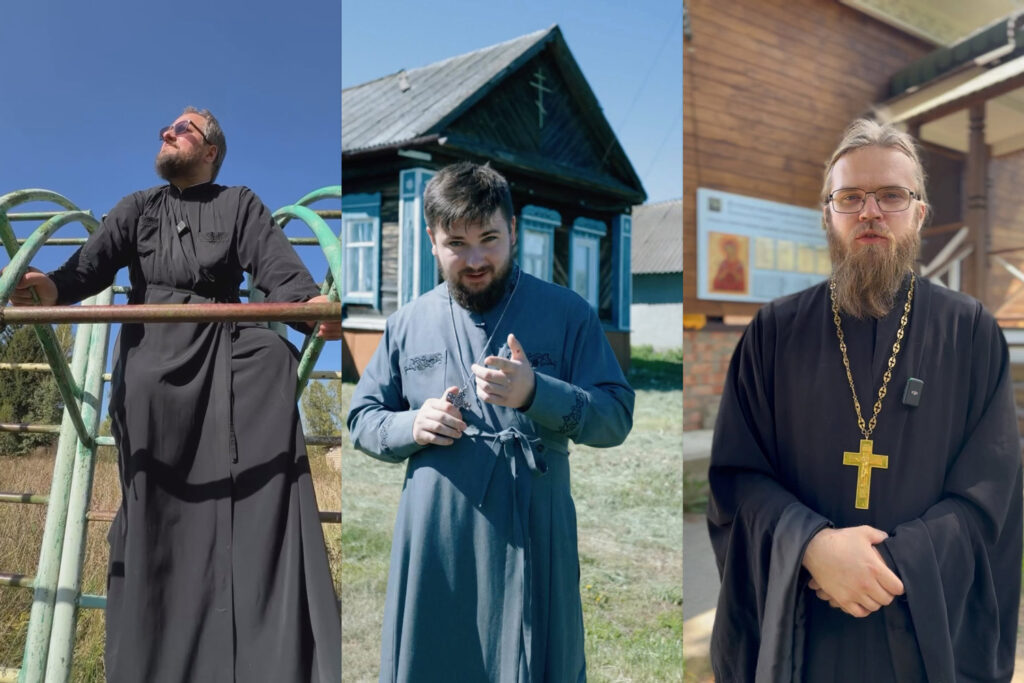
Connection with the Lord through rails
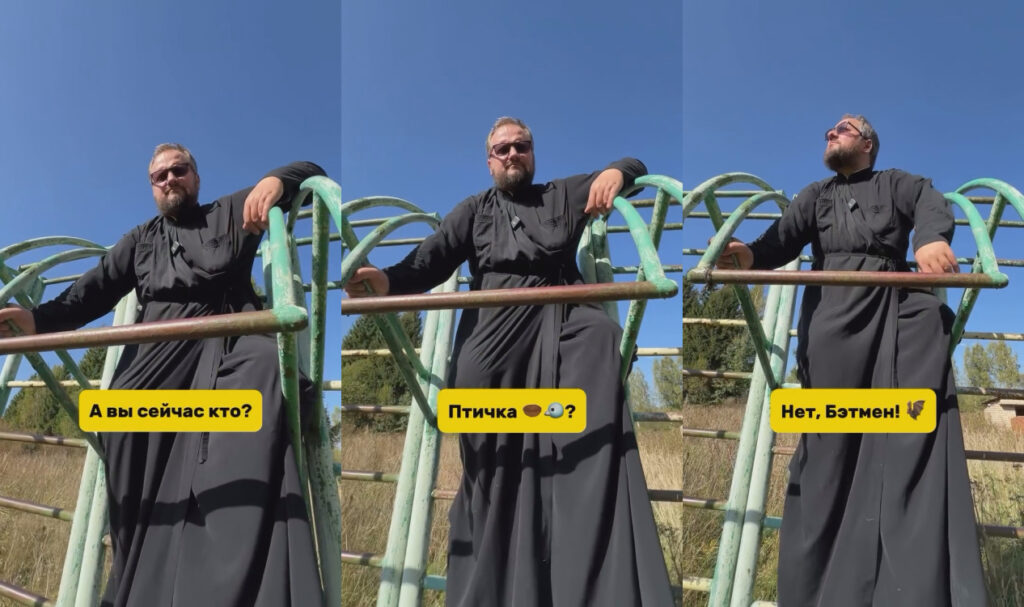
The priest of the St. Nicholas Church in the city of Mosalsk, Kaluga Region, Vladislav Beregovoi, sits on the playground. A woman's voice-over asks him:
- Father?
“Mmm,” the priest hums tiredly.
-Who are you now? Birdie?
- No. Batman.
- Wow, wow.
- I'm waiting for a signal. The world is in danger.
- Save, help, father, answer the question: is it a sin to hold a grudge against your husband?
— You can only keep a deposit in a bank.
- Can the soul hurt?
— Maybe when the deposit size is less than annual inflation.
- Thank you, father!
Vladislav Beregovoy has been in office since 2007; he started a missionary page on Instagram seven years ago, and before that he was a participant in the “Father. Online”, where he regularly answered people’s questions live. The priest is also engaged in the restoration of the Borisoglebsky Church in Mosalsk, and Instagram, which now has 251 thousand subscribers, is a good opportunity to raise money for this.
Two years ago, parishioner Alevtina began helping the priest with filming and editing. The cooperation turned out to be productive, and at the moment Father Vladislav answered about 10 thousand questions through stories.
“We tried to figure out how to make an interesting background, how to add dynamics to the video,” Father Vladislav tells Kholod. — The idea came to answer people, as if reluctantly. At that moment, I was really tired of talking about the same thing: what a woman can and cannot do on critical days in the temple, what incense to suck so that she doesn’t have a headache. We decided to honestly and sincerely show on camera how the annoying “why” is trying to catch up with the priest in different places. This shot up a million views. On YouTube alone, we collected 170 million in a year and a half. We set a whole trend in Orthodox blogging, and many priests began to copy us - our shooting style became so popular among the masses.”
How to pray for your husband if he disappeared in a war zone, how to read “Lord, have mercy” 40 times and not get lost, whether you need to remove the cross during intimacy - the priest answers any of Alevtina’s questions, hiding from her in the lilac bushes, fishing or assembling a toy house. Father Vladislav says that he has restrictions in choosing topics for videos, but they are connected, first of all, with the reaction of subscribers.
“There are a huge number of people without a sense of humor, and any joke related to religion causes acute rejection in them,” says the priest. — I try to keep balance. Sometimes it works, sometimes it doesn't. Naturally, there are unsubscribes, angry comments with curses, but if you focus only on people with a fine mental organization, you will not be able to do anything at all. I don’t need 5,000 rubles to please everyone.”
According to Father Vladislav, the leadership of the Synodal Department of the Russian Orthodox Church for work with youth understands how important it is for a clergyman to be represented on social networks, and he himself has never received a reprimand from his superiors for jokes in the video.
“A clergyman’s page on social networks is the entry point into the church,” says Father Vladislav. — The Church is a huge treasury, grace, joy and happiness of meaning in eternal life. Sometimes, if a young man enters a church, someone immediately curses at him: why are you wearing jeans, why are you wearing shorts, why are you not wearing a scarf, where are you lighting the candle, where are you standing, take your hands out of your pockets. There is a stereotype that you should definitely be approached by an elderly person who will immediately start scolding you for your tattoos and nose ring. Many young people are afraid to go to church, but on Instagram they can see that there are normal, adequate priests.”
How do Russian youth feel about Orthodoxy?
According to VTsIOM , in 2024, 66% of Russians surveyed consider themselves Orthodox, which is 9% less than in 2017. At the same time, the number of Orthodox Russians aged 18–24 is increasing - this year there are 38% of them, last year it was 29%. In the group of 25–34 years old, 53% consider themselves Orthodox; last year the figure was 47%.
In the reels, the priest repeats that the soul of a child appears in the body at the time of conception, that having an abortion for any reason is a sin, and getting tattoos is not a sin, but it is not necessary, because “if you received a clean body, give it back clean. There is no point in vandalizing the Temple of God.”
Father Vladislav believes that no priest working only in a parish will ever have the same reach as an Orthodox blogger: “Every priest who has at least some charisma should go to social networks, shoot videos and try to ride the algorithms.”
For six years, almost every day, Father Vladislav conducts live broadcasts, which are watched by 30 thousand people. “Today, it is Orthodox bloggers who are the connecting link between secular people who doubt the faith, believers and the church, as well as the Lord God himself,” he believes.
- Father ?
- Mmm.
— Is it possible to do strip plastic? Or is it a sin?
— Is it where the butt is higher and the legs are wider? Is there an option that virtue? Are other dances already prohibited here? Chaste, folk, athletic, beautiful?
- What if it’s for your husband?
Pause.
- So, to break the dishes with the fifth point? I'm afraid he won't approve.
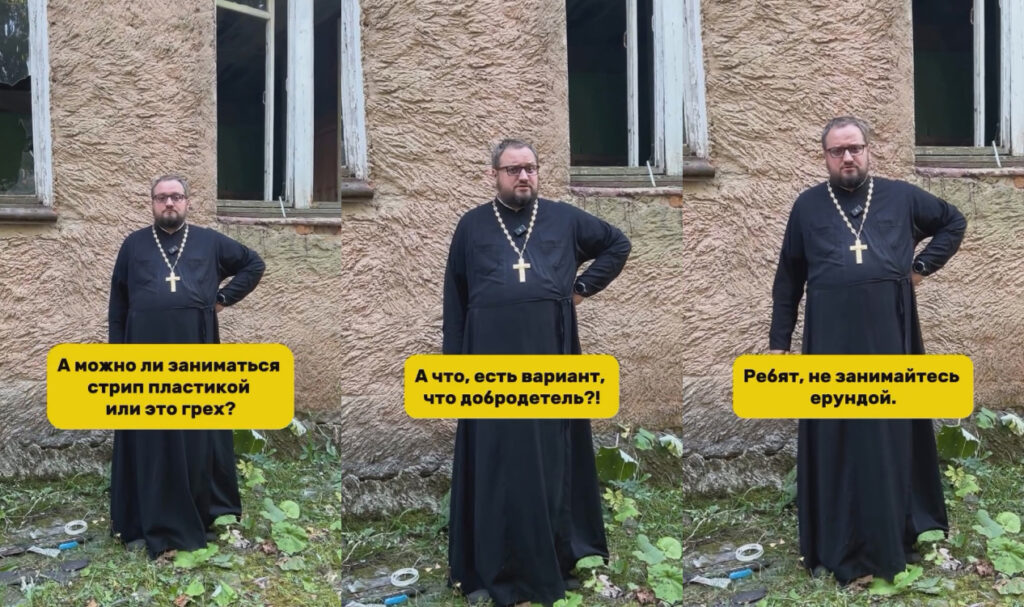
As long as there is no criminal liability for using Instagram in Russia, priest-bloggers can and should be present there, Father Vladislav is convinced: this social network “is used by many Russian people who cannot be abandoned to missionaries.” He believes that Orthodox blogging is a craft and needs to be taught separately. Father Vladislav was among the invited teachers at the school of bloggers of the Synodal Missionary Department of the Russian Orthodox Church, as well as at the Moscow “School of Good Bloggers” .
What is the “School of Dobrobloggers”?
At the beginning of December 2021 and at the end of September 2022, the Moscow cultural center “Favor”, with the support of the Presidential Grants Fund, held a four-day intensive course called “School of Good Bloggers.” The course was made for Internet missionaries “ready to talk about the good deeds that the Church and the Orthodox do on social networks.” Short intensive courses for Orthodox bloggers began to appear after the start of the coronavirus pandemic, during which people spent a lot of time on social networks.
Courses for the right insta-priests
One of the first priests on social networks was Moscow Archpriest Andrei Tkachev. He is now the most popular priest blogger, according to the Association of Bloggers and Agencies (ABA). After Instagram was blocked in 2022, he stopped maintaining his page there, but his YouTube channel now has 1.88 million subscribers, and his Telegram channel has 253 thousand. The priest was able to gather an audience without the help of special schools and courses.
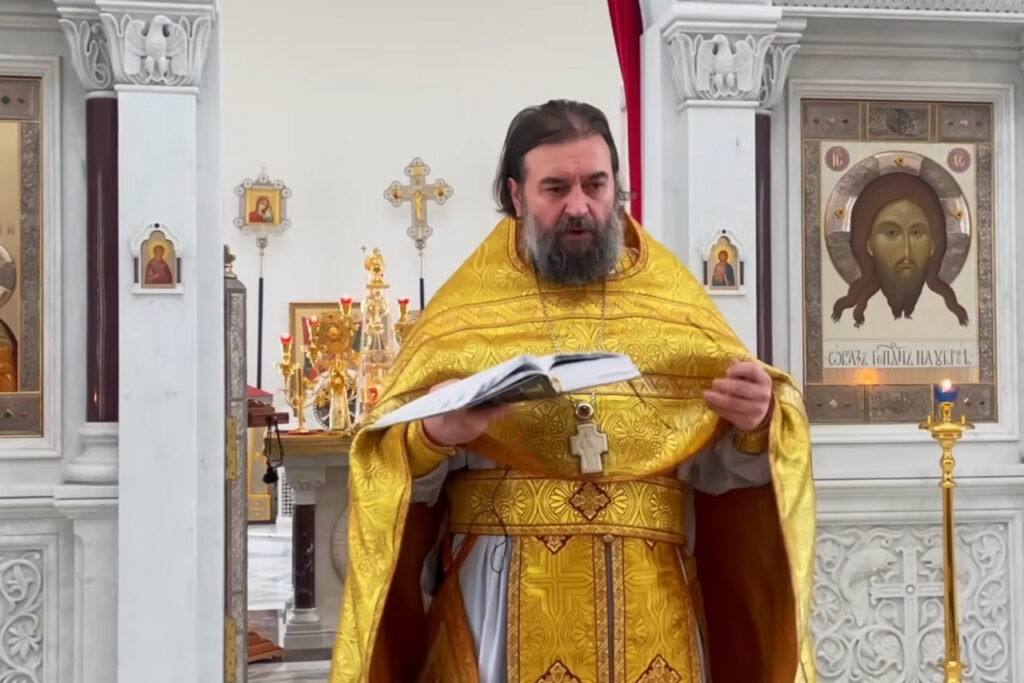
In the media field, he is known for his harsh patriarchal statements. For example, in one of the sermons published on YouTube, he says that if a woman does not fulfill her “natural mission” - does not give birth to children and does not breastfeed, her existence loses its meaning: “A woman is given a womb to give birth, and breasts are given, to feed. She lived her whole life and did not breastfeed - why does she need this breast? It would be better if you were a boy."
Archpriest Andrei Tkachev works for the “internal audience” - people who have already come to faith and who do not need to be convinced of the authority of the Holy Scriptures. You can talk to them using Church Slavonic terms. And the rector of the St. George Church in Nakhabino, Pavel Ostrovsky, on the contrary, sees his mission as attracting a young secular audience to the church. He has 730 thousand followers on Instagram and is a frequent guest of popular YouTube shows and public events.
The image of Father Pavel really attracts young people: he talks about religion in simple, modern language and openly shares facts from his personal life. At the beginning of his blogging journey, he answered questions from subscribers in stories, and signed posts in his feed with a short “Piu”. After the start of Russia's full-scale invasion of Ukraine, the priest wrote :
“Now that a war has happened, which I did not believe in and which I did not want, you will not expect a word of criticism from me against the Russian government, just as I have not criticized the Ukrainian government all these years. In recent years, my family has been actively helping Ukrainians in need. I'm not ashamed that I'm Russian. I love Russia. I’m not ashamed to call Ukrainians brothers and love Ukraine.”
Help Kholod tell human stories
We put people at the center of our journalism and talk about people who face injustice, but do not lose spirit and continue to fight for their rights and freedoms. To continue covering people's stories, we need the support of readers - thanks to your donations, we continue to work, despite government pressure.
- Foreign card
- Map of the Russian Federation ↘︎
- Patreon ↘︎
- Translation
- Crypt
Monthly
One-time
5 €
- 10 €
- 20 €
30 €
5 €
- 10 €
- 20 €
- Other
- Bank of the Russian Federation
- Foreign bank
Card number:
5536 9138 6472 8742
Copied!
Recipient:
Taisiya Bekbulatova
Copied!
Recipient:
Projektas Šaltis
Copied!
Account number:
LT613500010016198323
Copied!
SWIFT BIC:
EVIULT2VXXX
Copied!
Bank:
Lietuvos Bankas (Bank of Lithuania)
Copied!
Comment - purpose of payment:
Parama įstatymų numatytais tikslais (be konkretaus tikslo)
Copied!
We ask you to provide a comment so that we can accurately determine the receipt of funds. The phrase is translated as follows: “Support for statutory purposes (without a specific purpose).”
Amount: €
Donate
By making a donation, you accept the privacy policy
In March 2022, Father Pavel announced that he was “filing for divorce from Instagram” and moving the blog to a Telegram channel, and a month after the publication of this post, in an interview with the YouTube channel MGIMO360 TV, he said that “you need to be able to come to terms with reality” and that “Instagram is doomed anyway.” Nevertheless, posts on the priest’s account on the banned social network still appear regularly.
In an interview with figure skater Evgenia Medvedeva on her YouTube channel “BeS Comments”, Father Pavel said that popularity came to him by chance and naturally, and the desire of a priest to become famous is incompatible with true service: “There is vanity - when you notice how people react to you . When I went to seminary, I had a sincere desire to serve God and help people. The fact that Internet activity and interviews appeared was unexpected. Sometimes I don’t really understand my colleagues, some young priests who turn to me: “How to become popular?” It's a strange dream."
Nevertheless, the Russian Orthodox Church itself considers it important to support the activities of missionaries on the Internet. From January 29 to February 8, 2024, the Synodal Missionary Department of the Russian Orthodox Church conducted a pilot educational course for Orthodox bloggers - only 10 people attended it. The training was aimed at ensuring that priests “do not lose track of the sermon about Christ on blogs, avoid immersion in a non-church agenda and do not contradict the official position of the Russian Orthodox Church.” Orthodox bloggers were also taught technical details: how to set up lighting for a video, record high-quality sound, and promote publications on the Internet.
Is it a sin not to like the priest?
“Is it a sin to make readings on tarot cards?” — a girl asks priest Ilya Savastyanov off-screen. He answers all her questions briefly.
- Yes.
— Is it a sin to eat pork?
- No.
— Is smoking a sin?
- Yes.
- Is it a sin to meditate?
- Yes.
Next, the cut is a video in which Viktor Yanukovych, against the backdrop of the Ukrainian flag, says “Stop!” - a well-known phrase that has become a meme, from the address of the ex-president of Ukraine to Petro Poroshenko, in which he criticized the country’s new course, and the caption - “all tarot readers and spiritual practices after watching this video.” “What questions bother you?” — caption to rils .
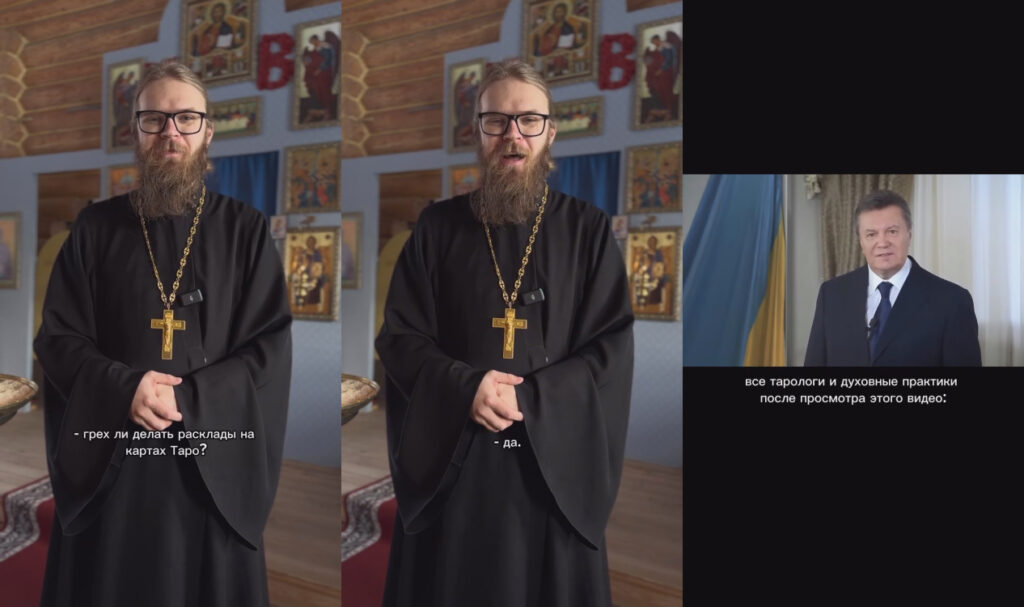
“Dear Father. To paint is a broad word! Answering such a question in one word is not correct,” subscribers are indignant. “This is a blitz, so the answer is in one word. There’s no point in going into details, because they don’t concern 99% of the parishioners,” the priest answers ( the authors’ spelling and punctuation have been preserved ).
The rector of the rural Vologda Church of the Seven-Arrow Icon of the Mother of God, Ilya Savastyanov, is 29 years old. In 2016, he graduated from law school, but realized that jurisprudence was not for him, and entered the Vologda Seminary. After two years of study, he was ordained as a deacon, and from that moment he began to actively blog on Instagram, which now has 68 thousand subscribers.
“If a person comes to church, he, as a rule, is embarrassed to ask a direct question to the priest,” says Ilya Savastyanov. — On social networks, a person can ask an important question more openly. I wanted to give people from different places the opportunity to communicate with the priest. I spied on other bloggers and saw several Catholic and Protestant examples. I wanted to do something similar in Orthodoxy.”
Navalny became a Christian without fully becoming Orthodox Priest Andrei Kordochkin - about the book “Patriot” and the politician’s path to faith Society 6 minute read
It was not easy to gain subscribers to an Orthodox blog without large financial investments. In addition, it is important for Father Ilya that the person publishing an advertisement for a priest is also a believer. The first subscribers came to him thanks to “mutual following” and advertising for several thousand rubles on the Instagram pages of mothers and large families. Now, according to the priest, such mechanisms do not work: people come for content - even the image of an icon must be of high quality.
“It may be difficult for a person to open the Bible without someone’s help; he may not understand much there,” says Father Ilya. - He goes to the Internet, and there he finds various information - some esoteric or Islamic information. Unfortunately, a person has practically no critical thinking; he does not know how to evaluate the information he receives. I try to be a helper for those who want to join the church and become a believer.”
There are many educational videos on Father Elijah’s blog: about why the Nativity Fast is needed or what a clergyman’s clothing consists of. There are also videos for the viral tracks “Pedro” , “Ikhvilnicht” and “Glamour, blondes, glamor and brunettes” , as well as “Orthodox unpacking” of icons.
“It’s hard for a person to perceive only serious information all the time,” says Father Ilya. “So I wanted him to be able to come to my page and watch not only videos that would load him up, but also ones that would help him relax.”
When Father Ilya’s account gained 10 thousand subscribers, laywoman Anastasia Byankina, also the author of an Orthodox blog , joined him. At first she helped the priest come up with and sign posts. And last summer, Anastasia and father Ilya began filming joint videos - the most popular were “question and answer”:
— Is it possible to go to temple during menstruation? - asks Anastasia. “Yes, I’m not ashamed to say this word in church, in front of a priest, in front of a man, because this is a natural process and you shouldn’t be ashamed of it.” Let's ask the priest, is it possible to go to church?
“It’s possible, if you maintain hygiene,” the priest answers.
- Can’t you take communion?
- You can’t take communion.
The priest notes that over the past few years, users on Instagram have become more aggressive. Negative comments repel the target audience, so you have to deal with haters using radical methods: “Sometimes the person who left a negative comment may be ready for dialogue, and sometimes people hate for the sake of hating. It can be easier to block a person or delete their comment. For example, some Ukrainian or some extremist criminals came and wrote something about the Northern Military District, about Russia, about the church. It’s easier to remove it because arguing with them won’t bring any results.”
Father Ilya’s 10-15 second videos get good views, but due to such a short format, some ideas are difficult to implement. For example, it is impossible to fit the answer to the question whether divorce is a sin or not into a short video, according to the priest. A definitive answer will either offend someone or be misleading.
I studied at an Orthodox school and was very afraid of going to hell. The school turned out to be a hotbed of violence, but the world outside of it was not so scary.
Society 16 min read
According to Father Ilya, which videos are best to post are more influenced by Instagram algorithms than censorship by the bishop - so he makes videos on viral trends and answers to questions. According to the priest, in the Vologda diocese he has never encountered strict censorship, only “soft recommendations,” while in some dioceses (he refused to specify which ones) there is strict control, and there it is easier for clergy not to engage at all blogging. To find out the official position of the Russian Orthodox Church in relation to priest-bloggers, Kholod turned to the chairman of the Synodal Missionary Department, Bishop Evfimy Lukhovitsky, but received no response.
“Sometimes subscribers don’t like my presentation, they write that a priest shouldn’t film something like that or that a priest shouldn’t be on Instagram at all,” says Father Ilya. - But if you shoot only instructive videos in the conversational genre, you can ruin your page, it will not be displayed to anyone. Sometimes it is necessary to use trends to promote, but we try to foresee everything. For example, we cannot take tracks in which there is a mat. ”
- Is it a sin to smoke an Ashkudishk? - Anastasia asks .
“Yes, sin,” the father replies.
- And the vape?
- Yes.
- Is there a sin of fast food?
- Not a sin.
- Is it a sin not to like a priest?
- Not a sin, but not blessed.
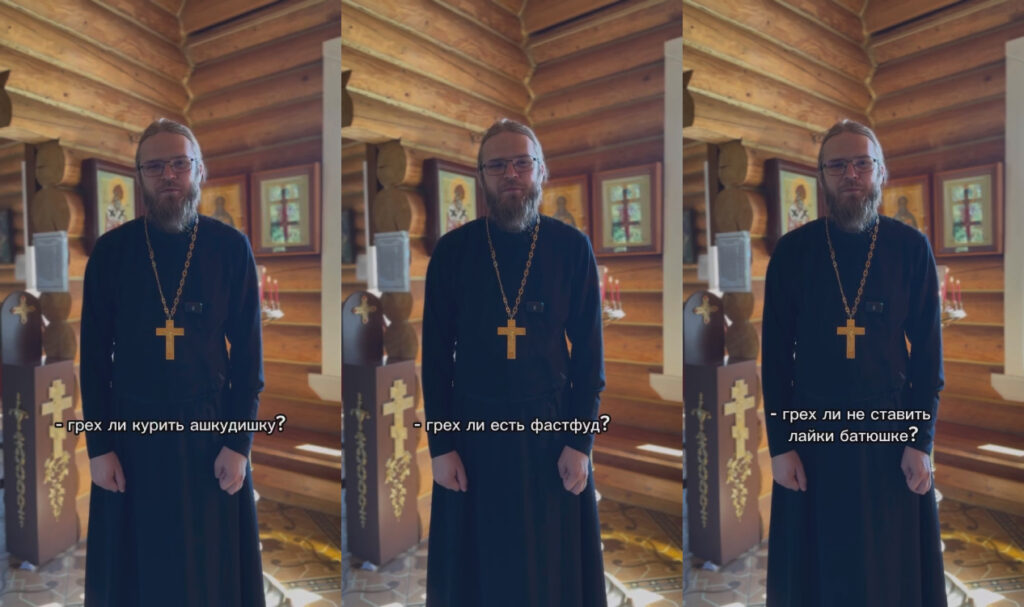
“About Vaipa, this is personally Jesus Christ told you? But is it a sin to come up with what is sinful and what is not? It is not necessary to remove the realmen, but to live according to the commandments of the religion that you are promoting, then the people will reach you, ”the user writes in the comments with Father Ilya.
He says that people have many stereotypes: supposedly priests wear gold and drive the Mercedes - therefore, every father, in his opinion, should have a page on social networks and be public. “We must understand that our mission is still a sermon,” explains Ilya's father. - Now a person can sit on the Internet for 12 hours a day. Our task is at least one minute during the day to take it with a question of faith. In some videos we have a million views. Where could we still collect such an audience? "
Ilya’s father believes that it is impossible to teach a person to be a successful Orthodox blogger in a special school, but you can create conditions for bloggers, organize assistance in filming, provide them with cameras and microphones.
“How can you evaluate the post that the priest wrote, what are the criteria here? - he asks a question. -The same post laid out at different times flies differently. How to explain this? The factors of luck are important here. In addition, one of the most convenient social networks for promoting content works in Russia is limited, but many do not work at all. Domestic counterparts are yet inferior: there are no mechanisms inside the platforms, while it all looks very kuts. Orthodox bloggers have recently appeared - these are priests, laity, and mother. Now people have the most important thing - a choice. Users can choose content and feed, and not look at one. ”
On June 8, 2024, at a meeting of the clergy of the Kaliningrad Metropolis in the Orthodox gymnasium at the Cathedral of Christ the Savior in Kaliningrad, Patriarch Kirill made a report in which he noted that some priests are “bought” to the number of likes and transfer accents in their activities to receive as much as possible to receive as much as possible encouragement. “As soon as you start thinking about personal popularity, it is better to remove the cross and go to the“ citizen ”,” said Patriarch Kirill.
"Father on the wire" and "Skivers of people"
The priest of the village of Baltay of the Saratov region Oleg Zhilyakov on Instagram is almost 41 thousand subscribers. He, like many, leads the missionary sermon on the network through answers to questions, but unlike other Orthodox bloggers, he does not chase short and trendy formats. In the filming of a professional camera, a friend with whom the priest is familiar with the seminary helps him. In the Rils, father Oleg prefers to reason for a long time, tell the parables, jokes or remember how he confused the baptism with funeral service.
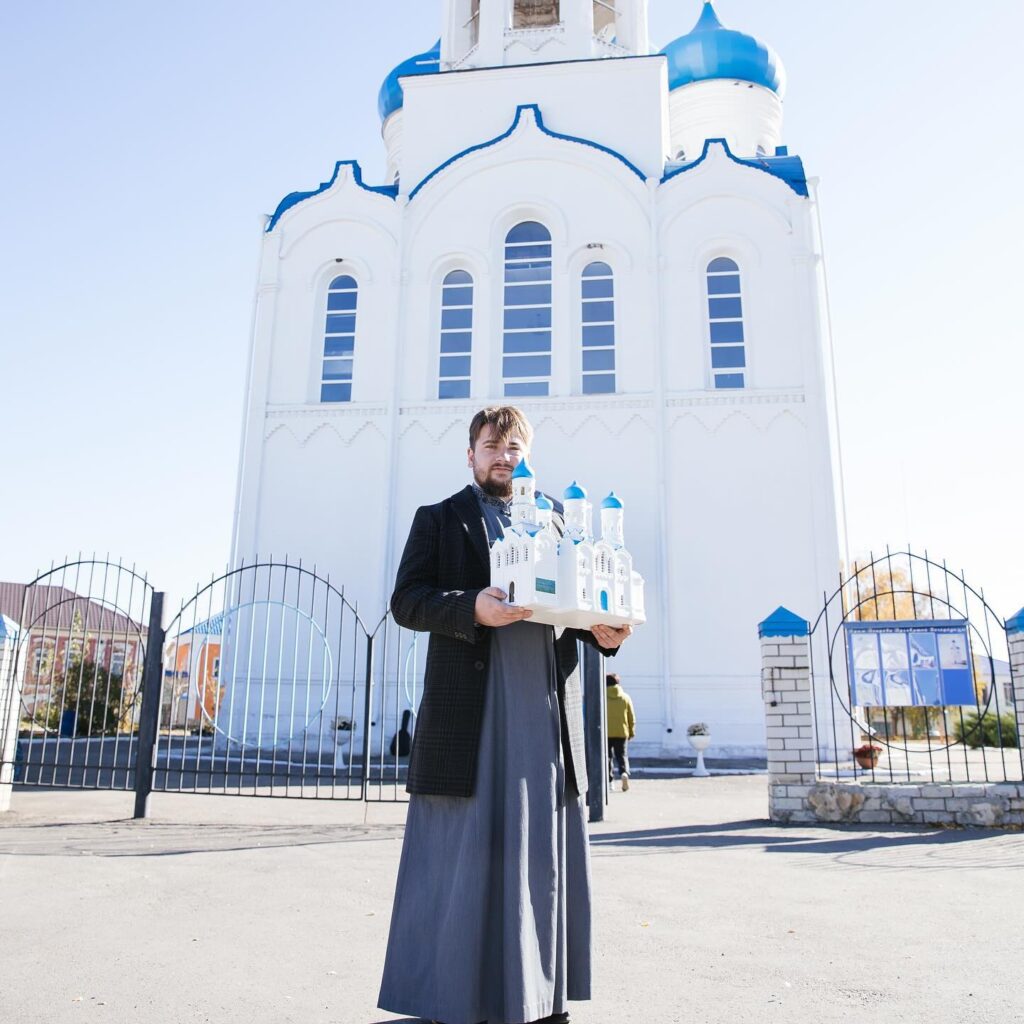
“I came up with the name of the account“ Father on the wire ”spontaneously,” Father Oleg tells the “cold”. - I wanted to make a nickname who would say that the priest is always in touch. We must fight for media space not because we want influences, but because there are many scammers and sectarians on the Internet who pretend to be the leaders of opinions, such as Vladimir Muntean (Ukrainian preacher, founder of the Hospital Center “Renaissance” . If we do not preach the gospel, those who carry out activities on the Internet from selfish purposes take this niche. The Lord says: "Follow me, and I will make you fish catchers." And where, if not in social networks, kindly bring people to God. No one, except Christ, will cure a person’s wound. ”
The journalist, religious scholar, communication director of the Center for Orthodox Studies of Fordemsky University Sergey Chapnin says that he does not see anything interesting or original in the content of Russian blogger priests. “I get the impression that their task is not at all to attract young people to the church,” says Chapnin, “and rather support the overall religiosity of the population, focusing on external forms, rules and practices.
The vast majority of realgs are stories about external religiosity: how to pray, how to go to the temple, how to submit a note, and how to combine this external religiosity with the daily life of modern young people. At the same time, the main thing escapes - the content of faith. There is practically no speech about the personal faith in Christ, about the Gospel, about the performance of the commandments. This is a kind of subculture to which it is cool to belong. Neither the books themselves, nor even the social networks can form faith. Faith is a gift that can be shared and which is revealed, first of all, in personal communication and prayer. ”
Chapnin believes that self -censorship for priests is a much more rigid limiter than censorship in the Russian Orthodox Church. “Patriarch Kirill demands from all professional members of the church - primarily young priests - complete ideological loyalty,” he says. - And with those who refuse to demonstrate it, straightens out extremely cruelly. The church reigns an atmosphere of fear of the Patriarch and the church administration, therefore, different mechanisms of ideological control are included, the main one is self -censorship. In a sense, it is worse than external censorship, and, of course, much more rigid. Everything that allows you to give an ethical assessment of the actions of church and state power. It is dangerous that helps a person think freely and independently. ”
Patriarch Kirill began ideological stripping more than 10 years ago. In November 2012, he forbade communicating with the press famous historian of the Church of the twentieth century and church publicist Archpriest George Mitrofanov. His statements did not always coincide with the position of the Patriarch: for example, he called for the release of the Pussy Riot group after Punk-Love. For several years, the Internet project “Orthodoxy and Peace” (now-“Pravir”) has been subjected to the pressure of the Moscow Patriarchate.
By 2100 in Russia, there will be less than 100 million people in the fight against LGBT, Childfri and abortion only aggravates the situation. This is how one could slow down the population of the population of 10 minutes of reading
The new stage in the struggle with disloyal clergy is associated with the war in Ukraine. For example, the priest John Koval was prohibited in the ministry of the altar of the temple, and a few months later was deprived of San for refusing to read the prayer for victory and replaced the word “victory” with the word “world”. He left Russia, was restored in the Holy San by the Patriarch Bartholomew by the Patriarch of Constantinople and now serves in Antalya.
The Orthodox Instasaders are trying to be creative, telling the Zumers about the faith in the language of memes and viral tracks. Discussing the menstruation in a woman in the temple, abstinence during fasting, quadraber and furry, none of them concerns truly acute topics: wars, repression, and the activities of the Russian Orthodox Church. Priests pay a lot of attention to the roles of a woman in the family, supporting patriarchal attitudes, so jokes about Mercedes and the gold watch do not excite the leadership: as a result, they further strengthen the authority of the church.
In order not to miss the main materials of “Cold”, subscribe to our social networks!


Kholod needs your help to continue working
We continue to work, resisting bans and repression, to preserve independent journalism for the Russia of the future. How do we do this? Thanks to the support of thousands of caring people.
What do we dream about?
About the simple and at the same time complex - the opportunity to work further. Life will change beyond recognition many times, but we, the editors of Kholod, want to stay close to you, our readers.
Support Kholod today so we can continue to do what we do best - be independent media. Thank you!
Author: Emma Dobrovich Editor: Ksenia Morozova