
Translated material
Orthodox hate
A pacifist priest was persecuted in Kazakhstan. Criminal case added to church punishments
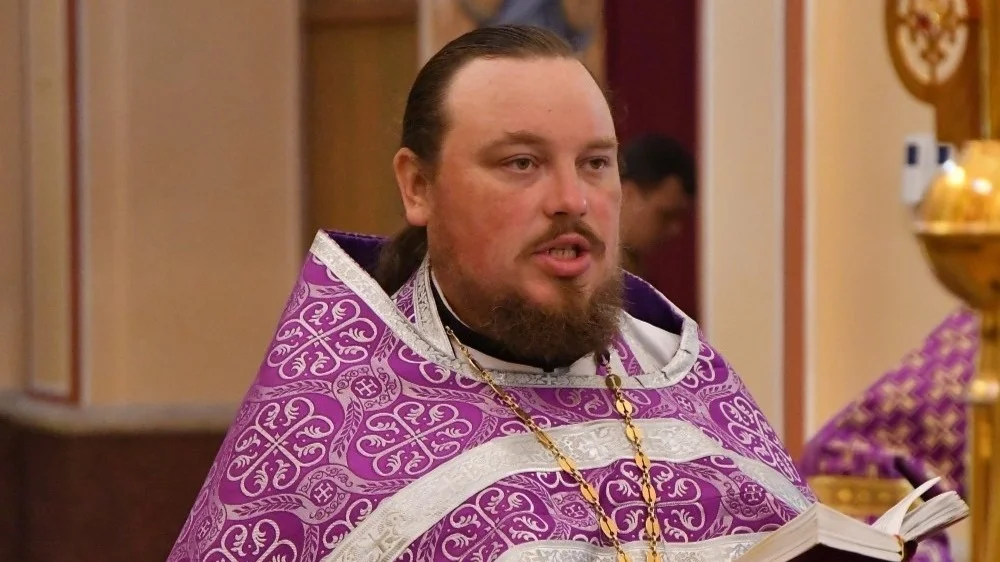
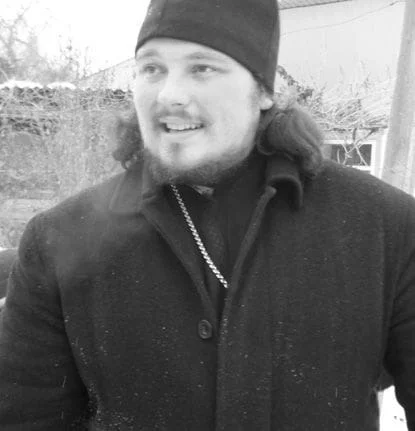
Hieromonk Jacob (Vorontsov). Photo: social networks
The Russian church empire is falling apart. Against the background of the Northern Military District, the churches of Ukraine, the Baltic countries, and Moldova are leaving the jurisdiction of the Moscow Patriarchate. The initiative for autocephaly of the national Orthodox Church also arose in Kazakhstan. Hieromonk Jacob (Vorontsov), convicted in the Russian Orthodox Church for his pacifist position, spoke with her. Under pressure from the Kazakhstan Metropolitan District of the Russian Orthodox Church, the authorities joined in the pressure on the cleric - his criminal prosecution has been ongoing for more than a year. The circumstances of this case and the situation of Kazakh Orthodoxy in general were examined by a Novaya columnist.
...A complaint addressed to the President of Kazakhstan Kassym-Jomart Tokayev was published on December 9 by the former cleric of the Kazakhstan Metropolitan District of the Russian Orthodox Church, the initiator of the creation of the Orthodox Church of Kazakhstan, independent from Moscow, and the author of the “New” Hieromonk Jacob (Vorontsov). Investigative authorities, violating Kazakh law, have been conducting a pre-trial investigation for more than a year into the publication of an anti-war post on the hieromonk’s blog. Its procedural status has no analogue in Russian criminal law: a witness with the right to defense against the charges brought against him.
According to the law, the investigation must last two months, but in the case of Fr. Jacob is already in his second year. In April, the state Institute of Forensic Science in Almaty found no signs of inciting ethnic hatred in his post, which vigilant Orthodox citizens complained about last fall. The beginning of the investigation surprisingly coincided with the statement of Fr. Jacob on the beginning of the registration process of the Orthodox Church of Kazakhstan, independent of the Russian Orthodox Church. If this initiative is successful, Moscow's monopoly on the religious tradition, to which about 20% of the country's residents belong, will be destroyed.
New Sergianism
In the first days of the North Military District, Jacob signed a letter from 293 clergy of the Russian Orthodox Church calling on them to stop hostilities and begin negotiations. On February 25, 2022, he sent a letter to the head of the Kazakhstan Metropolitan District of the Russian Orthodox Church, Metropolitan Alexander (Mogilev), calling on him, as a member of the Synod of the Moscow Patriarchate, to initiate the anathematization of supporters of the military conflict. According to Jacob’s plan, it was urgently necessary in Kyiv—through the mediation of the Pope and other world Christian leaders—to convene a “reconciliatory council” of Russia and Ukraine. And if the Russian Orthodox Church is unable to express a Christian peacemaking position, raise the question of the Orthodox Church of Kazakhstan leaving the Russian Orthodox Church.
Such frankness outraged the leadership of the metropolitan district, and Alexander called Jacob to repentance.
On March 4, the hieromonk wrote to his bishop: his sermon is not political, but purely moral, peacemaking. “To isolate ourselves and renounce,” he wrote, “is our duty to God and people, as well as to the future of Kazakhstan... We could protect ourselves and our Kazakhstan from sin (...). If we don’t do this, blood will be on our conscience.”
A few months later, Jacob compiled a list of his claims against the Russian Orthodox Church: complicity in Cain’s sin; preaching militarism, including through worship (inclusion of prayer for victory in the liturgy); guarantees of paradise to the participants of the Northern Military District who died for the Russian Federation; declaration of a “holy war”; sympathy or indifference of the clergy and laity to all this. After the appearance of the documents of the World Russian People's Council, dogmatically substantiating the SVO, Fr. Jacob called the head of the council (Patriarch Kirill) a “heretic.” According to him, instead of God, the patriarch worships the idol of the “Russian world,” endowing an individual people and its leader with the messianic function of the Holder of Evil, and attributes the unity of the Persons of the Holy Trinity to the “trinity of Holy Rus'.” If before February 24 some clergy in Kazakhstan allowed themselves to preach peace, then with the beginning of the Northern Military District everyone quickly “changed their shoes in the air” - Jacob was left alone. True, no one forces you to read the “victory prayer” in Kazakhstan - some priests do not read it with impunity.
Jacob sums up the results of his thoughts in the article “New Sergianism.” The name of the first Soviet Patriarch Sergius (Stragorodsky) was given to the most servile church movement in the Russian Orthodox Church, which, by the will of Stalin, became dominant. Sergianism teaches that the church cannot exist outside the state and must be subordinate to any authority, even anti-religious. The author sees a way out of modern Sergianism in moving to other local churches with which the Russian Orthodox Church breaks canonical communication (for example, Constantinople and Alexandria). By the way, the monograph by Fr. James “Spreading the Teachings of Christ” is dedicated to the anti-Sergian saint - Fr. Konstantin Aksenov, who was executed in 1937 and was under the omophorion of Metropolitan Joseph (Petrovykh) - the leader of the radical opposition to Sergius.
Orthodoxy without empire
Vladimir Vorontsov, the future hieromonk Jacob, was born in 1986 in Alma-Ata, where he graduated from the university with a degree in “Teacher of Russian Language and Literature.” In 2010, he was ordained a priest in Chimkent and became one of the few clergy of the local diocese with a higher secular education; served in the villages of Sarymoldaevo, Merke and Kulan, Zhambyl region, headed the diocesan department of religious education, and conducted children's Orthodox camps. Having experience teaching at the Almaty Seminary, he took courses at the All-Church graduate school and doctoral studies in Moscow and graduated from the Russian Christian Humanitarian Academy in St. Petersburg. The head of the metropolitan district noticed the promising cleric, transferred him to the Almaty Cathedral, tonsured him as a monk and appointed him head of three departments of the capital's diocese. At one time Fr. Jacob represented Kazakhstan on the publishing council of the Russian Orthodox Church in Moscow.
He brought to the metropolis, which was self-consciously a narrowly national community, a remote province of the “Russian world,” a fresh wind of Kazakh Orthodox identity.
Unlike most clergy of the diocese, the young hieromonk had no experience of life in the empire or “serving in Great Russia,” considering himself a bearer of Kazakh culture.
“We have not been a Russian colony for a long time,” he says, “the Kazakh language is the future of Kazakhstan. This is an important component of our self-determination and a guarantee of the unity of the people of Kazakhstan.” At Easter last year, during the liturgy in Aktobe, he read the Gospel in Kazakh. “You need to love the people of your country, live in their interests, and not in the interests of the mythical “historical homeland,” says Jacob, and this, of course, is a challenge to the ethnocentric majority of his church.
“You’re Russian!”
With the beginning of the Northern War, the mental and cultural conflict spilled out. Already in the first days of March 2022, the cleric of the cathedral removed Jacob from ministry. The diocesan administration criticized his position: “For many years, the Orthodox Church of Kazakhstan has built and defended its neutral position regarding any issues related to political assessments,” which means that its ministers do not have the right to give a moral assessment of the SVO. “People report that they did not delegate Hieromonk Jacob to make such statements, putting all believers in particular at risk,” the department wrote in the characteristic style of the Soviet party apparatus.
In March 2022, the disciplinary commission met twice (Novaya spoke in detail about this specifically clerical version of the comrade’s court) of the Almaty-Astana diocese, headed by the vicar bishop of Kaskelen Gennady (Gogolev). The learned hieromonk was treated humanely (when compared with similar commissions in the Russian Federation): they let things slide and took ridiculous subscriptions with a promise not to join parties and not to participate in political struggle.
“I was accused,” recalls Jacob, “of violating the principle of separation of church and state. Why are the patriarch and hierarchs allowed to participate in politics and even sign the “Order of the World Russian People’s Council,” which is nothing more than a political program?” “For correction” they were sent to a high-mountain monastery, where Jacob broke his leg and was hospitalized. At the beginning of 2023, he was “exiled” to Aktobe, where the hieromonk served for three months.
Both links were accompanied by “Orthodox hate” in pseudo-pious tones with the same argument at the end: “You’re Russian!”
After the third meeting of the diocesan disciplinary commission, on June 19 last year, the Metropolitan issued a decree banning him from serving. Among the six canons that Jacob is accused of violating is the notorious 25th Apostolic Canon on perjury, which the leadership of the Russian Orthodox Church applies to all pacifist-minded clergy. The decree was not given to the hieromonk, but was distributed on social networks, which he sees as an administrative offense. He recently discovered that his employment contract with the diocese had not been formally terminated.
On August 10 last year in Almaty, in flagrant violation of the Regulations of the Russian Orthodox Church on the Church Court, this very court met. Jacob was not present because he was not officially invited and was not familiar with the accusation. The court predictably found him “worthy of defrocking,” and Patriarch Kirill approved the decision in July of this year. As the experience of other ministers of the Russian Orthodox Church who were defrocked on the same grounds (Fathers John Koval, Alexy Uminsky, Andrei Kuraev* and others) shows, world Orthodoxy does not recognize the legality of these politically motivated repressions. Today, all of the listed clerics serve abroad in the Patriarchate of Constantinople. Father Jacob “temporarily” became a parishioner of the Ukrainian Greek Catholic community in Almaty. “This is like my church emigration,” he told Novaya.
Path in a circle
At the end of last year, with a group of like-minded people, Jacob began writing a charter for a church independent from Moscow. On December 4, he made a statement of intentions: “It is necessary to create an Orthodox Church in Almaty that will not be subordinate to Moscow, will not participate in the propaganda of the “Russian world” and will become the spiritual true Church of Christ, bringing peace and salvation to humanity.” He recalled that historically Orthodoxy in the lands of Kazakhstan (ancient Turan) is not connected with Moscow: even in the first millennium, there was a diocese here, presumably of the Patriarchate of Antioch and the entire East. “The Russian Orthodox Church came here in a later period - during the process of colonization of Kazakhstan by the Russian Empire - and carried out certain tasks of colonization,” says the hieromonk. “Given that Kazakhstan has long ceased to be a Russian colony, it cannot be considered the exclusive “canonical territory” of the Moscow Patriarchate.”
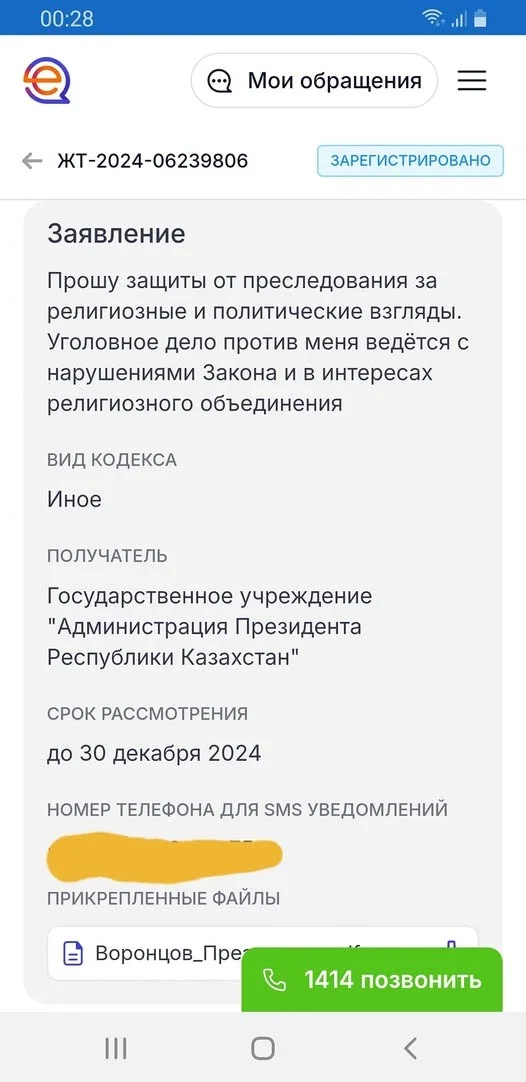
On this occasion, an appeal was sent to President Tokayev with an appeal to facilitate the establishment of the Kazakh representative office of the Ecumenical Patriarchate, which has a center in Constantinople (Istanbul), that is, in Turkey. “This step will help strengthen friendly relations between Kazakhstan and Turkey,” Jacob notes, referring to the important foreign policy vector of his country. “[This] would help strengthen Kazakhstan’s sovereignty.” The ROC’s monopoly on Orthodoxy in the country “infringes on the rights of Orthodox citizens of the Republic of Kazakhstan,” as the ROC’s isolation from world Orthodoxy increases. (...)".
On December 21, 2023, Jacob received a response signed by the Chairman of the Committee on Religious Affairs of Kazakhstan E.B. Nukezhanov, who confirmed his right to register a religious association.
But then something like a vicious circle began, conditioned by the severity of Nazarbayev’s religious legislation. At least 50 citizens of Kazakhstan living and registered in the same region can create a religious association.
At the same time, campaigning for the creation of an association and inviting people to join it are interpreted as missionary activity, and this is only permitted for registered associations. O. Jacob sees a way out in preaching via the Internet, which Kazakh officials are not yet monitoring so closely.
HELP "NEW"
The Kazakhstan Metropolitan District of the Russian Orthodox Church, which is also called the Orthodox Church of Kazakhstan within the republic, is a semi-autonomous structural unit within the Moscow Patriarchate, uniting 10 dioceses in Kazakhstan, in which eight bishops and about 370 priests serve. Their distribution among dioceses is extremely uneven: if in the capital, Astana-Almaty, dioceses there are 150 clergy, then in Aktobe - only 10, and in the Ural and Pavlodar - 22 each. According to the metropolitan district, Orthodoxy is professed by about 20% of the country's population, then there are just under 4 million people.After the re-establishment of the Russian Orthodox Church by Stalin in 1943 and until the end of the 1980s, the only diocese of this church operated on the territory of Kazakhstan. By 2003, when the synod of the Russian Orthodox Church created the metropolitan district, there were already three dioceses. Since 2010, the metropolitan district has been headed by Metropolitan Alexander (Mogilev), who previously served in Kostroma and headed the Synodal Department of the Russian Orthodox Church for Youth Affairs. His activities in the Russian Federation were accompanied by some scandals, which, according to experts, puts Alexander in a dependent position on the leadership of the Patriarchate and the Russian authorities. He demonstrates emphasized loyalty to the authorities and refuses missionary initiatives aimed at adapting Orthodoxy to the Kazakh language and culture. The vast majority of clergy and laity of the Russian Orthodox Church in Kazakhstan consider themselves part of the larger “Russian world.”
Since 2010, the Kazakhstan district has its own synod, the decisions of which come into force after their approval by the synod of the Russian Orthodox Church. At the Miusskoe cemetery in Moscow there is a district courtyard.
Denunciation from a parishioner
The statement of intent resulted in the initiation of a criminal case, in which Jacob is a witness with the right to defense (there is no such status in Russian criminal law). His fellow members of the Cathedral threatened him with a criminal case at the very beginning of the SVO, but the first complaint to law enforcement agencies was received only in response to a publication on his blog on August 2, 2023 (the post has now been deleted).
The police received an anonymous tip submitted through the electronic system. In it, the hieromonk is accused of inciting hatred and enmity towards the Russian people. Later, Anna Shcherbakova, a parishioner of the cathedral and a champion of the “Russian world,” acknowledged her authorship of the statement. It is clear from her blog that she is an emotional and politically savvy person. He calls the hieromonk’s supporters a “pack”, “woodpeckers” and assures that the Russian special services are not interested in them: “Don’t flatter yourself, no one needs you.” But he still wants to imprison the priest.
The police officer took explanations from Jacob, which boiled down to the fact that “the post talks (...) about the so-called Russian world, and not about the Russian people themselves... I outlined a critical assessment of the phenomena of Russian culture, (...) also my religious beliefs.” The officer promised that the case would be refused.
Having learned about this, the applicant organized on December 3 at the cathedral a collection of signatures under a collective demand to subject the hieromonk to criminal prosecution. From the pulpit, the keymaster of the cathedral, Archpriest Alexander Suvorov, called on parishioners to take part in a “good deed.”
The collective appeal, supported by the clergy, was put into action: on December 27 last year, the investigative department of the Almaty Police Department opened criminal proceedings on the fact of the publication, which allegedly contained signs of a crime under Part 1 of Art. 174 of the Criminal Code of the Republic of Kazakhstan (inciting social, national, tribal, racial, class or religious hatred, insulting national honor and dignity or religious feelings of citizens). The status of a “witness entitled to protection” assigned to Jacob is regulated by Art. 65.1 Code of Criminal Procedure of the Republic of Kazakhstan. As his lawyer Diaz Akhmet explained, such a witness is no different from a suspect, but has fewer rights - for example, he cannot refuse to testify.
The investigation ordered a psychological and philological examination in the case, which was carried out by L.N., a specialist from the State Institute of Forensic Expertise in Almaty. Sansyzbay. She signed her conclusion in February of this year, its key conclusion is as follows: “In the text of the publication under study there is no information aimed at inciting social, national, clan, racial, class or religious hostility or discord of an offensive nature towards representatives of a particular nation, religion, race, exclusivity, superiority or inferiority of one nation, religion over another, call for hostile actions against persons of a certain nationality, one social, class or religious, clan, racial group against another.”
In short, there are no signs of a crime under Part 1 of Art. 174 of the Criminal Code of the Republic of Kazakhstan, the investigation must be terminated. Indeed, it was suspended for some time, but then resumed.
On April 12, Jacob's lawyer filed a complaint with the city prosecutor, but there was no response. In response to a complaint to the president, a formal recording came from the investigator, which forced the hieromonk to file a second complaint - already with the publication in the media. Referring to the agreement on cooperation with the Council of Europe, the resolution of paragraph 13 of Pase No. 2540 of April 17 of the current year: “The hierarchy of the Moscow Patriarchate of the Russian Orthodox Church is most actively promoting the ideology of the“ Russian world ”, which proclaims *** against Ukraine and The “Satanic” West by the “sacred war of all Russians”, urging the Orthodox believers to sacrifice themselves for their country. The Assembly is shocked by such violence against religion and the perversion of the Christian Orthodox (...). "
38-year-old about. Jacob is pursued for “Russophobia”, but in fact - for the desire to separate his native Orthodoxy from the non -native “Russian world”. They are persecuted in independent Kazakhstan, about which Russian politicians periodically say that he is “in line” for “returning to his native harbor”. “Insopperity to turn a blind eye to a lie and take the sacraments in the Russian Orthodox Church, pretending that nothing was happening,” says Hieromonk. - For the sake of the truth of the Gospel, for the good of the Church, one should move away from the destructive church of Patriarch Kirill. If we do not do this, we become accomplices in the construction of the Church without Christ. ”
And he himself is ready to follow Christ with His Witnesses-Martyrs: “It's time to prison, because it is better to be in conclusion than to live a priest without a liturgy ministry. I always had a feature of the new martyrs and confessors of the twentieth century. ” Modernity laid the foundation for a new martyrologist - martyrs and confessors of the 21st century, in which several famous names are already.