Who controls business in occupied Ukrainian cities
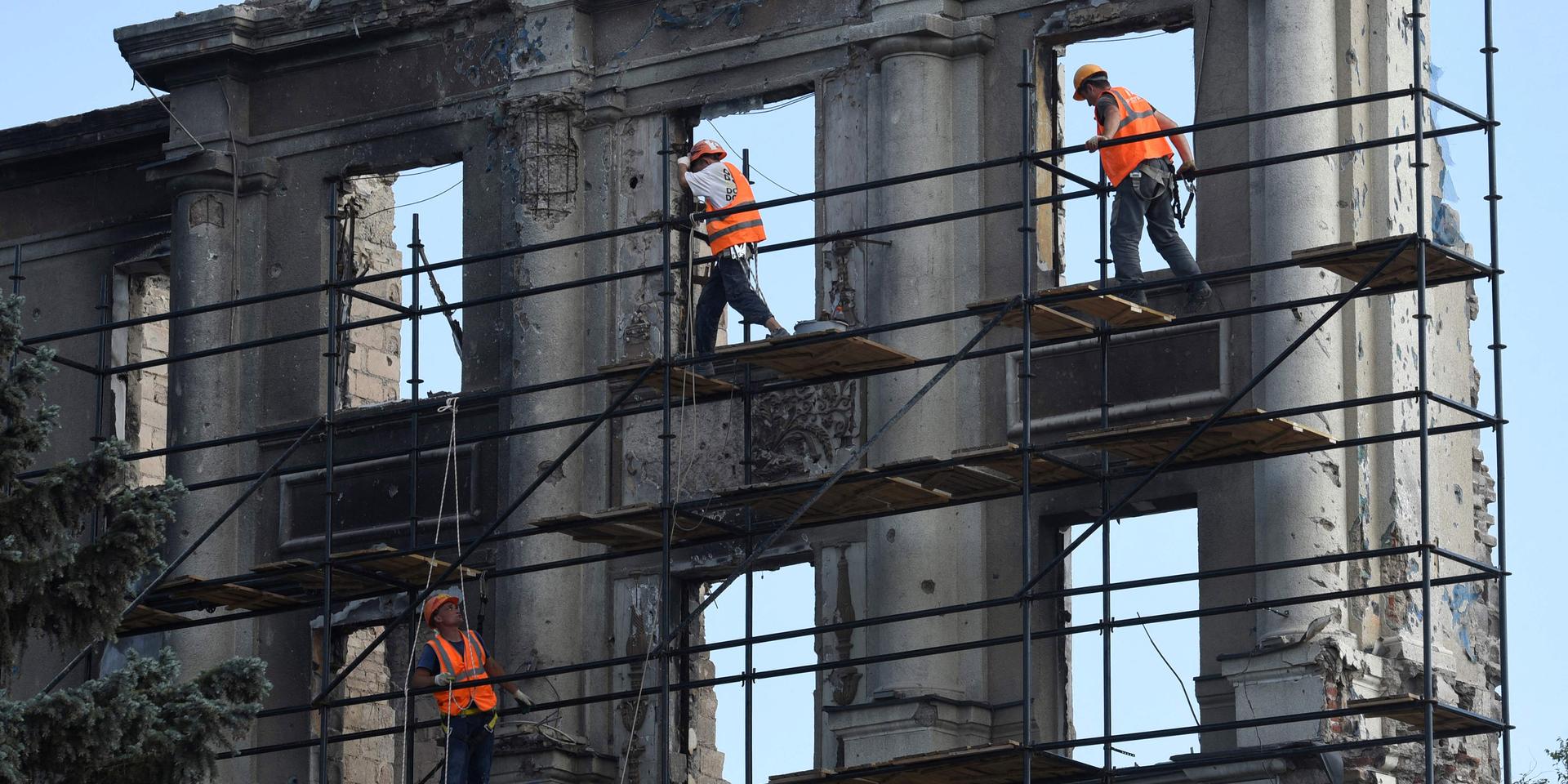
Date: Dec 20 2024Author Ksenia Churmanova Mariupl, August 16, 2023 Photo: AFP / Scanpix / LETA
At the beginning of 2024, walking through the destroyed Mariupol metallurgical plant - once one of the largest enterprises in the Donetsk region - assistant to the head of Chechnya Vakha Geremeev tried to joke about the plant seized by the Akhmatovites: “I already fell in love with it. I have already become a metallurgist.” Now the company is owned by associates of Ramzan Kadyrov.
It is not only Chechens who are seizing businesses, property and resources in the occupied regions. Entrepreneurs from different Russian regions come to Mariupol and other Ukrainian cities to buy construction contracts, scrap and surviving equipment.
Important Stories examined the corporate documents of companies in the occupied territories, their connections with each other and with government agencies to understand who benefits from the occupation of Ukraine.
Where do Russians come from to the occupied territories?
“Almost all of Russia is here,” an entrepreneur from Dagestan describes the situation with the construction business in Mariupol. “If earlier there were St. Petersburg and Moscow here, now they work from all regions.”
He came to the “liberated” city - as he calls it - in November 2022 at the invitation of a subordinate organization of the Ministry of Housing and Communal Services and Construction of one of the Russian regions. We managed to get this job thanks to connections: “Due to life experience, we once met in Moscow and crossed paths.” Nine months later, together with his partner, he registered a new construction business in Mariupol.
Businesses in Ukrainian regions controlled by Russia are indeed registered by entrepreneurs from all over Russia, as an interlocutor of “Important Stories” from Dagestan stated. This is also evidenced by data from the Russian register of legal entities that we studied.
The majority of Russians who became beneficiaries of companies in the occupied regions come from the south of the country: from the Rostov and Volgograd regions, as well as the Krasnodar Territory. This is more than 80% of the total number of owners with Russian TINs (this can be determined by the first two digits, which represent the code of the Russian region where the taxpayer number was issued). In fourth place is Moscow.
More often, companies are registered in the cities of Donetsk and Lugansk regions. For example, more than a thousand legal entities have been registered in Donetsk since February 2022, in Lugansk - 746, in Makeyevka - 255. Transparency International analystsassociated this with the perception of these territories by Russians as more “stable” for business compared to the Zaporozhye and Kherson regions.
Among the cities captured during a full-scale war, businesses are registered mainly in Mariupol and Berdyansk. Thus, in Mariupol, the beneficiaries of more than half of the legal entities registered in the Unified State Register of Legal Entities are Russians, 40 companies are registered to Crimeans, 179 are registered to entrepreneurs who received a Taxpayer Identification Number (TIN) in the occupied regions.
What we thought
We analyzed data on the owners, management, main activities, address and revenue of enterprises in the occupied territories of Ukraine, registered in the Russian register of legal entities. We downloaded the contracts of these companies and the legal entities that control them from the Russian government procurement website.
We studied documents from Zaporozhye and Kherson enterprises that appeared in the Russian register since February 2022. For Donetsk and Lugansk companies, we chose the period from April 2014, when Russia began to occupy Donbass. Officially, Putin annexed four regions in September 2022, but Russian entrepreneurs began operating in the Donetsk and Lugansk regions already in 2014.
Some of these companies existed in Ukraine before the war and were simply re-registered in the Russian registry during the occupation. Some of them have changed owners. We did not exclude such legal entities from the sample in order to see and analyze all possible connections.
Using the Python graph library, we found clusters of related businessmen and companies. Their connections are based on several types of relationships - by owners, by management and by government customers with whom the companies themselves or their owners entered into contracts. We have described two of them.
During the analysis, we discovered that access to data is gradually being closed: more and more messages are appearing in the database that data about the owners of a particular company is hidden in accordance with the law “On State Registration of Legal Entities and Individual Entrepreneurs.” In 2023, the government approved a new list of organizations whose access to data in the Unified State Register of Legal Entities may be limited: banks that have contracts for state defense orders, as well as legal entities located in the Crimea, “DPR”, “LPR”, Zaporozhye and Kherson regions. One of the reasons for this is the attempt of entrepreneurs to avoid Western sanctions.
Ukrainian businessman wanted and Chechen beneficiaries: participants in the construction cluster
The key figure in one of the largest groups of companies, whose main assets are concentrated in the construction industry, is Ukrainian Vitaly Kolesnikov. In 2020, a businessman was detained in Ukraine while transferring a bribe to the head of the State Property Fund, after which he left for Russia, and then, back in 2021, received a “LPR” passport. He was put on the wanted list in Ukraine, and in Russian-controlled Ukrainian territories his career almost immediately took off: Kolesnikov became the owner of seven companies in the occupied regions and three in Moscow.
Kolesnikov’s companies have similar names (VTEK, HIP-VTEK, VTEK Agro) and partners. They control several legal entities associated with Chechen big business and the government, Important Stories noted.
One of them is headed by Aslanbek Alkhanov. On Instagram, he poses at a desk against the backdrop of portraits of the Kadyrovs, Putin and the Russian flag—familiar attributes for Chechen bureaucratic offices. Judging by records from the GetContact service, Alkhanov introduces himself as an assistant to the representative of the head of Chechnya in the Krasnodar Territory: Alkhanov’s acquaintances record his contact as “Aslambek Pom Predstovit”, “Aslambek Predstav Chechnya”, “Aslambek Sochi Kadyrov” and “Aslambek Pom Said” (spelling preserved) . He confirmed to Important Stories that he held the position.
In the Donetsk region, Alkhanov runs the construction company “New Territories”, which his Sochi legal entity shares with the legal entity of businessman Kolesnikov. In a conversation with the journalistic “Important Stories”, he said that he plans to build high-rise buildings, low-rise buildings and cottage villages in Donetsk and Mariupol: “Please, if you have money, come build it. These are our territories, our Russian territories.”
In 2024, Kolesnikova’s VTEK became a co-owner of two more Donetsk construction companies with Chechen roots and similar names - Astar Group. Their beneficiary is the Grozny holding of the same name by Salambek Zulaev, which was involved in the renovation of the Heart of Chechnya mosque and, judging by its website and government contracts, carried out several other large Chechen projects. The new Donetsk company is headed by Zulaev’s brother, Ramzan Zulaev, a member of the Grozny City Duma from United Russia.
It is now difficult to track goods exported from occupied regions to Russia through customs databases. After the official annexation of the four regions, there was no longer any need to declare goods coming from there. But the occupation authorities do not hide the fact that they are exporting products from these territories. The head of the pro-Russian administration of the Zaporozhye region, Yevgeny Balitsky, reported about the export of grain from the port of Berdyansk (he later edited the message and deleted information about the grain). And Ukrainian officials talked about the export of scrap metal.
Help “Important Stories” With your help we will continue to talk about what is happening in Russia Donate
In total, since 2022, 63 enterprises in the occupied territories have appeared in the Russian register of legal entities, the main activity of which is related to the processing and trade of scrap - mainly in Mariupol, Donetsk, Melitopol and Lugansk. A share of one of the main metallurgical assets in Mariupol - the Ilyich iron and steel plant - was received shortly after the capture of the city by a relative of the senator from Chechnya Suleiman Geremeev Valid Korchagin (aka Geremeev). Alash Dadashov, who replaced him two months later, is also close to Geremeev.
In 2024, United Russia member Mikhail Poslamovsky was appointed acting director of the company that manages the plant. Before the war, he was engaged in processing and trading in waste and scrap in Stavropol, Moscow, Volgograd and Rostov-on-Don, and in his free time he was involved in sailing , competing , among others, with the Akhmat team at races in the Krasnodar region.
By the end of the second year of the war, Poslamovsky became a deputy of the Mariupol City Council and acting. Mariupol plant Ilyich. Data from the GetContact service suggests that he is still engaged in scrap metal in Mariupol and cooperates with Kadyrov’s representative in the Rostov region, Adam Gonchaev , who is now reporting on the achievements of the Chechen government in the captured city. Some acquaintances of Poslamovsky call him in their notebooks “Vtormetal Mikhail Akhmat” and “Mikhail Adam Gonchaev Metal”.
Russians are interested in factories because there is scrap metal and equipment left there, says advisor to the mayor of Mariupol Pyotr Andryushchenko. According to him, Russian equipment is in many ways similar to the equipment installed at the Ilyich plant, and the Russian metallurgy industry has problems with spare parts due to sanctions - therefore, “the equipment of the Ilyich plant can be used as a donor: remove something and send it to Russia.”
Subscribe to our newsletter We send only important stories
Zaporozhchermet is another Chechen business that received permission in 2024 to process and sell scrap and ferrous metal waste in the occupied territories. It is controlled by 32-year-old Aslan Baysarov, brother of the Chechen boxer Ramzan Baysarov, who competes for the Akhmat club. Ramzan Baysarov on his Instagram often publishes photographs with his brothers, as well as with Ramzan Kadyrov and State Duma deputy Adam Delimkhanov, who in 2022, against the backdrop of a burning building, reported on the implementation of the “instructions” of Putin and Kadyrov to seize Mariupol.
In a conversation with a journalist from “Important Stories,” Baysarov admitted that his business did not work out because “the port workers monopolized everything,” and advised him to contact him with the same question in two years. “Yes please, I don’t want anything,” he responded emotionally to questions about business. “I once wanted to work in the Zaporozhye region, export goods through the port, but the port workers are good guys and want to monopolize everything themselves. Therefore, in short, I abandoned this idea, I don’t want anything else.” The successful brother did not help Baysarov with his business in any way, he says disappointedly: “If someone had helped me, I would have started a business there a long time ago.”
In 2023, Ukraine imposed sanctions against the new owner of the Mariupol iron and steel plant, Ilyich Valid Korchagin. Baysarov is not worried about these risks: “I’m not such a big player that any sanctions should be imposed on me. I'm a small trader." In 2025, he wants to try again to do business in the Zaporozhye region.
Advisor to the mayor of Mariupol Pyotr Andryushchenko said that the metallurgical industry in Mariupol was given to Kadyrov’s supporters for plunder. Transparency International analystscalled this a “reward” for the capture of Mariupol.
More and more Chechen entrepreneurs with influential relatives are appearing in the occupied territories. But so far, immigrants from Chechnya as a whole make up a small share. Officially, they are the beneficiaries or managers of only 35 legal entities registered in the occupied territories since 2014 - this is less than a percentage of the total number of companies whose co-owners or managers are known.
Baysarov believes that representatives of Chechnya in Ukraine are now busy with the war, and not with business. “At SVO, it’s mostly people there. Someone needs to defend the homeland,” he says.
Donbass mines and factories: family assets of an industrial cluster
In 2023, the Russian authorities launched a coal reform in the so-called “DPR” and “LPR”. Her idea was to reduce the coal mines - from 114 (the number before the occupation) to 15 - and find funding for the remaining ones. An investor for one of the mines, Volynskaya, was found this summer at the St. Petersburg Economic Forum. It was transferred to GOK Energokoks, which promised investments worth 211 million rubles. Judging by the company's documents, the investor turned out to be 71-year-old Russian woman Sofya Belichenko.
This is not her only asset: Belichenko controls eight more companies in the occupied territories. Belichenko’s son-in-law is a Donbass and Crimean entrepreneur and member of the so-called Russia-Donbass integration committee Yaroslav Tibekin.
The Tibekin family, in whose hands large industrial assets are concentrated in the Donbass, established a foothold in occupied Crimea before Russia’s full-scale invasion of Ukraine: in 2017, Yaroslav Tibekin’s wife Tatyana became the owner of the Nizhnegorsky cannery, a company from the village of the same name, which has since concluded more than a hundred small government contracts for 18 million rubles for the supply of products with Russian ministries, FSB, hospitals and kindergartens. Tibekina’s Zaporozhye enterprise, the Melitopol Dairy Plant, previously owned by Ukrainian entrepreneurs, managed to receive five government contracts - this time larger ones - from the regional Ministry of Science and Education created there by Russia for 14 million rubles.
A 71-year-old relative of a Donbass businessman also owns 40% of the Komsomolsk stone quarry and, through the Energokoks GOK company, 50% of the Sverdlovsk Machine-Building Plant. Both enterprises are located in the Lugansk region. In addition to them, this “family” cluster controls another hundred legal entities from four occupied regions of Ukraine. Together they cover several main areas in the region - coal mining, equipment trade, agriculture and construction. In 2023, the revenue of all companies in this group for which data is available amounted to 8.5 billion rubles.
Belichenko ignored the message from the “Important Stories” journalist.
In total, the mining industry - mining of coal, decorative and building stone, limestone, gypsum, chalk and shale - is declared as the main activity of 203 companies. 36 of them were registered in the Donetsk region after the start of Russia’s full-scale invasion of Ukraine.
Companies with the largest revenue
In 2023, only 13 companies registered in the occupied territories after the start of the full-scale invasion had revenues exceeding a billion rubles. The first in terms of revenue are the companies “YUMMC” (79 billion) and “YUGMK Donetsk” (39.9 billion). Both were registered in the Russian register of legal entities a month after Putin’s decree on the “annexation” of four Ukrainian regions in 2022.
79 billion ₽revenue of the YuGMK company for 2023 is the largest in terms of revenue in the occupied territories of Ukraine
The companies are managed by the Moscow Soyuzmetallservice, which in turn is led by the former deputy governor of the Tula region, Vitaly Sherin, who in 2022 moved from there to the position of deputy general director at Roscosmos.
In the occupied Donetsk region, YUGMK was seized by seven factories at once, three of which before the war were part of the holding of Ukrainian businessman Rinat Akhmetov (as well as, for example, the Mariupol metallurgical plant seized by Kadyrov’s army).
The company exports products from these plants abroad: judging by customs data studied by “Important Stories”, at the end of last year Soyuzmetallservice sent 3.4 thousand tons of coal from the Makeevka coke plant and about 31 thousand tons of steel products to Turkey - from the Makeevka metallurgical and Yenakievo plants (the enterprises are noted in the documents as manufacturers).
At the same time, some enterprises registered in 2024 are still “zero” - they have no income. The only entrepreneur in the occupied territories from the Kurgan region, who registered three companies in Donetsk, calls his companies “zero”. A businessman from Dagestan, who has been involved in construction in Mariupol since 2022, has a similar situation. “Any working person is interested in the financial component,” he answers the question about his company’s revenue, “but for now I’m working for the future, for the subsequent regions - Severodonetsk, Lisichansk and other territories. Everything is in process, as it were.”
“Legally this business is up in the air”
In 2024, the Kiev School of Economics estimated Ukraine's revenue losses due to the full-scale invasion of trade, agriculture and industry at $943.5 billion. These losses are associated with the outflow of customers, the need to move the business, the destruction or damage of many industrial assets, reducing the production of agricultural crops and the breakdown of exports.
“Under the international law of armed conflicts, the destruction or assignment of property, not caused by military necessity, is a war crime,” explains lawyer Grigory Weipan. “Both civil servants and private individuals can be held accountable for this.” As an example, he cites Germany, where German industrialists were convicted after the Second World War - including for assigning property in the occupied territories and the use of slave labor.
In 2023, the International Arbitration Court in the Hague ordered Russia to pay 267 million dollars to the Ukrainian businessman Rinat Akhmetov for captured assets in Crimea. It was planned to receive this compensation at the expense of Russian assets in other countries. In June 2022, Akhmetov filed a complaint with the ECHR of compensation for damage already due to the full -scale invasion of Russia and the ensuing blockade, looting, destruction and redirecting of grain and metals flows. The ECHR can still consider it, since this is a complaint against violations that occurred before September 16, 2022 (the court does not consider complaints about later violations of Russia in connection with the exception of the country from the Council of Europe). However, Russia has already stated that it would not comply with the court decision on Akhmetov's complaints.
Vipan notes that Russian business in the seized territories does not have any legal guarantees. “Ukraine considers any acts of the Russian authorities in the occupied territories, including any real estate transactions, and it is right, and it is right, since Russia cannot introduce its laws in the occupied territories,” the lawyer says. - This means that any property rights in the occupied territories of Ukraine, which are today confirmed by Russian pieces of paper, are “bird rights”. Legally, this whole business hangs in the air. When the war is over, any Russian owner or entrepreneur can stay with nothing. ”