
Translated material
There are no fish, but you hold on
“There are rumors that everything will become more expensive, especially table salt.” What will actually become more expensive?
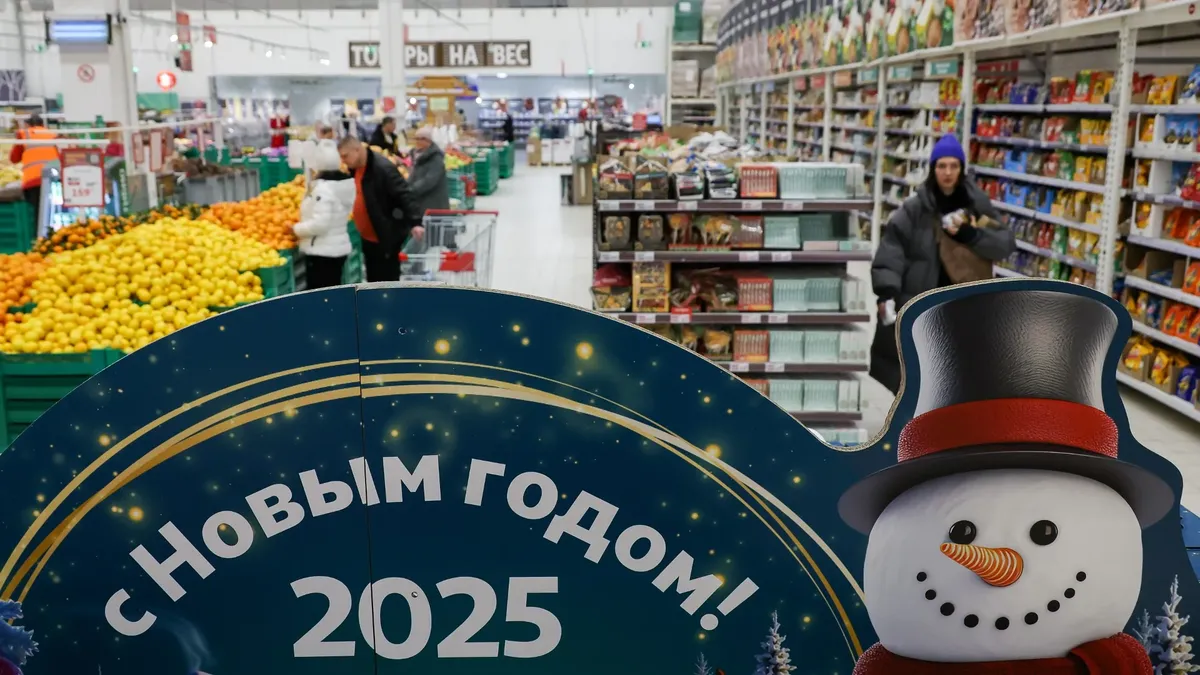
Photo: Kirill Kukhmar / TASS
Data from surveys conducted in the fall of 2024 by the IP RAS together with VTsIOM indicate an increase in fears associated with rising prices (78% in December 2024, +9 percentage points compared to April 2024). Well, in general, the Russians are right to fear.
Vladimir Vysotsky, in his song about rumors, probably could not have imagined that half a century later the price of salt would really rise sharply in Russia. The average cost of its half-kilogram package in 2024 increased by 27%, to 46 rubles - this data is provided by Kontur.Market.
However, it's not just about the salt.
Prices for products for the New Year's table have increased over the past year by 11.4%, according to data for November (according to calculations by the Association of Manufacturers and Suppliers Rusprodsoyuz).
The organization conducted an audit of the cost of 19 types of products that are usually bought for holidays in Russia.
In 2024, you will have to spend about 8,100 rubles on ingredients for salads (herring under a fur coat, Olivier salad), sandwiches with red caviar and butter, chicken, cheese and sausage slices, tangerines, champagne and chocolates.
Butter is the most expensive: it has risen in price by 31% over the year.
(up to 1 thousand rubles per 1 kg).
The most expensive treats are raw smoked sausage (1.2 thousand rubles per 1 kg), salmon fish (1.2 thousand rubles per 1 kg), chocolates (about over 900 rubles) and cheeses (840 rubles. ).
At the same time, chicken meat fell in price by 7%, to 214.5 rubles. for 1 kg. This is the biggest price reduction compared to other products. And the least amount of money for the New Year's table will be spent on vegetables, peas, chicken eggs and juices.
Although how can I say: vegetable oil and potatoes rose in price by 24%, prices for beef and tea increased by 18%.
A bottle of the cheapest sparkling wine costs more than 500 rubles.
The king of the New Year's table - Olivier salad (judging by the data of the Unified Interdepartmental Information and Statistical System (EMISS) - will cost 553 rubles, if you “put into it” 400 g of boiled sausage, 400 g of pickled cucumbers, 380 g of green peas, 200 g mayonnaise, four eggs, 400 g potatoes, 200 g carrots and 100 g of onions. Last year the same salad would have cost 510 rubles.
What else will become more expensive in 2025?
The simplest answer is everything! Inflation expectations of enterprises are at record levels.

The fact that “official inflation” was at a level of about 9% per annum as of mid-December was due to comparatively low inflation in January–April under current conditions, and since May (already 7 months) prices have been rising by 0.87% per month - this 11% per annum, and there are no signs of slowing down yet. For comparison: from December 2023 to April 2024, the average monthly price increase remained at 0.49%. According to Rosstat, in November 2024, monthly inflation reached 1.4%, a record level since 2002.
At the same time, prices grew fastest over the last six months (June–November) in the food sector: fish products - plus 18% in annual terms, oils and fats - 40.5% per annum due to butter, milk and dairy products - 21.1 %, cheese - 20%, bread and bakery products - 15%, fruits and vegetables - 48.4%! Such inflation has not been observed in the Russian Federation for twenty years.
The decision of the Central Bank of the Russian Federation to keep the key rate at the same level (21%) will also not give prices a chance to slow down: if consumer lending has begun to slow down, then corporate lending will receive a new impetus, and each loan is additional money thrown into the economy in a situation where there is no There is no growth in the production of consumer goods.
An increase in the availability of credit causes an increase in effective demand (from people and from companies), but this demand encounters a ceiling on the production capabilities of enterprises, which simply cannot increase output due to a number of restrictions.
What are these restrictions?
the “pivot to the East” caused the strongest shocks in production and logistics in fifty years;
access to technology and research potential of the world's leading countries has faced the most severe restrictions in the last third of a century;
due to cut-off from the global capital market and rising ruble rates, the cost of debt servicing has increased;
labor costs have increased due to a lack of personnel and the “structural transformation of the economy”;
Well, plus a significant devaluation of the ruble - (73.5 rubles per dollar in 2021 and over 100 rubles per dollar now).
And add to this the frontal increase in production costs due to sanctions (“parallel imports” are expensive due to the growth of chains of counterparties and compensation for sanctions risks), and many goods are so-called. critical imports remain unavailable.
As a result, the “new credit money” cannot be used to increase real production volume, but puts pressure on prices.
Inflation will not stop.
WHAT WILL INCREASE IN PRICE?
Coffee
Extreme forecast - 60%
Basic - 30%
The reason is the rise in price of Arabica coffee on the world market and the weakening of the ruble exchange rate.
Home Internet
Base forecast 10-15%
The reason is the increase in costs for providers, including due to new government initiatives in the field of Internet control.
Beer
Basic forecast - 10-15%
The reasons are rising inflation, rising prices for raw materials and, as a consequence, increasing costs.
Cloth
Basic forecast - up to 20%
The reasons are the increase in the cost of purchasing materials abroad, the weakening of the ruble, and rising costs.
Cars
Basic forecast - 10-15%
The reasons are instability of the exchange rate, an increase in production costs and a continuing shortage of components, and an increase in recycling fees.
Fish preserves
Basic forecast - 5-25%
The reason is a shortage of fish and rising prices for raw materials.
The most pronounced increase is expected for fish sets for beer; mussels in oil and brine, chopped squid, and seafood paste will rise in price by 20%.
Imported wine from the EU, USA, New Zealand and Australia
The minimum price for a bottle of quality wine can be at least 1000 rubles
The reason is the increase in duties imposed by the state.