
Translated material
Survive for 27 seconds
“The Knife” - reflections of the writer Rushdie, who almost died at the hands of a murderer
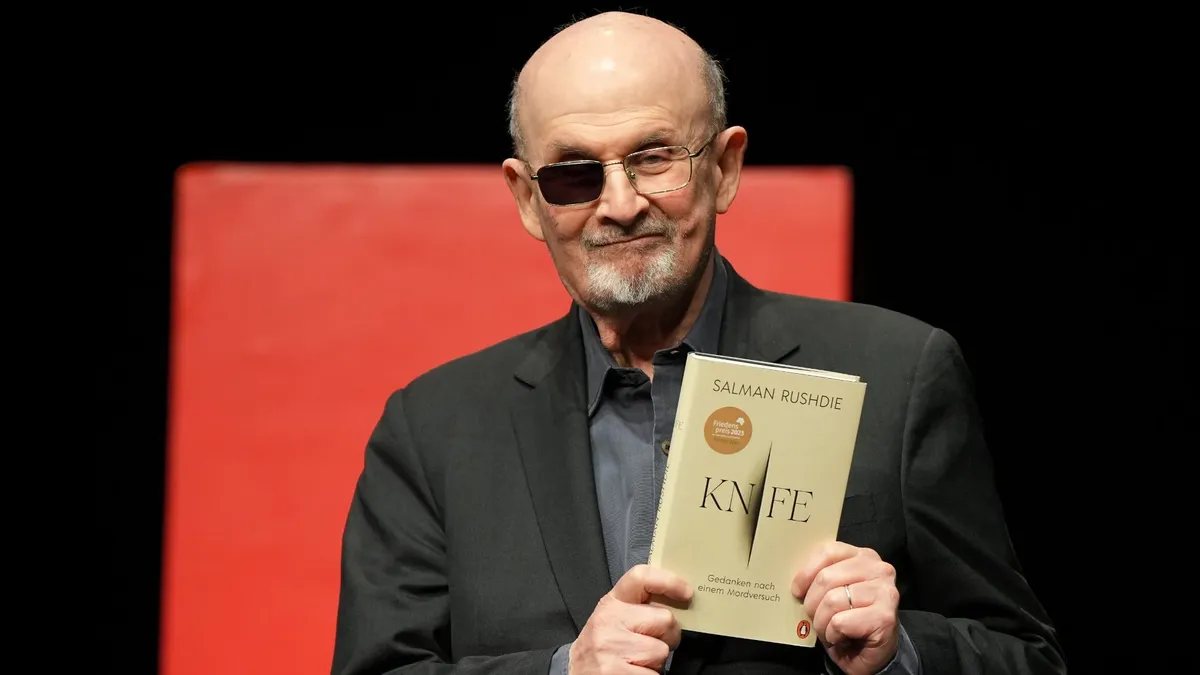
Salman Rushdie. Photo: dpa/picture-alliance
What can you do in twenty-seven seconds? Read a prayer, confess your love, read a Shakespeare sonnet out loud, write a short text message to a friend, look at the starry sky... There are an endless number of options. Salman Rushdie learned the hard way that in twenty-seven seconds you can almost lose your life under a hail of knife blows.
“The knife goes into the left hand. And then into the body, into the neck, into the chest, into the eye. The blows rain in non-stop. There were ten of them in total."
The doctor will later say that he was very lucky. It was lucky that the attacker had no idea how to kill a person with a knife. It was lucky that there was a person nearby, not even a doctor, who, the entire time the ambulance helicopter was flying to the call, pressed the wound and did not allow it to bleed. I was lucky in many ways. Therefore, we can now read the book written after.
The book is unusual in all respects and does not fit into the usual genre framework. Not a novel, not a memoir, not even a confession, although it contains a lot of personal, frank, intimate things. Sometimes even too much. How to perceive “The Knife” in the context of Rushdie’s work and in the context of time - we will return to this later.
The structure of the text is important for perception and understanding - centrifugal and centripetal. Everything comes from one point and returns to it - the evening of August 12, 2022, Chautauqua, New York. In the narrative space, Rushdie finds himself again and again on stage during a public lecture and experiencing an attack. The knife will become the cause and symbol that divides life into before and after. The author especially often reflects on what he saw, thought, felt at that fateful moment. And wanders along the waves of associations that arise in and around the fateful twenty-seven seconds.
“Some of the audience, unwilling to give up their own picture of the world and see what was actually happening, decided that the attack was a kind of performance intended to clearly demonstrate the problem of the safety of writers that we had gathered to discuss.”
Rushdie's picture of the world changed radically for the first time in 1988, after the release of his fourth novel. A forty-one-year-old native of Bombay, a graduate of the Cambridge history department, now a citizen of Great Britain and the United States, gained worldwide fame and received a death sentence that has not yet been overturned. For the book, for the words, for the fantasies. There was a huge public outcry, and it was then that discussions about the boundaries of freedom of speech resumed with renewed vigor. And opinions were divided. Then there were the Charlie Hebdo tragedy, terrorist attacks, and assassinations, directly related to different understandings of these borders. The current “new tolerance” is partly a consequence of those fierce debates.
The story is well known, there is no point in repeating it. Perhaps not everyone remembers this. The author of “The Satanic Verses,” as a person of Western culture, could assume that not everyone would accept his creation, that there would be dissatisfied, indignant, he never expected such an effect, such hatred, such consequences for himself. And after two years of persecution and ostracism, he took a step forward. At the beginning of 1990, a carefully verified statement from the writer was distributed in the press with detailed apologies, assurances of loyalty to Islam and a promise to ban the republication of the novel.
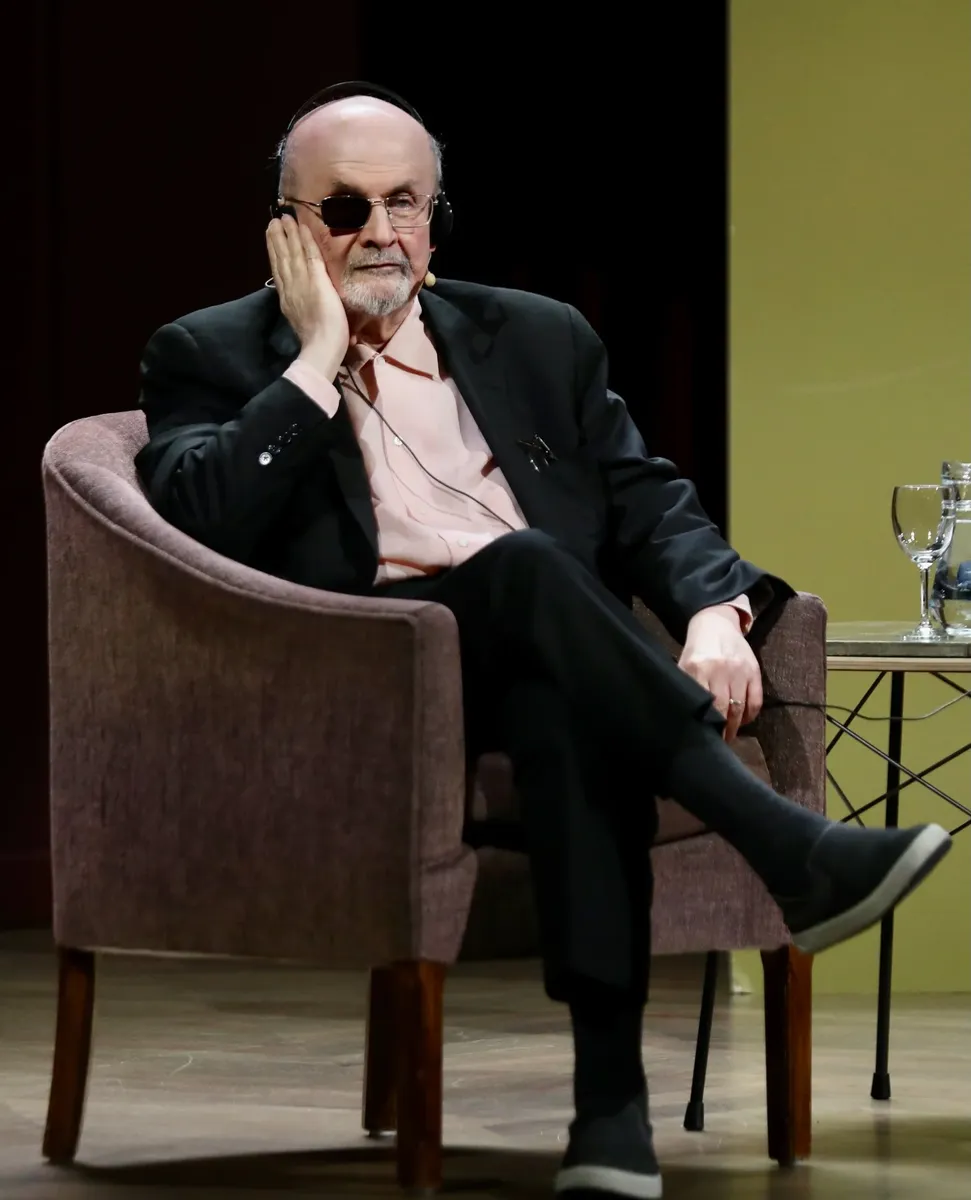
“I recognize,” he wrote in a statement, that Muslims around the world are sincerely outraged by the publication of my novel. I deeply regret that this book has caused suffering to honest followers of Islam. We live in a multi-faith world and this incident reminds us that we should all be mindful of other people's feelings."
The answer of the then, already new, leader of Iran amazed many. The essence of the answer is this: only the one who issued it can cancel a fatwa. Since Khomeini is dead, the order to kill Rushdie remains in force: “Even if Salman Rushdie repents and becomes the most pious man of all time, every Muslim is obliged to use all his strength, life and wealth to send him to hell.”
Since then, the writer lived in a state of constant threat, hid, changed addresses, rarely appeared in public places, always unexpectedly and only with security. After 35 years, he agreed to perform in Chautauqua.
“Over the years, I have more than once imagined how my killer separated from the public at one gathering or another and moved towards me, exactly the same as now. So my first thought when I saw this deadly shadow approaching me was: “There you are. You have come." They say that the last words of Henry James were the phrase: “Well, here it is, an outstanding event!” Death was approaching me too, but it did not seem to me an outstanding event. It seemed like an anachronism to me. My second thought was, “Why now? Is this really true? So much time has passed. Why now, after so many years? Without a doubt, the world has changed and this story is a thing of the past. But he was here - a peculiar time traveler, a deadly ghost from the past, was rapidly approaching me.
“Reflections...”, in particular, about how violence changes the picture of the world. For a person who has been subjected to violence, as in the case of our hero, the picture has not only changed, the world has shattered into pieces, fragments, fragments. The survivor needs to restore lost integrity, regain balance.
Rushdie has repeatedly said that he suffered from post-traumatic stress disorder. People overcome this condition in different ways. “The Knife” is a kind of therapy, a classic example of psychotherapeutic writing. Sometimes pain and suffering drown out sophisticated literary skill, which is all the more valuable. In this genre, you can do anything—make up rules and immediately break them.
The author talks about the loss of privacy and immediately recalls the most intimate physiological details of his own stay in intensive care. She talks about her desire to maintain an aura of secrecy around her personal life and speaks with inspiration about her current—fifth—wife, a current poetess. Their stormy romance is a separate lyrical plot, which becomes a contrast to the cruel world. In their case, love definitely conquers death.
“The Knife” is a kind of auto-fiction, but auto-fiction of the highest flight thanks, first of all, to self-irony, which helps to put your world back together.
Salman Rushdie recalls - and reproduces in the text - a famous shot from Georges Méliès' silent film A Trip to the Moon:
“Remembering the picture of the spaceship piercing the right eye of the Moon, I could not imagine what would be in store for my own right eye the next morning.”
Ironic about the strange quirks of the elusive consciousness.
“How much do you weigh?
My mind was clouded, but I realized that this question was addressed to me. Even in that terrible state, I was embarrassed to answer. Over the past few years my weight has spiraled out of control. I knew I needed to lose 20-25 kilos, but that was too much and I wasn't doing anything about it. And now I have to tell everyone within sound range this shameful figure.”
When it is not just a suffering person who writes, but a sophisticated master, therapy becomes an act of creativity; “The Knife” is a self-portrait of an extraordinary personality, unique in its emotional intensity and frankness - in contradictions, illogicality, pride, bragging, vanity, weaknesses, passions, death and love. A full-blooded portrait of a living person.
Thank you for being alive!