
Translated material
Reverse relocation
Why new emigrants will return to Russia: an economist explains
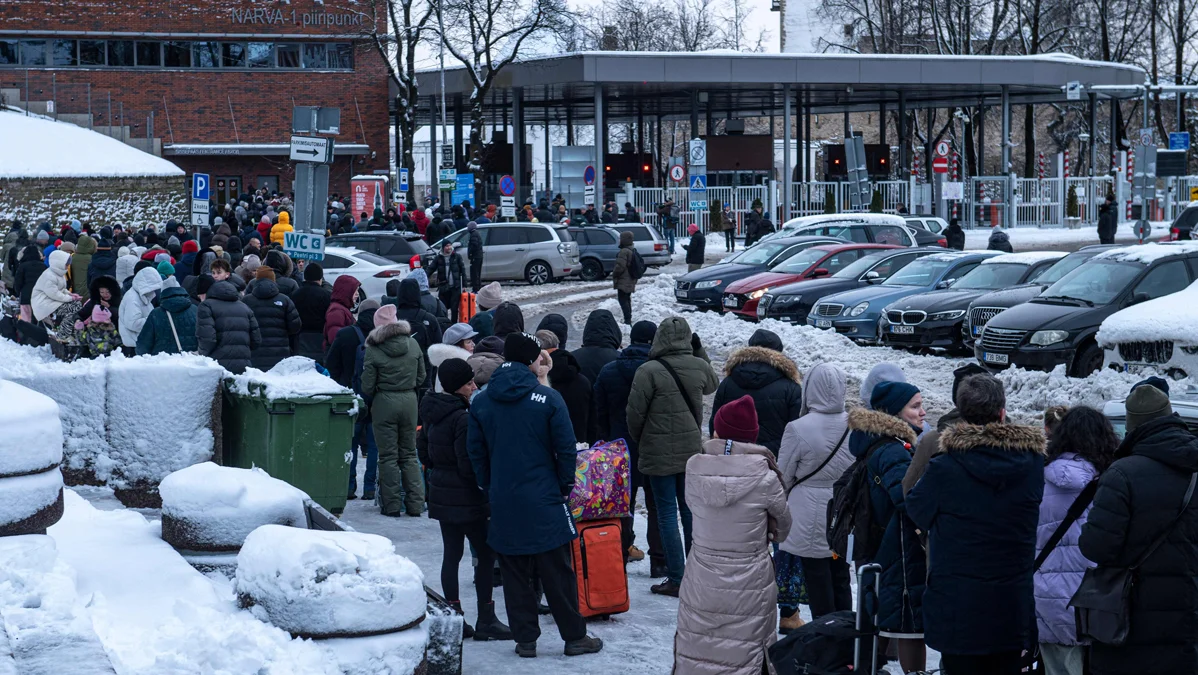
A queue in front of a checkpoint across the Russian-Estonian border in Narva, Estonia, December 15, 2024. Photo: Marko Mumm / AFP / Scanpix / LETA
I am pleased to read the texts that Novaya Gazeta has been releasing in recent days in the form of parts of the report “The Torn Generation” announced by the editors. Much in them is consonant with my own feelings, some (like the disparaging word “who have left”) are difficult for me to come to terms with, some I want to argue with on the merits. However, today I would try - as an economist - to look at some existing trends and think about the prospects for Russian “relocation”.
Some points noted in a number of materials are undeniable - no one was waiting for us and, by and large, people fleeing Russia should not count on sympathy. We haven't done even a fraction of what we should have done in opposing Putinism. Unlike the “white emigration,” we did not fight the dictatorship, leaving on battered ships after three years of armed struggle. For a long time we found excuses for coexistence with the regime and enjoyed the conveniences of life in Russia, and then moved to other countries and became (mostly ineptly) to prove that we represent something by marching with assorted flags along the streets of foreign cities or staging cultural performances.
At the same time, it seems to many (including me and my colleagues ) that Russian relocants are professional and enterprising - and therefore could give a lot to Europe, bringing the fervor of Russian competition and the ability to survive in any circumstances. However, this is approximately the same as telling Muscovites about the benefits of attracting another million migrants: you can argue for it, but you cannot be charmed by such a prospect. Therefore, the most likely result of today’s relocation, as I wrote about this more than a year ago, I would call a wave of return, which will begin, if not immediately, then soon after the end of the acute phase of the war in Ukraine (I will say that it is still impossible to even approximately determine its date ).
If we look at the dispassionate facts, then sustainable economic migration takes place today where per capita GDP at market prices between the host country and the regions of departure differs by a factor of 10 or more. So, if we evaluate the five countries that are the main suppliers of new residents to the United States in 2023 (Mexico, India, the Philippines, the Dominican Republic and Vietnam), then their average GDP will be only 8.6% of the US (a gap of 11.6 times), if carry out the same analysis for the UK (arrivals from India, Nigeria, China, Pakistan and Zimbabwe), the figure will be equal to 7.7% (a 13-fold gap), and if for France (arrivals from Algeria, Morocco, Senegal, Syria, Côte d'Ivoire) - 6.2% (16.2 times gap). The Russian situation here is very different: the gap between our country and the average for the EU does not exceed three times, and before the war, those who left for Europe were primarily those who belonged to the upper middle class in Russia and who did not intend to integrate into the European economy on any terms. Therefore I believe that
many - and most likely, the majority - of Russians who did not leave for clearly political reasons (those who feared mobilization and their loved ones; people who were afraid of a new economic collapse; who were afraid of closing borders and the inability to leave, etc.) will return back if the war ends .
An important motivating factor will be the discomfort of living abroad and the presence of relatives, housing and a familiar environment of communication in Russia (in the new host countries, few people have become “friends” for the locals, and Russian communities abroad are not distinguished by their solidarity). Russians, and this is easy to notice, are the only diaspora in the world that is financed from income received from their homeland, and does not send home what they earn abroad, like other migrants.
Therefore, I repeat: the mass exodus from Russia of the majority of both citizens and businesses seems to me to be temporary.
Back in the second half of the 2010s, Forbes magazine breathily kept a list of oligarchs who transferred a significant share of their fortunes abroad and who therefore “are not afraid of nationalization.”
After the start of the war, only a few of the 100 richest Russians did not return to the country - the rest preferred either to relocate in the opposite direction or to create a comfortable “jump infrastructure” for themselves in the Emirates, Egypt, or Turkey.
No one assumed until 2022 that the threat to the fortunes amassed over decades would come from the West (where, as of the end of 2024, more than 20 billion euros of private Russian assets were seized ), and not from the Kremlin, which imposed only a 10% tax on big businesses. tax on “excess profits” and has so far refrained from significant nationalizations. In addition to the oligarchs with their private investments, companies previously registered in European offshores such as Luxembourg, the canton of Zug or Cyprus, which the authorities “recommended” to be reduced to specially created Russian “offshores”, also came back (up to 30 Russians of Russian origin left Cyprus alone in the last two years companies, and in total almost $50 billion of previously withdrawn assets were returned to the country). A number of entrepreneurs who recently sought to get rid of Russian property have changed their point of view (for example, Dmitry Korobkov, founder of the ADV communications group, after a year and a half absence from the country, intended to sue the share in the business previously sold to his partners and return to management of the company that had previously worked with many large Western companies represented in Russia). This case, in my opinion, may turn out to be precedent-setting in at least two aspects. On the one hand, this is a unique example of how a major entrepreneur is reconsidering a previously made decision to exit Russian business (oligarchs like Mikhail Fridman, Andrei Melnichenko, who returned to the country, like many of their colleagues, never decided on this, only diversifying their investments between "here" and "there"). On the other hand, this is the first case when the former co-owner of the business demands the restoration of his rights and claims that he was misled when selling his share to his partners (note that this circumstance, if it is taken into account by the court, which should take place in the near future , can be used when reviewing a lot of other similar cases).
And here I want to move on to the sentiments that dominate Western business. As sad as it is to admit, they have changed a lot over the past year. In Europe - and above all in Germany - there is a growing understanding that leaving Russia for many has become a very unprofitable enterprise, the moral benefits of which in no way compensate for material losses. My communications in Berlin (as well as Paris and Brussels) indicate clear differences between the position of business and politicians: the first wants a gradual lifting of bans on business in Russia; the second, on the contrary, is tightening restrictive measures. I will note in this regard: despite a lot of radical statements, a little more than half of Western investors left Russia - and 21% of the companies that left Russia retained the opportunity to buy back the business, and another part (such as large service companies in the field of oil production - Baker Hughes and Halliburton) “sold” their divisions to Russian managers in anticipation of normalization of the situation. It seems to me that if the active phase of the war in Ukraine ends, many Western companies (even despite the fact that formally the sale of their assets was carried out by mutual agreement) can apply to international arbitration, using government regulations on a 50-60% discount on sale of assets and special deductions from the amounts received as grounds for recognizing transactions as forced or made under duress.
As for those companies that simply sold goods under their own brands on the Russian market, many of them declare their readiness to return now, and restoring their previous positions will not be a problem for them.
Why do I pay so much attention to the behavior of both Russian and foreign businesses? Because he is generally less emotional than individual citizens and, in the current conditions, can set an example of the beginning of “reverse relocation.” In the coming year, I believe that Russians who have left will face several significant challenges. Firstly, the Kremlin will make more and more new decisions that will significantly complicate the conditions for their stay abroad : a ban on obtaining passports at Russian consulates looks quite realistic; restrictions on the transfer of funds in favor of Russian citizens located outside the country; tightening the regime for the use of Russian assets remaining in the ownership of citizens, etc. - that is, I am practically convinced that the authorities will help “squeeze” Russians back into the country. Secondly, in Western countries, in the context of the cessation of active hostilities, many assistance programs for Russians, who are still often viewed by the authorities as political emigrants fleeing the Putin regime, will be limited or closed - and the “normalization” of the situation in Ukraine will lead to significant changes in this sphere. Thirdly, and this is also important, the end of direct confrontation between the West and Russia - which, I believe, the new US authorities will strive for from the first days - will lead to a sharp reduction in assistance to the anti-Putin opposition, which will quickly have a demoralizing effect on the entire Russian emigration, the politicized part which cannot survive without such support.
In these conditions, the most important question is posed by Dmitry Potapenko in the last part of his article: will those who have “left” have somewhere to return to or will Russia turn out to be a country completely uninhabitable in a few years? In my opinion, such a statement still seems like a clear exaggeration.
For those who have not entered into political conflicts with the regime and prefer to solve their personal material problems rather than think about the imperfections of our world, Russia was and remains not the worst place to live.
Since I have long been based on the thesis that Russian society is extremely individualized , where people try to rationally respond to ongoing economic changes, I do not see what could give rise to an even greater outcome than what happened in 2022. Open borders and the end of mass emigration indicate the emergence of a certain equilibrium, where leaving the country is driven only by political and security reasons (including especially justified among representatives of persecuted groups), which means that a softening of actions (or even just rhetoric) authorities towards emigrants can easily swing the pendulum in the opposite direction.
The stability of diasporas is determined, in my opinion, by the correspondence of their situation to the emigrants’ ideas about success. If diasporas eventually manage to integrate into host countries and achieve higher levels of prosperity than at home, they are able to survive for decades (an example is the Turkish community in Germany). If diasporas are fueled by a sense of martyrdom (the fact that they were forced to relocate due to the unbearable situation in their homeland) and therefore prefer to suffer rather than work, communicate with each other rather than integrate into new societies, the chances of the long-term existence of such communities are close to zero. Russian relocants—this is also evidenced by most of the texts published in “New Europe”—extremely rarely consider their position to be stable and their departure to be a life achievement. All this, in my opinion, suggests that in the near future the “emigrant separator” will finally divide those who left Russia for economic and political reasons. The former will return sooner or later, the latter will prove to themselves even more intensively the correctness of their choice until they begin to dissolve into the host societies, as happened with the Russian emigration of the 1920s or the Cuban emigration of the 1960s.
The term “relocation”, invented by the relocants themselves, will thus determine their fate: unlike emigration, relocation will turn out to be a purely temporary phenomenon.