
Translated material
The Kremlin understood the hopelessness of the Afghan adventure, but still sent troops there - why? How the Brezhnev Politburo was convinced by US phantom missiles, a mythical CIA agent and one pillow murder
Against the backdrop of the third year of the Ukrainian nightmare, it is somehow strange to remember the anniversary of the start of another war - the Soviet one in Afghanistan. A war, of course, different in many ways from the current one, but similar at the level of symbolic details. Then it was “fulfillment of an international duty”; now it has become a “special military operation”. Apparently, the Kremlin finds it even easier to start wars than to call them by their name.
We still need to remember the entry of Soviet troops into Afghanistan today. At least so as not to fall into the tragicomic situation into which the Brezhnev leadership of the USSR found itself at that time. Yes, there is a great temptation to consider them the notorious “forty legs with four teeth” from the folk riddle, a bunch of crazy old people who decided to play a war game out of boredom. However, the historical reality is much more complex.
Transcripts of the Politburo Central Committee for 1979 show: both Leonid Brezhnev and his comrades at first quite soberly assessed both the situation in the neighboring country and the prospects for Soviet intervention. Why did it end up that the Kremlin elders, having correctly guessed all the letters, assembled the wrong word from them?
"Storm", assault and shuravi
December 27, 1979 turned out to be an extremely busy day for Hafizullah Amin, head of government, chairman of the Revolutionary Council and secretary general of the party in power of the Democratic Republic of Afghanistan . Saturated - and at the same time the last in life.
In the afternoon there was a gala dinner with Soviet comrades, where they tried to poison Amin. He lost consciousness, his life hung by a thread, but the Soviet doctors pumped the politician out; as it turns out later, they did not know about the special operation of their fellow citizens from the KGB. By evening, the 50-year-old man seemed to be coming to his senses, but a new misfortune struck. His Taj Beg Palace, which resembled more of a military base than the residence of the head of state, was attacked by unknown men in Afghan military uniforms with white armbands.
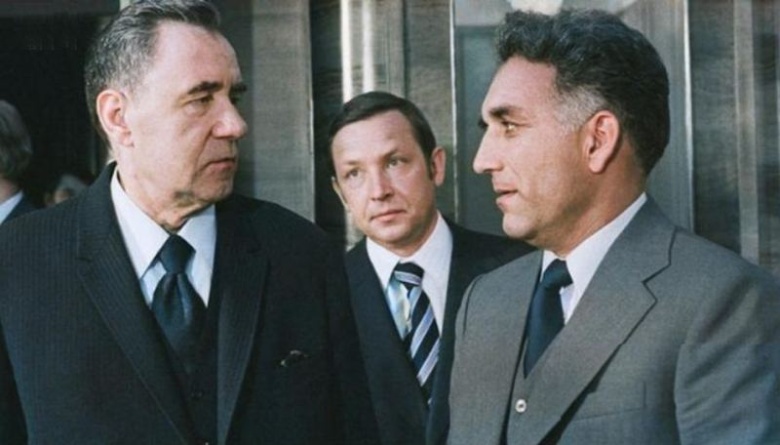
Hafizullah Amin (right) at a meeting with USSR Foreign Minister Andrei Gromyko, 1979
Photo: unknown author
Amin hardly overestimated the love of his fellow citizens for himself. He ruled the country for only the fourth month: in September, the Afghan forcibly deposed Nur Mohammed Taraki's predecessor, and three weeks later ordered his secret killing. The usurper could not help but know that his death was wanted not only by open enemies - Islamist rebels who had been fighting against the pro-communist government for the second year - but also by opponents within the ruling People's Democratic Party of Afghanistan. Therefore, Amin trusted the Soviet allies much more than his compatriots, regularly asking them for a full-scale deployment of troops into their country.
Even in his wildest dreams, the politician could not imagine that this invasion would begin with the seizure of his palace and his own murder.
One of the leaders of the assault (Operation Storm-333) , KGB Major General Yuri Drozdov, subsequently claimed that Amin did not fully understand what was happening. They say that when the attackers fought their way into Taj Beg on the evening of December 27, the politician ordered the adjutant to immediately ask the shuravi for help. The officer said in confusion: why call them, the shuravi are already here - they put on our uniform and shoot at us, look, the Russian mat stands like a wall. The wounded Amin allegedly did not believe the adjutant, cursed him with the last words and threw an ashtray at him.
However, Yuri Ivanovich, in another fragmentof his essay, gives a completely different, much less brutal image of the Afghan politician in the last minutes of his life. Apparently, habit is second nature, and the seasoned intelligence officer, even in retirement, did not abandon the temptation to confuse the uninitiated.
“Soon they saw Amin walking down the corridor in white Adidas shorts, holding bottles of saline solution in his arms, wrapped high in tubes, like grenades. One could only imagine how much effort it cost him and how the needles inserted into the cubital veins were pricked.
Amin leaned against the wall, but then a child’s cry was heard - from somewhere in the side room his five-year-old son was walking, smearing his tears with his fists [he soon died along with his brother from Soviet weapons - Republic] . Seeing his father, the child rushed to him, grabbing him by the legs, Amin pressed him to himself, and the two of them sat down against the wall.”
Subscribe to read in full
Subscribe to Redefine.Media to read Republic
Subscribe [You can pay with a Russian or foreign card. The subscription is renewed automatically. You can unsubscribe at any time.]
Where does the subscribers' money go?