
Translated material
What do war supporters think about?
In his new column, writer and Z-community researcher Ivan Filippov sums up two years of daily reading and analysis of hundreds of Z-channels.
About the fact that in Russia no one needs her, just like they themselves
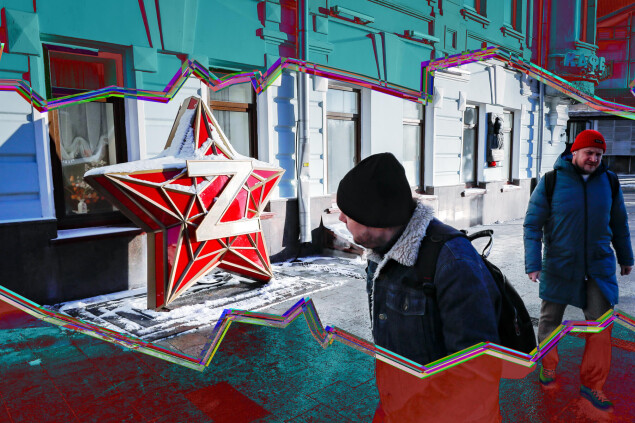
The year 2024 has ended, a little more than a month remains until the third anniversary of the full-scale invasion of Ukraine by the Russian army. Until the third anniversary of the start of the war.
For the last two years I have been reading and analyzing several hundred Z-channels, trying to find answers to many questions, trying to piece together a true picture of the war from scattered pieces of information. A picture that differs both from the one painted by official propaganda and from the one presented to its readers and viewers by independent and foreign media.
The idea behind this study is quite simple. I understand what I think about the war. What does Ilya Yashin think about her, or what did Alexei Navalny think about her? How do the Russians who left the country with me and those who remained at home feel about the war? Forced to remain silent due to the repressive laws adopted, but also desperately hating her. And with military analysts documenting the course of hostilities, such as Ruslan Leviev, Yan Matveev or Michael Naki, everything is also clear. We are all on the same side of the barricades.
What do war supporters think? Those who sincerely believe in its necessity, in its righteousness? This question occupies me the most. And when I started studying military propaganda, I quickly noticed one thing: pro-war authors write about many problems and shortcomings of the Russian army. And their words sound as convincing as possible - after all, they want this army to win.
Is Ukraine preparing a counteroffensive? There is no direct evidence of this, but Z-bloggers are sure: the Ukrainian Armed Forces will soon go on the attack Politics 4 minute read
It seems to me that we should start the final column with a short explanation of what Z-space is and where it comes from. And this explanation is extremely brief: with the beginning of the war, many of our fellow citizens realized that the TV was lying to them. That Vladimir Putin, Sergei Shoigu, Igor Konashenkov, Chief of the General Staff Gerasimov - they are all either lying, or not telling anything, or exaggerating. Realizing this, people began to look for alternative sources of information.
Their beliefs did not allow them to seek the truth in the Russian independent press, and even less so in the foreign press. But demand creates supply, and, like mushrooms after rain, channels documenting the war began to appear on Telegram. The channels are independent, not included in the huge mechanism of Russian propaganda.
The extent of the Kremlin's control over these channels is still a matter of debate. Probably, Comrade Major can somehow influence the author’s position, although the fewer subscribers a particular author has, the more openly he writes. But frankly, and sometimes very emotionally, the authors of channels with millions of subscribers write: “Rybar”, “Two Majors”, “The World Today with “Yuri Podolyak””. One thing is quite obvious: Z-authors are radically different from the official propaganda, they really don’t like propagandists and they reciprocate their feelings.
The authors of these channels are extremely different people. Among them are the “heroes of the Russian spring” who have been fighting in Donbass since 2014. Volunteers, residents of Donetsk, retired military personnel, instructors training recruits at training grounds, military pilots - both helicopters and airplanes, former or current security forces, soldiers fighting with weapons in their hands in Ukraine, Wagnerites, neo-Nazis of the DRShG "Rusich" ( sabotage- assault reconnaissance group "Rusich" - a combat detachment of Russian neo-Nazis who took part in Russian-Ukrainian war since 2014 in the Donbass - Kholod ), Z-intellectuals, writers, documentary filmmakers, doctors, drone operators, engineers and even priests.
What is Z-poetry made of? Writer Evgeny Babushkin analyzed the latest legacy of war-time writers. Now you definitely don’t have to read them Society 8 minute read
The emergence of a full-fledged media space in itself is a phenomenon that deserves detailed study. But what these authors write about turned out to be many times more interesting than I could have imagined.
Z-authors write about the endless problems of the army. About the lack of front-line logistics. The fact that the army was catastrophically unprepared for war. About a show worth thousands of lives. About losses. About untrained commanders who set up formations at training grounds, which were immediately hit by HIMARS. About terrible words that have become firmly entrenched in the military lexicon: grinding, meat assault, zeroing.
Grinding is the process of sequential destruction of a military unit against a Ukrainian settlement or fortification. A meat assault is a foot assault not supported by artillery or aviation, in which most of the attackers die - or all. Finally, the relatively recently popularized term “nullification”, that is, extrajudicial execution by sending guilty military personnel into assaults.
Military authors talk about the monstrous scale of corruption, about the terrible disorganization of the army, about the idiocy of the command, which does not spare people at all. About the lack of these very people. About terrible punishments - pits into which they are thrown even for minor offenses. Moreover, those thrown into the pit must pay for their upkeep there. Just like in hotels.
They also write about the deplorable state of military medicine. About the incredible military bureaucracy that is literally killing Russian soldiers. About the difficulties with evacuating the wounded, when military personnel with traumatic amputation of limbs can end up on the surgical table in a few weeks. That when the Minister of Defense boasts about the high survival rate of wounded in hospitals, he is right - it’s just that only those who are lightly wounded make it to hospitals.
Another important topic is drones, which have radically changed the tactics of warfare. At first, drones burned Russian columns - there was plenty of video evidence of this. Over time, the Russian military began to travel in convoys less frequently (although they did not stop completely), and Russian enthusiasts began to develop their own UAV school. All recent Z-texts indicate that the 7 to 1 advantage in favor of Ukraine still remains, but the Russian military is learning and improving.
I like executions The story of Z-blogger Thirteen, who incurred the wrath of the people of Ukraine, Russian security forces and Chechen special forces Society 15 minute read
What don't Z-authors write about? Easily. About Vladimir Putin. Either they write about him extremely laudably, or his statements - the falsity of which the Z-authors themselves clearly understood - are quoted exclusively “telegraphically”, without any evaluation or context. Once upon a time, Igor Strelkov broke this taboo, and his fate discouraged other channel authors from experimenting.
The main conclusion that I can draw from reading the Z-channels in 2024 is very simple: all the problems that they wrote about in the first year of the war have not been solved. None. Yes, reading their endless complaints is very interesting and sometimes even pleasant, but the main thing is still different - the absence of any changes.
The army is still largely supported by volunteers. Not with heavy equipment or ammunition, of course, but with other things most important for waging war. For example, necessary for the delivery of ammunition and the evacuation of the wounded by transport. Or secure digital communication. Or Starlinks . Medicines, food, sometimes water. Drones. Starting next year, they say, they want to “close down” the volunteers - there are too many, according to State Duma Speaker Volodin, among them are swindlers. If this really happens, the issue of providing for the army will rise to its full potential. Which is not bad.
And the second conclusion, it seems to me, is no less important.
I have repeatedly said that, according to my estimates, approximately 7% of the population actively supports the war in Russia. It was the word “actively” that was important here. After all, for the pro-war part of society, “supporting” means giving money, volunteering, weaving camouflage nets, sending humanitarian aid to the front, or volunteering or serving as a contractor. As they themselves wrote many times, sticking the letter Z on your forehead but doing nothing for the front is not support. So, for the first few years these were my grades. Today, the Z-authors themselves write this way.
Ivan Pomidorov shot himself. He fought the opposition, was imprisoned for setting fire to United Russia, fought for the LPR, and committed suicide because of censorship. The wild story of Andrei Murza Morozov Society 7 minute read
Today they are already writing about the indifference of society, that war is not interesting to anyone and is rather annoying. But veterans are not very loved and feared. The outlines of “we didn’t send you there,” which were rather vague in the first two years, became extremely concrete by the end of 2024. And, yes, Z-authors estimate the level of support at 7-10%. The level of indifference is 90%.
The country doesn't care about the war. And let the moral assessment of this state of affairs be quite controversial: after all, by ignoring the “feat” of the Russian soldier, society ignores the pain, death and grief that he brought to Ukraine. Nevertheless, the fact remains: Russian society does not support the war. The war was and is lived primarily, if not exclusively, by the marginalized. And this is great New Year's news.
The author's opinion may not coincide with the opinion of the editors.
In order not to miss the main materials of “Cold”, subscribe to our social networks!


Kholod needs your help to continue working
We continue to work, resisting bans and repression, to preserve independent journalism for the Russia of the future. How do we do this? Thanks to the support of thousands of caring people.
What do we dream about?
About the simple and at the same time complex - the opportunity to work further. Life will change beyond recognition many times, but we, the editors of Kholod, want to stay close to you, our readers.
Support Kholod today so we can continue to do what we do best - be independent media. Thank you!
Author: Ivan Filippov Editor: Maxim Martemyanov Photo: Yuri Kochetkov / EPA / Scanpix