
Translated material
“Echo of Covid restrictions”
News of a “new virus” from China has been spreading throughout the past month. Should you worry? A molecular biologist speaks
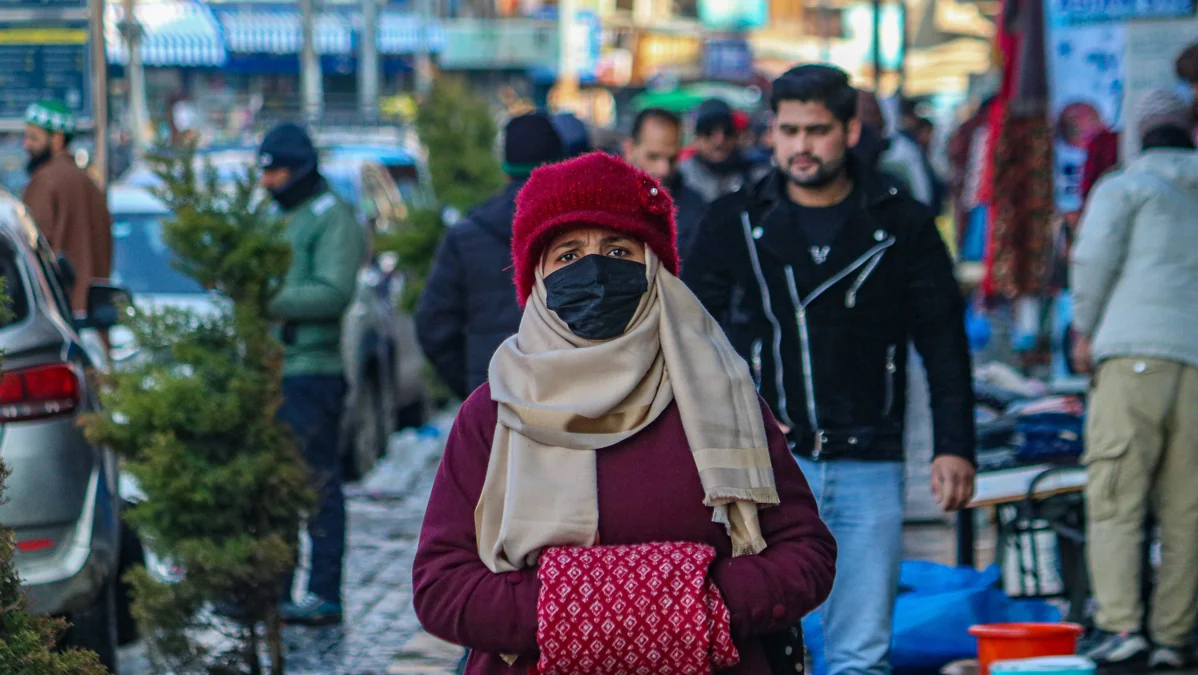
A woman wears a protective mask on the street in Srinagar, India, January 7, 2025. Photo: Firdous Nazir / NurPhoto / Shutterstock / Vida Press
Before the New Year holidays, it became known that a “new virus” was spreading in China, from which 43% of those infected would certainly die, and this infection, called human metapneumovirus (HMPV), is already coming to us. Scientists began to explain: not new, not 43%, will not die, not going. But we remember the story of the emergence of Covid on the eve of 2020: at first, even then, we were reassured that the pathogen had long been known and caused a disease no worse than the flu. What is a metapneumovirus and what should we be afraid of, explains molecular biologist and popularizer of science Irina Yakutenko.
Irina Yakutenko
molecular biologist
— About the metapneumovirus, which is supposedly killing people in China now, biologists and doctors say that it is not new, but old and well studied. But we heard the same thing at the beginning of 2020 about the coronavirus?
- No.
- No? What is the difference between a non-new coronavirus and a non-new metapneumovirus?
“The difference is that the coronavirus that appeared in 2019 and caused a pandemic was precisely a new virus. New - in the sense that it was different from those coronaviruses that had previously infected the human population. It has been changed quite a lot, it is not like the viruses we are used to that cause common colds. That is, the group of viruses was the same, but the virus itself was changed. Apparently, it also came to us from bats, and bats, as you understand, are not people, and the viruses that pass through their immune system are new to ours. That’s why our “collective” immune system reacted to it this way. This was a new zoonosis for us, a new virus added to those that were already spreading in the human population.
As for metapneumovirus, there is no new zoonosis. And there is the usual story: cold season, people en masse pick up various respiratory infections, including metapneumovirus. This season, more people have been diagnosed with metapneumovirus infection, and with complications.
— Why has this particular virus manifested itself in such a way now? And why did a nonsense disease, which we already knew about and from which there should be immunity, begin to develop complications?
— Most likely, many factors play a role here. This may be partly an echo of Covid restrictions. Because people behaved differently, including in China, patterns of typical annual cold infections have changed. Perhaps people were not immune to the metapneumovirus for some time, and this year the outbreak is more widespread.
It’s possible that now more people are being tested. Before Covid, you didn’t fool yourself about what kind of respiratory crap happened to you. Tests are now being implemented
There are test systems for both respiratory syncytial virus and metapneumovirus, and they are being used more often.
Perhaps both factors were at work. We have known seasons when the flu turned out to be more vicious than usual. Apparently, nothing extraordinary is happening now. Just not a very good “cold” year.
— In 2019–20, the genome of the virus was not immediately sequenced; at first, your colleagues often said that this was a completely ordinary coronavirus, we know them. Has the current metapneumovirus been fully recognized?
— Then they finally recognized the virus almost immediately, it’s just that after five years all this was forgotten. The WHO message that a new unknown virus is spreading in China appeared on December 30. That is, it was first discovered in November, and then there were reports that there were people with severe pneumonia of unknown etiology. In February 2020, it was already completely clear that this was something new. The first sequence, decoding the genome, appeared, if I’m not mistaken, at the end of January or February 2022, that is, it quickly became clear that this was a coronavirus, but not the same as those known before. In the case of this metapneumovirus there is no doubt. And there is no reason to worry, this virus does not cause anything unusual.
- Where then does the data come from that in Taiwan the mortality rate reaches 43%?
— If we open scientific articles about metapneumoviruses, we will see these same 43%. Yes, 43% of the mortality rate occurs in certain populations. It is not yet clear how reliable the reports from Taiwan are, because from China, on the contrary, they report that nothing special is happening, just a normal cold season.
— But still, there was data on such a high mortality rate before?
“This applies to risk groups: older people, patients with chronic diseases, people undergoing therapy, say, for cancer, or, for example, receiving immunosuppressants after an organ transplant. And it was known before that for them
metapneumovirus has a mortality rate of 10 to 40%. Because for such people everything is dangerous, and this virus has a complication - pneumonia.
We cannot treat viral pneumonia; there are no specific antiviral drugs for it. In the case of bacterial pneumonia, we can give the person antibiotics and kill the bacteria that caused the disease. In the case of viral pneumonia, a person has nothing to give to destroy the virus, and his own immunity cannot cope because it is weakened, for example, by therapy.
— But something happened that made people start talking about this virus? Maybe the flash is too strong?
— New Year, no news. Your colleagues also asked me about why cholera is in Africa. The news “cholera in Africa” is something like “a dog bit a man”; there are cholera outbreaks there all the time. That is, nothing special happens.
What didn't we like when Covid hit? It spread like a fire, with tremendous speed, and in all groups of the population there was immediately a huge mortality rate. With the first strains it reached 10%, although it is difficult to talk about this, because at first not everyone was tested. In other words, it was clear that something out of the ordinary was happening.
Here we see the picture of cold season, but with a slightly more vicious pathogen, more people are infected than usual. So the matter, apparently, is still partly due to Covid restrictions. Because of them, people have become a little less immune to colds and respiratory viruses, because during the period of restrictions they were encountered less often than usual. If these viruses infect us every year, then the disease is more or less mild. And since we have missed several years due to Covid restrictions, the virus may be new to the immune system, it will have to kind of re-ignite itself, because viruses change quickly, and then meeting them can be more dangerous. This is what doctors warned about during the Covid restrictions: yes, now we are saving people from Covid, but this can lead to a more serious course of the flu, because during the restrictions people are in quarantine and do not encounter the flu either.
— Now there is a lot of talk that the Covid restrictions were a mistake. It turns out that those who think so are right?
— We must avoid binary judgments. We really want to say: this was right, and that was wrong, our brain is designed that way, it wants simple solutions. But no: the mistake was, perhaps, that the restrictions were too soft and not synchronously introduced. If humanity had been more decisive and introduced stricter restrictions for a shorter period at the very beginning, we might not have had a pandemic at all. That is, the virus would most likely have broken through anyway; we see how contagious it is. But at least we would have gained some time.
The mistake was the way the Covid restrictions were introduced. All coronavirus policies have been suboptimal. At first they waited too long, did not want to introduce any restrictions, did not want to take unpopular measures. And when the disease began to spread like wildfire, when the mortality rate was high, everyone got scared and began to tighten the restrictions too much. This can be compared to the fact that we drive through a red light, and then, out of fear, stop twice when it turns green. This is roughly what the anti-Covid measures looked like, and that was what was wrong, not the restrictions themselves.
So, since the times of plague pandemics, we know that quarantine is a good method. But the coronavirus spread quickly, its mortality rate was high, and we had neither a vaccine, nor specific medications, nor even protocols for managing patients with severe Covid. Then protocols appeared, and now, even without specific antiviral drugs, we know how best to treat people whose Covid has become severe. In 2020, we didn’t know any of this, but we had to do something. The restrictions were a necessary step, but they were introduced too late.
— Are there any modern protocols for the management of patients with metapneumovirus? To what extent is the experience of the pandemic taken into account in this matter?
“I’ll say again that the Covid experience does not need to be taken into account. We have been familiar with metapneumovirus since 2001. You have immunity to it, I have immunity, we have all had it, more than once. My daughter had it, and we recently received tests. The panic we are seeing now is due to the lack of news. Well, with the fact that during the pandemic everyone was very scared.
There are no new recommendations on what to do with metapneumovirus; there was and is no specific treatment against it, and there is no specific vaccine. We must interact with this virus in the same way as with any other respiratory viruses: try not to visit crowds, wear masks - all this reduces the likelihood of infection. During the acute period, stay at home so as not to infect others, and drink plenty of fluids. And if complications arise, then consult a doctor, he will see if there is a bacterial infection, as often happens. If it comes to viral pneumonia, you will be admitted to a hospital where you will be given supportive therapy.
— You said that now sick people are tested for viruses more often. Is this a result of the covid experience?
— Yes, they test more often now, there’s nothing special about that either, it’s just that after Covid we began to pay a little more attention to respiratory infections. But when we carry out some kind of medical manipulation, for example, a test, we need to understand: what next? Why do we need the test result? To - what?
Some tests do not need to be carried out because no changes in our behavior occur as a result of these tests. The situation is similar here. Of course, it is always interesting to know what exactly you are suffering from, what kind of infection you have.
But in the case of metapneumovirus, I repeat, there is still no specific treatment or vaccine. You will get the test result, but this will only enrich you with new knowledge and will not help you with anything else.
In the case of Covid, when it was spreading, testing made sense: it was necessary to identify the coronavirus as early as possible, so that the person with it would stay at home, so that he would not go to work and not infect everyone around him. Because we knew for sure that a significant number of patients, especially in risk groups, would have serious consequences, people would end up in hospitals, accordingly, hospitals would be overcrowded, and this would put a strain on the healthcare system, and so on. That is, we knew what to do if a positive test result was received. In the case of the analysis for metapneumovirus - well, okay, you found out about it.
- But you still need to do the same thing as for any cold? Should you sit at home and not sneeze on those around you?
“The only reason it makes sense to do a test is to understand whether the nature of the disease is bacterial or viral. Metapneumovirus can give a lingering picture, which is more typical of bacterial infections. In order to understand this, in order to know what therapy to carry out, it is worth doing a test.
— You repeated several times that everything is known about the metapneumovirus. What exactly is known about him? How is it distributed? What does it hit? What kind of animal is this anyway?
“This virus apparently jumped to us from birds; it is a close relative of the avian metapneumovirus. It is an RNA virus, just like coronavirus. The distribution picture is also absolutely standard. We haven’t thought about it for many years precisely because globally it is no different from many other respiratory infections. It spreads with droplets of liquids that a sick person secretes, during close contact, with fomites - that is, with objects on which the virus has come into contact with liquids, you then touch them, put your hand in your mouth or nose and also become infected. For most people, the disease occurs as a normal infection.
- But it can still lead to complications in the form of pneumonia. So, like Covid, it affects the lower respiratory tract?
- In most cases, the lower respiratory tract is not affected, but in some people the disease can descend and enter a severe phase, causing pneumonia. In principle, this is also a standard picture, here the metapneumovirus also does not stand out in any way from other viruses. It's amazing how much attention it got.
— If this is an RNA virus, then it apparently mutates just as violently as the coronavirus? So new options are constantly appearing?
- Apparently not. That is, as an RNA virus, it does have the right to mutate quickly, but, as far as we know, even in this case it does not provoke the immune system in the same way as the coronavirus spike protein did, which caused a hyperreaction - a cytokine storm. Therefore, the metapneumovirus is being monitored, there is data about it, but so far it has not stood out in any way.
— Actually, the cytokine storm turned out to be the most dangerous in Covid, this is what distinguished it from the “old” coronaviruses. Does metapneumovirus have such features that we can expect surprises from?
“It’s a surprise and a surprise that we don’t know about it in advance.” But this virus is nothing special.
— Suppose it turns out that the metapneumovirus is still more dangerous than your colleagues think. But medical systems in different countries have experience with pandemics. Are they ready to meet the epidemic faster and respond to it more correctly?
- This is a good question, but it definitely does not apply to metapneumovirus. So far we see no indication that it is particularly dangerous in any way. In principle, probably, medical systems are now more ready, because there is experience with covid. Another question is what’s wrong with society.
- What about society?
— During the coronavirus, we saw a problem with medical systems, it’s true, they were not ready. Because there haven’t been such epidemics since the Spanish flu, everyone somehow relaxed. Now there is a problem with society, and this is because of the unpreparedness of medical systems, because of the unwillingness of governments to take unpopular measures.
The situation in 2020 developed very rapidly, and we had no understanding of what needed to be done to ensure it was exactly right. In a dynamic situation it is impossible to know. People demanded clear answers: to wear masks or not? to wear gloves or not to wear? But the situation was developing before our eyes, we studied the virus literally online, we knew nothing about it, scientists were sitting in laboratories, all this was developing, as they say, at our fingertips. We proceeded from what we knew about influenza and other respiratory infections, and then it turned out that some of the recommendations did not apply to Covid. For example,
The fomite route of spread was not confirmed, that is, gloves, disinfection of objects, placing quarantined products on the balcony - all this turned out to be unnecessary. But we didn’t know that at the moment.
And as it turned out, society was not ready for this. It was not prepared for the fact that it had to be adjusted, that recommendations changed on the fly, depending on the acquisition of new knowledge. And this Covid experience has served society very badly. I am afraid that now in order for people to agree to comply with the restrictions, a virus like Ebola will be needed, when sick people will bleed on the streets and everyone will see that this is a damn dangerous thing. In less obvious cases, society will react much worse than it did during Covid.
— Yes, this is the favorite topic of anti-vaxxers: during Covid we were only tortured in vain. How exactly will this manifest itself if a new epidemic occurs?
“If a new pathogen appears, but it is not as terrible as, say, Ebola, if people do not, like in horror films, die in the street, splashing blood, then society will react very badly. People won't cooperate. There was a split before Covid, we had seen anti-vaccination sentiments before, but Covid strengthened and cemented this split. Two camps - and each has strengthened its positions. Some say “my body is my business”, others say “you don’t wear a mask, therefore you are murderers”, both positions have become stronger. And if some fairly dangerous infection appears, but not so “bright,” the consequences will be bad.
- Can this error be corrected somehow?
“I don’t think it can be fixed quickly enough.” Coordinated action is needed to respond to pandemics and other global challenges such as global warming or antibiotic resistance. And not on the scale of one country, but on the scale of a continent, and generally speaking, of the planet. Because we saw how quickly Covid spread from continent to continent. And the events of recent years show that countries cannot come to a common opinion; we react to global crises in a very fragmented way, depending on what. Therefore, I am afraid that we will go through crises like pandemics in increasingly worse scenarios.