
Translated material
Wonder weapon
How the Ministry of Defense is fighting with the relics of Ilya Muromets
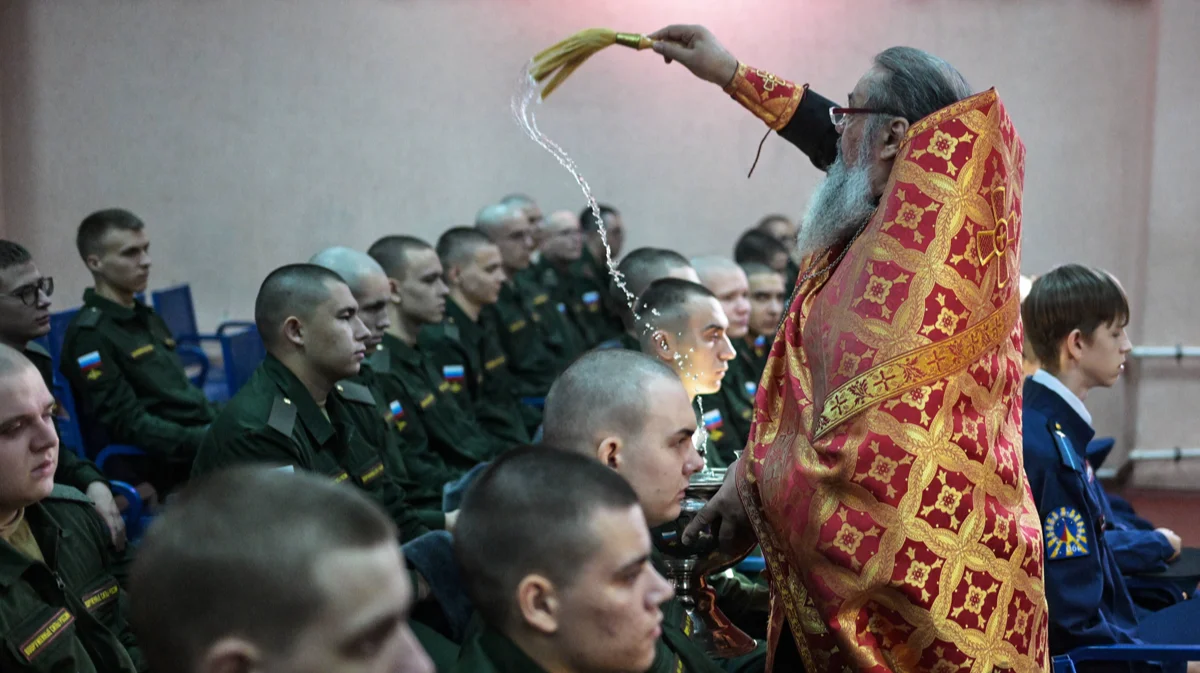
Photo: Alexander Kryazhev / Sputnik / SNA / Imago Images / Scanpix / LETA
The Ministry of Defense of the Russian Federation does not give up hopes of turning the tide of the “SVO” with the help of Orthodox relics delivered to the front line. The relics of Ilia Muromets were brought from Buryatia. The experience of the first three years of the war shows the senselessness of this practice. But that doesn't stop anyone.
Where does the power come from?
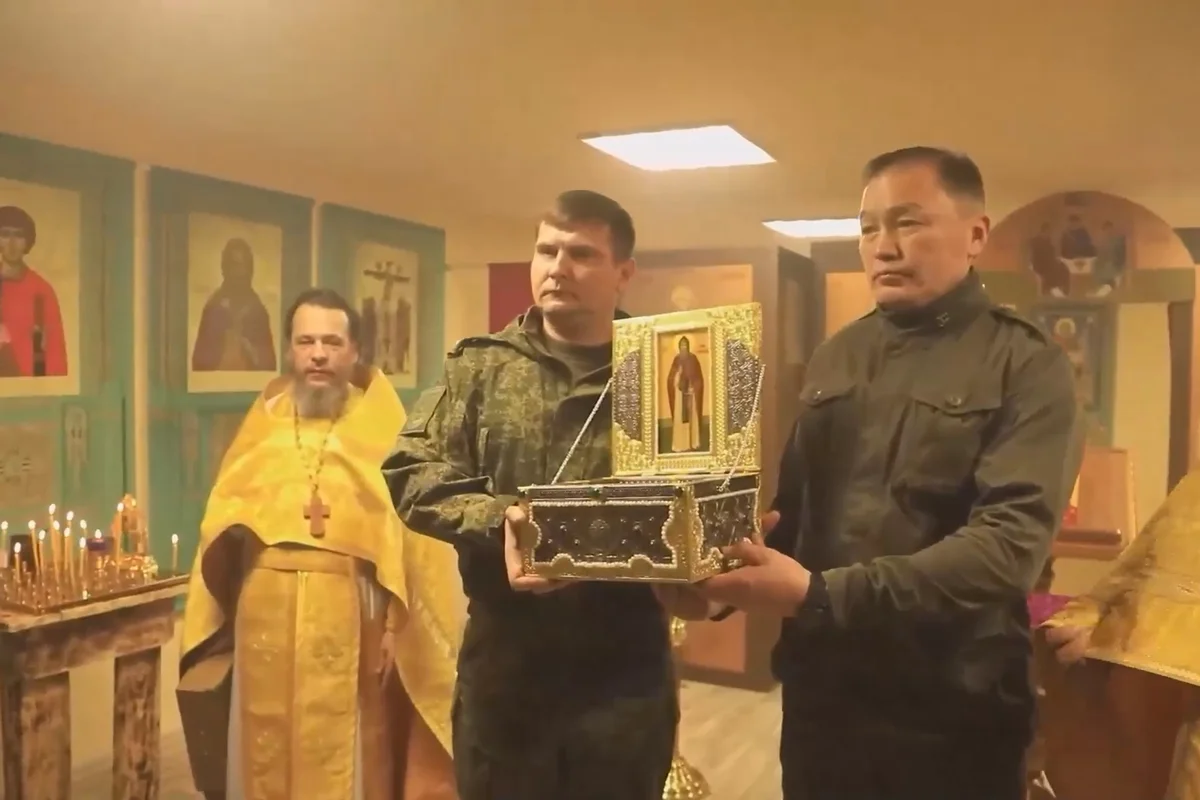
A reliquary with the relics of St. Elijah Muromets arrived from distant Buryatia to the location of the Vostok group of the Russian Armed Forces on the internationally recognized territory of Ukraine (Donetsk region; the Russian Federation declared its inclusion in its composition). A brief message about this appeared in mid-January in the telegram channel of the Russian Ministry of Defense, however, both the official website of the Synodal Department of the Russian Orthodox Church for interaction with the Armed Forces and Law Enforcement Institutions, and the official website of the Buryat Metropolis of the Russian Orthodox Church remain silent on this matter. Moreover, in the list of shrines located in the churches of the Buryat Metropolis, there is no mention of a particle of the relics of Elijah of Muromets.
It remains to be assumed that the Ministry of Defense, headed by Minister Andrei Belousov, who emphasizes his churchism, has its own “bank of shrines”, not controlled by the Russian Orthodox Church.
If you believe official church sources, the relics of St. Elijah of Murom are located in the Near Caves of the Kiev Pechersk Lavra. Before the start of the “SVO”, the spiritual and administrative center of the Ukrainian Orthodox Church (UOC), a self-governing church within the Moscow Patriarchate, was located on the territory of the monastery. However, in May 2022, the Council of the UOC announced its complete separation from the Moscow Patriarchate due to the latter’s active support for the actions of the Russian authorities leading to the destruction of the Ukrainian people and their shrines (according to a rough estimate, about a thousand churches were damaged during the “SVO”). At the end of 2022, the Ukrainian authorities began to gradually evict the structures of the UOC from the Kiev Pechersk Lavra - now this church controls only one temple on its territory. The spiritual and administrative center of the church moved to the Kiev monastery of Feofaniya, where the head of the UOC, Metropolitan Onufriy (Berezovsky), lives.
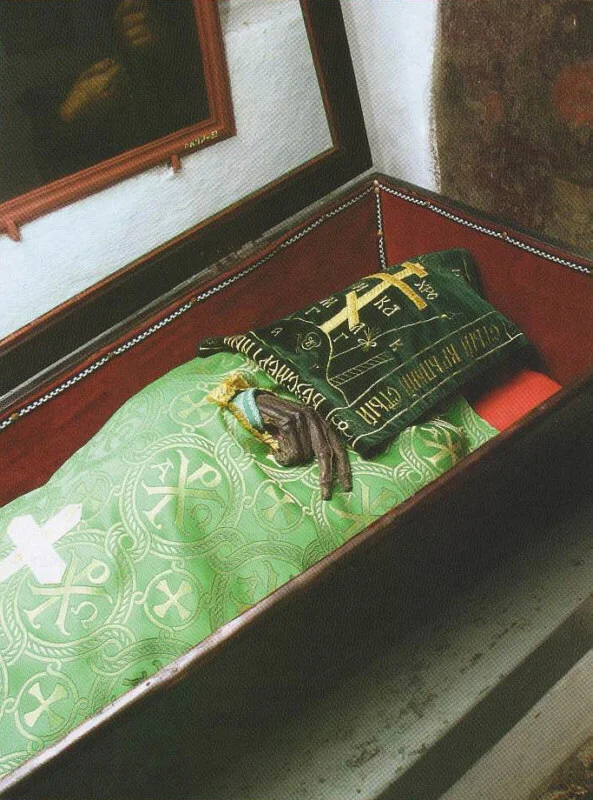
Historians are still arguing whether it is possible to identify the Pechersk monk Ilya of Muromets with the hero of ancient Russian epics - the great hero from the village of Karacharova. According to Lavra tradition, the Monk Elijah died in 1188, but his veneration as a saint began only in the middle of the 17th century. It is interesting that in the documents of that era the saint appears as “Muravlyanin”, that is, his origin was associated with the village of Murovlya on the lands of the Chernigov principality (now in the Oryol region of the Russian Federation). The nickname “Muromets” and the association with the hero of the ancient Russian epic were established for the saint later, after the annexation of the Kyiv Metropolis by the Moscow Patriarchate in 1686. The relics of Elijah Muromets in the Near Caves are completely covered with a brocade cover and monastic vestments - visitors can only see the hand of his right hand, the fingers of which are clearly folded into two fingers. The reference to this fact was one of the most important arguments of the Old Believers in polemics against the official church of the Russian Empire, which, after the reforms of the mid-17th century, switched to the three-fingered sign of the cross (Old Believers perceive it as “heretical”).
When the question arose about the transfer of the Kiev Pechersk Lavra and all the relics of the church located in its caves, in 1988 the relics of St. Elijah, among others, were examined by an interdepartmental commission created under the Ministry of Health of the Ukrainian SSR. The commission confirmed their dating to the 12th century and found that the saint’s height was 177 centimeters. It was also discovered that Elijah suffered from a spinal disorder and had extremely thick bones in his skull, wrists, and collarbone. According to the commission, the cause of his death at the age of 40–45 was a wound to the chest and left hand, with which Elijah covered his chest. Ukrainian historians have suggested that the saint could have been killed during the storming of the Kiev-Pechersk Monastery in 1203 by a Russian-Polovtsian army led by Prince Rurik Rostislavich, who occupied the Kiev throne six times during civil strife.
Before the start of the Russian-Ukrainian conflict in 2014, the abbot of the Kiev-Pechersk Lavra, Metropolitan Pavel (Lebid) (now under house arrest on suspicion of justifying aggression against Ukraine and other crimes), actively distributed and sold particles of the relics of the Kiev-Pechersk saints, violating security regulations obligations to the Ukrainian states assumed by the Lavra. In particular, the middle finger of the left hand of the Monk Elijah of Murom ended up, thanks to Paul, in the Spaso-Preobrazhensky Monastery of the Russian Orthodox Church in Murom, revived in the early 1990s. The trustee of the monastery was the former Prime Minister of Russia and former head of the Foreign Intelligence Service Sergei Stepashin, on whose initiative a luxurious shrine of St. Elijah was built, in the center of which the middle finger was placed. It was not possible to find any information about the separation of smaller fragments from it and their transportation to Buryatia in official church sources. Of course, all this could have been done unofficially: the internal life of the Russian Orthodox Church is a large gray zone, absolutely closed not only from civilian control, but also from its own hierarchy.
For example, on the official website of the Synodal Department of the Russian Orthodox Church for Monasteries and Monastics, it is stated that on the territory of the Russian Federation the relics of St. Elijah of Murom are available only in the cathedral church of the Transfiguration Monastery in Murom.
Adhering to the version of the identity of the epic hero with the Kiev-Pechersk monk of the 12th century, the leadership of the Russian Orthodox Church “appointed” St. Elijah as the patron of the Strategic Missile Forces and the Border Service of the FSB of Russia. If the last appointment still lends itself to some logical explanation (the epic tells how Ilya Muromets guarded the border, driving away various Polovtsians, Khazars and Nightingale the Robber with his boot), then in the case of the Strategic Missile Forces the reason was the location of the Russian Orthodox Church temple, one of the thrones of which was consecrated in honor of St. Elijah, next to the headquarters of these troops in the closed village of Vlasikha (Odintsovo-10) near Moscow.
God sends a signal
After the resignation of Sergei Shoigu, whose religiosity was of an eclectic-esoteric nature with a clear bias towards Altai shamanism, the Russian Orthodox Church is actively strengthening its position in the Armed Forces of the Russian Federation. The number of military priests is growing, each diocese sends its clergy to the Northern Military District zone on a rotational basis, the Ministry of Defense publishes “warrior prayer books”, icons and various kinds of amulets, such as belts with the 90th Psalm - “Alive in Help” in huge editions. As Novaya Gazeta wrote , Andrei Belousov turned to faith at a very mature age and was baptized on March 3, 2007 in the Church of the Kazan Icon of the Mother of God in the village of Puchkovo (the city of Troitsk, now within Moscow). After his baptism, he even “performed some of the duties of an altar boy” in this temple, as its rector said. As his career progressed, Belousov joined the elite “Diveevo Brotherhood,” which unites top-level Russian officials and security forces around the Seraphim-Diveevo Monastery in the Nizhny Novgorod region and esoteric Orthodox practices associated with the name of St. Seraphim. The Diveyevo Monastery he created, Novaya Gazeta noted, is perceived as a “center of power” by “nationally oriented” officials.
According to the Kremlin Snuffbox telegram channel, the reliability of which is questionable, during a prayer service in front of the reliquary delivered from Buryatia, a missile strike was carried out on the field temple. Allegedly, 23 participants in the prayer service died, including two officers, but the shrine itself was practically undamaged. Perhaps this is a coincidence, but after this information appeared, any information about the movement of the shrine along the front line disappeared from both the channel of the Ministry of Defense and the channels of the Z-military correspondents.
Orthodox shrines have been used as an element of Russian expansion in Ukraine since 2014. In January of that turning point, even before Viktor Yanukovych fled the country, a number of Russian “Orthodox-patriotic” organizations led by Konstantin Malofeev’s “Tsargrad” organized the delivery of “Gifts of the Magi” to Crimea and Kyiv - supposedly the very same gold, incense and myrrh , which were brought to the newborn Christ by Chaldean astrologers. The protection of the shrine during the trip to Ukraine was led by Igor Girkin-Strelkov, who, as the Ukrainian special services later admitted, carried out reconnaissance, knowing about one of the possible Kremlin scenarios - in the event of a Euromaidan victory.
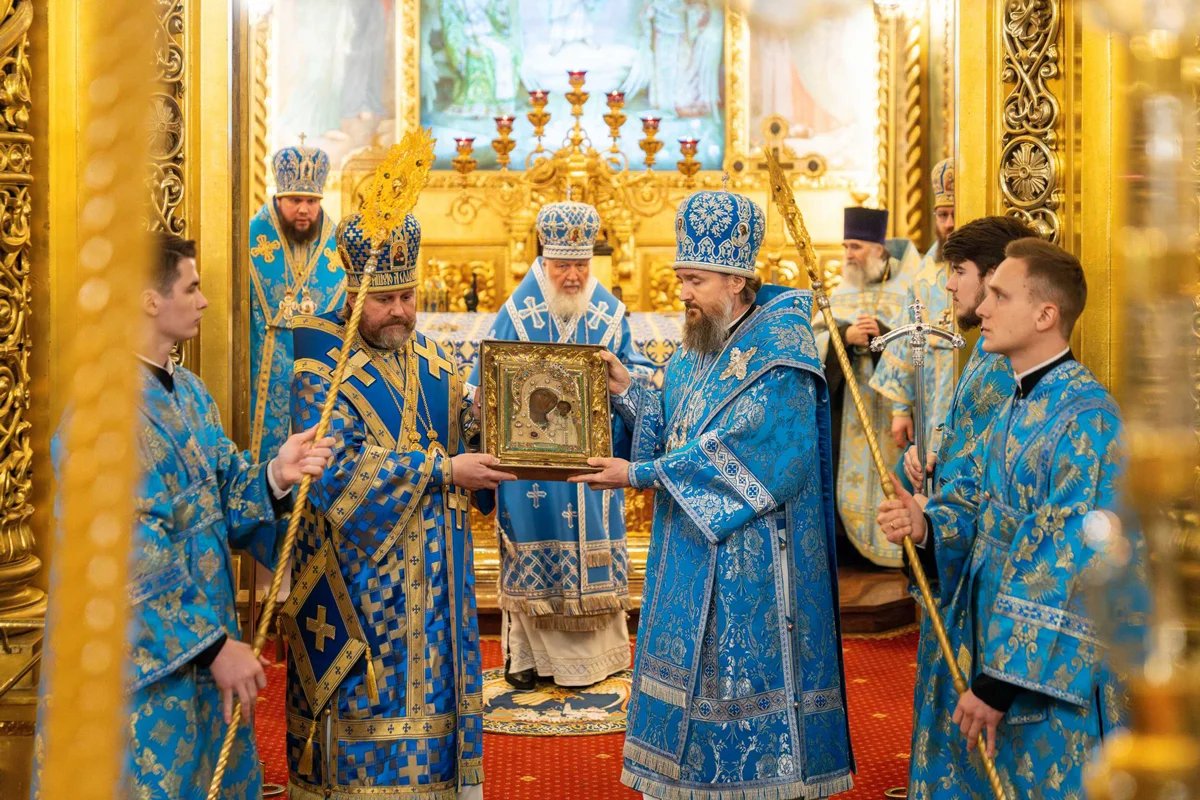
In subsequent years, various kinds of relics and miraculous icons were brought more than once to the combat zone in Donbass and to the current front line. For example, last summer along the Russian borders in the Bryansk, Kursk and Belgorod regions, a religious procession was held with the Kazan Icon of the Mother of God, which Patriarch Kirill “miraculously” found in his closet and tried to pass it off as the original of the miraculous icon, which disappeared at the beginning of the twentieth century . The Kursk operation of the Ukrainian Armed Forces, which continues to this day, began just during this year of the cross.
The transfer to the Russian Orthodox Church of the most valuable exhibit of the ancient Russian collection of the Tretyakov Gallery - Andrei Rublev's "Trinity" - did not lead to the "turnaround" promised by the patriarch. Much has been said about the fact that in the Trinity Cathedral of the Trinity-Sergius Lavra, where the icon is now installed, it is impossible to provide museum storage conditions, and the monument is already in critical condition: after a “test” trip to the Lavra in 2023, dozens of new ones were discovered on it damage - mainly peeling of the paint layer and expansion of cracks.
In essence, the icon was thrown into the sacrificial fire on the altar of victory. But this did not bring any victory to Putin and Kirill.
If you look at all this manipulation of shrines through the eyes of a believer, you will have to admit that God is sending the manipulators a negative signal: He is clearly not on the side of the aggressors and psychopaths striving for a “new redivision of the world.”