
Translated material
Trump as a cryptocurrency
The US President-elect launched his own “memecoin” and outmaneuvered all the cryptans.
Photo: Peter Foley/EPA
On Saturday, January 18, 2025, I woke up in high spirits: after the victory of Donald Trump, who decisively declared his intention to turn the United States into the world center of the crypto-economy, my like-minded people associated with decentralized financial systems lived in anticipation of the cherished date - January 20.
The symbolism of Trump's inauguration for the crypto community is associated not so much with the end of political persecution and the appointment to key positions in the government of people determined to eliminate the inquisitorial policy of the Democrats in relation to the crypto-economy, but with the new president's solemn promise to release Ross Ulbrecht, a legendary man, on the very first day , who created SilkRoad in 2011, an anonymous online platform that accepts payments in Bitcoin.
I woke up, which means I was in high spirits, unfolded the investment statistics on the screen and... gasped: overnight, 40% of the value of speculative assets seemed to have been licked by a cow!
The crypto world is famous for its hellish volatility, I’ve seen other things like this, but on the eve of such a positive event for DeFi (decentralized finance) to receive such a sensitive blow to the gut - somehow I don’t even remember.
My first thought: I probably messed something up with the selection of assets, I overdid it with AI-agents tokens - decentralized artificial intelligence agents, which in recent months have become the focus of speculative excitement in the crypto world.
I checked with my colleagues: they all had the same problem. The collapse occurred everywhere in the market of “memcoins” - those “meaningless” assets deeply despised by rational investors, which, at the very least, today control $125 billion.
If a mass exodus of capital on a similar scale occurred throughout the entire crypto market, then one could assume the outbreak of a nuclear war. However, the “blue chips” (tokens of Bitcoin, Ethereum, Solana, etc.) did not collapse, but, on the contrary, even grew a little.
The money came almost exclusively from “memcoins,” an area of the speculative market that attracts “ gamblers ” willing to take reckless risks for potential profits of thousands of percent.
What extraordinary thing happened that selectively affected the only specific segment of the crypto market?
I look at the analytical section Trending of the thematic information resource, which reflects the crypto-assets that are in the highest demand at the moment. I look and rub my eyes several times in surprise: the ENTIRE TOP is occupied by a single memcoin and several of its fake clones!
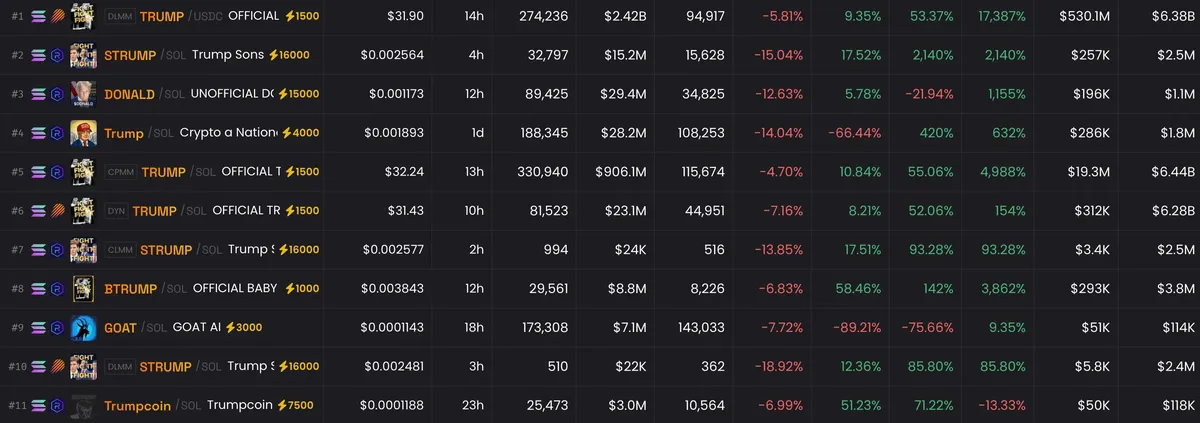
On the first line is the culprit of the monstrous collapse - the OFFICIAL TRUMP memecoin with capitalization - let's hold on tight! — $6.44 billion! Further - in the range of $1-3 million - there are different clones of this disgrace.
That is, just yesterday there was no $TRUMP token, but two days before the inauguration, the new president issues his own memecoin in the most “Degen” Solana network and collects $6.5 billion in just one night!
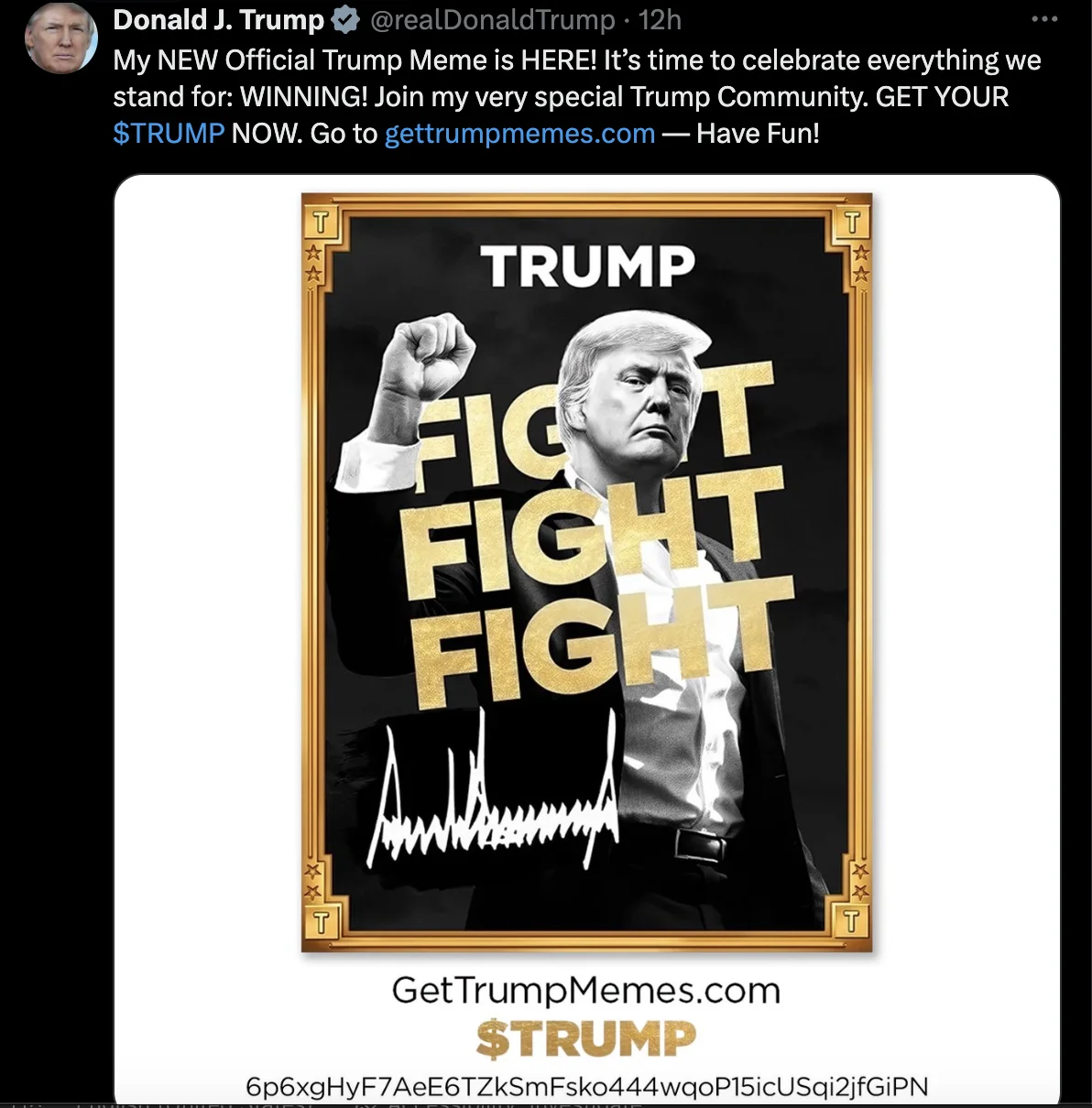
On Friday evening, Donald Trump solemnly announced in X a new format for monetizing power and popularity: “My NEW official TRUMP memecoin is already here! It's time to celebrate everything we fought for and WON! Join my exclusive Trump Community. BUY YOUR $TRUMP NOW!”
At the time of writing this remark, 415 thousand people who want to “celebrate” have already joined the “exclusive Community”:
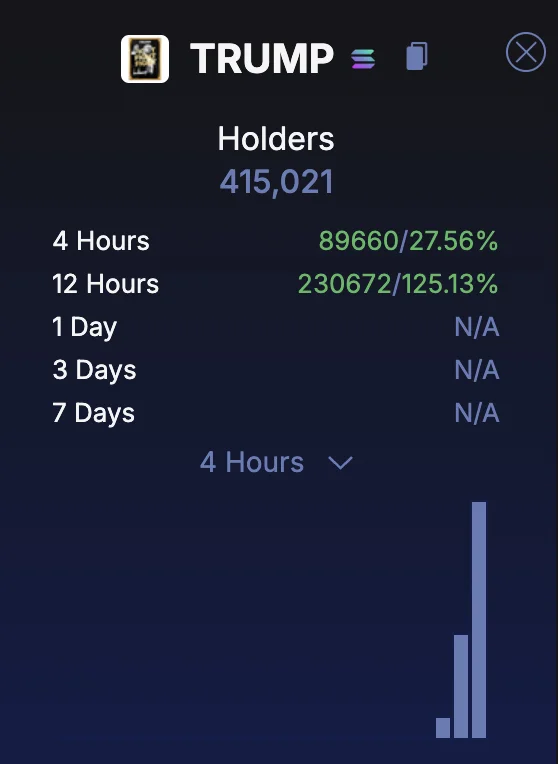
And, judging by the schedule, the flow of applicants is not going to dry up:
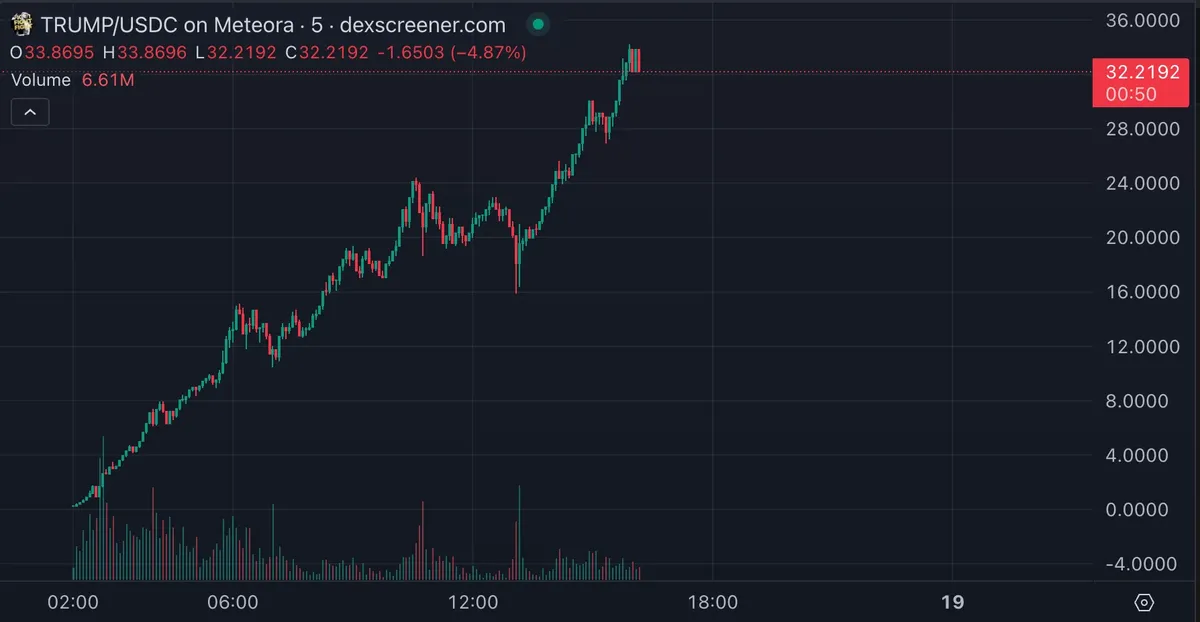
It is into this memecoin of the “first crypto-president of America” that funds from other assets, including those related to AI agent technologies, are massively flowing.
Does the reader now understand what kind of chaff the US President-elect has played on the crypto market? For two full months after winning the election, Trump pumped up the narrative of the crypto market, demonstrating in every possible way his desire to “support and develop.” And three days before the inauguration, at the peak of general euphoria and anticipation, he slipped the market his own “candy wrapper”, personally taking over a blanket worth $6 billion.
Those initiated into the basics of tokenomics and crypto-emissions may be confused by my statement about a “personal blanket”. Well, that's great. Because this is perhaps the key aspect on which I would like to focus the attention of the audience.
Over the past 10 years, the crypto world and especially decentralized finance have been dominated by financial assets with a “corporate” logic of issuance. That is, the development team launches a token in which 10 to 50% of the issue is reserved for its own needs and the needs of seed investors, if any. So that the public does not become too indignant, the “owner’s” section is blocked for a certain time (the so-called cliff) with the right to stage-by-stage partial implementation (the so-called vesting).
A conditional example for clarity. We are creating some kind of crypto project and issuing 100 million tokens for it. The team takes 20 million, 10 million is given to the “advisers”, 10 million to the initial investors, the rest is thrown onto the market for anyone to buy. 40 million “blat” tokens are locked for 1 year, followed by linear vesting for another 1 year. Thus, the team, “advisers” and investors will not be able to sell anything on the market in the 1st year, and then during the 2nd year they will have the opportunity to sell a small part of their share (1/365) on the market every day.
The team uses the money collected in this way to pay themselves good salaries and bonuses, and investors receive hundreds and thousands of percent of the profit. All this, of course, provided that the project is successful and takes off.
Above, I mentioned the contempt of rational investors for “meaningless” memcoins. Now we will leave aside the ignorance of people brought up on the “investor’s bible” ( the cult book “Security Analysis” - “Security Analysis”, written by Benjamin Graham and David Dodd in the Paleolithic 1934 - Author’s note ) in matters of mass psychology and mechanisms of viral spread of ideas in a hypersaturated information space. It is important for us to highlight another omission: a lack of understanding of the logic of pricing crypto assets is further aggravated by a lack of understanding of the role of the ethical component in the crypto-economy.
In the outside world, it is generally accepted that crypto is the realm of complete scammers. Generalization, of course, is stupid and naive, but even it evaluates the situation from the side of those who offer their services. That is, developers and creators of crypto projects, many of whom are great! - really are a real scam and scam.
There is, however, another side to the barricades. Those same hundreds of millions of crypto enthusiasts who are buyers of crypto assets. It is obvious that for the most part they are driven by a thirst for profit, and their inflated speculative expectations border on gambling addiction. However, the energy of the masses in the crypto world - just like in reallife - is charged with a powerful ethical impulse.
A revolutionary crowd is always cruel, but this crowd is driven by a subconscious thirst for the restoration of justice. A similar ethical component is strikingly overlooked by financial analysts who compete to ridicule meme culture and memcoins. The façade of “economic meaninglessness” and “lack of intrinsic value” obscures the most important thing: the “memcoin revolution” that we have been seeing for two years in a row is a subconscious reaction to the injustice of traditional crypto-assets with the corporate logic of emission.
Project developers print “candy wrappers” out of thin air, pay themselves 10–50% of the emission for their beautiful eyes, sell it on the market and thereby finance further business development. On the surface, this resembles an IPO, the initial offering of a company's shares on the public market in traditional finance, but the similarity is deceptive.
When I buy shares of Nvidia, Apple or Tesla, I become a shareholder of that business. I get the right to a part of the profits of this business (in the form of dividends). Nothing like this exists in crypto projects. When I buy ETH, SOL, AVAX, ADA, SUI, APTOS - anything in DeFi - I do not and cannot have any rights to participate in the profits. At best, I buy the idea of spiritual involvement in a project from which others will earn money.
The injustice of this order of affairs was the main subconscious impetus for the massive exodus of investments from traditional DeFi narratives and at the same time the explosive interest of market participants in memcoins in 2024.
The justice of memcoin lies in its unique emission. If we consider the Solana network, then the generally accepted practice is to issue 1 billion tokens, while the entire emission without a remainder from the moment of creation is freely offered on the market. The creator of the “meme” usually keeps 1–2% for himself, which he most often sells in the first few days if the memecoin becomes a viral success. After this, the crypto asset floats freely and fairly, and its price depends solely on the vagaries of supply and demand.
I describe existing issuance models in such detail and emphasize the importance of ethics in the modern crypto space in order to demonstrate to the reader the depth of the moral decline of Donald Trump, which he personally caused on the eve of his inauguration.
So, without three days, the president throws an elegant gop-stop at the crypto market, drawing huge cash flows onto his own memcoin.
Let's now see how the OFFICIAL TRUMP token emission is distributed:
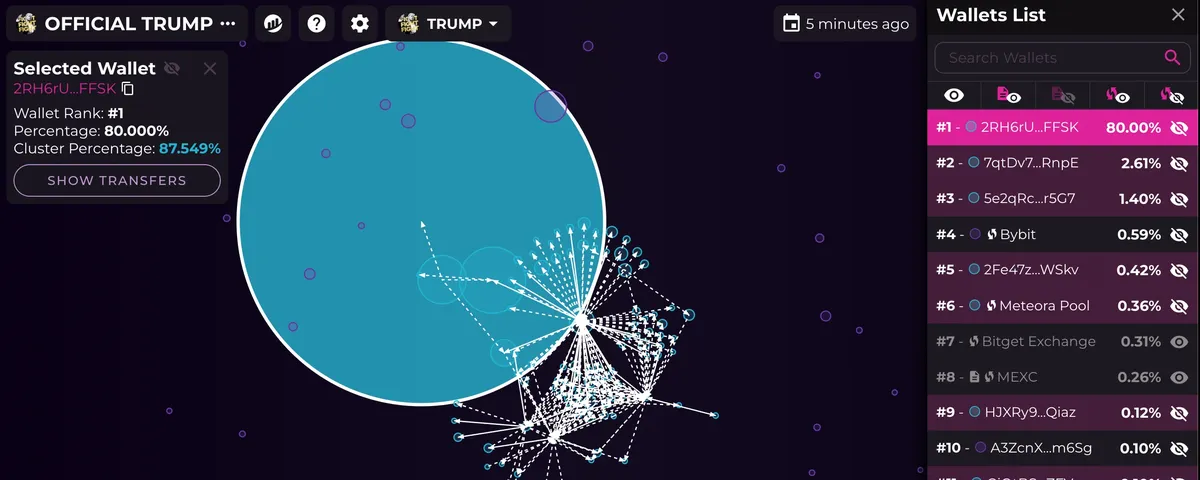
To understand the anomalous horror of this picture, I suggest comparing the asset allocation with some traditional memcoin.
For example, with the $OPUS token, which memetizes the first “liberated” and decentralized LLM model Claud Opus:
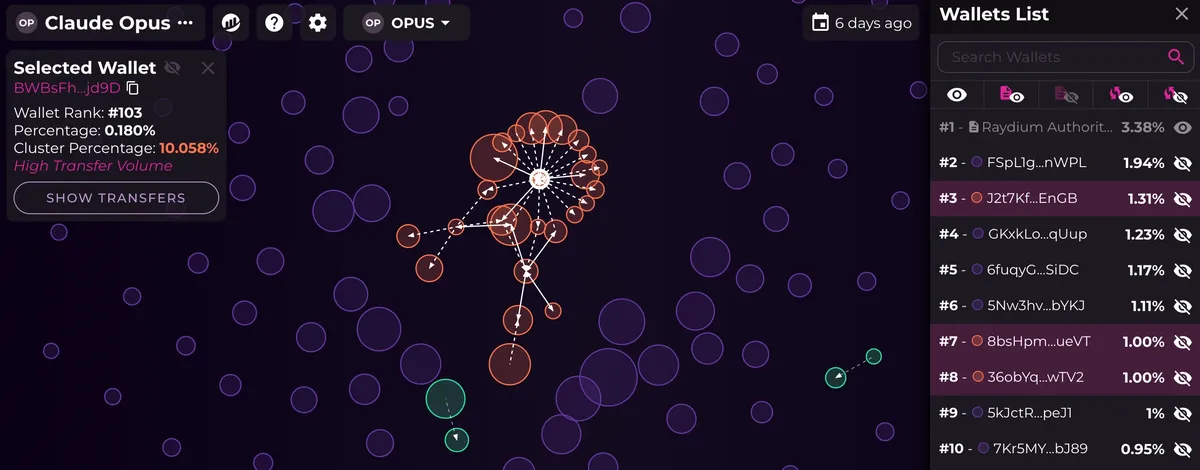
Each bubble reflects the number of tokens located at a separate address in the crypto network. In the $OPUS distribution, we also see a small concentration of emission (10%), which reflects the attempts of the development team buying the token on the open market to gain at least some control over the emission.
What anomaly do we see in the distribution of the Donald Trump token? A bubble of gigantic proportions - 80% of the entire issue (!!!) - belongs to one single address! In other words, the $TRUMP token has nothing to do with memetic culture. The president mercilessly exploits the fashion narrative and monetizes his popularity. We can consider that the $TRUMP token is a tool for Donald Trump to obtain a free, interest-free loan worth billions of dollars with the only collateral: people’s love and trust.
By the way, those who like to explore the financial connections of Trump’s election campaigns with the Kremlin will also find a lot of interesting things in my story. From the same conspiracy theory grew the guess about the terrible dependence of the new American president on Putin. Like, I'm in debt for the rest of my life. I remember there were figures like $200 or $300 million that Trump “in desperation” tried to get from Russian sources last year in order to cover obligations on legal fees and bail.
Friends, what are you talking about? What 200 million? Donald Trump has just demonstrated how he can and knows how to make 6 billion in 12 hours. Out of nothing. From the air. For the love of crypto, so to speak.
I confess that the events of January 18 became a sad revelation for me. So sad that Kirill Martynov, savoring my reaction, could not resist the pleasure of sarcastic: “You probably didn’t expect that power in reallife could be so cynically used to implement a private libertarian utopia?” Well, live forever and learn.
My epilogue, however, will be joyful and optimistic. The gesheft with the pseudo-memcoin $TRUMP made such an unforgettable impression on hundreds of millions of people in the world, who just yesterday knew nothing about the existence of memcoins and the Solana network, that the epoch-making “mass adoption”, which the crypto fraternity is always dreaming of, It looks like it's definitely not far off now.
FROM THE EDITOR
During the preparation of the text for publication, the capitalization of memcoin doubled and now stands at $12 billion.