Date
Author
Константин Гайворонский
Source

Preserved copy
Translated material
They fought until the end of the victorious - they were on the end of the inglorious. Why in 1870 the French tried to simultaneously overcome the Prussians at the front and arrange a revolution in their rear
"It seems that the peoples are still obeying their immediate passions much more willing than their interests."
- Sigmund Freud, 1915
On January 28, 1871, Paris capitulated to the Prussians after a 135-day siege. “The capture of Constantinople by Mohammedans is nothing more than a trifle compared to the siege and fall of the queen of cities, the most beautiful of the capitals, the center of European culture, Mecca of luxury for the entire civilized world, the scenes of the most vivid and tragic events in France’s history, houses for two million people, The largest fortified camp ever created by the genius of engineers ever held by such a large army, ” wrote The Times .
Each word here is pure truth. Only one thing remains to add: this siege served as the immediate cause of the latter from a series of revolutions in France - the Paris Commune. The study of her experience helped the Russian Bolsheviks avoid many mistakes of their French predecessors. The benefit of the event in Paris between September 1870 and March 1871 had many parallels since 1917 in Petrograd. And it all started the same - with the collapse of the empire.
"The whole French nation must be punished"
The French, how idiotic was the war with Prussia began, was just as mediocre and led it. Six weeks after the start of hostilities, one of the French armies Prussians blocked in Metz, and the second - along with Napoleon III personally - surrendered near the sedan. France did not have the third at that moment.
The news of the Sedan catastrophe and the captivity of the emperor, reaching the capital, led crowds of people to the streets. On September 4, 1870, angry Parisians broke into the legislative assembly. Under their indignant cries, the leaders of the republican opposition Jules Favr and Leon Gambett proclaimed the overthrow of the monarchy and the creation of the Provisional Government of National Defense (PNO). The commander of the Paris garrison, General Troshu, went over to the side of the revolution, standing President of the Republic.
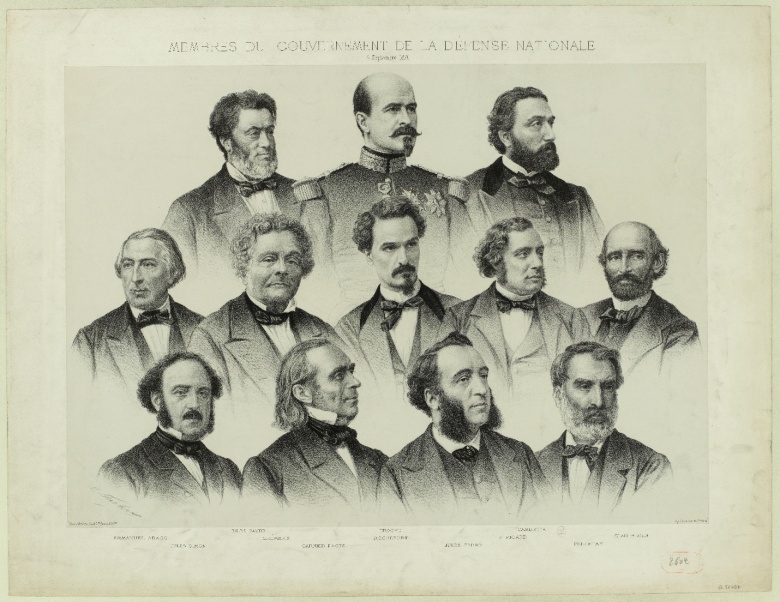
Provisional Government of National Defense. In the upper row from left to right: Favr, Troshu, Gambetta
Image: Wikipedia
Then, when everything went not at all under the desired “temporary” scenario, the Favr was justified. Like, if he and his associates did not pick up the power that had fallen out of the empire, then in Paris, on September 4, they would proclaim a commune, the leaders of the left have already gathered for this in the Paris Town Hall ... But it would seem even better for the country in retrospect. The province would still remain conservative, so the “red” Paris would be in isolation and quickly fell.
After which France could conclude the world faster and on more favorable conditions than in reality.
However, at first, it seemed to the capital that the revolution on September 4 and meant the end of the war. The next day, the city was a spectacle of a grandiose holiday, as if there was no sedan. In the air, there was an intangible feeling that now everything would be fine, because the war of Prussia, people reasoned, the emperor Napoleon III declared, and if we overthrew the evil tyrant, then what is the meaning of the Germans to continue to fight? When in 1814 the allies on the Anti -Napoleon coalition entered France, they announced that they were fighting not with the French, but exclusively with the emperor. And, indeed, they retired immediately after its renunciation. The story seemed to be repeated before our eyes.
The world famous writer Victor Hugo made an eloquent appeal to the Prussians:
“Paris is the center of mankind, Paris is a sacred city. Anyone who attacks Paris attacks the whole human family ... Can you, Germans, become vandals again, personifying barbarism that decreasing civilization? ”
The word “again” sounded very tactlessly here, given that the German press tirelessly reminded its readers about fourteen (!) Invasions of the French in German lands from 1785 to 1813. The Prussian military minister General von Ron expressed the universal feelings of the Germans, saying: "The whole French nation should be punished so that it does not occur to her to fight again, regardless of who reigns-Bonaparte, Bourbon or someone else." But, as Alphonse Dode noted, the great noise of the collapsed empire stunned the French and prevented them from hearing the boots of the advancing Prussian army.
Subscribe to read the whole
Make a subscription Redefine.media to read Republic
Subscribe [you can pay for a Russian or foreign card. The subscription is extended automatically. You can unsubscribe at any time.]
Where are the money subscribers going