
Translated material
Inborn reflex of freedom
Each animal has it and is needed for survival. And with a person not everything is simple. Psychotherapist - about slavery and the border of adaptation to the established order of things
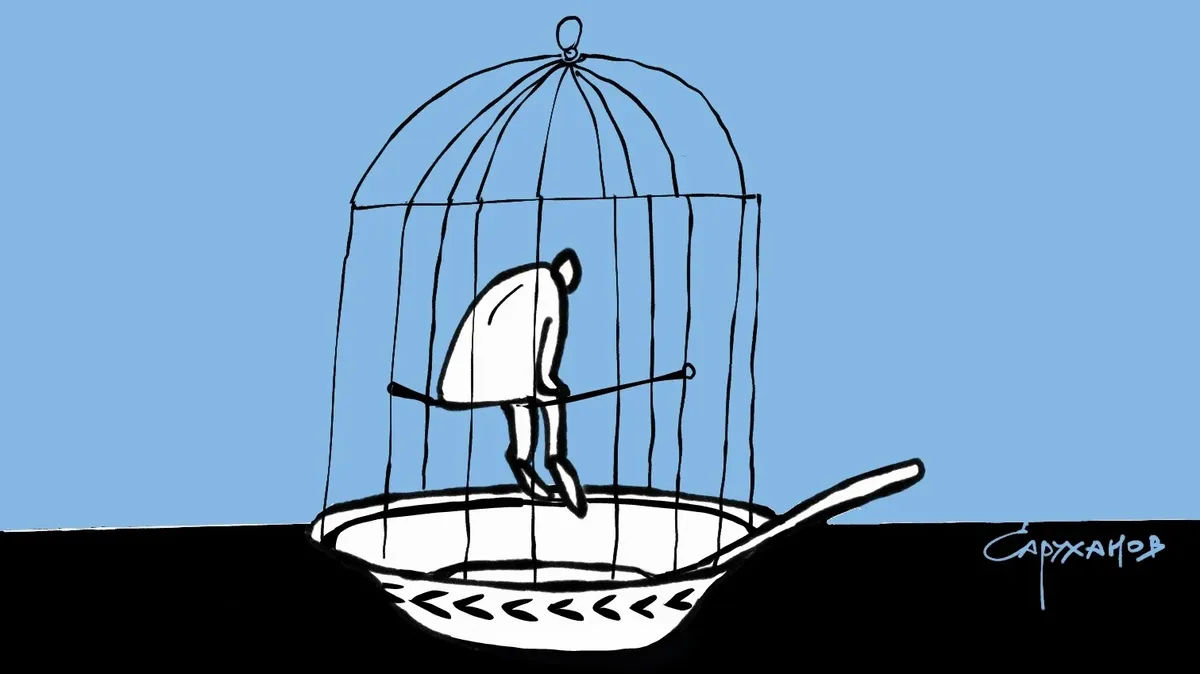
Illustration: Peter Sarukhanov / "New Gazeta"
Freedom in dark times
Despite external calmness (people walk around the parks, go to concerts and restaurants, engage in their usual everyday business), in society, in addition to anxiety, there is a feeling of fatigue and helplessness, which occasionally erupts in conversations in the form of involuntary, among other things the said replicas.
Moreover, this applies to both opponents of his and its supporters, as well as those who choose to be “out of politics”. Although the causes of suffering from all these people are different, what unites them is a feeling of lack of control, inability to influence the situation in any way. Not only ordinary citizens, but also public figures with a well -deserved authority shrug. And the leaders of the states are now at a loss.
And, of course, I can’t even imagine how it would be possible to influence what is happening globally. However, I have several ideas on how to help an individual find at least a relative point of stability in the current chaos. These ideas may be useful for people who do not accept the current regime and feel that they cannot calmly accept the existing order of things.
In this regard, I again want to turn to existential philosophy. From the point of view of existentialists, one of the essential characteristics of human existence is freedom. Everyone knows the statement of Jean-Paul Sartre: "A person is free, a person is freedom."
However, this thesis should not be interpreted vulgarly. Sartre did not mean at all that a person can do anything or that for the performed actions he will not be. The set of elections available to a person is determined by the fact of the situation, i.e. objective restrictions. And the flip side of freedom is responsibility.
The refusal to admit that his own action in the usual wakeful state of consciousness was committed by his own will, Sartre called the badness (Bad Faith).
Depending on the specific situation, the set of elections available to people may vary radically. But as shown, based on his personal experience, Victor Frankl, Edith Eve Egert and other former prisoners of Nazi concentration camps, more or less freedom of choice remains even in conditions that seem to have no freedom.
Victor Frankl wrote that in the most extreme cases when a person does not have the opportunity to perform any external actions, he still has internal freedom, i.e. The ability to choose your attitude to what is happening.
And preserving the sense of inner freedom in a concentration camp was necessary even for simply physical survival.
If we turn to biology, you can find out a curious fact: the founder of the theory of conditioned reflexes, Academician Ivan Pavlov believed that animals have a congenital reflex of freedom. Otherwise, they would not be able to adapt to any new situation. However, this reflex can be suppressed with captivity. In addition to this, we know that, by virtue of a more developed nervous system and social learning, there is potentially large pause between an incentive from the external environment and the subsequent response. And even if the action is performed reflexively, there is the opportunity to “roll back” back and try to fix it.
At the same time, the ability to choose in itself does not guarantee either the effectiveness of the chosen solution, or even moreover its ethical justification.
Freedom of will and totalitarianism
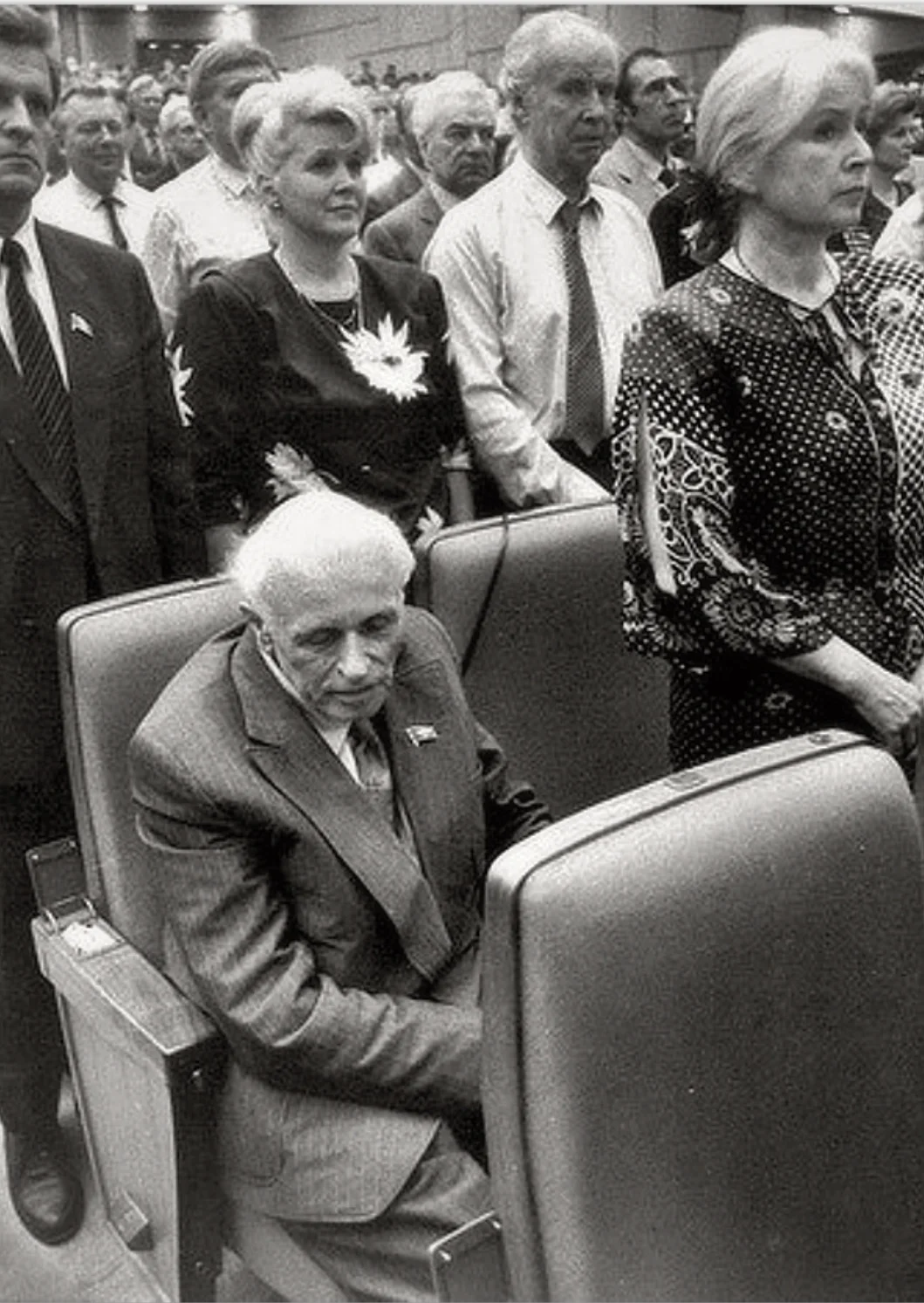
Next, I want to touch on the problem of free will in the conditions of totalitarian regimes. I believe that as a guiding thread in this regard, we can use two famous essays. The first is “Live not by lies” by Alexander Solzhenitsyn, written in the early 70s. The second, entering into a roll call with the text of Solzhenitsin, is Vaclav Gavel's essay “The power of the powerless”, published in 1978. Although both author are not philosophers, it seems to me that these two texts are examples of practical existentialism. Of course, these texts cannot be a direct instruction to action, since they were written at another time, in other conditions, but they indicate general landmarks.
Solzhenitsyn offered to his compatriots, who obviously will not go to demonstrations of protest, because it is very dangerous, at least not to participate in unseemly matters: “Let the lies cover everything, let him have lies, but in the very small one, let him go through: let him owe it not through me ! " Continuing the thoughts of Solzhenitsyn, Vaclav Gavel made an amazingly subtle analysis of the psychology of social life in the late period of the Soviet socialist system.
Gavel, like Solzhenitsyn, called for contrasting “life in a lie”, which is the basic principle of behavior in a late Soviet society, “life in truth”.
On the one hand, the path that Solzhenitsyn and Havel proposed is the path of moral self -preservation for an individual. On the other hand, they believed that “life is in truth”, becoming an example for other people, could radically change the whole society. Unfortunately, with regard to the second, now we understand that it does not work so straightforwardly. It turned out that from the habit of living in lies it is not so easy to get rid of, and it is reborn, like a Phoenix from the ashes, under the slightest favorable conditions.
In the conditions of totalitarian regimes in the process of education and everyday experience, a person assimilates the unspoken rules of survival. I know this very well, because I myself grew up in the Soviet Union. Do not stick out if your opinion is contrary to the opinion of the authorities. Predict the expectations of political leadership. To be able to double: to demonstrate the “right” point of view in time, to change it after the slightest hint from the leadership of the Communist Party, to say one thing in the kitchen, and to behave in public in the opposite way.
The regular repetition of such actions becomes so familiar that it no longer causes any sense of internal dissonance. This way of life is perceived as quite natural and perhaps the only possible. And what dissonates with him, on the contrary, causes irritation. And it would be naive to hope that one day one boy will say that the king is naked, and the lies system will collapse immediately. As we see in practice, it is tenacious and actively resists.
Usually people subsequently do not remember actions committed by virtue of obvious, and often imaginary state pressure. Or they explain them by the fact that “there was such a time”, “it was impossible in a different way”, they were “forced” or they did not know “all the truth”. But of course, it is quite clear that such explanations are mostly a lie. People quite consciously made a choice in favor of their utilitarian interests, extracting either very tiny or even rather big dividends.
In reality, in the late Soviet Union, despite the extremely constrained freedom of expression of his opinion, there was a backlash, which allowed at least not to participate in frank meanness. There were actions for which arrest and imprisonment would almost definitely follow (for example, access to a public protest). But there were many situations in which a person could maintain a moral position without any serious negative consequences for himself.
As we know, there were psychiatrists who refused to make a conjunctural diagnosis of the then punitive Soviet psychiatry “sluggish schizophrenia” to Vladimir Bukovsky.
There were academicians who refused to sign a letter condemning Academician Sakharov. Among them is Peter Kapitsa. A funny story about academician A.P. is also known Alexandrova. When they called him home with this proposal, his wife replied: "He cannot come, he has a binge." However, 40 academicians still signed this letter, thereby making their names to the list of scoundrels. The reader can easily draw an analogy with the current signatures himself.
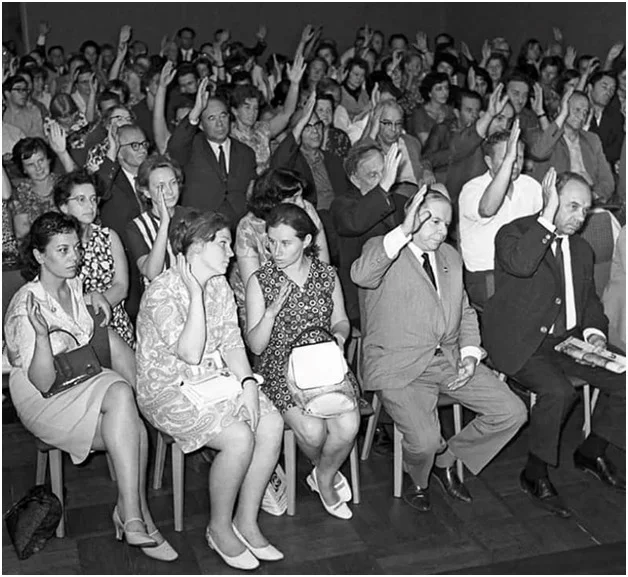
It is in connection with the freedom that a person originally possesses that it seems to me completely inappropriate to justify the unseemly acts of people that they committed by virtue of their understandable and all the inherent interests, biological needs, the influence of herd instinct, social pressure, the influence of authorities, and the laws of group dynamics etc. It is impossible to argue with the fact that a person is primarily a biological being, and he is influenced by social forces. Nevertheless, a person, unlike the animal from which he grew up and which he is largely, can resist these pressure, otherwise he simply rolls into previous evolutionary steps. As history has repeatedly showed, it is completely easy to do.
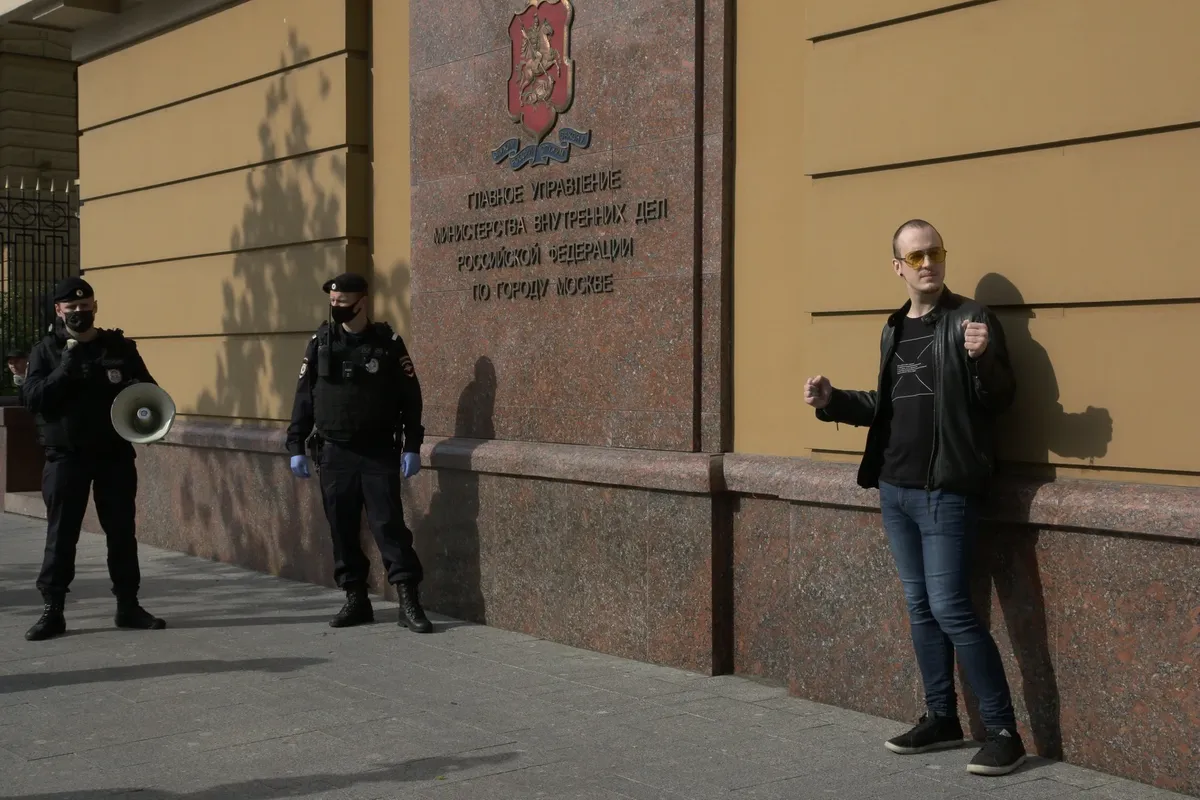
At the same time, as we have repeatedly seen, a freely performed morally motivated action will not necessarily be supported and approved by a wide environment. We can recall the campaigns of public persecution in the Soviet Union. And we can - and relatively recent examples. How much bile was poured with ordinary respectable inhabitants about the Sasha Skolichenko promotion, and earlier about girls from Pussy Riot! Few people noticed the shares of Soviet dissidents, and few notices the shares of those who are going on single pickets today. And above all, not at all because the information is not available, but because it simply is not included in the circle of interests of an ordinary person. And if the usual current layman hears about such promotions, then at best, if he does not regard them as a direct work on a collective enemy, then at least perceives them as eccentric tyranny or banal misunderstanding of a self -evident alphabet of life. In order not to offend anyone, I admit that I myself feel most of the time as a completely ordinary ordinary layman who goes to shops and in a cafe, but which the things that are happening around the things sometimes hurt.
Life “in a lie” or “in truth”, apparently, is a universal dichotomy of human existence, but in the times of totalitarian and other political dictatorships the conflict of these polarities becomes the most intense.
Something similar can be observed both in the framework of the family and in state or commercial corporations. But the difference is that in the case of state totalitarianism, the individual has practically no way to physically go beyond the scope of control and coercion.
What can be done
I will go to the practical part of my reasoning. I think, first of all, you need to admit to yourself in your own (mostly) powerlessness and accept your restrictions. Everything that we do as ordinary citizens in any foreseeable future, by and large, will not affect the situation in the country, and even more so beyond its borders. However, the recognition of restrictions does not need to be confused with the position of a person who says: “Nothing depends on me anyway! What do you want from me? " Our actions can be very significant for the near circle and a circle of like -minded people - close or distant. And we also plow a more fertile field for descendants one way or another, although we will most likely not see the results of our labor. First of all, the latter concerns representatives of the older generation.
We can conduct an inventory of what we are able to do, despite all the restrictions. Make a list of things, at least small that we can do. Despite the rapidly narrowing framework of the manifestation of freedom, during which we live, still there are still many opportunities available to us, which the inhabitants of the former USSR could not even dream of.
I mean in this context not freedom to choose my attitude, namely external freedom, which, nevertheless, is the basis of any conscious external action. We still have almost unlimited freedom of access to information, although not directly, but with the help of technical tricks. We still have a limited, but still affordable freedom of statements in the private and public sphere. We can still make some kind of small, but at the same time for someone very important external actions-for example, write a postcard to the political prisoner. Personally, I have great respect by people who provide all possible material or moral assistance to those who have been subjected to politically motivated persecution.
From my own experience, I know that even just comments on social networks can sometimes be great support for a person who feels isolated and with whom you have never met personally.
Well, the most important thing is that so far we may not participate in actions that we consider morally unacceptable, without risking our own life.
You should also evaluate acceptable risks. Although in an unpredictable, constantly changing situation it is impossible to predict anything accurately.
Well, you do not need to expect some bright and quick results. There were many disappointments from unfulfilled hopes for positive transformations in the last couple of decades. The largest reward, even if nothing in the foreseeable future changes for the better in the outside world is that we will remain in accordance with ourselves, with our conscience.