
Translated material
At the bottom. To be continued
In the space of the St. Petersburg art center "Pushkinskaya-10" the exhibition "History of one newspaper" was opened
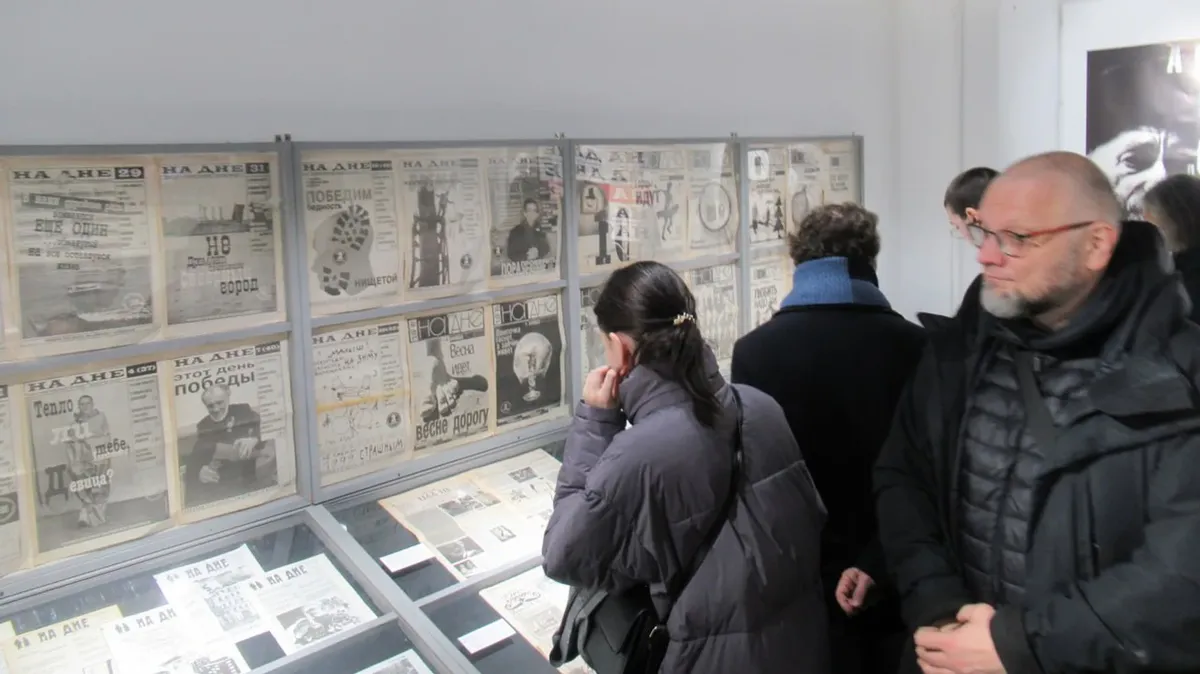
Exhibition "History of one newspaper." Photo: Natalia Skek
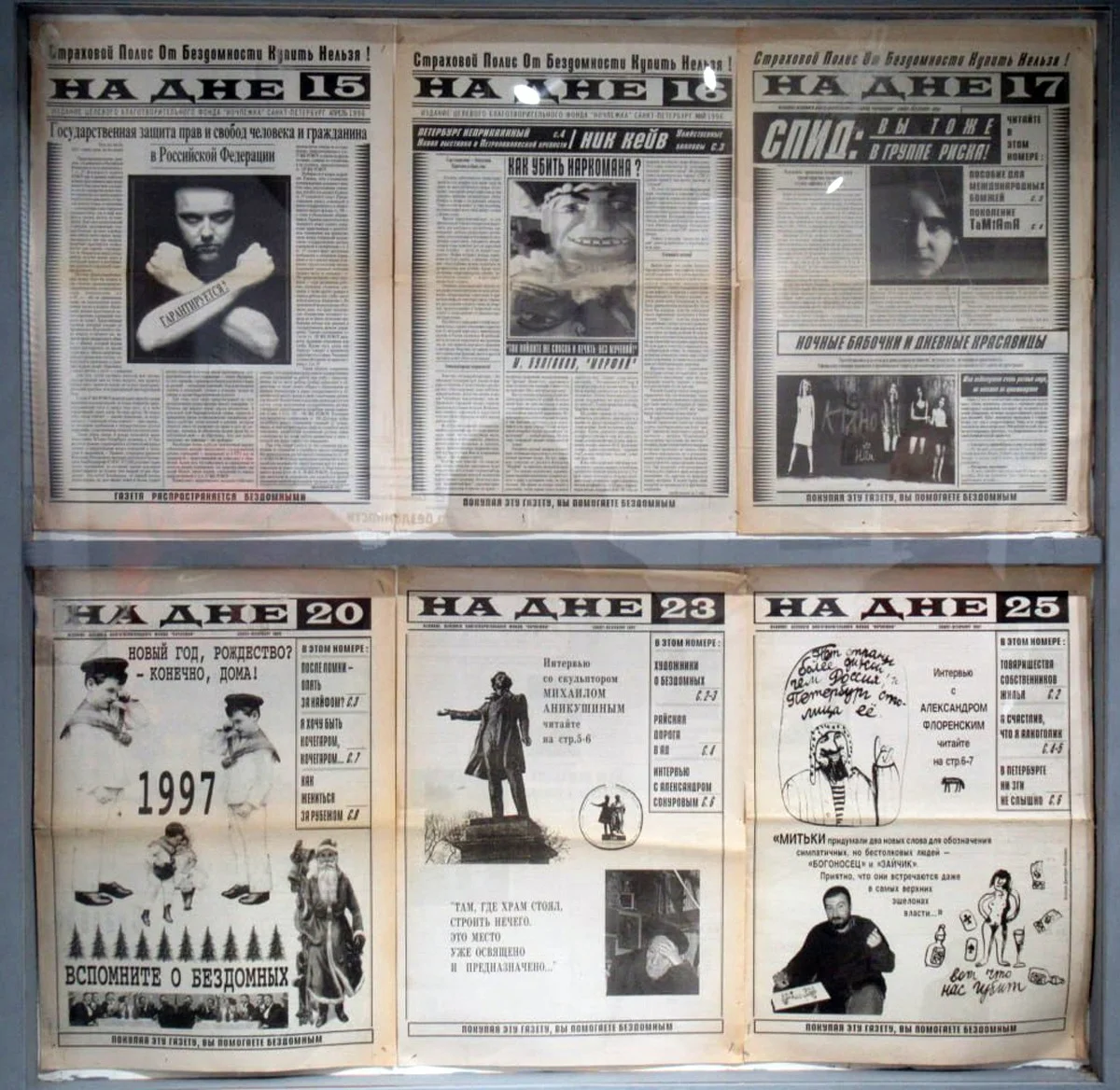
The exhibition is dedicated to the thirtieth anniversary of the legendary newspaper "At the bottom", published in Leningrad-Petersburg from 1994 to 2004. It was not just a newspaper: she saved the homeless from hunger, helped them legally earn money and mainly told the general public about real life at the bottom of society and taught Leningraders-Petersburgers true compassion.
The small space of the desktop gallery is literally hung with exhibits. Here you can see rare numbers of the newspaper "At the bottom", photos, video interviews, documents and printed materials related to the work of the editorial office. Visitors can get acquainted with the full digitized archive of the publication and hold the genuine numbers of the newspaper in their hands.
Anna Zhezhkova , author and curator of the exhibition:
“My acquaintance with“ at the bottom ”happened in 2022, when I accidentally discovered her in the archive. She revealed the U -turn, called "in the sky", and there - the poems of Oleg Grigoryev and the illustrations for them Maxim Isaev and Pavel Semchenko, the creators of the Ahe Engineering Theater! It really inspired me! The newspaper was then made by the most talented people of St. Petersburg, and this is really a real work of art. So this exhibition was born. ”
The first issue of the newspaper "At the bottom" was released in September 1994. A significant part of the texts are materials about city events, journalism, stories about modern fine art, music and cinema. And a large theatrical, exhibition and concert-club poster not only events in St. Petersburg, but also in Moscow. Then the Leningrad-Petersburgers could find out about cultural events in the capital mainly from publications in the "Bottom", which came out once a month.
The organizer and publisher of the newspaper was Valery Sokolov, who founded the Overnight charity foundation in 1990 (at that time Sokolov himself was homeless). The homeless received the newspaper for free, sold it on the streets of the city, the proceeds brought it to the fund and received their share of earnings, and the rest of the money went to the issue of the newspaper and other needs of the fund.
Valery Sokolov:
“Firstly, it was the most obvious way to earn money, and secondly, the newspaper helped to promote the ideas of the Overchka Foundation. Just then, at the city level with our participation, it was possible to achieve the creation of a whole program for helping homeless. And it was necessary to talk about this program - both the homeless and all the townspeople. ”
It was a time when it was urgent to break the stereotypes in relation to the homeless: homelessness was decriminalized in December 1991, when the articles of the Criminal Code 198 and 209 were canceled (criminal liability for living without registration and conducting a parasitic lifestyle). Thousands of people had to integrate into the social sphere - they were not paid either pensions or benefits, they did not give out coupons for products, they were not medical care for them.
They stopped taking homeless people from the streets, plant, and they became a noticeable part of the city landscape. For the state, this was a completely new problem with which few knew what to do.
Yakov Gilinsky , famous Russian criminologist and sociologist, Doctor of Law:
“Now young people cannot understand this, but in the late 80s-early 90s there were simply no products in the city, they began to be given out in coupons, as in a blockade. The residents of the city were given coupons, but there are no homeless people: they did not have a residence permit, housing. Then I had a colleague who held a high post, Valery Sokolov and I turned to him, and he helped: the homeless began to issue coupons for products. Then I was also published in the newspaper "At the bottom", gave legal advice. "

The newspaper published not only city news, but also stories and poems, including the homeless people themselves. Famous journalists, writers, critics collaborated with the newspaper: Larisa Petrova, Andrei Kudryashov, Dmitry Pilikin, Oleg Yurchenko, Nina Zakharova, Alexey Barsopko, Anna Komets, Evgeny Mayzel, Alexander Pokrovsky, Vladimir Nakhimov and others. Photos for issues were taken by Andrei Chezhin, Igor Lebedev, Andrey (Willie) Usov, Dmitry Vilensky, Alexander Menus, various artists provided their works, including Dmitry Shagin, Alexander Florensky. The publication collaborated in various projects with the Ahe group, galleries "Gallery-21", "Borey" and others.
Julius Rybakov , artist, human rights activist, one of the organizers of the space of independent artists "Pushkinskaya-10":
“In the early 90s, Valery Sokolov appealed to me, then to the deputy of the Lensovet, the chairman of the Human Rights Commission. He said that the Overnight Foundation can help homeless people with clothes, food - then a huge amount of humanitarian aid came to Russia. But they have no place. They tried to attach to the “Mercy” fund Dmitry Likhachev, but they quickly drove them away from there - it was painfully spawning audience to come there. Then Valery came to me. "
Rybakov suggested that the Ownership Foundation occupy the basement on the facade of the building in Pushkinskaya, 10. There, in fact, the newspaper’s publication began, in which many artists, writers and musicians who lived in the art space took part. As Julius Rybakov said, “for us the homeless and those who worked there were ours. We were all cooked in one boiler. ”

In the early 2000s, the circulation of the newspaper reached 23–25 thousand copies. After 2003, new people in the leadership of the Fund decided to publish instead of a black and white newspaper with a name that reminded of hopelessness and despair, the Main Home Journal. Now, according to Valery Sokolov, the times of homelessness of a new type have come, and new media can help this homelessness, like thirty years ago.
Valery Sokolov:
“Today we are faced with a new type of homelessness, akin to the one that happened in the 20s of the last century. For various reasons, a lot of people today are forced to leave their homes, their homeland, this is what we call "new homeless people." This situation concerns me personally - many of my friends were forced to leave. Therefore, we decided to restart this project, it will be called "at the bottom. Media ”, we are now actively preparing it for launch on the Internet.”