
Translated material
"Out of the blue is a global crisis"
Trump began the tariff war that threatens the world economy with big losses. But Russia can even benefit from it
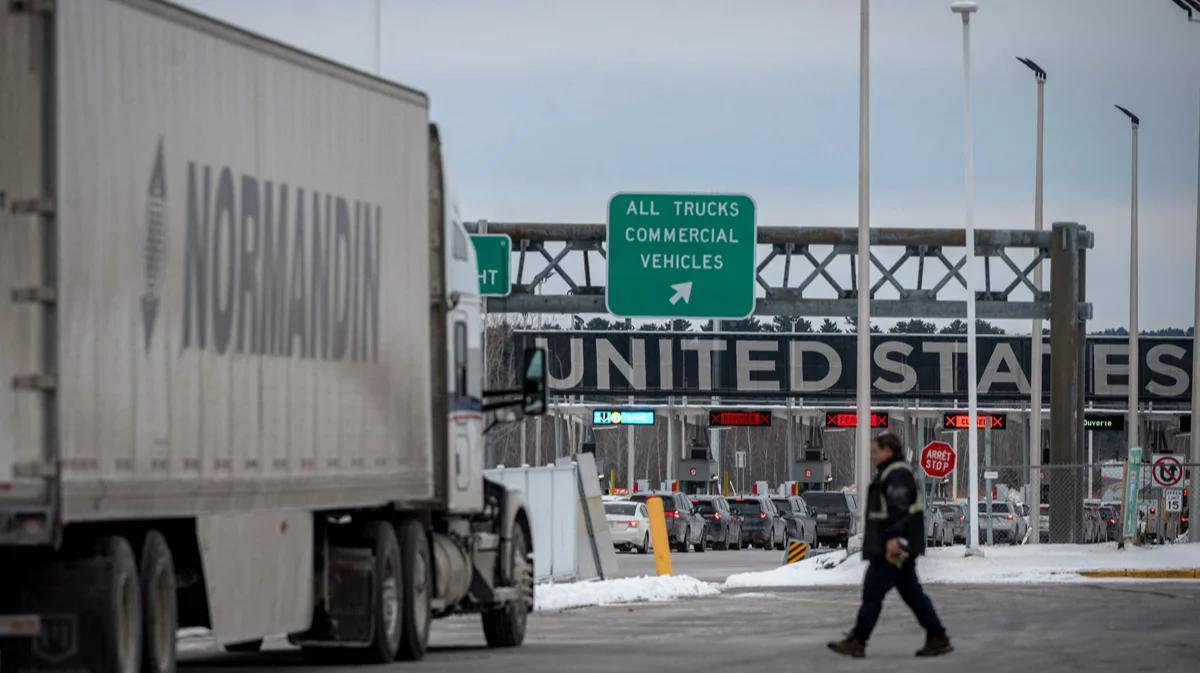
A truck at the checkpoint on the border of Canada and the USA, Quebec, Canada, February 2, 2025. Photo: Andrej iVanov / AFP / Scanpix / Leta
The second battle of Donald Trump for the liberation of the American economy on imported dependence can be a gift for the Kremlin if the conflict takes light forms. But if there is a global trade war and a large -scale crisis, Russia, on the contrary, will suffer from the increased imports, the fall of the ruble and the loss of part of the reserves. The “New Gazeta Europe” was versed in the possible consequences.
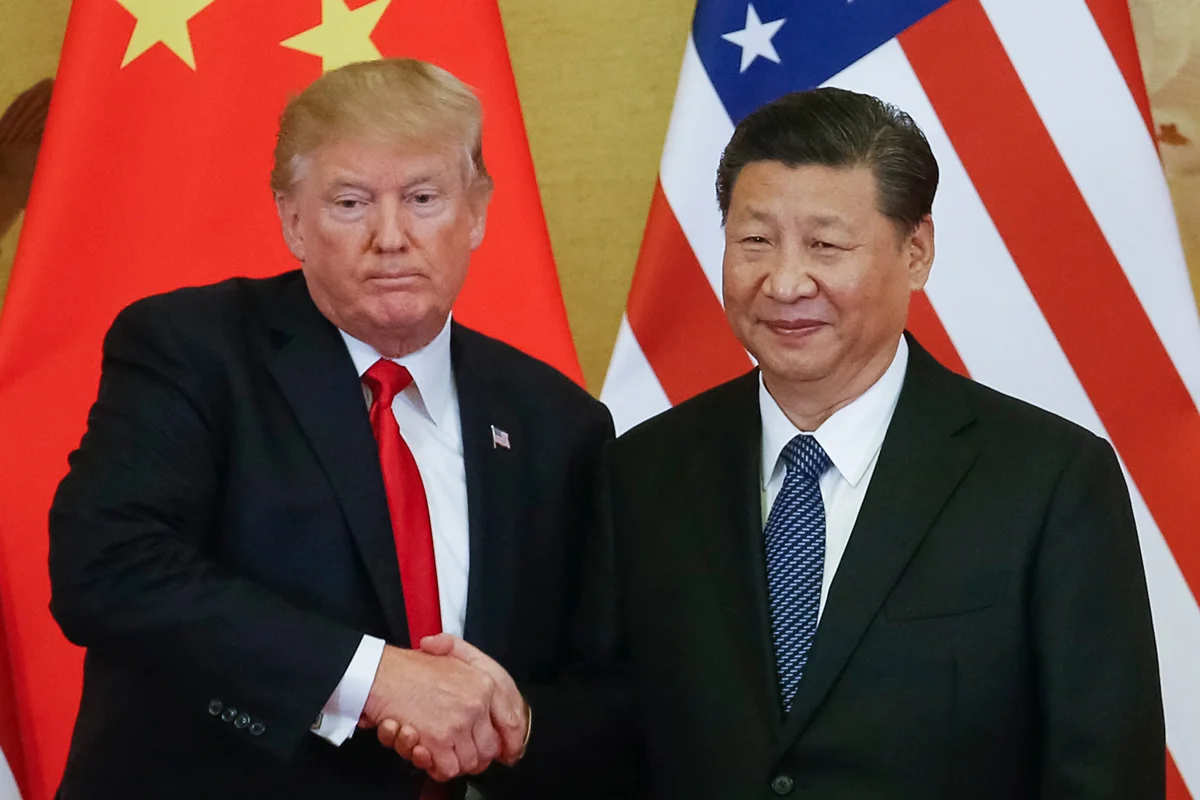
Trump introduced , starting on February 4, a 10 percent imported tariff for the entire Chinese imports without exception by an annual volume of about $ 450 billion. But he stopped the trade war with his neighbors, Mexico and Canada: he first announced a 25 percent duty on goods from these countries (except for Canadian energy-their president wanted to impose a 10 percent tariff). But immediately for a month he suspended the decree after Mexico City and Ottawa agreed to strengthen the border protection to combat drug trafficking and illegal migration.
This is Trump's second offensive to freedom of trade - for the first time he went on the attack in 2018. But the current war may have more deplorable consequences for two reasons.
Firstly, now it is much stronger than the scope. The main difference between the current campaign and the first - in 2018-2019, tariffs for China, although they were higher ( from 10% to 25%), were introduced only by two -thirds of Chinese deliveries ( about 370 billion dollars a year and not all at once, Phased). Now all the import of the PRC has been lined with, which Washington may not limit himself.
A possible next step is the tariff attack on the European Union, to which Trump of the second period also promises duties. In 2018–2019, he already introduced a 25 percent duty on steel purchases and 10 percent-for aluminum (except Canada and Mexico), including in the European Union and in Russia.
The second reason why it can now be worse-the world has just got out of the economic consequences of the pandemic, the main of which were reduction in jobs and high inflation. And immediately the largest war in Europe, unleashed by the Kremlin, began, due to which the largest economies in the world and without Trump, were forced to greatly limit the degree of freedom of world trade in 80 years. There have never been such a set of economic restrictions - not only in relation to Russia, but also against companies and organizations that cooperate with it. The new war in the Middle East greatly complicated world trade.

Trade wars are easy ... are played
Trump explains his struggle with the global freedom of moving goods by trading distortions - by the fact that US partners buy very little from America, and sell it many times more, which is why American industry suffers. Indeed, the United States bought $ 918 billion more in 2024 than exported themselves.
Trump in 2018-2019 was already trying to straighten the tariff sledgehammer with the problem of trade deficit. But making his current statements, of course, he does not remember that the first trade war, which he waged in his first parish in the oval office, lost the American economy - contrary to Trump's signal Twitt from 2018 that “trade wars are good, and they are good and they are good Easy to win. ”
Three American economists concluded that only in the incomplete 2018 year, American consumers and business lost $ 4.4 billion - expenses from increasing imports fell on their shoulders.
In addition, duties reduced exports from the United States. This can happen now: the analysts that Reuters spoke with are waiting for China to be reduced due to the response of China’s repetition duties. Now the shipments of liquefied natural gas can also suffer - its largest exporter, and China is a large buyer.
By the way, Russia, by the way, can win, who will have a chance to replace these volumes with its hydrocarbons, the Russian economist told us (he asked not to name his name). That is, the opposite will happen both to Trump's promises to revive the American industry and the Western plans to reduce Russian oil and gas revenue.
But in 2018-2019, not only America lost - according to the IMF calculations , then everything lost: Trump's first trading war cost the world $ 700 billion, or 0.8% of global GDP.
Everyone will pay
Economic science believes that not only external suppliers suffer from trade barriers - the final harm outweighs the benefits for the country itself, which introduces tariffs. The Nobel Laureate for Economics Pol Krugman and the chief economist of the IMF (from 2015 to 2018) Maurice Ostfeld in the book “International Economics: Theory and Politics” proved that the wealth of both consumers and manufacturers is reduced in the “enclosing” country. “Studies show that“ paying for tariffs ”will be American consumers themselves (and manufacturers; trading war is a reverse -reaction thing),” writes the author of one of the Russian macroeconomic channels “Long time economy”.
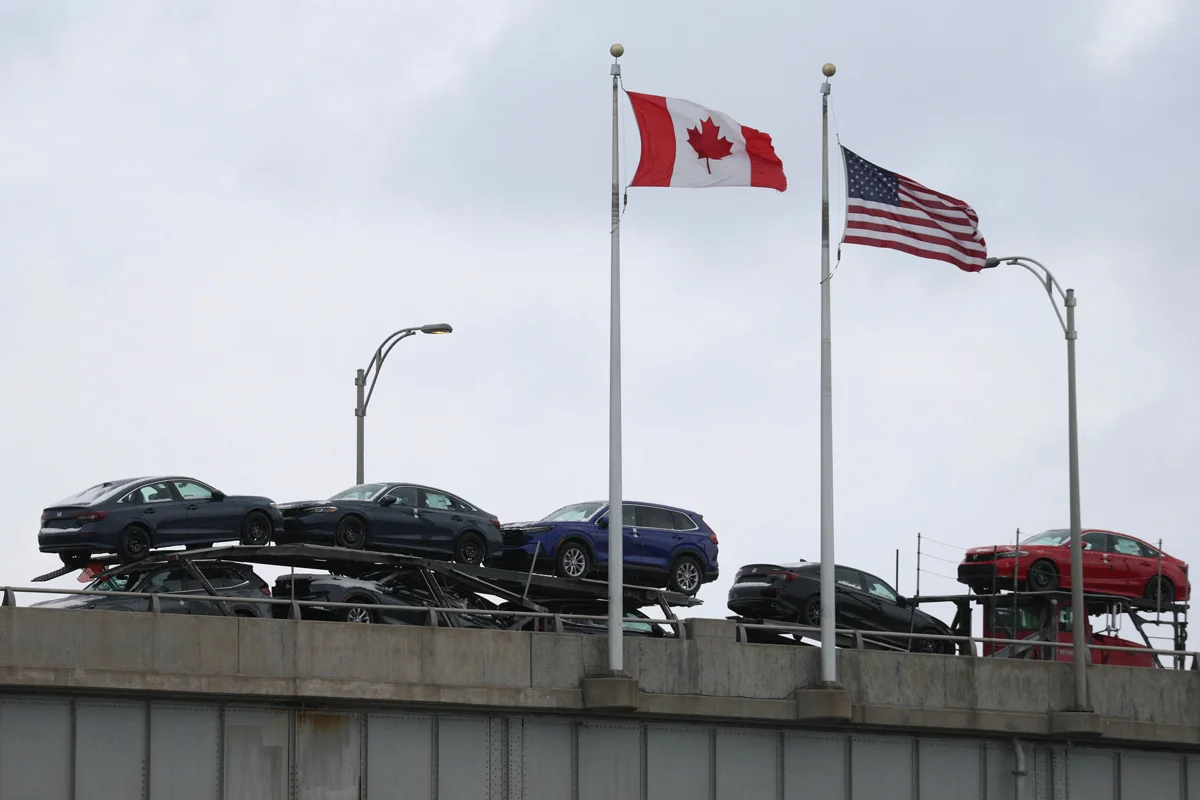
The reason is that manufacturers under the protection of barriers cease to sensibly evaluate the effectiveness of their production-as a result, the consumer overpays for poor-quality products, the head of the Russian Research Economic Center explained to the New Year (we do not name his name for security reasons).
Our Russian interlocutor cited this example:
Trump import duties will increase the cost of an American car, which will create competitive advantages to the Japanese auto industry.
“So, you will have to defend yourself from cheap Japanese cars, then introduce duties against the Koreans, and there will be an endless war in which there will be no winner: this is a return to natural economy.”
And if the largest economies in the world begin to suffer, starting with the United States, this can turn into a global recession, our interlocutor says. “I would not underestimate the risk that a global economic crisis can arrange a global economic crisis in the blue than in 2008,” the economist Dmitry Nekrasov agrees with him.
This can happen. “In China, Vietnam and a number of other countries of Southeast Asia, a large positive balance of foreign trade and low domestic consumption. They are very dependent on exports, a tough crisis may begin with its reduction, ”says Nekrasov. “After that, the suppliers of raw materials - the country of Bay, Brazil, Australia will begin to“ fall ”. With this development of events, oil prices will also fall. As Trump promised, although such prices will roll American oil production, ”Nekrasov explains.
Consequences for Russia
If a world recession occurs, then prices for the main export goods of Russia - oil, gas, metals and coal, the sales of which in world markets have already collapsed from the beginning of the war. But even a large -scale global crisis, but the problems of only two main economies, China and the USA, can hit the prices for hydrocarbons, which are very sensitive to demand in these countries.
“The general slowdown in the global economy, the decline in demand for raw materials, the increased volatility of markets and the decline in investment are all bad for the Russian economy,” one of the Russian researchers told us. A decrease in currency revenue will hit the budget revenue and ruble, and also disperse inflation even more. The Russian authorities will have to look for ways to replenish the budget. “The taxes have already raised the debt, I don’t want to increase the debt, the national welfare fund is limited in its capabilities, and it remains only to sell state property or start printing money,” another Russian economist argues.
Inflation will accelerate due to the fact that the goods that Russia are imported will rise in price. Import will grow in price due to mutual tariffs of those countries that trade with Russian companies, said private investment consultant Andrei Kochetkov.
Another threat lurks in the fact that China, in order to compensate for losses due to tariffs in its currency, can devalue Yuan, say Reuters sources. Its course is determined not by the market, but by the Chinese leadership. That is how it was already during the Trump’s first-time trade war-from March 2018 to May 2020, Yuan fell to the dollar by 12%. Nekrasov calls such a devaluation “a completely logical measure”, and if this happens, then the ruble will move after Yuan, the economist believes.
Yuan devaluation is also fraught with the fact that Russian gold and foreign exchange reserves will “lose weight”, half of which Russia was already selected, frozen immediately after the start of the invasion of Ukraine. How much the Bank of Russia now holds in the yuan is unknown, because the Central Bank with the outbreak of war has stopped disclosing the structure of reserves. At the beginning of 2022, the Chinese currency accounted for 17%, or 31.5 billion dollars. If you imagine a new weakening of the yuan by the same 12%, then for Russia this means a loss of about $ 3.8 billion. A little, but now for Moscow, every penny in the currency on the account.
However, in the event of a “soft” tariff conflict that will not result in a full -scale global crisis, Russia may even win.
Firstly, due to the fact that global leaders will be so interested in the struggle with each other that their desire and willingness to control the sanctions regime will weaken. And then for Moscow, “increased conflict may be a gift,” the Russian macro economist told us. The gift will be even more expensive if a place for Russian oil and gas is released in the Chinese market due to the fact that Beijing Twins on hydrocarbons from the United States will remove part of the volume of American raw materials from Asia.
And secondly, the trade war in Light mode will become a strong impetus for states to be divided into alliances of friendly economies, inside of which trade relations will be deepened, investment consultant Andrei Kochetkov notes. In this case, he says if, for example, Chinese automakers will be supplanted from the US tariff zone, they will have to penetrate deeper into the Russian market. And this can expand the offer and reduce cars for cars in Russia, the expert concludes.
Forward, in the century before last
In the last third of the 20th century, many states understood: from the free movement of goods, they get rich more than from the closure of markets and protecting their manufacturers. And then the era of free trade began. Countries began to form zones partially or completely freed from trade barriers. The main of them are the European Union, the North American Agreement and the Asia-Pacific Economic Cooperation .
Trump enters the White House for the second time - and the second time begins the attack on these rules. His intentions to support the American industry are understandable, but measures contradict the experience of developed economies of the last half of the century, textbooks on economics and its own, Trump, practice.

“What Trump is doing now is like a game without rules, it returns the world to the 19th century, when everyone fought with each other for an incomprehensible purpose,” the head of the Russian Expert Economic Center told Novy-Europe (we do not indicate his name for security reasons). - Each country has its own competitive advantages. They must be developed. And trying to create a closed economy is the century before last, ”he added.
The archaic and the meaninglessness of the tariff war proven in practice - for these reasons, the economists interviewed for these reasons are inclined to believe that the real actions of the new leader will not be as gestured as his statements. “I do not think that Trump seeks to arrange a global economic crisis. I think that in his usual shocking manner he is trying to knock out some concessions from different countries and governments, ”economist Dmitry Nekrasov told us.