
Translated material
TS-s
Why does the psychological heritage of totalitarianism live in our children, and even grandchildren will suffer from them. Psychotherapist about fear and conformism
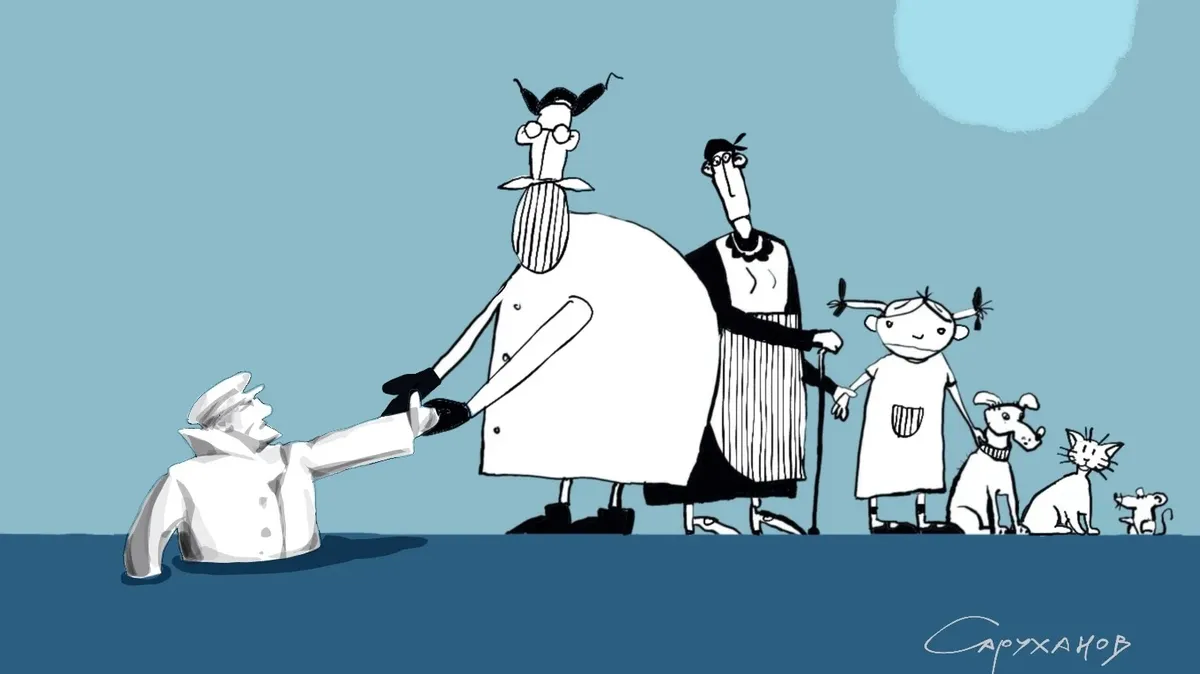
Illustration: Peter Sarukhanov / "New Gazeta"
Linear models explaining to some reason why authoritarian and totalitarian dictatorships are established in individual countries-by traditions, characteristics of people, insidiousness and ingenuity of dictators, economic or geographical characteristics, determined by military-political conditions-do not work very much in practice.
The main counterargument against the hypothesis that the reason for the establishment of a political regime is the mentality of people is that there are examples when citizens of one people and one former state, divided according to an arbitrary geographical line, built completely different societies.
On the other hand, there are many examples when in the country, despite the radical change in historical conditions, political will and attempts to build a democratic state, all this is nevertheless not crowned with success. Despite all this, for some reason, something similar to ancient despotism was reproduced, at best decorated with elements of modern democratic institutions.
I assume that for which regime it will be established, the mutual influence of many factors - economic, military, and political. Nevertheless, in no case should you discount the so -called "soft" factors.
And as modernity shows, economics and technological innovations can develop much faster than changes in the worldview of people.
Since the 60s of the last century, the attention of psychiatrists and psychologists has attracted attention that the experience experienced by previous generations has a significant impact on attitude, mental health and a way of life of descendants.
This experience can be broadcast quite clearly in the form of open verbal messages. If you recall the Soviet education: “Do not stick out”, “Be like everyone else”, “Do not say what you think”, “Do not argue with the authorities.” But it can be much more hidden and camouflaged. Through the fact that children involuntarily, unconsciously infected the emotional state of parents.
Or parents convey their attitude to certain situations, even without realizing this, through non -verbal signals without verbal explanations.
For example, they freeze, demonstrate emotions of fear, shame, etc. at the mention of certain topics. This hidden - unlike obvious, verbal transmission - the mechanism for transmitting experience from generation to generation was called transgeneration.
Personally, I remember how my parents suddenly suddenly lowered their voice and fell silent if they spontaneously escaped any critical statements regarding Soviet power and Soviet history. One of my colleagues shared his childhood memory. His mother, when he was still small, walked with him around the field in the village (it was in the 60s), and she told him: "Just do not take any blades." Already much later, he learned that his grandmother was convicted by the “Decree on Three Spikelets” in the 30s.
Another example. The young man shared his sensations from participating in the elections. It was more than 10 years ago, in times, one might say, almost vegetarian. He was born around the mid-80s. in the USSR. He loved to talk about himself as a man completely independent, free and soberly thinking. However, he described his experience in voting as follows: when he went into the booth, he was seized with fear, his thoughts began to arise whether hidden cameras were watching him, and he wanted to quickly escape from this place. The same person at the same period of time, when someone in a conversation suddenly released any critical statement about the president or Russian politics, began to smile nervously, let go of jokes about Barack Obama and tried to translate the conversation to another topic.
Some psychologists began to use the term "transgeneration atmosphere."
It implies that people who have experienced traumatic experience, in particular the experience of repression in totalitarian regimes, create an emotional background around themselves, which involuntarily involve others.
And in which their family members feel forced to feel, lead and react in a certain way.
This concept can be extrapolate beyond a separate family, because This phenomenon is clearly visible on the scale of fairly large communities. Something similar, i.e. A specific emotional atmosphere is one way or another every person feels when a social and cultural environment falls into a new for him.
The consequences of the collective mental trauma and the mechanisms of its transmission to descendants, and even its distant influence on the biochemistry of the body and on the human genome, were detailed in the population of the victims of the Holocaust and their descendants for four generations. The transgeneration consequences of the forced relocation of the indigenous population in North America and Australia, slavery in the United States, the consequences of political terror in Chile were less detailed. As for scientific empirical research, which were conducted in the territory of the Russian Federation or in other post -Soviet republics, they can be recalculated literally on the fingers.
In 2019–2020 I conducted my study of how the experience of life under totalitarian regime was transmitted to the next generation. The study included several stages, in general, 547 respondents, students of the Novosibirsk Medical University were covered. As methods, a group interview, an analysis of written essays and a survey method were used. At the first stage, the participants were invited in free form to answer the question of how, in their opinion, the repressive policy of the Soviet period influenced the life principles and behavior of their family environment - parents, relatives, grandparents - as well as their own features of emotional response, installation and behavior. Based on the most common answers, a structured questionnaire was compiled, which was used at the subsequent stages of the study .
I will dwell only on the most indicative, in my opinion, results. Most respondents indicated that they received verbal and non -verbal messages from their parents, which can be regarded as related to totalitarian experience. So, 55% of respondents noted at least one point regarding the behavior of parents, grandparents, of the following:
"The alertness in actions and words that are in any way associated with politics",
"The desire to avoid critical statements about power in a public situation",
"The negative attitude and fear of participation in any events with a political agenda, which, in their opinion, are not approved by state power."
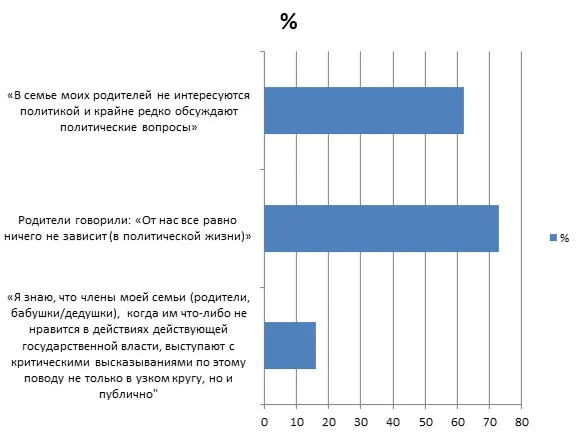
Also, 62% of respondents agreed with the statement "in the family of my parents are not interested in politics and are extremely rarely discussing political issues." 73% - with the assertion that they heard from their close messages, similar in meaning with the phrase "nothing depends on us (in political life)." And 16%-with the statement “I know that my family members (parents, grandparents), when they do not like anything in the actions of the current state power, act with critical statements about this not only in a narrow circle, but also publicly (at public meetings, on the Internet). " This statement was presented in the reverse formulation, i.e. This means that in 84% of cases, close from the closest family environment of respondents avoided making critical statements about the authorities publicly.
Verbal and non -verbal parent messages
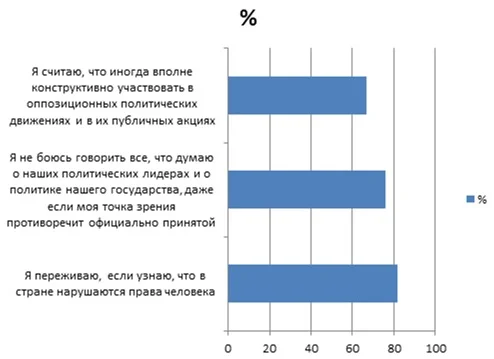
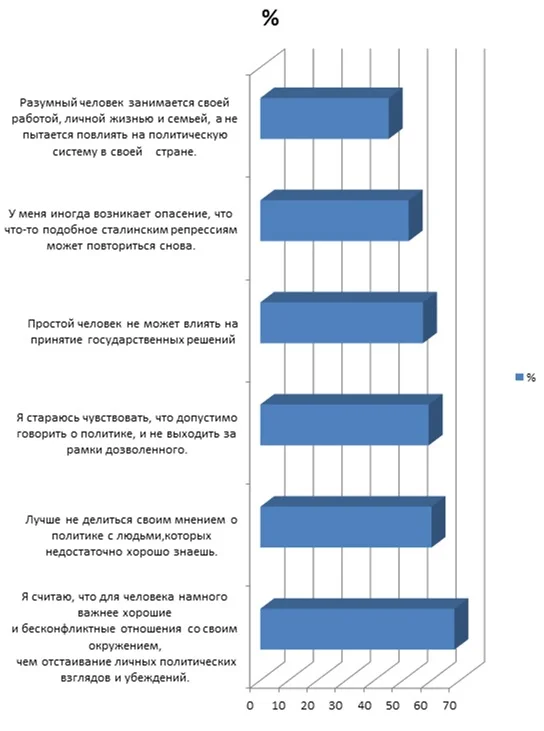
As for the attitudes of the respondents themselves, they turned out to be contradictory. In terms of meaning, they can be divided into antitotalitarian (liberal) and posttotalitarian. On the one side,
“I am worried if I find out that human rights are violated in the country,” 82% of respondents noted;
“I am not afraid to say everything that I think about our political leaders and the policy of our state, even if my point of view contradicts the officially accepted” - 76%;
“I believe that sometimes it is sometimes quite constructive in opposition political movements and in their public actions” - 67%.
Antitotalitarian installations of respondents
On the other side,
60% agreed with the statement “it is better not to share their opinions about politics with people who do not know well enough”;
59% - with the statement “I try to feel that it is permissible to talk about politics, and not go beyond the scope of the permitted”;
57% - with the statement "A simple person cannot affect state decisions."
52%-with the statement “sometimes I have a fear that something similar to the Stalinist repressions can repeat again”;
45% agreed with the statement “A reasonable person is engaged in his work, personal life and family, and not trying to influence the political system in his country”;
68% - with the statement “I believe that for a person, good and conflict relations with his environment are much more important than defending personal political views and beliefs.”
Post -Totalitarian installations of respondents
If you make a generalizing conclusion from these polls, it can be noted that
Installations formed in the conditions of totalitarian rule had a tendency to weaken in the generation of respondents, but they did not completely disappear.
In our studies, we dealt with the grandchildren and great -grandchildren of those who were directly injured or witnessed the political repressions of the Soviet period. Parents of the study participants lived already in a relatively liberal environment, in which until recent years there has not been strict political censorship. Given these circumstances, it can be concluded that for a partial weakening of posttotalitarian installations, 2-3 generations were needed. It should also be emphasized that the results presented in the article were obtained even before the ban on freedom of speech and restriction of access and free dissemination of information in Russia, as well as a sharp tightening of the persecution of opposition activity.
Foreign researchers of the consequences of political repression indicate that repressions lead to freezing of society - loss of interest in politics, social apathy, which is quite consistent with the data obtained.
It is difficult to say exactly how many generations should have been replaced for their complete overcoming, provided that there would be political freedoms in society. But Russian history has accepted a completely different direction. And even if it hypothetically assume that a more liberal regime will suddenly establish in Russia, most likely the consequences of a new frost will make themselves felt for a long time.