
Translated material
And when will the deputies become AI?
The laws on elections are introduced by the next changes, the main thing is the actual abolition of paper ballots
18+. This material (information) was produced, distributed and (or) sent by foreign agent Vishnevsky Boris Lazarevich or concerns the activities of the foreign agent Vishnevsky Boris Lazarevich.
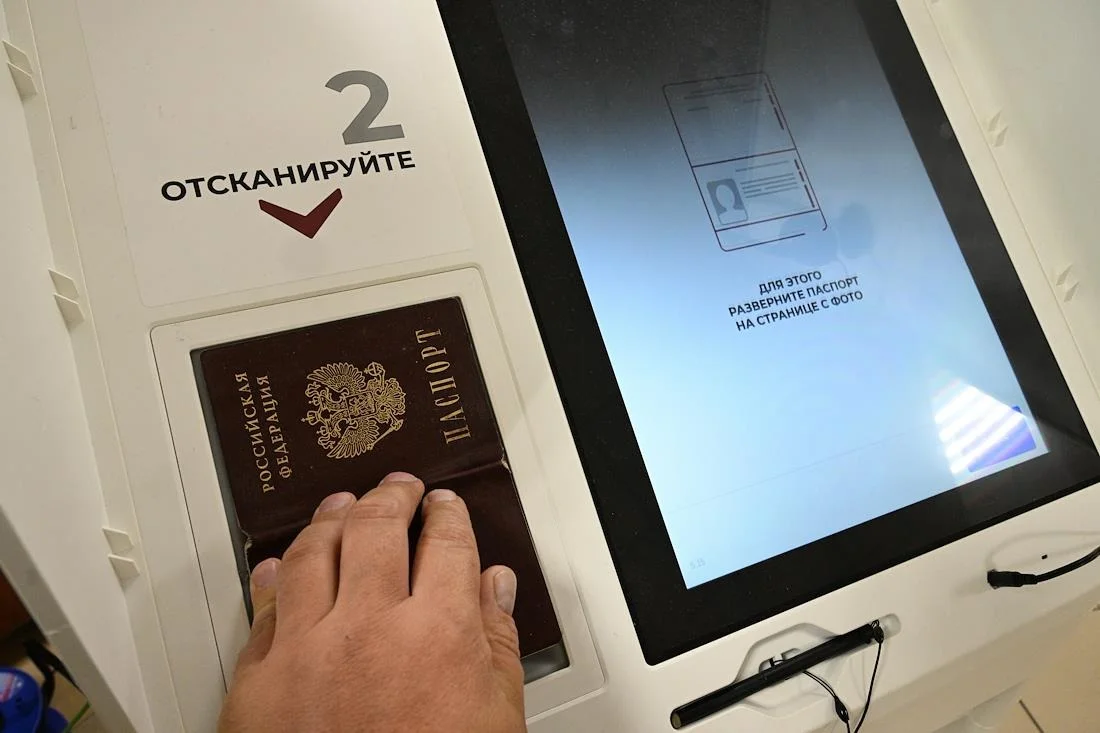
The State Duma introduced the next draft changes to the electoral legislation, the main of which is the transition to electronic voting. If earlier, by default, paper ballots were used, but by the decision of the CEC or local election commission, an electronic vote could be carried out, now the logic changes to the opposite.
By default, they will vote electronically, and only by special decision of the election commission - paper ballots.
Given how the election commission is being formed in Russia, it will be possible to finally forget about independent election control. There will be no longer any counting of votes in the sites in the eyes of members of the commission and observers and the issuance of protocols for voting results.
Among the authors of the project are Senators Andrei Klishas and Nikolai Fedorov (ex-minister of justice and ex-president of Chuvashia), State Duma deputies Dmitry Lameykin and Leonid Ivlev (formerly the first deputy chairman of the CEC) and others.
It is proposed to change five federal laws - “On the Basic Guarantees of Electoral Rights and the Right to Participate in the Referendum of Citizens of the Russian Federation”, “On the elections of deputies of the State Duma”, “On Political Parties”, as well as laws on licensing and the System of GAS “Elections”.
First - about relatively insignificant changes.
“Additional” elections of deputies of all levels (in the event that one or more deputy mandates is released), it is proposed not to be appointed and not to spend in the year preceding the year of the following, planned “main” elections. The only exception is that, if as a result of the early termination of deputy powers, the relevant representative bodies remained in the unauthorized composition and cannot work.
At conferences and other events of political parties where candidates are nominated, representatives of the relevant election commissions and the Ministry of Justice (or its territorial bodies) are entitled to be present. Now they will have the right to “unhindered implementation of photography and video recording”. Note that now no one is bothering to do it. At the same time, for some reason, the election commission themselves are not as open as this requires the parties: the maintenance of photo and video shooting in the premises of election commissions is virtually prohibited by everyone except observers and media representatives.
Not only the “in agents” will not only be able to sacrifice the parties to the parties to the electoral funds, but the Russian legal entities established by them, as well as those who are included in the list of “extremists and terrorists”.
Frankly, a cynical proposal: recall that citizens who are included in the “foreign agents” with an arbitrary decision of the official’s official, on the basis of laws adopted by the same State Duma, are deprived not only by many constitutional rights, but also by the right to dispose of their income, but to those who are introduced In the “extremist” list, they block bank accounts, allowing you to spend no more than 10 thousand rubles per month. What are the donations for the elections ...
The names of political parties when voting on party lists will be placed in the ballot in the same font - in order to avoid “small tricks” indicating their names (if it is written in the party charter) with a semi -fat font, more attracting the attention of voters unauthorized in advance.
Now - about more significant changes in the electoral legislation.
Previously, in the elections of the State Duma of Russian voters voting abroad, they attributed to one or another single -mandate districts. And their vote could theoretically - especially with acute competition - to influence the result of elections in the district.
Now it is proposed to establish that voters living outside the territory of the Russian Federation are considered assigned to the federal constituency, and will not vote for the "single -mandate". They will receive a ballot and will vote only on party lists - where their “weight” is significantly lower and much will affect the results of the elections.
Actually, for this they change the legislation: practice shows that “external” voters are much more opposition than “internal” ones.
At the same time, if now in the “list” ballots of each batch are the names of all candidates included in the general federal part of the list (there may be from one to fifteen), now voters living and voting not in Russia will see only the first five surnames.
This innovation in an explanatory note is explained by logistics difficulties.
Like, “at present, taking into account the current political situation when organizing voting in the elections of deputies of the State Duma in polling stations formed outside the territory of the Russian Federation, the manufacture and delivery of ballots of a non -standard format can be significantly difficult or impossible, and therefore the only way To ensure voting in these polling stations is the manufacture of ballots directly by foreign district election commissions. ”
However, information about all candidates included in the general federal units of the federal lists of candidates will be placed in the voting room in the “foreign” polling stations.
Another proposal is a rare example of reasonable changes in electoral legislation in recent years: special electoral accounts from which all the expenses of candidates for election campaigning are financed (including the manufacture of signature sheets, if they need to collect signatures), it will be possible to open, conduct and close In remote mode.
Now, in order to open such an account with a bank (not to anyone, but by the election commission), a candidate or his financial authorized person must come there personally. What requires time, sometimes - considerable, especially with a large number of candidates, and on the “path” to the opening of electoral accounts, the candidates had problems more than once.
Now all this can be done in remote mode, which, as indicated in the explanatory note, “will reduce the total time spent, in particular, candidates, authorized representatives of candidates for financial issues upon receipt of services on special election accounts, and will also exclude the need to visit departments a credit institution, including those in remote and inaccessible areas. ”
The experiment on the remote opening of special election accounts of candidates is planned to be carried out in 2025.
Finally, the main thing is the most significant change:
It is proposed, as already mentioned, to conduct an “default” precisely electronic vote instead of voting using ballots “made on paper”.
At the same time, by the decision of the corresponding election commission, at the same time as electronic voting, “paper” is also possible, but this is a reservation for naive ones: wherever the power considers electronic vote for itself, it will easily not allow “paper”.
And she will consider it profitable, most likely, almost universally - given that electronic voting, compared to voting with ballots, seriously reduces the possibilities for independent control and seriously increases the likelihood of falsification.
There are no ballots that are lowered into the urn, there is no open and vowel process of their counting, but nothing can be checked - because physically there is nothing to recount in case of doubt. And all the equipment for electronic voting is completely in the hands of the authorities - so, given the long -term practice of falsifications in the elections where they voted with ballots, it is very difficult, if possible, to believe that the results of electronic voting are completely protected from exposure to the direction of the direction necessary for the authorities.
No wonder the results of electronic voting were often qualitatively (and not just quantitatively) differed from the results of voting with paper ballots, and candidates for deputies who confidently defeated the “paper”, then lost in “electronic” voting and in the elections as a whole.
Yes, they have long learned to falsify the elections in the "paper" version. But in this case, although a small one remains, but the possibility for monitoring, checking, recounting and canceling a falsified result.
In the "electronic" case, this possibility simply does not.
"But what about foreign experience, because electronic voting is widely used there?" - A question may arise.
It turns out (I refer to the data of the head of the analytical department of the Yabloko party, political scientist Ivan Bolshakov), which is not so wide.
So, in France, it is used as a form of voting for expanses (legally living in the country, but not having citizenship).
In Germany, the Constitutional Court acknowledged such a vote that does not meet the principles of honest and open elections.
In Italy, electronic forms of voting are constantly canceled due to the threat of cyber attacks.
In Japan, electronic voting is allowed only in municipal elections, but even there it is practiced extremely rarely.
The Netherlands conducted an experiment with voting machines, but abandoned this practice due to threats of falsifications.
In South Korea, the electronic counting is only a counting of votes - there they simply read paper ballots with a scanner.
In Switzerland, where electronic voting began to be introduced against the background of frequent practice of referenda, they have repeatedly found critical vulnerability in the system. In 2019, the parliament suspended the use of electronic voting for five years. In 2023, against the backdrop of the Pandemia of Coronavirus, he was returned on a limited scale. Electronic voting is allowed today in only three cantons out of 26, where no more than 30% of canton voters can take part in it.
So, perhaps, the only example of a successful and preserved electronic voting over the years is Estonia, where 51.1% voted electronically in the parliamentary elections of 2023. But this is an exception that only confirms the rule.
And one more circumstance, critical of evaluating the “reliability” of electronic voting: even if you believe that it provides the secret of voting, the voter, in principle, does not have the opportunity to check how his voice is taken into account when determining the results.
Which further reduces the level of confidence in the "electronic" will.
In general, “trust” is a keyword for evaluating these changes.
Because the trust of citizens to the electoral system - as I had to write, appears where there are independent media, and there are employees of the law, and not the authorities, law enforcement agencies.
And where citizens know that any attempt of falsification will be severely punished, and those who are involved in it will pay for this almost inevitable defeat in the next elections.
In the same place where all this is not, there is no trust.
And for the introduction of electronic voting, you need a very high level of this trust - which there is no need to talk about yet.
However, it must be understood that if in Russian politics there are no fundamental changes, the question of the form of voting in the elections will not be the most important.
And if they happen, the elections will be held in completely different laws.