
Translated material
What to do if the United States withdraw troops from Europe?
Financial Times tells how European countries have been concerned about their defense
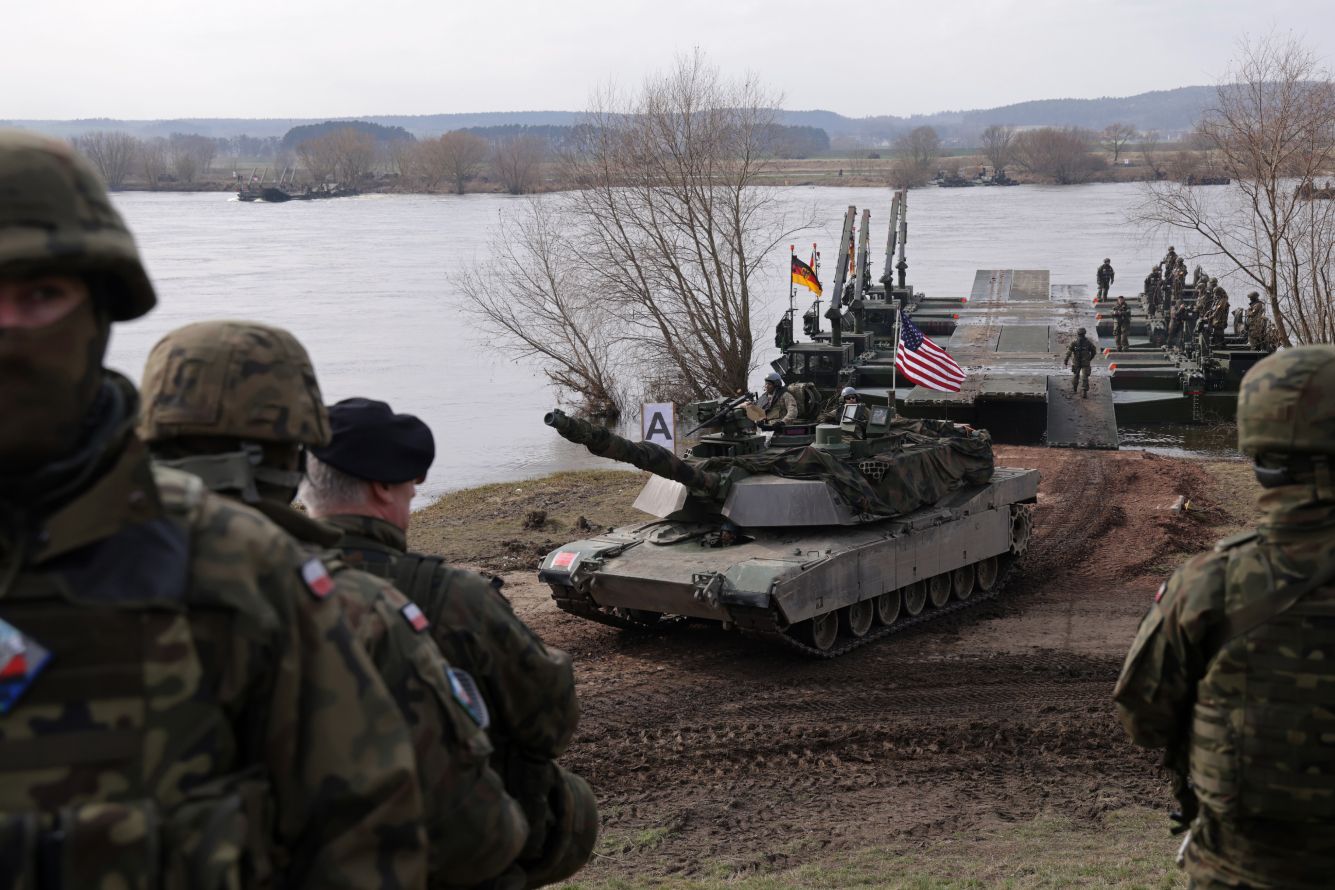
European countries are concerned that the United States can withdraw military personnel and military equipment from Europe, as well as abandon the role of the main guarantor of security of Ukraine and Europe as a whole.
As stated in the Financial Times, European states are faced with several priority tasks: increasing defense expenses, strengthening air defense, replacing logistics equipment and other auxiliary equipment, which is now provided by the United States, as well as an increase in the combat readiness of European troops and maintaining effective nuclear deterrence.
In recent days, discussions about re -equipment have sharply activated in Europe. Officials, according to Financial Times, are discussing how to increase national military budgets and find new financial mechanisms to ensure joint defense projects.
Among these projects, journalists call the pan -European air defense shield and transport systems, including the aircraft that the United States now provide. In addition, as NATO representatives told, Europe lacks ammunition for long -range weapons.
If Europe manages to find the necessary resources, this will become a “significant change in the rules of the game,” said Kamil Grand Camille Grand, former assistant to the NATO Secretary General for Defense Investments. In this case, Europe could perform almost the entire range of military tasks without the help of the United States.
“Their [USA] is not without reason called an indispensable ally,” the Foreign Minister of one of the European countries told the publication. “Without them, we cannot carry out any complex military operations or solve even simple tasks.”
One of the questions that bothers European officials is what to do if the United States partially or completely withdraw its military personnel from Europe. Now in several European countries there are 90 thousand US military. In particular, officials and analysts who talked with Financial Times are afraid that Trump will withdraw 20 thousand American soldiers, who were sent to Poland, Romania, Latvia, Lithuania and Estonia in 2022 after the start of the Russian-Ukrainian war.
Trump said that he was not going to withdraw all the US troops from Europe as part of a possible peace agreement on Ukraine. “No one asks about it, so I do not think that we will have to do it. I would not want to do this. But this issue has never been raised, ” said the US President, speaking to journalists in his residence in Mar-a-hala in Florida on February 18.
In theory, European states have enough troops to protect their borders in the event of an attack. The armies of European countries have almost two million military personnel, of which 1.3 million people are only in the EU. But in practice, the publication claims, most of these troops are not suitable for deployment. Including because the last 80 years, European armies were recruited and studied, relying on the support of the United States. Replacing this system will require time and expenses of billions of euros. In addition, it is unclear whether European countries will be able to supply their troops.
But, probably, the main strategic problem of Europe is the future of the “nuclear umbrella” of the United States and the lack of its own tactical nuclear weapons. According to Financial Times, France and Great Britain, European nuclear powers, have about 515 nuclear warheads, but basically it is strategic weapons.
What is the difference between strategic and tactical nuclear weapons?
Military expert Pavel Luzin explained to Medusa that “classic” nuclear weapons are usually understood by strategic nuclear weapons , which causes irreparable damage to the likely enemy. Non -strategic, or tactical , nuclear weapons are intended directly to solve problems at the theater of military operations and even on the battlefield.
If the United States officially refuse to protect Europe, the lack of tactical nuclear weapons will create a “gap in the deterrence system”, which Russia can use, the article says.
The desire of Europe for defense autonomy tried to realize over the most part of the history of NATO, starting with the idea of creating a European defensive community in the early 1950s. All these attempts failed, but then the United States was ready to take on European defense, writes Financial Times.
“European thinking should change,” Former Finland President Sauli Ninistu told reporters. “You will not avoid war, demonstrating your weakness.”