
Translated material
Anti -fascist who became a German deputy
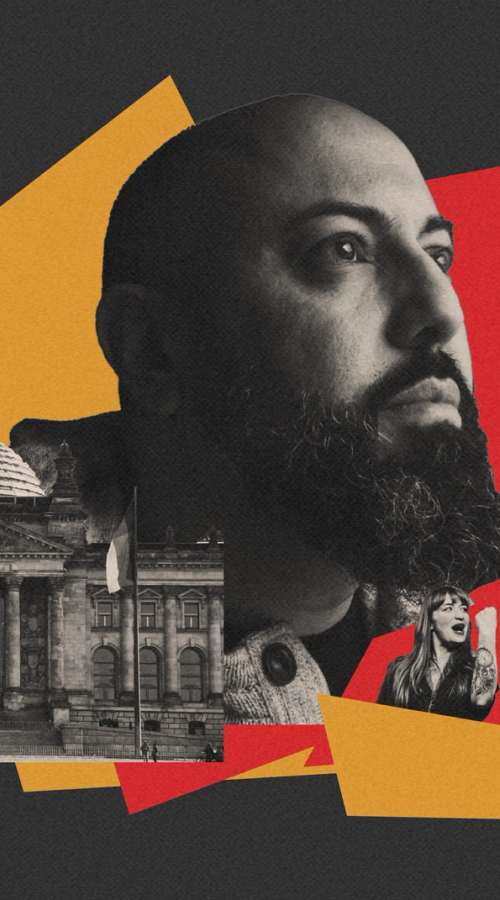
Interview with Ferat Kochak
On February 8, 2024, DOXA was included in the register of "undesirable organizations."
If you are in Russia or plan to return to it, you can not replace our materials on social networks, refer to them and publish quotes.
Read more about what is possible and impossible, read in the cards .
Trump’s victory, 20% for the “alternative to Germany” - it seems that the farm are gaining popularity throughout the West, who want to get rid of migrants. But in the last German election, the Die Linke party (“left”) unexpectedly gained 9% of the vote, although according to polls, it should not have gone to parliament. One of the most striking campaigns of these elections is the campaign of the candidate from the “left” Ferat Kochak in the Berlin district of Neukeln. Frat is an anti -fascist activist of Kurdish descent, for which almost every third voter of the district voted.
Armen Aramyan talked with Ferat Kochak about how he managed to achieve such success as he and his team convinced voters with anti -migrant views and how he sees the future of the “left” in Germany.
Illustrator
Illustrator
Vitya ErshovPublication
February 28, 2025
It is not so simple to contact the Frat through his team - the priority of the media that is read in Berlin - but he himself quickly responds to my message in Telegram. In the voice, he says: “Well, you understand, if I lose, I will have a lot of free time. And if I win, I don't know. Let's agree on Wednesday for now. ” After a confident victory in the election, he does not tolerate the meeting and invites me to find a cafe in the area. I think: how to find a private place in the area in which the poster from the photo of the frats hangs on each pillar? As a result, I choose a spacious cafe that is empty during the day - but in it, the waiter and a pair of young visitors meet the fraud warmly.
Ferat was elected in his native Neukelna. This is the area of West Berlin, which is known for the abundance of migrants. First, Turkish, who came to Germany since the 1970s, and then the Syrian in the 2010s. Today on the streets you can also often hear Ukrainian and Russian speech. The area is considered fashionable, but at the same time zlamic and unsafe. It seems that in such a leftist and migrant district, Ferat had the most chance to win the elections, but in fact several other left-wing candidates competed with him, including a former deputy from the region from the Social Democrats (also Turkish origin) and a candidate from the Green.
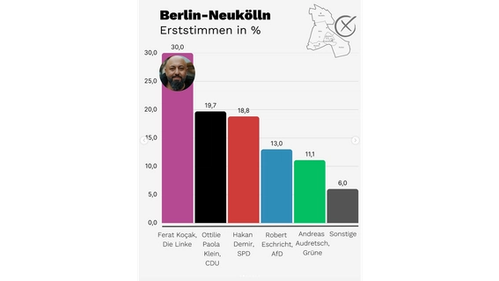
Noikeln elections results
Instagram @der_neukoellner
Before the interview, Frat complains to me that last year was very difficult for him: first the operation, then the death of his grandfather. And between this - accusations of anti -Semitism, which rained down on Ferates for the support of the detained missing protesters in Neukelna. A few days after the election, the large newspaper Tagesspiegel called it a "radical activist", which "polarizes even its own party." Looking at Ferata and how carefully he chooses any formulations on the theme of Israel and Gaza (“I am not on the side of the Palestinians, I am on the side of human rights”), these accusations seem especially absurd to me.
How did the Kurdish anti -fascist managed to become a deputy in the country in which anti -migrant sentiments become more and more? I tried to figure it out in our conversation with Frat.
Your family moved to Germany in the 1970s. Tell me how your parents came here and what they did.
My family has a Kurdish Alevith Alevism is a religious tradition that combines elements of Islam, Sufism and folk beliefs. Most of the Alevites live in Turkey. origin. My parents come from the city of Sivas in Central Anatolia. Father initially came to Berlin to study politics, but he had to quit the university to support his family. At first he worked as a courier, and his mother - a tailor. Then they opened the Kurdish restaurant - things went well until they opened the second institution and burned out. Then the father opened the insurance agency, which served migrants in Germany, and mother worked in the family Derennaya.
My father became a trade union activist, even when he worked in Istanbul. Mom was feminist activist in the framework of the Kurdish movement in Germany. So I grew up in a very politicized environment. But they were involved in Turkish policy, especially in defense of the rights of the Kurds and Alevites in Turkey.
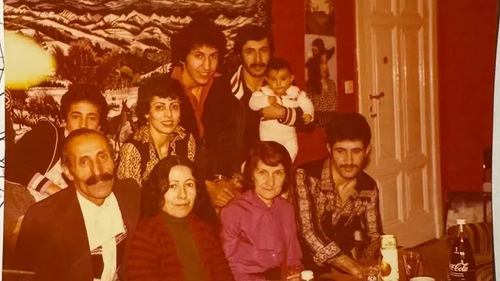
Ferat Kochak family in the late 1970s.
Teamferat.de
I became interested in German policy after neo-Nazi attacks on migrants in the early 1990s. I was shocked when, as a result of the arson of migrant houses in Melna, several Turkish workers died in 1992. I began to go to meetings of youth organizations, where we discussed the fight against racism.
As a child, I did not really face this problem, because they grew up in the Kurdish and Alevik community. We did not even have problems with the Turks, although people of different views came to Germany, including nationalist ones. But in this country we were all in the same boat, we had the same problems, [therefore we did not particularly conflict].
I always felt the problem of racial discrimination by the police. But I was especially hard with racism when I graduated from the university and found office work. There I had many colleagues - elderly white men with very racist views. And you sit there and think: I need this job, I want to make my family happy. But what should I do when one of the bosses gave a racist joke? I think this is one of the reasons why in 2014 I had a burnout and I went to Turkey.
How did you engage in politics?
After school, I received an economic education at the Free University of Berlin. I tried to find work in the political sphere, but it did not work out. My father helped me get a large insurance agency. Then I ceased to be interested in politics. Well, you yourself understand: you have the first job, you first earn money, other things begin to worry you. My friends were joking then: you ride a Mercedes and say that you are an anti -capitalist? [Laughs] I really was an anti -capitalist. But at such moments you understand that life can look different.
Then, somewhere in 2013-2014, I had a crisis, and I wanted to leave Germany. I married a woman from the same region from where my ancestors come from. I lived one year in Antalya, but everything did not work out there, I divorced and as a result returned back. I realized that Germany is my house. Berlin is my hometown. I can't live somewhere else.
Then I returned here and began to engage in politics. [Nothing stopped me:] I had no work, I had no apartment, I settled with my parents. Then I have not yet collaborated with Die Linke [the Left Party]. I voted for them, but I did not feel that they represented me. There are not many migrants in German parties. So basically I participated in street movements.
After the rise of the “Alternative for Germany” in 2016, I decided to join Die Linke to try to confront him. The Neukelnskaya party of the party invited me to become a candidate in the Chamber of Deputies of Berlin from our region, because at that moment the "alternative to Germany" was gaining popularity in the south of Neukelna. [In these elections, Frat doubled the results of the “left”, but he himself did not get to the ward]. So the neo -Nazis first recognized me about me.
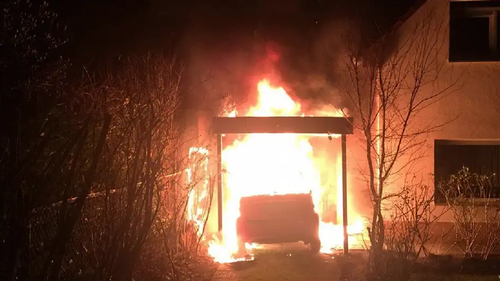
Fire in the family of the Ferat Kochak family.
Picture-alliance/dpa/f. Kocak
In 2018, they attacked the house of my family. The police found out that they specifically followed me to find out where I live and prepare an attack.
At that moment, I worked as a marketing director at a private university. I did a lot of social networks, but did not use them for politics. And at some point I thought: “My life and the life of my family are threatened. The police know about it and does nothing. Okay, then I will use social networks to talk about the attack on my family and other attacks of the ultra -right. ”
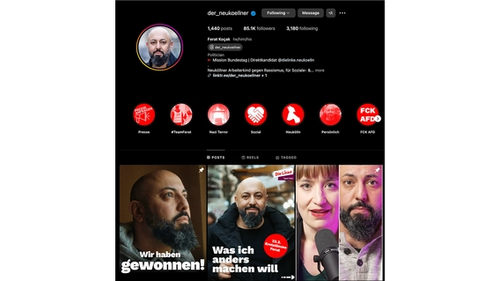
So my account Der Neukoellner appeared [in translation from German - “Neukelsk”] - first on Instagram , and then on Twitter and Tiktok .
In 2021, Die Linke invited me again to become their candidate for the deputies of Berlin. And I said: “Okay, but then I need a good position in the party list in the elections. I do not want posters with my face to hang around the area and that after the elections the Nazis attacked me again. ”
They even then offered me to get out of the federal parliament, but I said that it was unrealistic. This is a typical story for the German left: they need migrant faces to get voices, but if the far -right attacks me, they will not be able to do anything.
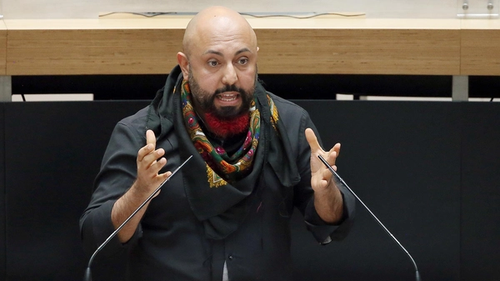
As a result, I was elected to the city parliament, where I became the speaker of the party for anti -fascism, migration and climate. I used this platform in order to maintain lower movements. People told me that I was an activist in parliament, and this is exactly what I tried to work.
Picture Alliance / DPA / Wolfgang Kumm
Last year, the party faced a crisis [it left the Politicals of Sarah Wagenknecht and its supporters, who opposed migration and for cooperation with Russia]. We discussed what to do to cope with this situation. On September 1, elections in Saxony and Thuringia were held, where ADG scored very high numbers, and the “left” failed with a bang. The only positive example was the campaign of Die Linke Nama Duya Nguen in Leipzig, where he was able to go to the land parliament. We decided to try to hold a similar campaign in the parliamentary elections. That's how I became a deputy.
As part of your campaign, you went around more than one hundred thousand apartments ...
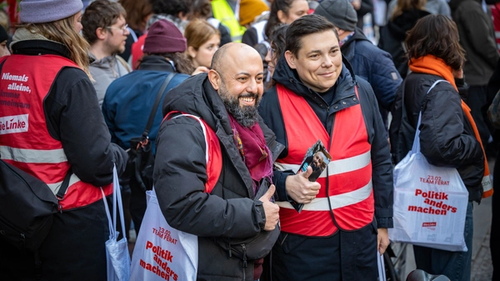
Two thousand people participated in the campaign. We went around 139 thousand apartments and talked with 50 thousand voters.
Wow. What problems did the voters spoke about?
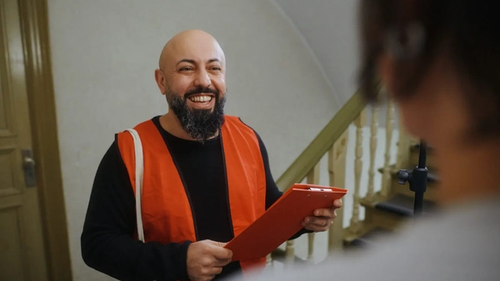
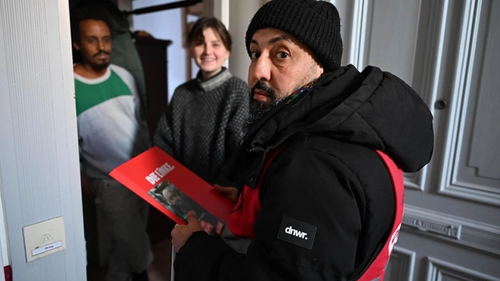
In October, during the preparatory stage, we went around 10 thousand apartments to ask people about their problems. We started with the question: “If you could change something, what would you do first?”
I changed the wording a bit. It was such a marketing idea. I asked: “If you were the chancellor or German chancellor right today, what would you change?” Because then people immediately had the image of an angel Merkel or Olaf Sholz before his eyes.
Teamferat.de
Residents most of all complained about a high rent, food prices were dissatisfied with garbage on the streets. And by public transport, which walks badly.
At the end of the conversation, we invited people to general meetings to discuss these problems. At the meetings, I talked about the fact that all issues of residents will be indicated in my program and I will fight for their decision. I also promised that such meetings would continue [after my victory in the elections] and people will always have the opportunity to come to them and ask: “What have you done over the past three months to solve this problem?” I promised that I would always remain in contact with people from Neukelna.
During the campaign with the bypass of apartments, we worked according to the same scheme, only now at the end of the conversation they called for voting for me in the elections.
At first we focused in the north of Neukelna: many students live here and vote more for the “left” and “green”. In the south of Neukelna there are more right -wing voters who support the CDS and the right wing of the SDPG. But there are three areas in which many migrants live with German citizenship, which usually do not vote.
I always stayed in the center of the campaign, because I am also a migrant, I live here, I speak the same language with these people. Not only in the sense that I say in Turkish and Kurdish. But even in the fact that I speak like an ordinary person, and not as a politician or deputy.
Your strategy with the massive bypass of apartments was very successful. Why wasn’t it used by other candidates?
Other candidates used agitation with the bypass of apartments. But we led her more systematically. For example, [candidate from Social Democrats] Hakan Demir set a goal to bypass 20 thousand apartments in the entire campaign. We went around 36 thousand in one day.
We used the application in which agitators noted in which apartments they were already. We also analyzed who lives in a particular area. For example, to where there are many students, we sent stadulator agitators.
I think it's all about motivation. People believe in me because I have been engaged in activism for the past ten years. I am always in touch with people and lower movements, and they know that they can always call me and I will try to help. That for me politics is not a career. People from a variety of groups joined the campaign: climatic movement, anti -racist and anti -fascist movements, trade unions.
Nici Wegener, 2025
We also managed to mobilize the migrant community. As part of the campaign, I first went into the mosque to talk with the imams. They are scared by what is happening, and see that the “left” is the only party that can help them.
The Kurdish movement also joined the agitation. They also walked around the apartments, but they had their own approach. When they knock on one apartment, then they spend an hour there: they communicate with one family and drink tea. There are many Germans in my team, and they do not understand this approach. [Laughs] In such communities, sometimes talking with one family is more important than talking with a hundred families, because this one family will then tell everyone else.
The first point of your pre -election program was a promise to reduce your salary from 11 thousand euros to 2500, and the rest to sacrifice non -Niza initiatives and needy residents of Neukel is. Did you think it was important for your voters?
The funny thing is that I did this since 2021, but I did not talk about it publicly. In the Neukelne cell Die Linke, we all do this, but before we did not use it as part of the campaign. But in the Leipzig parliament, we saw that in his campaign this was used by Nguyen [candidate from the “left”], and he, in turn, picked up this from the Austrian communists.
But in fact, even at the university, I read about the president of Uruguay Jose Mukhik, who donated almost all of his salary for charity. I remember that then I thought: "If I become a politician, I will do the same."
This place in parliament should belong to Neukelna
It works because people understand: Frat does not do it for the sake of money. He does this because it is important for him.
Our goal was to ensure that the position of the deputy became collective. Of course, I am the face of this movement, and if I make mistakes, it flies to me first of all. But this place in parliament should belong to Neukeln, it should be the voice of Neukel. That is, not just to say: “I am the voice of Neukel,” but really work with people, give them the opportunity to speak out, give them a voice in parliament - for me this is the most important thing. Most politicians do not do that. They turn to people only during the elections.
One of the complaints of your voters is a high crime rate in Neukelna. This problem is well exploited by the right ones, and they have a ready -made solution: more police control, more stringent punishments for criminals. How do the left propose to solve the problem of crime?
In order to effectively fight crime, you must first ask the question about why it is happening. It seems to me that the reason is in the social situation of people. If people are all right in their lives, they do not become criminals. The same with terrorists. Of course, there are always crazy people. But if you think about it [about refugees from Muslim countries], then they come here because of the war, they are injured. You place them in one place where they live in uncertainty and do not know what will happen to them tomorrow. And in these places there are people who wash their brains [and involve them in terrorist activity].
So I think that the most important thing is to give people who come here to build their lives. The same problem with herlitser [Park in Berlin, which is known for selling drugs in it]. Refugees are crossed through the Mediterranean Sea (and many are drowning in it), not to sell drugs to the Germans. They come here because they want to work and help their families.
Germany needs migration because society is aging. There are fewer young people who can make deductions to the pension fund or pay for medical insurance. So Germany needs young people. Now Germany invites workers from Brazil. For what? You have people in the country who want to work. Give them a professional education - and they will work.
Funke Foto Services | Reto Klar
In Germany, we are always talking about migration and crime at the same time. Migration, integration and crime - one ministry is engaged in all this. As a result, it looks like it is all related problems. Therefore, one of the points of the program of our party is to create a separate Ministry of Migration and Integration. To integrate people, it is very important to allow them to participate in the life of society. Let them participate in the elections and become part of this society.
All parties talk about the problem of migration. And the position of our party: we are not talking about migration [as a problem], because migrants are not to blame for the fact that people cannot afford products, cannot pay for rent, cannot find an apartment.
As you mentioned, all German parties, except for the “left”, are talking about problems with migration. The Left program has a very progressive position on this issue. Do you think it is possible to attract the voices of those people who voted for ADG in these elections?
I am sure that there are voters of ADG who voted in these elections for me after I talked with them as part of the campaign.
Когда я прихожу к ним домой, и они говорят мне, что главная проблема — в миграции, сначала это вызывает у меня гнев. Но потом я стараюсь успокоиться и узнать, как именно это влияет на их жизнь. Наша стратегия заключалась в том, чтобы обсуждать с людьми их проблемы, чтобы они осознали, что дело не в мигрантах. Дело в том, что политики работают не в интересах простых людей, а в интересах богатых.
Я называю нашу избирательную кампанию антифашистской, потому что в рамках нее мы смогли отреагировать на расистские нарративы, которыми люди набираются в соцсетях. На одной из наших встреч с избирателями, одна женщина сказала, что ей нравится Алис Вайдель Глава ультраправой «Альтернативы для Германии». . А еще ей нравится Грегор Гизи Влиятельный немецкий политик, член «Левых». . И ее мечта — чтобы они объединились в коалицию. А потом [после общения со мной] она сказала, что ей нравятся мои взгляды, и она проголосует за меня. Так что, возможно, она проголосовала за меня как за кандидата по округу, и за АдГ по спискам. Это безумие, но так это работает.
Как ты думаешь, с чем связан такой успех партии Die Linke на этих выборах? Еще месяц назад по опросам вы не проходили 5% барьер, а в итоге получили почти 9% голосов.
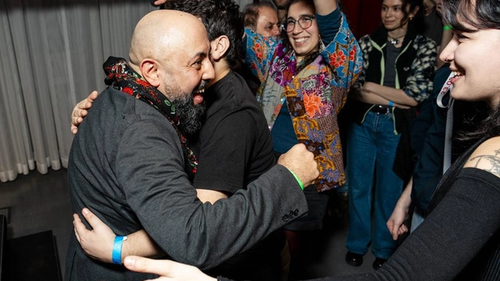
Во-первых, дело в нашей кампании с обходом квартир. Она показала людям, что мы можем повлиять на проблемы, с которыми они сталкиваются в повседневной жизни.
Во-вторых, мы занимались прямой помощью. Например, у нас есть приложение, в котором люди могут указать свою арендную плату и узнать, не переплачивают ли они за нее, и если переплачивают, вернуть себе деньги через суд. Мы также проводили встречи, на которые люди могли прийти и рассказать о своих личных проблемах. Они приходили с самыми разными вопросами. Например, ко мне приходили пожилые люди, которые не умеют пользоваться интернетом и которым нужно было получить какую-то информацию оттуда.
IMAGO/Eventpress/IMAGO/Eventpress Jeremy Knowles
Еще один фактор — все партии сдвинулись вправо и подхватили антимигрантскую риторику. «Левые» — единственная партия, которая сказала: нет, мы не пойдем этим путем. Германия поддерживает войны, продает оружие, и люди потом бегут от этих войн в Германию. Мы на стороне этих беженцев.
Мы также успешно использовали соцсети для агитации. У Хайди Рейхиннек и у меня очень популярные аккаунты в соцсетях, что позволило нам привлечь молодых людей. Многие раньше не знали о том, какую позицию «Левые» занимают по разным вопросам. Все знают, что есть левые, есть зеленые, есть социал-демократы, но не понимают разницу.
Die Linke критиковали за неоднозначную позицию по вторжению России в Украину. В 2023 году партию покинула Сара Вагенкнехт и ее сторонники, у которых были сильные пророссийские взгляды. Как после этого изменилась позиция партии по этому вопросу?
Да, большинство так называемых друзей Путина уже покинули партию. Такие люди, как я, считаем, что нужно критиковать Путина и поддерживать левую оппозицию в России. Однако левое крыло Die Linke также критикует НАТО. И я лично понимаю эту критику: Турция — часть НАТО. Германия отправляет оружие Турции, после чего это оружие оказывается в руках исламистских групп, которые тем же самым оружием убивают курдов и алевитов. Эрдоган делает то же самое, что и Путин, но на севере Сирии. Правильно критиковать Путина, но также нужно критиковать Эрдогана и НАТО.
Я не самый подходящий человек для обсуждения этого вопроса. Но я думаю, что Европе нужна другая политика по безопасности. Мы видим, как Трамп говорит, что европейские страны должны увеличить свой бюджет на оборону. Но мы считаем, что Германия должна стать более миролюбивой страной.
Прямо сейчас Украина находится в состоянии войны, и перед нами стоит вопрос о том, должны ли мы отправлять оружие. Но Европа два года отправляет оружие, и это не помогло достичь мира. Европа ничего не сделала, чтобы добиться мира. Китай и Бразилия хотят стать посредниками в мирных переговорах, но Европа не хочет с ними над этим работать.
И мы уже опоздали. Теперь Трамп хочет заключить мир на своих условиях. Мы идем к тому, что Трамп скажет: «Окей, Донбасс будет частью Россию». This should not be. Это не соответствует левой политике.
В Германии это также чувствительная тема, потому что Германия начала две мировые войны, в которых погибли миллионы людей. Это неправильно, что сейчас она зарабатывает на войнах. Такие оружейные компании, как Rheinmetall, очень много заработали после вторжения Путина в Украину и начала войны Израиля и Газы. Мы считаем, что Германия должна добиваться мира, а не зарабатывать на оружии.
Так что мы не на стороне Путина. Мы на стороне мира. Но я понимаю, почему эта позиция подвергается критике. Путин напал на Украину, начал войну в Европе. Так что люди в Германии боятся, что Путин нападет и на нас, и считают, что нужно больше вкладываться в армию.
Некоторые жители Берлина плохо относятся к Нойкельну. Они считают, что это опасный и неблагополучный район. За что ты любишь Нойкельн?
Когда я был помоложе, то же самое говорили про Кройцберг Район по соседству с Нойкельном. . У меня была девушка, которая говорила: «Моя мама не разрешает мне приезжать в Кройцберг, пригоняй в Шарлоттенбург». "Why?". «Потому что там опасно». Потом мы расстались, и я как-то встретил ее на Котбуссер Тор. Я спросил: «Что ты здесь делаешь? Тут же опасно?». И она такая: «Ну, тут классные бары, вечеринки». Так что вот так.
Медиа всегда говорили о Кройцберге как о каком-то опасном месте, потому что это мигрантский район. То же самое сейчас говорят о Нойкельне. Но это неправда. Да, у нас есть свои проблемы, но главная — в том, что это одно из беднейших мест в Германии.
Ferat Kocak
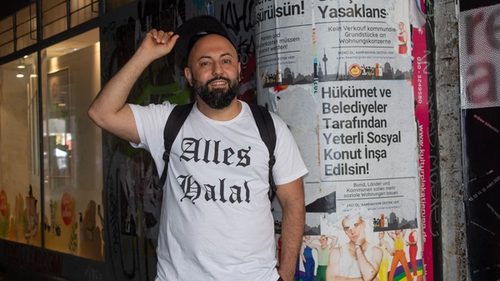
Я люблю Нойкельн. This is my house. Разнообразие — это то, что делает Нойкельн Нойкельном. Нойкельн — это как Германия в миниатюре и в то же время как отдельный город. Так что я нойкельнец. [смеется] Мне нравится гулять по Нойкельну, тут можно очень вкусно поесть. Летом кажется, что ты где-то в отпуске: выходишь на улицу, а там люди из разных стран. Это очень интернациональный район. Я хочу, чтобы весь мир мог быть как Нойкельн. Но без тех проблем, которые есть в Нойкельне.
Other materials
Ультраправые побеждают на выборах в западных странах. Почему и как им помешать?
Подробный разбор от политолога Ильи Матвеева


От экологии к мигрантофобии
Почему на смену «коалиции прогресса» в Германии приходят правые

Как левые (снова) становятся влиятельной силой во Франции
Победа на выборах 2024 года не позволила левым войти в правительство, но все равно внушает оптимизм

2025 год — лучшее время быть богатым
Наследство, монополии и коррупция создают триллионеров прямо сейчас

Музыка billy woods — хип-хоп после революции
Интервью с легендой американского андерграунда
