Date
Author
Константин Гайворонский
Source

Preserved copy
Translated material
Churchill turns into Chamberlain. When their own shirt is closer to the body, the moral absoluts recede into the background
Only the peaks are remembered
yes flowering poppies
What is Monte Cassino
These were the Poles.
- Joseph Brodsky
So, in the first part, we found out how easily world problems are solved when the big guys who profess Realpolitik say to each other. And now let's see how difficult it is to persuade to agree to such a decision of the Plawer Politicians.
Just such a task was to Joseph Stalin and Winston Churchill in the fall of 1944. The Polish Emigrant Government in London did not agree to a new state border with the USSR, or to any contacts with the pro-Soviet understudy represented by the National Liberation Committee.
On October 12, 1944, a delegation of emigrant Poles, led by Prime Minister Stanislav Mikolaich, arrived at negotiations in Moscow. The next day, a meeting took place in which the Polish guests participated, Stalin and Churchill, their Foreign Minister (Vyacheslav Molotov and Anthony Eden), as well as as an observer - US Ambassador to Moscow and Roosevelt’s personal friend William Averell Harriman.
"Lviv - ours, Gdansk - yours"
Stalin's conditions were simple and lapidar. The Polish government in London should have admitted that:
- The Kerzon line is the basis of subsequent negotiations on the demarcation of the eastern border;
- PKNO is the legitimate interim government of Poland, which, when reforming, will include representatives of non -communist parties.
Mikolaychik read out his memorandum in response. Its essence came down to the fact that after the liberation of Warsaw, the Polish government should be restored from five existing political groups, including the Communists. Compromising formulations sounded: a wide coalition, a democratic basis, and so on in a similar spirit. Stalin and Churchill were nodded in agreement until it came to the borders.
Mikolaychik expressed the hope that Poland "would come out of this war of the undistorted."
Then Churchill could not stand it: “The British government supported the proposed border [ Kerzon's line ], because it considered it its duty. Not because Russia is strong, but because Russia is right in this matter. ” Then he with extreme irritation reminded Mikolaychik that the United Kingdom entered the war in order to maintain the independence of Poland. The Englishman significantly abandoned that "at this stage, the Polish government would be unreasonable to separate from the UK."
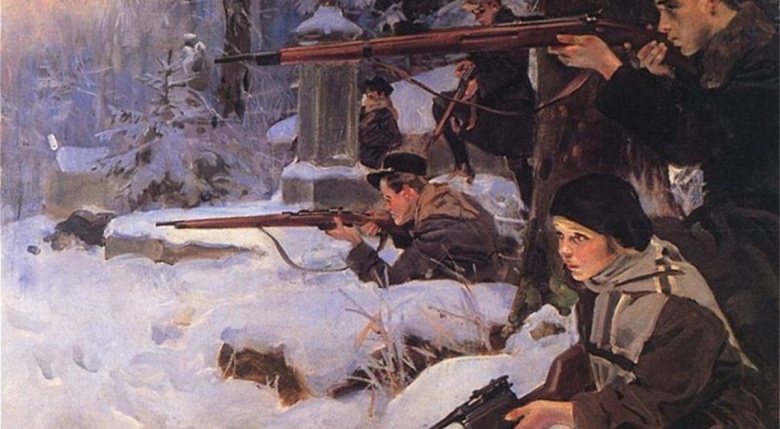
"Lviv Orlates" (ORLęTA Lwowskie), painting by Wojciech Kossak 1926. In the Polish national memory, adolescents-volunteers occupy a special place who defended the city during the Polish-Ukrainian (1918–1919) and the Soviet-Polish (1920) wars
Image: Wikipedia
Mikolaychik insisted on his own, stating that the Polish people would regard as an insult to Lviv’s loss and Vilna. “The Polish people will not understand this, since he believes that Poland should not bear [territorial] damage, if only because there was not a single quisling in Poland.” Stalin in response noted that “the line of Kerzon was invented not by the Poles or the Russians. She appeared as a result of an arbitration decision made by the Allies in Paris [in 1919]. The Russians did not participate in the development of the Kerzon line. " The Polish prime minister does not want to be less Russian than Lord Kerzon?
“Gdansk is clearly no less for Poland than Lviv,” the British prime minister exhorted Mikolaychik. “Among us, Russians, there is an opinion to give Poland not only Gdansk, but also Shchezin,” Stalin echoed him.
But despite this pressure of the two grads of world politics, Mikolaychik refused to publicly recognize the “Kerzon line” as the eastern border of Poland. The verdict of Churchill in the message of the message to King George VI was destroying: “Our [Polish] delegates from London, as your Majesty knows, decent, but weak fools, and Lublin delegates [pro -Soviet PKNO], it seems, are the biggest villains that can be imagined.”
Subscribe to read the whole
Make a subscription Redefine.media to read Republic
Subscribe [you can pay for a Russian or foreign card. The subscription is extended automatically. You can unsubscribe at any time.]
Where are the money subscribers going