
Translated material
The time of dictatorship and the time of man
Ivan Davydov - about the diaries of Victor Klemperer
In Russia, forty years after the first publication in the GDR, the diaries of Victor Klemperer, a German Jew who lived under the Third Reich and managed to carefully document everything that happened around him - from the language of newspaper editorials to the death of friends in concentration camps and disasters on the Eastern Front - were published. Read about what else this difficult book in every sense can tell our contemporaries in the material by Ivan Davydov.
All of us, since February 24, 2022, have found ourselves in the face of advancing barbarism, violence and lies. In this situation, it is extremely important to preserve at least the remnants of culture and support the values of humanism - including for the sake of the future of Russia. Therefore, the editors of Gorky will continue to talk about books, reminding our readers that there is still a place for thought and fiction in the world.
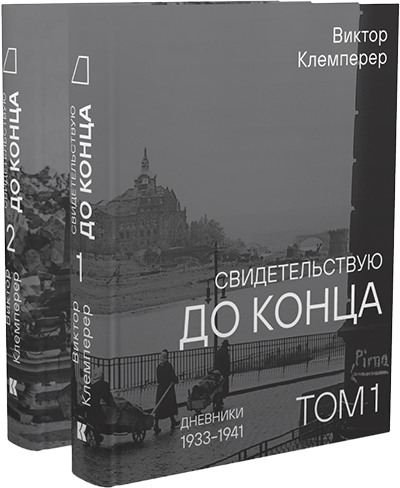
Victor Klemperer. I testify to the end: diaries 1933-1945. In two volumes. M.: Kuchkovo field; Jewish Museum and Tolerance Center, 2025. Translation from German by T. F. Datchenko. Fragment
 In the late nineties, Victor Klemperer’s book “LTI. The language of the Third Reich." This is probably the most famous work of the German philologist - hardly even specialists now read his works on French literature of the Enlightenment. “Language” is a different matter. An unusually fascinating, subtle and accurate story about how speech in a totalitarian dictatorship becomes a weapon for exterminating the undesirable. With vivid examples, sometimes even funny, although it would seem that the material is not conducive to fun at all.
The first original edition appeared in 1947, and here we need to understand the context. Klemperer is Jewish. Son of a rabbi. A veteran of the First World War with military decorations, who converted to Protestantism in adulthood, and even, perhaps, a little bit of a German nationalist. A famous scientist with a bunch of publications, a world figure, an article in the Brockhaus was dedicated to him during his lifetime. But since 1933, only the first characteristic has been important in Germany. Jew - that is, excluded from the world of the living. A Jew means a condemned person. That is, doomed.
He did not leave Germany. At first I didn’t dare, and then there were no opportunities left. Until the end of the war - in Dresden, the road from life to survival, and from survival to death, stretched out in time. But he survived and all this time he collected material about the mutations of the German language under Hitler. Speeches of leaders on the radio, newspaper editorials, front-line reports, chatter of ordinary people. Extreme poverty of vocabulary. Craving for superlatives. Willingness to forget with unimaginable ease what was very important just yesterday. Words that become fashionable and then disappear without a trace. Well, for example, “blitzkrieg”. And an unstoppable craving for abbreviations. Actually, the very title of the book contains something like a parody, a play on Nazi acronym passion: “LTI” is also an abbreviation, Lingua Tertii Imperii, the language of the third empire.
He made notes for a future book, realizing that he would never write a book, much less publish it. But these are minor things - the main thing is that if the records are found during a search, he will be killed. Literally. And everyone mentioned in the recordings will most likely be killed, too. My beloved wife, friends, acquaintances. Even random people they meet, whose conversations Klemperer recorded, can be found and punished: the Gestapo has good specialists, they know their job.
He understood this and wrote anyway. Asking himself from time to time the question: does he have the right to risk other people's lives? It really bothered him. The answer he found: it is the duty of a scientist. Perhaps not morally blameless. But Klemperer chose him. Eva, my beloved wife (Aryan - this is important, “mixed marriage” until recently served as protection from the concentration camp), took the covered pages to a good friend, also an Aryan. Everything survived. It's almost impossible, but everything survived.
He also tried to write books - a history of French literature of the 18th century and his own autobiography. Both, by the way, were completed after the war, both were published.
In addition, Professor Victor Klemperer kept a diary all this time.
***
The diary has its own destiny. Klemperer remained in the GDR. They didn’t touch him, he was allowed to work, he was published, he was awarded, but the diary did not reach the court. Individual fragments were published in the sixties, but the first major publication appeared only in 1985 (the author has been dead for 25 years). And then - fame, unflagging attention, complete editions, translations, documentaries. So Russia has waited in the wings. True, another forty years later: Victor Klemperer. “I testify to the end. Diaries. 1933–1945." Moscow, “Kuchkovo Field”, Jewish Museum and Tolerance Center, 2025. Two volumes, about one and a half thousand pages, translation by T. F. Datchenko.
The volumes are huge, a real monument, and this is actually a monument. To the author who survived, who had the courage to see and remember, who told us about one of the main nightmares of humanity. And to everyone who didn’t survive, of course, too. To them - first of all.
There is probably nothing comparable to anything in my reading experience. You involuntarily remember Anne Frank's diary. This, I think, is generally one of the most terrible books that humanity has: a talented little girl chats with you, chatting about boys, about American movie stars, about books, about cats, about plans for the future, yes, but you know how it all really ends. Actually, not in the book. There is no future ahead, there is death. And you know it, but she doesn’t. And from this the reading process turns into an inescapable icy horror. But still an accomplished man (in 1933 Klemperer was fifty-two), a university professor, an experienced writer, who, moreover, is not hiding in a shelter, but lives in a large German city - with a yellow star on his chest and with a kenkarta, a special Jewish passport in his pocket - sees differently and sees more.
Reading is like a slow descent into darkness, into a space where there is neither light nor air, where a person simply cannot live. Slowly - great history is characterized by a certain sadism. A page, a step - and a little darker around. And one more thing. And one more thing. And now there is nothing but darkness, and the text is not going to end.
A diary is a special book. The author does not build a plot, does not invent characters, does not try to prove something to the reader. He simply records the events happening around him (a strange mixture of extreme subjectivity, auto-description with extreme objectivity). And yet, wading through the horror of someone else’s everyday life, you begin to understand that the book has a plot.
***
This book is about the clash of times. The time of a dictatorship and the person whom the dictatorship declared an enemy are different. Or rather, this: a dictatorship that has overcome the period of formation, has taken shape, has come - if we ignore the language of the third empire and switch to the language of the St. Petersburg gateways - to success, there is no time at all. A successful dictatorship is a realm of static.
First - a rapid flow: Hitler comes to power, Hitler acquires allies, Hitler destroys his enemies... Between the Night of the Long Knives and Kristallnacht there are four years and an eternity. Kristallnacht is an important point: there is nothing to be ashamed of, positions are outlined with final clarity, there is nothing in the pogrom that could confuse the established government and its admirers. And then time in a dictatorship seems to disappear, becoming a redundant category. The sequence of events is not important (and in a sense, even a world war, as long as it consists of victories, does not become a real event: it does not move time, it strengthens timelessness). Does the author feel something like that? I don’t know, the author is in a situation of personal catastrophe, we’ll talk about the author now, but the reader definitely feels: it doesn’t matter at all when and what the dictator will make his next speech, what will be in the new front-line report, if this report is about the latest successes of German weapons, it doesn’t matter what the newspaper editorials are filled with and what novels are published by writers officially registered in the Imperial Chamber of Literature... The world of the established dictatorship is a gray frozen jelly in which there is a lot of things nothing happens and nothing happens at all. These changes are prohibited and most likely punishable. Dictatorship means peace.
But the person whom the dictatorship declared an enemy is in a completely different situation, of course. Catastrophe is dynamics. Inside a personal catastrophe, everything is moving upward. At first, our hero is only unpleasantly surprised by what vile types can come to power in his enlightened Germany and what nonsense can be published in newspapers. However, he lives, completes a house in the suburbs, buys a used car, drives around the neighborhood with his wife, plans new books and even works on them. And over evening coffee with friends he sighs: this cannot last long, they are about to disappear, because how could it be otherwise?
But time is moving faster, and the troubles are becoming more terrible: now he is fired from the university, because there is no place for a Jew in the civil service. True, he was dismissed with a pension and almost with honors, and the only trouble is that the pension is not large enough. He, a famous scientist and war veteran, could have been given more. The wife plants a garden near the house, they go for rides in the car, and friends over coffee do not lose confidence: this cannot last long.
Now he is no longer allowed to publish reviews in magazines, and it is clear that the books he writes are also unlikely to ever be published. And this cannot last long, but it continues, it does not want to end, it seems like it will never end at all. The car has to be sold cheaply because Jews are no longer allowed to drive cars. Instead of their own house - a “Jewish house” (there was no ghetto in Dresden; Jews were settled in separate houses). The Star of David blooms on the chest, a special passport with a large letter J, a beautiful Gothic font, appears in the pocket. He is no longer Victor Klemperer, but Victor Israel Klemperer, this is required by racial laws. If the name is not “Jewish,” then Israel is a mandatory addition.
Cards, searches, humiliation in the Gestapo, even prison, although only for a week: a retired professor violated the rules of blackout, forgot to lower the dark curtain in time. A German would be fined for this, but a Jew could be killed. Klemperer was lucky. Anecdote - questionnaire in the Fourth Reich, questions: how long were you in prison under Hitler? If you didn’t sit, then why?
The death of Mouchel the cat. Jews are prohibited from having pets; they must be disposed of, but the Klempers manage to take their pet to the veterinarian for euthanasia a couple of days before the new order comes into force. They give the beast an easy death. Conversations that this won't last long are dying down. In the notes are the dates of death of those with whom Klemperer had these conversations. And the names of the death camps where they were killed. Dachau, Theresienstadt, Buchenwald, Auschwitz. Warsaw ghetto, Riga ghetto.
And (this is, perhaps, an optional remark that allows us to understand something about the larger history) information about the lives of the leaders, ideologists and commanders of the Reich mentioned in the text is also available in the footnotes. Some died in the war, some committed suicide in 1945, some were executed. But basically everything is not bad: “sentenced to life imprisonment, released after three years for health reasons.” Or even: “hid in Argentina.” Sometimes history is condescending to people.
A strange detail (this is already related to the question of German order): in 1941, 1942, and even 1943, relatives from concentration camps were sent urns with the ashes of the tortured. They are buried in a Jewish cemetery with prayers and all the required ceremonies.
***
And then there comes a moment when personal time stops. There are no more searches, because there is nothing to take from the doomed. There are no new prohibitory laws, because almost everything is prohibited. There are several dozen Jews left in Dresden, and they themselves do not understand why they continue to exist. Personal catastrophe rests on statics. Even empathy goes away: the author notes that reports about the latest victims do not evoke any emotions in him. “I’m still alive” is all he can think.
But there are also changes in the dictatorship. A catastrophe gives back time to a dictatorship. 1943, Stalingrad, first strange reports from the front: “After long and protracted battles, our valiant troops managed to capture a three-room apartment with a bathroom” (and this is not a cruel joke, this is a quote). Then these reports contain less and less specificity, and newspaper editorials contain more and more calls for fanatical resistance. LTI actually loves the word “fanatical.” And it is already clear that this really cannot last long, but there is no one else to gossip over coffee with Professor Klemperer: almost all the interlocutors have been exterminated, and there is no coffee to be had.
The two time streams are woven together by a catastrophe, visible with our own eyes - the bombing that destroyed Dresden. The world of dictatorship collapsed along with the beautiful baroque buildings; it’s enough just to remove a star from your jacket to get lost among the crowds of survivors. And then the war is over, and people around suddenly begin to say in unison that they have always hated the Fuhrer and the party, and the Jewish passport turns into a document capable of opening any doors in the offices of the new masters of Germany.
During his refugee wanderings, Victor Klemperer is accosted by a Soviet officer with incomprehensible, but possibly threatening speeches. “My brother treated Lenin,” the professor tells him. And it’s true, Georg Klemperer once went to Moscow for consultations to save the leader of the world proletariat. However, it didn’t save me.
***
Klemperer survived. Both his house and his manuscripts survived. A personal happy ending, slightly poisoned by unanswered questions. Where are the real Germans, who are they? Those who, risking their freedom or even their lives, in the most terrible years approached on the street to secretly shake hands with a man with a yellow star? Sharing extra potatoes? Or those who shouted insults after him? Or a Gestapo man who liked to spit in women’s faces during searches? Could he, Victor (no longer Israel) Klemperer, become a German again? How? And how will children, who seem to have been saturated with Nazi propaganda more than adults, be healed?
The Germans (who, of course, always hated Hitler, etc.) have their own questions: could German soldiers have done the horrors in Russia and Poland that the victors are now talking about? Could they? The winners are lying, they are probably slandering.
There are no answers, the Russian edition of the diary ends suddenly, Victor and Eva are in Dresden, their house will be returned to them, there will be new flower beds and a new cat. And books, and coffee, and human life. But the people who stayed in Theresienstadt, Auschwitz and Dachau will not come to chat over coffee. Never again.
***
Books about the Third Reich and the first post-war years of Germany are now in fashion, many of them have been published, there are even entire book series. It’s probably clear why this is so, but it doesn’t matter. Historical analogies are a bad, worthless way of reasoning; the point is not what it looks like.
It is important to remember that people - educated, intelligent, civilized, normal, cultured, and so on, the Germans were exactly like that - can quickly turn into something like this. Something that Klemperer talks about in detail. They can. He is a witness. Not at all impartial, but it wouldn’t have worked out any other way.
And yes, a belated disclaimer: this is a heavy book. The German professor showed in too much detail how the terrible transformation occurs. Step by step, a little darker, a little deeper... When starting to read, keep in mind: it will hurt. It will definitely hurt you. That's how it should be.