
Translated material
Superstrings for a snowman in the flames of hell
About the book “Amazing Numbers of the Universe. Journey beyond imagination"
Wanting to show how deep the rabbit hole goes, theoretical physicist, cosmologist at the University of Nottingham and YouTube blogger Antonio Padilla takes a tour of the Universe, mostly in its extreme states. He takes as his companions some of the most outrageous numbers mathematics has ever known. So, the Graham number is so large that if you try to imagine it, your head will collapse into a black hole (and this is not even a metaphor). Or an extremely small number 10–120, thanks to which the Universe known to us can exist for more than one moment and not collapse to the size of an atom. However, is it known? It is possible that we live in a three-dimensional hologram, and the world is actually two-dimensional - at least there is such a hypothesis.
Antonio Padilla. Amazing numbers of the Universe. A journey beyond imagination. M.: Mann, Ivanov and Ferber, 2025. Translation from English by E. Ponikarov. Content
 Entropy is growing
In abstract mathematical notation, monster numbers can only really excite geeks (again, mathematicians). For everyone else, they are like Leonid Andreev for Leo Tolstoy: they scare, but usually no one is afraid.
Perhaps this is in vain. So, the Graham number (we talked about how to calculate it in the material dedicated to another book) is much larger than such huge numbers as googol, googolplex and even googolplexian .
But first, a few words about two important concepts that need to be understood in order to approach this issue. It's about entropy and information.
We briefly mentioned the connection between entropy and heat and energy in the material about the book by physicist Carlo Rovelli (by the way, Antonio Padilla is in some way his opponent, which we will talk about later). Entropy can be described as a measure of the irreversible dissipation of energy or its uselessness. Whether we are talking about cars or wind turbines, they always lose something in the environment, since not all the energy is used for useful work.
The constant increase in entropy (sometimes it remains at the same level, but since our Universe is very large, within the general chaotic reality of the physical world it still increases) describes the second law of thermodynamics . As entropy increases, more and more energy is converted into useless heat output, so from a global perspective, the future, as Antonio Padilla writes, is:
“<...> a post-entropic nightmare, overcome by paralysis. Heat death awaits us, a Universe awaits in which there is no movement, no action.”
There are other versions as to what beauty will be like far away, but that’s not what we’re talking about now. If we imagine a gas - that is, a vast expanse of emptiness with chaotically moving atoms and molecules - as a room, and Brownian pirouettes of particles as insects flying from corner to corner and sometimes colliding, then entropy can be defined as a census of all the microstates of the participants in this process.
Imagine a record of the location and movement of every molecule and every atom: where they are and what they are doing at any given moment in time, exactly how each of them rotates, how they interact, with what speed and force they repel each other. Atoms themselves are made up of building blocks, each state of which is also described. The result will be a breathtakingly detailed report.
Entropy is a measure of this hidden detail, since it takes into account all microstates that maintain the invariance of the macroscopic properties of an object. We can talk about entropy in any other context where there are microstates of the system, be it a car or a human body. In each unit of time, the composition of the fuel in the gas tank changes at the molecular level, as does the microflora in the human intestine. There are myriads of such processes, this is a swarm of states unimaginable to any mind. The number of these microstates only increases over time, which means that entropy always increases and never decreases.
Kamikaze calculus
Entropy is closely related to information. Moreover, Padilla brings these two concepts closer than ever, considering them, with some reservations, one and the same, since they both measure the degree of uncertainty, but in different ways.
At the same time, information can be massive , says Antonio Padilla. The value of this mass depends on the form in which the information is stored. For example, in a smartphone, data is stored by trapping electrons in a memory unit, these electrons have slightly higher energy compared to electrons outside the trap, and since they have more energy, their mass is also greater (a direct consequence of Einstein’s formula E = mc2 - mass is equivalent to energy). On average, one bit of data adds 10–26 milligrams of mass. Therefore, to increase the weight of a gadget by the weight of a speck of dust, it needs to store 10 trillion gigabytes of data, which is comparable to the volume of the global datasphere. In other words, the weight of information to a first approximation may seem quite insignificant. But everything is known by comparison - and this is where we begin to approach Graham's number.
What would happen if someone took upon themselves the feat of imagining it in full, that is, introducing all the information about it into their head? There are ~100 billion neurons in the human brain. If we take into account that each of them can either be excited or not, we get ~ 100 billion bits. These are extreme indicators: in reality, the person who would use so many resources for any practical application has not yet been born. Except for our suicide bomber...
There is no point in trying to repeat this, since all these calculations, of course, are purely theoretical - in fact, no head can work with such a mind-boggling amount of information. But if you imagine what it can still do, accumulating gigabytes after gigabytes?..
Since information has weight, you will eventually have to pack more than ten times the mass of the Earth into one head (information weighs little, you say?). All these processes will cause exorbitant internal pressure and monstrously high temperatures in our heroic head - and it will finally explode.
Is your head tired? Let's imagine that for some miraculous reason the accumulation of information will continue after the explosion of the skull. Once we reach the threshold of 10 billion trillion trillion trillion trillion gigabytes (for comparison, the Large Hadron Collider produces 10 million gigabytes of data for an entire year), there will be a black hole where the head was (as always happens when you try to cram too much into too little space). By cosmological standards, this will be a black hole of modest size, since the average radius of a human head is about 11 cm. But this will already be a very solid “hard drive”, because even the idea of using black holes for storing data has been expressed .
But next to Graham’s number, all this is zilch - it’s still like before Chinese Easter.
You can continue to accumulate data and become more and more fulfilled in your knowledge, like Stalin’s brain filling the entire Universe from the sentimental novel “Blue Lard.” But sooner or later, nature itself will begin to resist this growth, forcing the Universe to go into the Big Crunch . In other words, our Universe is not enough to record all the information about the Graham number. Need more.
And we have them.
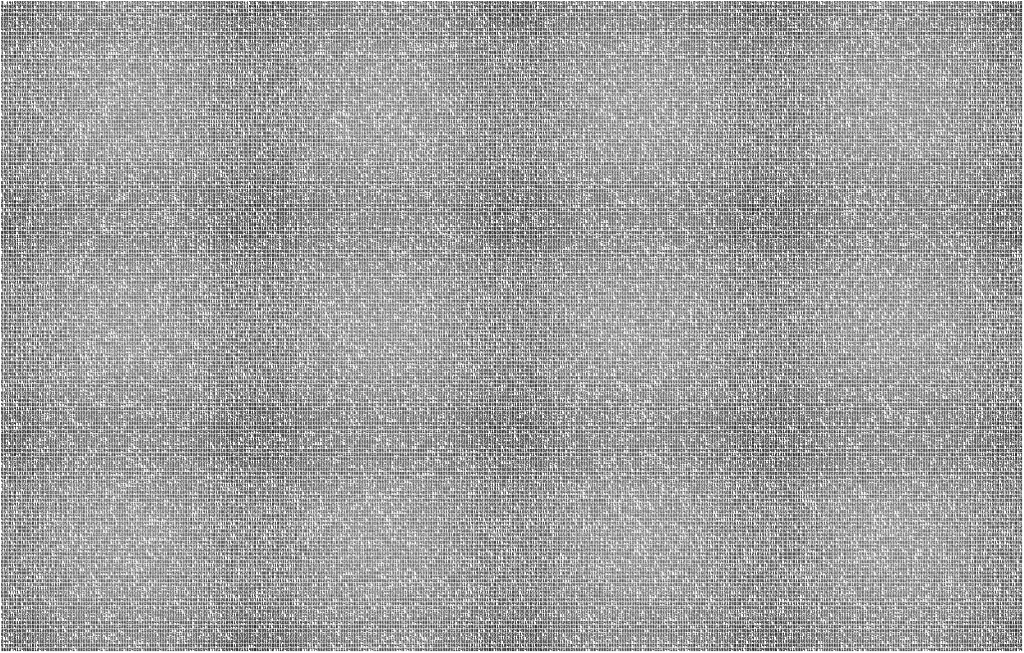 This is what a small fragment of Graham's number might look like. If you look closely, you will notice that the gray ripples are numbers
At least theoretically, the continuation of this story can still be conceived by using the hypothesis of the Multiverse , that is, the coexistence of many different Universes with different laws of physics. Then, perhaps, sooner or later, somewhere and sometime there will still be a place for the Graham number.
But there are also numbers for which in this reality there is not even an intuitively clear way to realize that they exist at all. For example, this number TREE (3) is even greater than Graham's number. To deal with him, you will have to go through more than one Poincaré return time , necessary for a complete reboot of the Universe. After each such on/off, an exact return of the entire universe will be carried out, down to the location of individual atoms in every star and planet, in every insect in the room and in every copy of “Blue Lard” destroyed by HOA activists . Many such reboots will need to be done. But even then the goal will not be achieved. The laws and settings of our Universe simply will not allow us to get closer to TREE (3).
By the way, about the settings - the monster numbers also managed to reach them. But this is already good news for us.
Unsteady constants
Now we will talk about a monstrously small number - 10–120 . However, there is nothing to be afraid of here, but there is something to be surprised by. Earlier we talked about the fine tuning of the Universe , thanks to which the visible and invisible world exists. Here, without mincing words, we must immediately state that, in fact, our Universe, like us, should not exist. The fine-tuning of fundamental physical constants (the speed of light, the charge of an electron, the gravitational constant, etc.) is so fine that the probability of the constants having the value that they actually do is about the same as if you flip a coin and it comes up heads 156 times in a row. Numerically, this is equal to 10–47 or:
0, 000 000 000 000 000 000 000 000 000 000 000 000 000 000 000 01.
Moreover, emptiness itself has colossal energy. This vacuum energy (zero point energy) arises from quantum fluctuations - virtual particles constantly being born and disappearing (like exploding caramel in the mouth or dolphins jumping and diving back into the sea) that permeate all space-time and are an integral part of it. According to calculations, in each sector of space the size of a teacup there should be nearly one hundred thousand trillion trillion joules of energy. This is quite enough to evaporate all the oceans of the Earth. Only in one cup.
With such a colossal amount of energy, the Universe, obeying Einstein’s laws (let’s remember E=mc2 again), should be literally crushed and crushed under the weight of nothingness - emptiness. And since vacuum energy is omnipresent, the world would have to have an insignificant extent - it could not even reach the size of an atom.
But in reality everything is somewhat different, as each of us has noticed. The true value of the vacuum energy density is 10–120 of what it should be according to calculations. If you write this number as a decimal, it looks like this:
0.000000000000000000000000000000000000000000000000000 0000000000000000000000000000000000000000000000000000000000000000000000001.
One tea cup of vacuum will not evaporate not only the ocean, but also a puddle, or even a drop. It takes at least 10,000 cups of energy just to crush a mimarid , the world's smallest insect (0.14 to 4 mm).
"Light map" of Plato's cave
One of the most fascinating ideas in physics at the turn of the 20th-21st centuries is the hypothesis of a holographic Universe . It is about how gravity and three spatial dimensions are in some sense an illusion. We supposedly live in a holographic world, locked within the boundaries of the space that we usually perceive. We are like inquisitive two-dimensional cockroaches exploring the three-dimensional world, but the difference is that the world is actually two-dimensional. However, this is just a hypothesis. But it is gaining more and more popularity among scientists.
“The holographic principle is the most important idea to emerge in physics in the last thirty years. It led to breakthroughs in our understanding of the force of gravity, the resolution of the black hole information paradox, and a deep understanding of the nature of quantum gravity. <...> Moreover, it challenged our perception of reality, our idea of the space around us. It prompted us to question whether it really exists or is just an illusion . "
Scientists Gerard Hooft (Nobel Prize winner) from the Netherlands and physicist Lenny Susskind from Stanford formulated this idea in the early 1990s as follows: if black holes are at the top of the entropic “food chain” (as we discussed above in connection with the exploding head), and if maximum entropy is determined by the surface area of the black hole's boundary, then one could assume that all information is stored at that boundary. In other words, a certain volume of three-dimensional space is completely encoded on the boundary of this volume - on a two-dimensional surface. It's as if the contents of a package could be found on its packaging.
And if we go even further, we can imagine physics in which some spatial dimensions would be superfluous and, moreover, illusory. Since the boundary covers everything, these measurements are simply not needed. In this sense, the border is everything .
In much the same way, a hologram is created, which is not a static image, but a “light map” of a three-dimensional object. In a hologram, light, optics and physics combine to encode higher dimensional (3D) information onto a lower dimensional (2D) surface.
“The brilliance of the hologram is that it allows you to create code for a three-dimensional image on a two-dimensional plate. Roughly speaking, you can think of the density of light and dark stripes as representing depth along the missing dimension. In other words, a dense dark stripe encodes some perpendicular distance close to the plate, and a lighter stripe depicts something further away. <...> You experience three dimensions rather than two because that is how your brain chose to decode light and dark bands. He decided to think of them as a third spatial dimension and a little bit of gravity.”
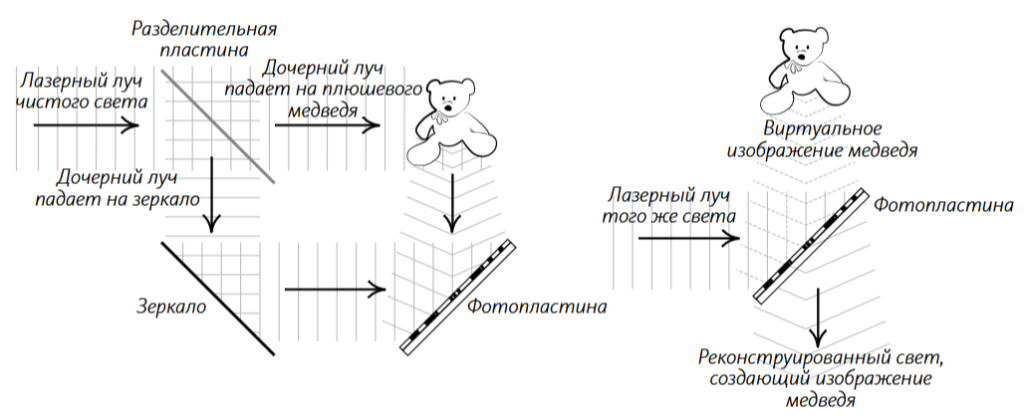 How to create and decode a hologram (illustration from the book)
And if in this regard we recall Plato’s textbook cave, then the shadows on its walls will be no less real than the objects casting them. Or we can put it another way: these objects are no less illusory than shadows. In the holographic world, we and the world around us are shadows. There is nothing in it but shadows.
Or maybe quantum fields ?
New spaces up your sleeve
Quantum physics has given us a picture of the world that is counterintuitive and generally not very comparable to everyday experience.
For example, particles in such optics are just vibrations - quantum ripples of quantum fields. If we take the surface of the sea as an analogue of some fundamental field, then when a ripple appears at the top of such a wave, this will be the equivalent of some kind of particle. Ripples in different fields are different particles. A ripple in an electron’s field produces an electron, in an electromagnetic field a photon, etc. Here we can also talk about real and virtual particles: there may be real photons, or there may be virtual ones (like electrons, quarks, gluons, etc.). A virtual particle is simply some kind of field disturbance caused by other particles and other fields.
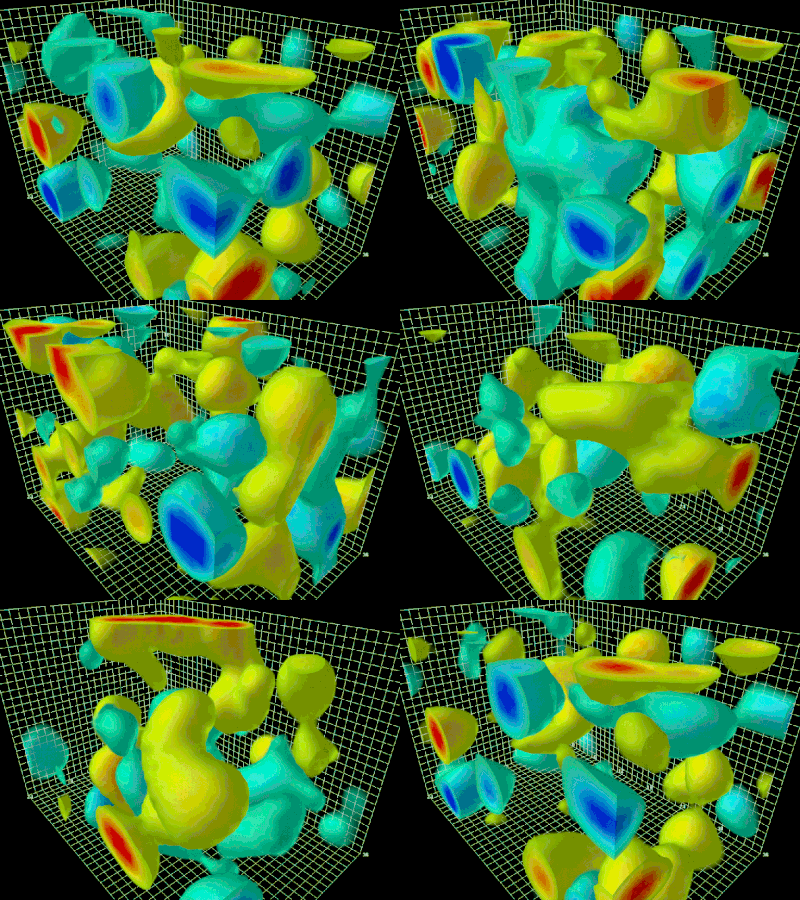
Earlier we mentioned physicist Carlo Rovelli, an adherent of the theory of loop quantum gravity , on which hopes are pinned for the possible reconciliation of quantum physics and classical physics. Opponents of loop theorists are string theorists, who believe that a future theory of quantum gravity will be based on string theory. Antonio Padilla is one of her supporters.
The essence of string theory is that at a fundamental level we are dealing with extended objects of zero thickness, zero width and having only length. These are constantly oscillating open/closed loops—strings—in an infinite number of different ways.

String theory only works if spacetime has a dimension of 26: one time dimension and 25 spatial dimensions (in superstring theory, this dimension was reduced to 10 dimensions). By the way, in general there is not one string theory, there are five of them: type I, types IIA and IIB, and two heterotic string theories (we will not go into the details of each of them now). Uniting five different versions of string theory is M-theory (it has 11 dimensions), where the fundamental objects are branes (extended two-dimensional or more dimensional membranes) - vibrating objects of a higher dimension than strings.
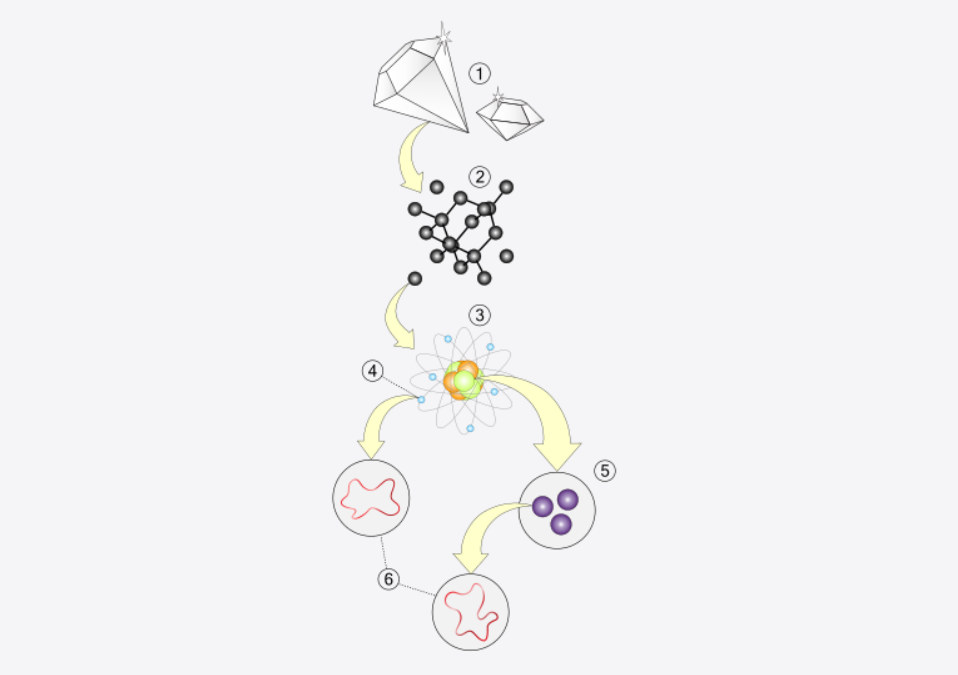 Levels of the structure of matter: 1. Macroscopic level - substance. 2. Molecular level. 3. Atomic level - protons, neutrons and electrons. 4. Subatomic level - electron. 5. Subatomic level - quarks. 6. String level. Source
Where are all these extra dimensions if we live in a four-dimensional world with three spatial and one temporal ? Yes, anywhere - even in your sleeve. Like a wilting flower, in superstring theory the extra dimensions seem to “wither” or curl up.
“They are everywhere - from here to the Andromeda nebula <...> But they are curled up and invisible - a silent eternal partner living next to our macroscopic world. Measurement is just another direction of movement. When we say that space has three dimensions, we mean three independent directions of movement: forward and backward, left and right, up and down. The six extra dimensions of string theory are just six new directions of motion. But they are folded up like tiny circles, and you won't be able to go very far in these new directions - you'll just end up right back where you started...we're just too big to see them. We don't even see them at the Large Hadron Collider, although we look into a world that is a billion times smaller than an atom. If extra dimensions exist, they are simply eclipsed by everything we see in nature. <...> there are googols of ways to collapse them.”
All this happens on mind-bogglingly small Planck length scales of the order of 10–32 cm: if an atom were the size of a galaxy, then the strings that make up its electrons, quarks and gluons would be no larger than a fly.
However, string theory has not yet received experimental confirmation: the Hadron Collider has never detected supersymmetric particles in the energy range where they were expected to be seen. This disappointment is especially acute after the discovery of the Higgs boson, one of the most important events in science of the 21st century (its mass is 0.00000000000000001 of what was expected; physicists still, since 2012, have not found a clear explanation for this).
“Discovering such a Higgs boson <...> is like finding a snowman in the flames of hell. This can happen, but in reality it should not happen,” writes Antonio Padilla.
However, we have already learned that many things should not exist in reality, like reality itself.
But it still happened.