
Translated material
How about learning this spring?
"Smolny without borders" opens an additional acceptance of applications for semester courses
On February 8, 2024, DOXA was included in the register of "undesirable organizations."
If you are in Russia or plan to return to it, you can not replace our materials on social networks, refer to them and publish quotes.
Read more about what is possible and impossible, read in the cards .
What's what?
An independent educational project “Smolny without borders” announced an additional acceptance of applications for new courses of the spring semester. They are all free!
You can apply for semester courses until March 17 on the Smolny without borders.
The program contains the art of analyzing data and introduction into it, historical memory in Europe during the Russian-Ukrainian war, western on the Soviet screen and other courses.
The program of free online courses of university levels, which are read in Russian and English. By passing the vast majority of courses, you can get loans. The main feature of the training in Smolny is that the lecture format is minimized, and from the student: to actively participate in pairs.
We asked the teacher: Smolny Smolny without borders recommend a potential student: a camp for one text or film that is somehow connected with their courses.
Ethnic and language policy in central-eastern Europe
The author of the course is Oleksandr Vasyukov
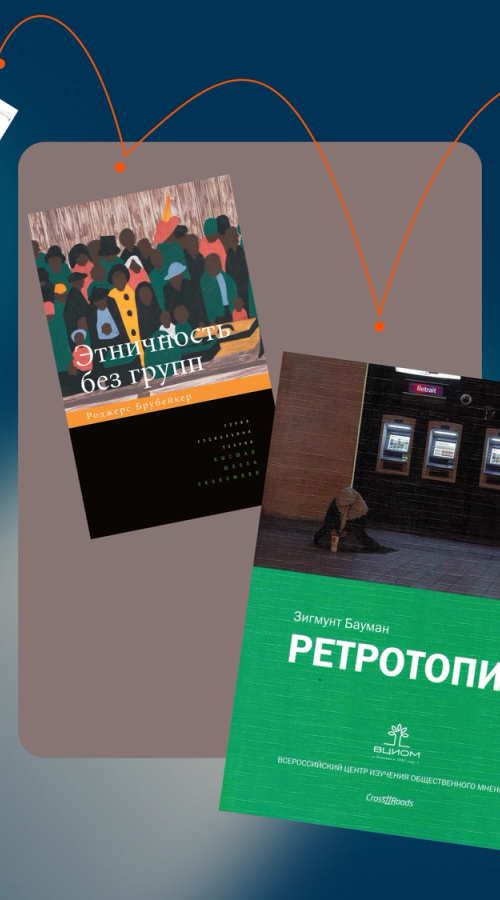
Read: Rogers Brubeker, "Ethnicity without groups"
Wars, communism, Transylvania and the centuries-old (or seemingly so) Hungarian-Romanian rivalry is a wonderful background in order to plunge into one of the best studies about ethnic conflict and the construction of social.
In his book, the American sociologist Rogers Brubeker breaks with the traditional approaches of social anthropology, calling for abandoning “groupism”, or the perception of ethnic conflict as a confrontation of two (or more) groups. On the example of one of the dozens of prolonged ethnolinguistic confrontations in central and eastern Europe, the scientist helps us to gradually make sure that the ethnos is not a collective personality with his inherent unified identity, interests and strategies, but rather the result of a certain political project that is invented, justified and approved by special “entrepreneurs”.
Reading this book within the framework of the course on the ethnopolitics of Central Europe will help many in a new way to look at the ethnicity as a special worldview, which includes ethnically colored ways of vision or ignoring, explanation, memories and oblivion of social facts.
Georgia in the social sciences
Author of the course - Vera Ivanova
To viewing: “Social dilemma” (Netflix, 2020)
The Social Dilemma talks about how technological giants use analytics for users manipulating.
The film consists of an interview with former high-ranking employees of companies such as Facebook, Google, Instagram and others who left their posts due to the fact that they considered certain ways to use data analysis within these companies unethical.
The film discusses how the algorithms offering us new content based on the analysis of our behavior can not only cause dependence on social networks, but also lead to geographical and social polarization of opinions and the spread of disinformation in society.
This film is a call to think not only about the need for a critical attitude to the information that we receive through social networks, but also about the impressive possibilities of applying the results of data analysis.
Data analysis art: visualization
Author of the course - Vera Ivanova
To view: The Great Hack (Netflix, 2019)
One of the films that perfectly explain the principles of data analysis and their impact on the real world is the Netflix documentary “Big Hak” (2019).
The focus is the effect of using data on social networks on political solutions.
The film illuminates the scandal associated with the London company Cambridge Analytica, which provides political consulting services. The organization was accused of using personal data of Facebook users to influence the outcome of the US presidential election in 2016, as well as a referendum on Brexit. One of the central figures exposing the company is its former employee.
The film tells that, owning the necessary information, you can get control or power over mass consciousness and democratic processes.
It is recommended for everyone who is interested in data analysis, digital security and the influence of social networks on politics.
Historical memory in Europe during the Russian-Ukrainian war
The author of the course is Yuri Latv
Read: Sigmont Bauman, "Retrotopia"
View: "20 days in Mariupol"
The book of the most famous sociologist will help to understand the deep reasons for the revival of interest in the past, subordinate historical memory to the sphere of national security and the militarization of history. In it, he tries to answer the following questions: why does modern society no longer believe in progress? Why does humanity no longer build utopia and is not able to imagine the best future than it has today? Was the Romanian pro -fascist philosopher Nikiforrenik was right when he claimed that nostalgia was the driving force of history? Why did the Russian authorities use historical nostalgia as the driving power of aggression and how did Ukraine answer this?
The film of Ukrainian director Mstislav Chernov, shot in the besieged Mariupol and awarded the Oscar, is the equal equal to the first person, which is difficult to accept and which is difficult to believe in. And without which it is much more difficult to understand why Ukraine pursues just such a policy of memory that can be described by the word “deerusification”-a complete rupture of any connections with everything that creates a single Russian-Ukrainian cultural space.
Cinema in the Balkans: political and social dimension of visuality
The author of the course is Jan Levchenko
Read: Daniel J. GOULDING, Liberated Cinema. The Yugoslav Experience, 1945–2001
The book of Daniel Golding (1936–2018), a classic for his cinema facility,, which completed the teaching career as an honorary professor Oberlin College in Ohio. This is probably the most informative review of Yugoslav cinema in its period when the federation united future independent countries, and the slaughter cinema itself aroused lively public interest, which was inherent in the era of analog media.
Golding adheres to the book of the approach of a social historian, he is less interested in aspects of the theory of cinema or analysis of the film. Thanks to this, it is paradoxically relevant, although the first edition of the book was published back in 1986, eventually developing with new chapters.
Yugoslavia and independent countries that remained in its place at the end of the last century traditionally produce a very original cultural product. In addition to the well -known Kusturitsa, we will talk about masters who in the last century rattled not only and not so much in the socialist camp, but throughout Europe and even sold behind the ocean. Zhika Pavlovich and Dushan Makaveev, Goran Paskalievich and Slobodan Shiyan-these and other names, rarely talking to the modern viewer, became the symbols of the "Yugoslav miracle", a country that managed to go along the third path between the Soviets and the West for some time.
Western on the Soviet screen
The author of the course is Jan Levchenko
Read: Sergey Lavrentiev, Red Western
Just like the Soviet Western (aka Istron, Oster, etc.) would not have withstood direct competition with high -class American originals, this book is not needed at all in order to see its wit. It is valuable as a carrier of a fundamentally non -academic, consumer optics and a look through the paradigm “Like - Do not like”. This makes the book an important source on anthropology (post) of the Soviet viewer.
In the course “how the outskirts were won: Western on the Soviet screen” sets out the history of the Soviet colonization of the outskirts of the former Russian Empire, which was reflected by mass cinema. In the USSR, the term “western” was considered “alien”, but the genre itself was quite close to the Soviet cinema. Already in the 1920s, the so-called “historical and revolutionary movie” began to appear, which in industrial volumes combined the correct ideology with models borrowed from entertaining films about cowboys with chases, fights and shootings.
Today this movie, which has dried up only by the 1990s, fascinates not its clumsy entertainment, but by the ideas that it instilled in the viewer, often speaking about what was not in the plans. For example, it demonstrated spontaneous racism and other value hierarchies, which were not customary to talk about aloud, but without which it is so difficult to understand that it continues to happen with the unfinished Soviet Union in the form of a modern Russian Federation.
Introduction to data analysis
Author of the course - Evgenia Polyakova , the course is in English
Read: Charles J. Whelan, Naked Statistics: Striping the Dread from the Data
Many people think that statistics are boring, but if you look closely, it helps
To identify patterns and better understand the socio-economic world around us.
Data analysts are similar to detectives: studying large arrays of information, they
Find hidden connections, formulate questions and interpret the results. For example, how many years are immigrants required so that their income is equal to the income of local residents? And what does this say about the dynamics of modern society? Why do women earn fewer men and how is this due to stable mechanisms of inequality? How do somewhat affect the salary?
The book Naked Statistics: Striping the Dread from the Data “spaces” statistics, explaining its basics in simple language, without complex formulas, but with life examples. If you want to learn how to interpret the data and see real stories behind the numbers, start with this book - and then we will discuss the details on my course.
Illustrator
Illustrator
WindowPublication
March 11, 2025