
Translated material
Proletariat 3.0: Why do we work, but do not earn anything

Anthropologists Daria Kholodova are versed
Young people cannot afford the standard of living of their parents even in rich countries. And this is not because the youth has become more lazy. In the past 15 years, housing prices in developed countries have risen faster than salaries. Some experts believe that housing affordability is at a historical minimum . Therefore,it is likely that half of 20-30-year-olds in developed countries can never earn their own apartment. Since 2020, inflation, even in usually stable economies, has become so high that economists began to talk about the crisis of the cost of life . The food has risen in price so that olive oil and grapes began to be considered luxurious gifts for Christmas. Why is it becoming more and more difficult to earn a living?
After the fuel crises and stagflation of the 1970s and with the weakening of the socialist camp, the world economy was reoriented to reduce the participation of the state in the distribution of benefits and subordinate economies to market principles. According to the then popular neoclassical economic thought , financial markets should become a regulatory mechanism that will direct resources to where they will be most effectively used.
Since the 1980s, the world economy began to more and more obeyed not by production, but financial logic. If earlier managers sought to increase the profit of their company, increasing performance, now it is more important to raise the price of shares of their enterprise, that is, profitability for investors. To satisfy the interests of investors, company managers orient their activities on short -term benefits. Therefore, risky agriculture or production, which require a long training of workers or the construction of factories, lose investments.
Two industries, where investments in the qualifications of workers remained justified are digital technologies and finances proper. The bulk of capital flows into the service sector. The most significant place in developed countries is occupied by health and care services (doctors, nurses and nurse), then financial services (consulting and management of financial assets) and digital (production programs, design and sites, digital marketing, etc.) are also made from the training of personnel for this industry, and a lot of accelerated educational courses for this industry is also obtained for this industry digital specialties.
The field of services is characterized by the relative ease of organization and flexibility - what is needed for financial markets. In Europe, for example, in the service sector the largest share of employees in temporary contracts. The maximum flexibility of labor relations in which the employer tries to avoid any guarantees or obligations is one of the main characteristics of the work in financial capitalism.
An entrepreneur himself
According to the neoliberal thought that inspired reforms around the world in recent decades, a person should become an entrepreneur and independently manage his human capital . Everyone should be able to evaluate risks, find advantageous opportunities and ahead of competitors. Any occupation is perceived as a business, and the language of the world of finance has spread to all spheres of life. Now we invest in our education, optimize our productivity and set measurable goals for the first quarter of the year.
The employer in this paradigm is not obliged to take care of the health and well -being of his employees. He just buys a working clock, and who exactly is not so important anymore.
In the network economy, flexibility evolved into the form of fractalization of work. <...> The worker no longer exists as a person. He or she is simply interchangeable manufacturers of microfragments of values that are included in the constant flow of the network. Capital no longer pays the employee to operate it for a long time. The salary no longer covers the entire spectrum of the economic needs of the employee. <...> working time is divided into time cells. These cells are sold on the network, and enterprises can buy as much as necessary, without any obligations to social protection of the employee.
Franco "Bifo" Berardi
Freelance is the operating mode of a non -standard contract, when the employee sells only a certain number of hours or a certain result. This form of labor relations has become popular with the development of communication technologies that allow the parties to cooperate without meeting personally. In the EU, for example, 14 % of all workers are freelancers. It is really convenient for many to work from home or traveling. After a pandemic, many European workers did not want to return to offices. A survey in the Netherlands showed that freelancers experience less pressure and stress than office employees, and in Britain - that freelancers are more satisfied with their leisure.
However, the exploitation from this does not disappear, but, on the contrary, extends to a freelancer all the time, even to sleep. He must independently perform the functions of managing and setting tasks for himself, distribute the workload and maintain health at the optimal level for work. As a result, many freelancers work an irregular time or at night, which is why their social ties and health suffer . Moreover, if the traditional labor contracts conquered in the era of industrialization obliged the employer to cover the employee’s medical insurance or compensate for harm from production, then in the modern flexible economy all these risks and costs fall on the shoulders of the freelancer.
Many self-employed workers find customers on digital aggregators. In the social sciences, this trend is called the prism of labor. Platforms that do not produce anything, but act as intermediaries between buyers and sellers of services, become the strongest players in the labor market. Their business model is based on the network effect: the more sellers they have, the more buyers.
A designer, a taxi driver and a pizza deliveryer are forced to use the platforms and give them part of their earnings simply because other ways of searching for customers are supplanted. As a result, it is the platforms that become the actual employer - with the difference that they have no obligations to their employees at all. The executors of the tasks on the Freelance, FL, UPWORK, KWORK and others are forced to pay for almost any action on the platform: for publishing a profile on the first pages of the search, for the ability to respond to any number of offers, for the withdrawal of payment from the platform. Starting from scratch on such a platform is so difficult that some freelancers are ready to pay for fake customer reviews to increase their profile rating and be able to get an order. A separate problem is fraud by customers or simply unpaid orders .
The rules of the platform work are usually opaque, and their responsibility is practically absent to users. For example, the Roblox platform, where you can create your own games, gets a huge profit from the games that children come up with. The authors receive only 25 % of the profit from the game. And the minimum amount that can be transferred to real dollars and withdrawal is equal to $ 1,000 (usually on such platforms, the withdrawal is available starting from 10 or at least $ 100).
In 2022, half of the American children used this platform, and half of the creators of the games were younger than 13 years. Work on the game is not regulated in any way, and many children were in the conditions where they were operated or intimidated by the older "colleagues". The freedom of action on the platform was attractive to pedophiles: 13,000 complaints were registered only in 2023. The Bloomberg publication discovered special chats where pedophiles discuss successful tactics of hunting children on Roblox. And in 2023, a collective lawsuit was filed against the company: it made it possible to involve children in an online casino, where bets were made in Robaxes-the currency of the Roblox platform.
The word “platform”, although very often used, is not entirely accurate, because it inspires the illusion of the plane and the same appearance of all players. This is far from the case, and the main income of the platforms is to take payment for more visible positions. In addition, platforms receive privileged access to data about sellers and buyers who use them. And these data provide their main competitive advantage, which exponally accelerates the process of turning them into monopoly.
Providing people with the digital space for interaction, the platforms find themselves in a position that allows them to extract data from the analysis of natural processes (weather conditions, productive cycles, etc.), production processes (assembly lines, continuous stream production, etc.), as well as observing the actions of other companies and users (transitions on sections of sites, user data, etc.). In relation to data, this is a production tool.
Nick Snrnichka. "Capitalism of platforms"
Proletariat 3.0
In a society where every person is an entrepreneur, it seems, there is no longer a place for a conversation about countering classes. Between Ilon Mask and any other person, the difference is supposedly only in how successfully each of them has invested his human capital. But such an optics is deceiving. Instead of a factory worker, a typical worker now is rather an employee of a number of a number of a number or a courier of an online store. But this is still a worker who is forced to sell the clock of his life in order to earn on food and roof over his head. His interests are all the opposite of the interests of the capitalist who seeks to reduce his expenses for labor and production in order to increase profits.
The influence of global corporations (large capital) has been constantly growing since 1980, which allowed them to lubricate a decrease in the average corporate profit tax from 40 to 24 %. That is, the profit began to be distributed worse and concentrate more and more in the hands of the minority. At the same time, the number of employees participating in trade unions and labor organizations on average in Europe fell by 28 % . If we present the modern economy as a conflict of labor and capital, you can see that the world economy is at the point where capital has a significant advantage in power in comparison with working people.
As financial logic penetrates into all production processes, the owners of capital are trying to minimize risks and take control of as many processes as possible. Therefore, they are more willing to invest in the development of technology, and not in the training of workers and improving working conditions.
The economist from the University of Massachusetts Lenore Palladino considered that in 1972, wages in American companies were one fifth of all expenses, and now only one tenth. At the same time, the costs of payments to shareholders doubled. The most dynamic sector of the economy, digital technologies, differs in that it can make more profits, hiring fewer people. In attempts to reduce labor costs, technological giants automate or outsources everything they can. Apple directly hires only 4 % of its employees , the rest - temporary contractors. And this despite the fact that in 2023 and 2024, large technological companies conducted several waves of mass dismissals. Even in developed countries, work becomes less stable and covers less expenses (the same crisis of the cost of life ). And in low income countries there are fewer jobs that allow you to get out of poverty.
Despite the low level of global unemployment (5 %), the report of the World Labor Organization calls to look deeper. This figure deceptively hides structural inequalities and a lack of high -quality jobs (providing predictable income sufficient to cover basic needs), especially in the global south. When the authors wrote a report, the global index of the uncertainty of economic policy was below 2020. But now, after the victory of Donald Trump in the US elections, he broke the historical maximum.
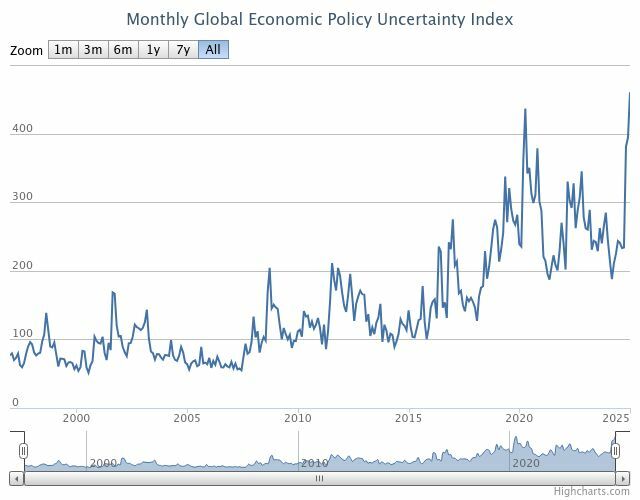
The lack of certainty, stability, predictability is the main differences between the conditions of a modern working person from the proletarians described by Marx.
The classic of French sociology Pierre Bourdieo called the modern working class Prekariat, from the English word Precarious - "unreliable, temporary." The British sociologist Guy Standing developed this concept in the 2011 book “ Precariat: New Dangerous Class ”. “Precariat is distinguished by a status that does not give the possibility of career growth, nor a sense of reliable professional affiliation and almost does not give the right to receive state and industrial benefits and benefits that those who attributed themselves to the industrial proletariat can rightfully count.” Standing wrote. The author indicates that most of the precariates are migrants, youth and women, that is, already unprotected groups.
Prekarii live in constant anxiety to lose earnings. They cannot afford to get sick, because, firstly, medicine and medicines are becoming more expensive, and secondly, the loss of business days or rejected orders can affect their further opportunity to find customers. If Prekariya is also migrants without a family or a strong community, then the legality of their stay in the country may depend on at least some contract. And besides all this, unlike the proletarians, the precaries are divided. They do not see each other as part of a working collective or professional community. This not only leads to psychological alienation, but also threatens democracy.
Standing warned that the neoliberal practices of commercialization of everything from personal life to politics are at risk of leading a precariat, tired of pressure and anxiety to fascist populists: “The precariat would affect the rising wave of neo -fascism and a reduction in the social state. Currently, he cannot withstand this. Those whom the social and economic situation drove into the precariat became politically infantile. Due to their instability and insecurity, they are easy to lure them, and they willingly support populist and authoritarian actions against those whom they will be indicated as a threat. ”
To resist this trend, Standing urges Precariat to become a “class for yourself”, formulate a general utopian project and not pay attention to how unreal it may seem. Since supporters of neoliberal ideas managed to come from a mug of marginals to global hegemony, this can also be obtained in more progressive people.
Literature
- Burardi Franco "Bifo". PRECAROUS RHAPSODY: Semiocapitalism and the PatHologies of the Post-Alpha Generation. 2010.
- Palladino Lenore. Good Company: Economic Policy after Shareholder Primacy. The University of Chicago Press. 2024.
- Guy S. Prekariat: a new dangerous class. Ad Marginem. 2014.
- Snrnichka N. Capitalism Platforms / Per. From English. and scientific. Ed. M. Dobryakova. - M.: Ed. House of Higher School of Economics. - 2019.