
Translated material
Memory of Lensovet
35 years ago, a city parliament appeared in Leningrad, for which it was not ashamed
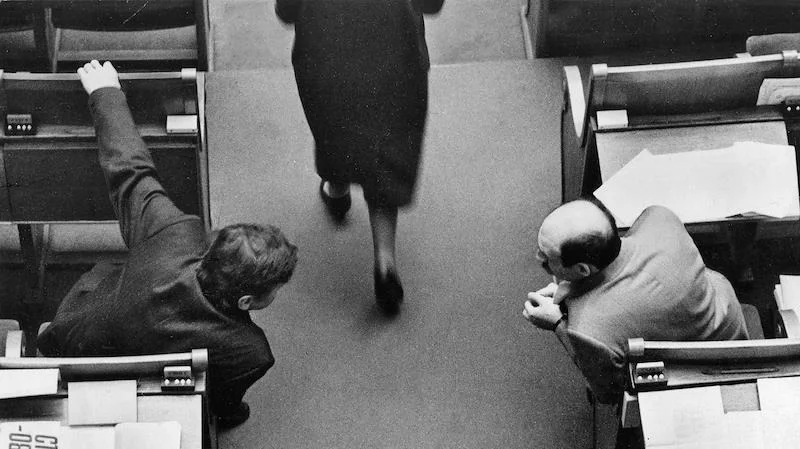
Hall of meetings of 13 session of the Lensovet. Deputies during the meeting. Photo: Alexander Tymoshenko / Kommersant
18+. This material (information) was produced, distributed and (or) sent by foreign agent Vishnevsky Boris Lazarevich or concerns the activities of the foreign agent Vishnevsky Boris Lazarevich.
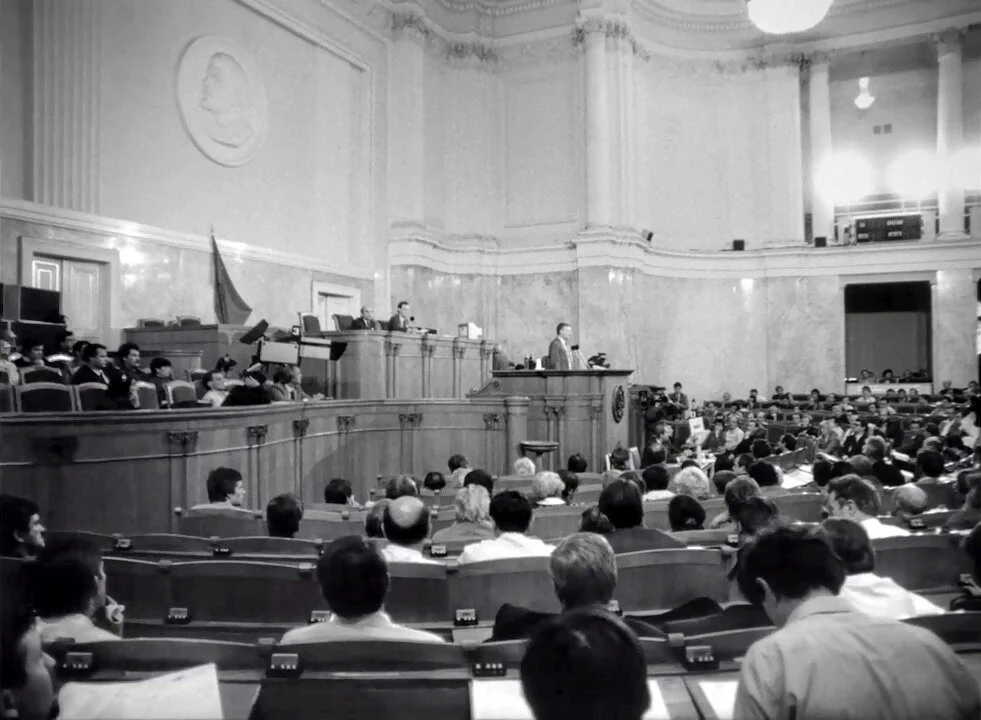
It was exactly half a life ago: on April 3, 1990, the first freely elected city parliament-the Leningrad City Council of People's Deputies of the 21st convocation in the Mariinsky Palace began to work in the Mariinsky Palace.
The city gained new power - strikingly different from the old in all indicators.
The Leningrad Council could not commit a miracle that was expected from him, and could not finalize the entire due date - but did a lot.
... In the elections on March 4 and 18, 1990 (almost all deputies were elected only in the second round) about 65% of the mandates in Lensovet received those who were supported by the Democratic Elections-90 Bloc, while about a third (120 people) of all deputies were members of the Leningrad Popular Front, uniting supporters of democratic changes.
Then Leningrad chose the best in an honest struggle: you can treat them differently, but never before or after-so many bright personalities have appeared in urban politics at the same time.
The first meeting of the Leningrad City Council, which opened on April 3, was attempted by the old habit of leading the chairman of the Lemor Executive Committee Vladimir Khodyrev, but, of course, this was not allowed. And until the leadership of the Leningrad City Council was elected, meetings in the Great Hall of the Mariinsky Palace were held daily shutting three presenters (at the end of each day they chose those who will be leading to the next).
The deputies of the Leningrad City Council of the 21st convocation were the first to make decisions not after 70-year Soviet history (where the CPSU regional committee was sitting) and not at the direction of his own executive committee, but of his own free will.
With the rare exceptions, none of them - senior and junior researchers, engineers, university teachers, doctors, journalists - had the slightest experience in managing the city, did not understand how urban economy was arranged, and did not know how to solve the everyday problems of a huge metropolis.
Everything had to be studied on the go, stuffing cones, stumbling and mistaken.
The deputies conducted long discussions on the seemingly simple issues (which is not surprising for almost 400 people gathered in the hall and had different points of view, not very easy to a common decision). But for starters, it was necessary to solve a lot of procedural issues - in other words, organize their own work, develop rules, form commissions and committees ...
All this took time - but the city, meanwhile, did not want to wait. There was an economic crisis in the yard: back in 1989, coupons appeared in the city for products and essential products: tea, sugar, meat products, soap, washing powder, cereals. I wanted a quick improvement in life - but it did not come. Instead, the townspeople were shown (meetings were broadcast on TV), as the people's deputies discuss some little things for hours and argue hoarsely because of, as it seemed from the outside, trifles.
Then, after a month and a half, when it turns out that not one of the two leaders of the democratic majority - neither Marina Salier nor Petr Filippov - he receives the right number of votes for the election of the Leningrad City Council, they decided to call to the chairman of the “man from the outside” chair. They helped to elect in additional elections (not all districts were filled) Anatoly Sobchak’s extremely popular deputy then, and immediately chose him as a chairman.
Soon, many deputies regretted this decision, but it was too late. The way out of the situation will then be found in the introduction of the mayor of the city and “moving” Sobchak into this chair - but it became, as the “new” said, even worse. And it all ended with the dissolution of the Leningrad City Council in December 1993 “with the presentation” of the mayor, the establishment of simultaneously for almost a year, and then - the appearance of a legislative assembly, which initially had much less authority than the Lensolete ...
Over the past decades, myths remained for the most part about the Lensoovet era.
The fact that the deputies allegedly "only chatted" and "prevented Sobchak from managing the city." The fact that it was Sobchak who saved the city from the GKChP in August 1991 and returned the historical name to him in September. The fact that in the fall of 1993 the Lension defended Khasbulatov and the “reactionary” Supreme Council. And so on and the like.
In fact, the deputies of the Leningrad City Council were the first to make decisions to conduct privatization and rules for the provision of targeted social assistance. Who established the competitive distribution of urban real estate and organized the registration of socio-political organizations and parties. Who introduced compensation to parents whose children do not go to kindergartens, and free privatization of housing.
It was the deputies that prevented the food crisis of 1990–91 and introduced free travel for pensioners in public transport.
It was the deputies who organized the resistance to the PUPCHCHP - the decisive role in this was played by the defense headquarters they created on the morning of August 19 (the mayor flew to the city only in the evening, when the Lensovet Extraordinary Session was in full swing).
It was the deputies who returned his historical name to the city, appointing a survey about this on June 12, 1991 - and most of the inhabitants spoke “for”.
As for the autumn of 1993, the Lension (as I had to write then) defended the Russian parliament, illegally dissolved by Yeltsin, and not his chairman Ruslan Khasbulatov - he defended parliamentarism and the constitution violated by the president, clearly calling his actions by the government. And in comparison with the current State Duma, the “Reactionary Supreme Council” looks almost the ideal of parliament.
The Lensolete was dismissed, within the framework of the “phased constitutional reform”, not at all for his rejection of the presidential “Decree 1400” on the dissolution of the parliament.
He was dismissed (and after the adoption of a new Constitution) in order for the city hall to finally get rid of the deputy control of the extremely interfering with her, to freely distribute city property, and to allocate finances and organize the election of the following city parliaments.
After the dissolution of the Leningrad City Council, part of his deputies, disappointed, will move away from politics, someone will return to the previous professions (which will be very difficult), someone will change the profession, someone will continue political activity.
Igor Artemyev, who has been a deputy and the first vice-governor of St. Petersburg, will head the Federal Antimonopoly Service, Vladimir Churov will become the head of the CEC, two or three dozen “Lensovites” will become deputies of the State Duma and Legislative Assembly, members of the Federation Council, and officials of the federal and urban level.
By the present day, however, only two will remain in “status” positions: Alexander Shishlov and Mikhail Amosov - deputies of the St. Petersburg Legislative Assembly.
Today, some of the deputies of the Leningrad City Council will gather in the Mariinsky Palace at the traditional “anniversary” meeting.
There will not be many “veterans”, especially since the thirds of the “Lensovites” are no longer alive.
They, according to tradition, are remembered - the sad list is becoming longer with every anniversary ...
The vast majority of the deputies of the Leningrad City Council - the rare time in the current time - went to power to solve the problems of the city, not their own.
And therefore, they are still not ashamed of them.