
Translated material
"This is a policy"
Five years ago, the researcher and director of the Medvezhyrsky Museum of Repression Sergey Koltyrin did not become. He died in prison
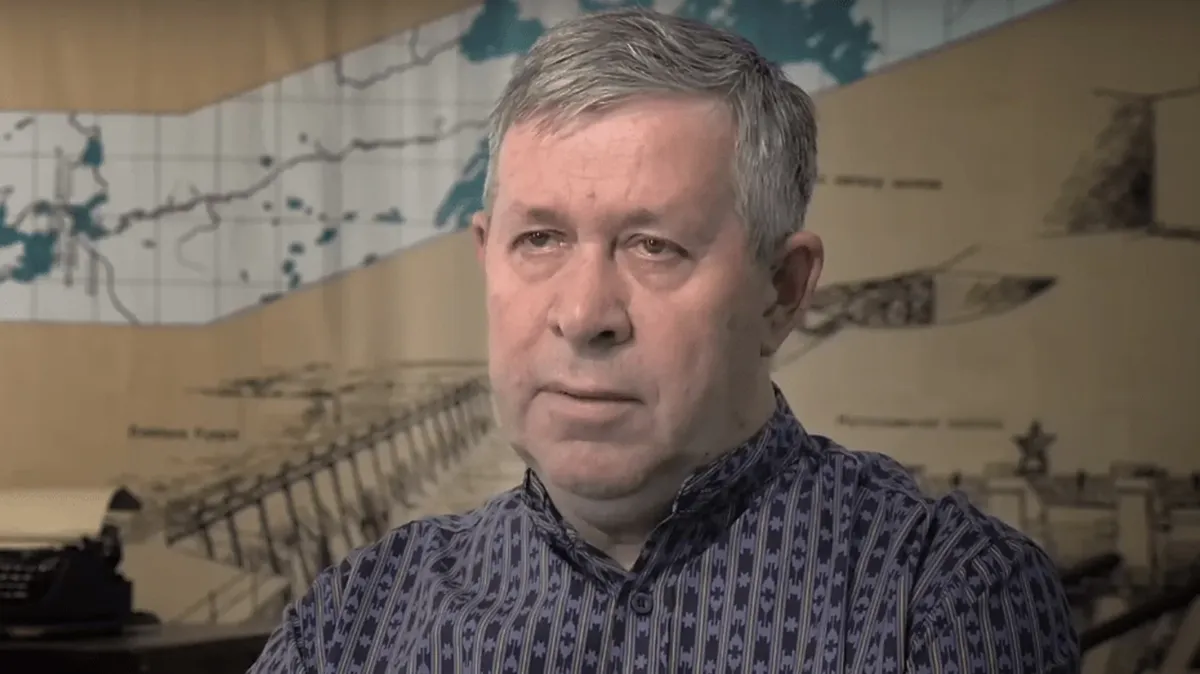
Sergey Ivanovich Koltyrin. Photo: Bezfomat (News of Petrozavodsk and Karelia)
Five years ago, the former director of the Medvezhyegorsky Museum, local historian, researcher of Stalinist repressions Sergey Ivanovich Koltyrin (October 24, 1953 - April 2, 2020) died in a prison hospital.
During excursions, lectures, speeches at scientific conferences and from the pages of Karelian newspapers, Koltrin spoke not only about the bright, but also about the bitter pages of the history of Russia. And not only told, but also did a lot.
One of his main merits is the restoration of the Medvezhyegorsky Museum from the devastation of the Medvezhyegorsky and concern for maintaining the place of memory of the Stalinist repressions - Sandarmokh. It was thanks to Sergey Ivanovich and his colleagues that Medvezhyegorsky Museum became one of the important centers of education in Karelia and beyond, and suddenly became the topic of repression for the country again.
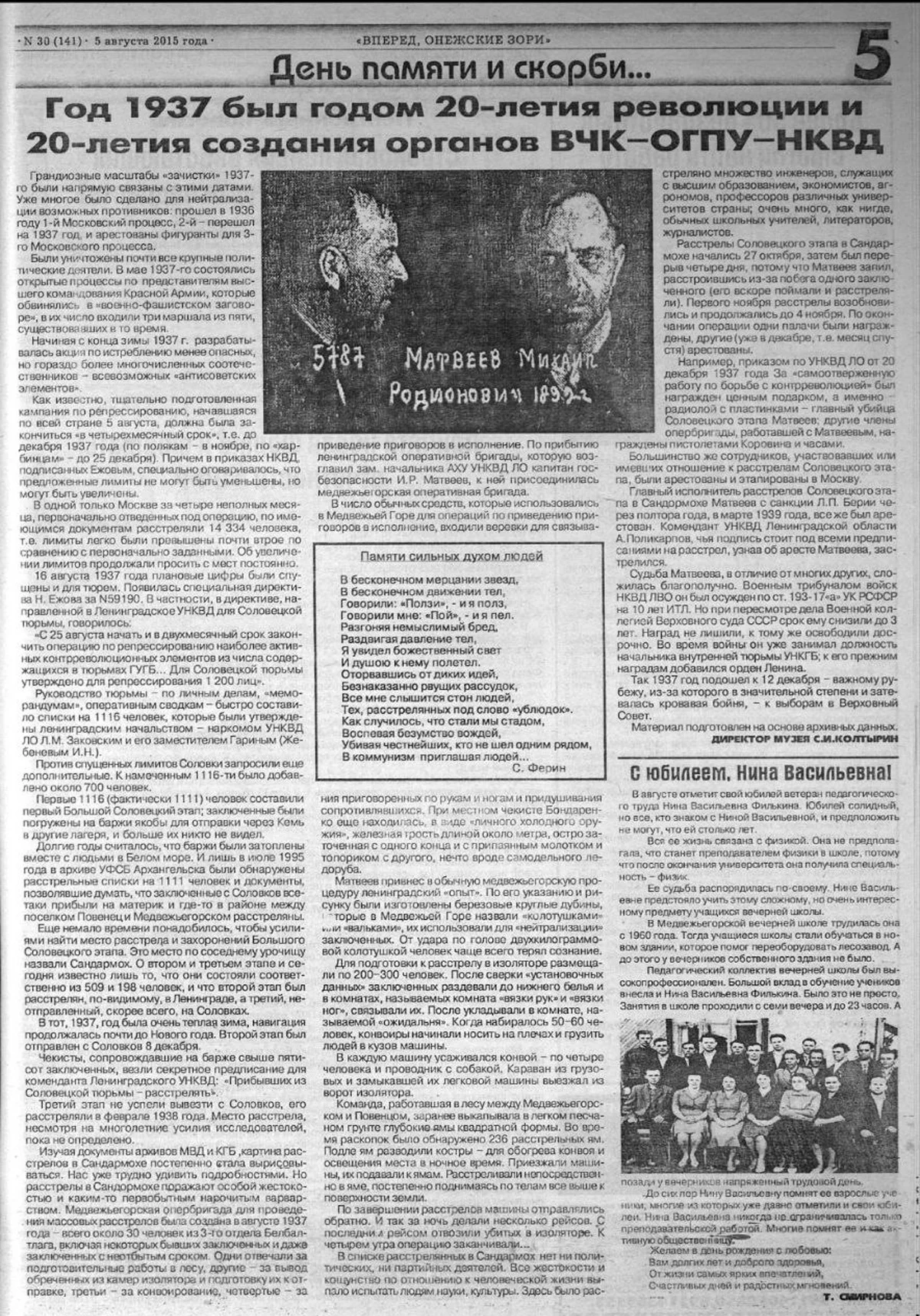
A fragment of the article by S. Koltyrin “The Year of 1937 was the year of the 20th anniversary of the revolution and the 20th anniversary of the creation of the Cheka-OGPU-NKVD organs from the newspaper“ Forward, Onega Zori ”(Medvezhyegorsk). August 5, No. 30 (141), 2015. S. 5 ( read completely ):
“It is already difficult to surprise us with details. But executions in Sandarmokh are amazing with special cruelty and some primitive deliberate barbarism. Medvezhyegorskaya operas team for mass executions were created in August 1937-only about 30 people from the 3rd department of Belbaltlag, including some former prisoners and even prisoners with an unsuitable term. Some were responsible for preparatory work in the forest, others - for the withdrawal of the insulator doomed from the cameras and their preparation for sending, others - for escorting, the fourth - for bringing sentences in execution. Upon arrival of the Leningrad Operational Brigade, led by the deputy chief of the AHU UNKVD LO, the captain of state security I.R. Matveev, the Medvezhyegorsk operational brigade joined her.
Among the usual means that were used in the bear mountain for execution transactions included ropes to bind the sentences and legs and strangling the resistant. At the local Chekist, Bondarenko was still in the form of a “personal cold weapon”, an iron cane about a meter long, sharpened from one end and with a soldered hammer and an ax from the other, something like a home -made ice ax.
Matveev brought the Leningrad "Experience" to the usual Medvezhyegorsk procedure. At his direction and drawing, birch round clubs were made, which were called “scribbles” or “rollers” in bear grief, they were used to “neutralize” prisoners. From a blow on the head, a man of a two -kilogram block most often lost consciousness.
To prepare for execution in the isolator, 200-300 people were placed each. After the reconciliation of the "installation data" of the prisoners, they undressed to the underwear and in the rooms called the rooms of "knitting hands" and "knitting the legs", connected them. After laying in a room called "waiting." When 50-60 people were recruited, the escorts began to wear on their shoulders and load people in the body of the car.
Four people and a guide with a dog were seated in each car. The caravan from the cargo and a passenger car closed from the gates of the insulator.
The team, which worked in the forest between Medvezhyegorsk and the lamp, dug deep square pits in a light sandy soil in advance. During the excavations, 236 shooting pits were discovered. ”
Before the arrest in 2018, Koltyrin was a curator of excavations in the tract of Sandarmokh, where, according to the version of the Russian Military Historical Society, the victims of the Finnish occupation of the 40s were buried. But after the scientist’s statement that it was still about the remains of repressed Soviet citizens, he was detained on charges of depraved actions against a minor (similar accusations were also charged with the historian Yuri Dmitriev, who also participated in these excavations).
Already during the detention, Koltyrin was sick with cancer. In the colony, without proper treatment, the disease finally took its own. In early March 2020, the court freed Sergey Ivanovich from the conclusion that the researcher could spend the last days with his relatives, but due to the protest of the prosecutor's office, the last hours and minutes of his life took place in a prison hospital.
A long -standing acquaintance, co -editor of the collections of “Leningrad Martyrologist” and “The place of memory of Sandarmokh” Anatoly Razumov recalls him: recalls his
“We met with Sergey Ivanovich Koltyrin 25 years ago.
As far as I remember, he always enthusiastically showed guests the Medvezhyegorsky museum and the place of memory of Sandarmokh. So, on June 4, 2010, Sergei Ivanovich accompanied the Russian Orthodox Church in the Sandarmokh of the Patriarch, and in February 2017 - members of the Human Rights Council under the President of the Russian Federation.
In the summer of 2017, we met with Sergey Ivanovich at the Solovetskaya conference and in Sandarmokh, where, according to tradition, he led a rally on the day of August 5.
The story of the real life of the builders of the White Mocornal at the Solovetskaya conference Sergey Ivanovich accompanied the bravurian Soviet newsreric of that time. The contrast struck the listeners. “Then we found a place for the shooting of Sandarmokh and took care of memory, and now you know what is happening around Sandarmokh,” Koltyrin concluded the speech.
Sandarmokh, like other places of Soviet atrocities, was subject to "remake of memory." In 2018, Koltyrin was banned from participating in a rally. Soon, RVIO began excavations in Sandarmokh, and Sergey Ivanovich was arrested. The arrest was revenge for the firm denial of Koltyrin far -fetched “hypothesis” about the executions of captured Red Army soldiers in Sandarmokh.
I remember both the office of the office of Sergei Ivanovich, and the empty room filled with life.
Sergei Ivanovich died in a prison hospital, he was not even released to die of his brother, although there was a court decision.
Shortly before his death, he wrote to me from the prison hospital: “Do nothing else, Anatoly Yakovlevich. This is a policy. "