
Translated material
Trump announced import tariffs on goods from 185 countries, but not Russia
The White House said that sanctions imposed on Russia already exclude any “meaningful trade” with it
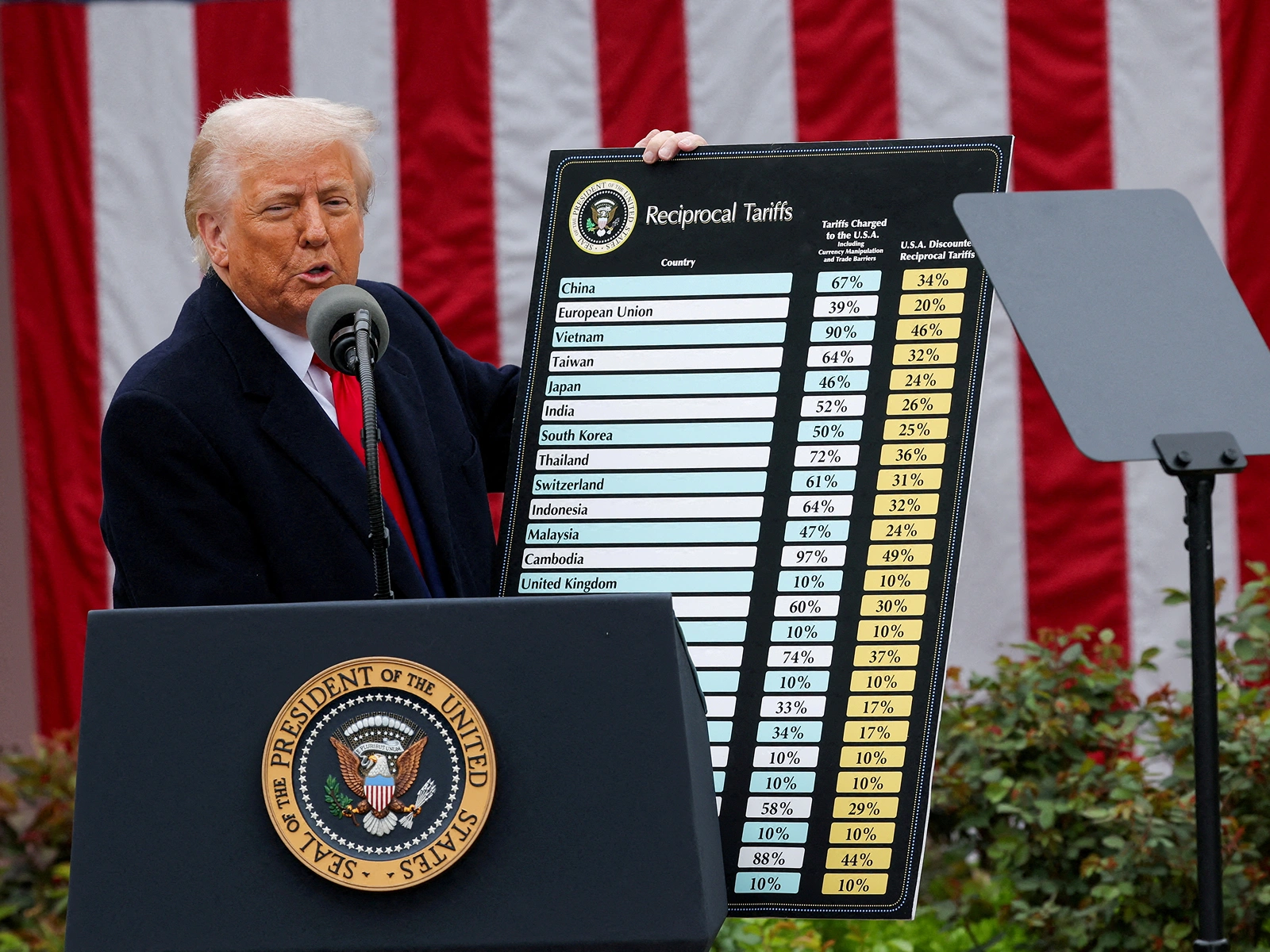
US President Donald Trump announced the introduction of tariffs on imports of goods from 185 countries. The only countries not included in the list are Russia, Belarus, Cuba and the DPRK. As the White House explained , US sanctions imposed on Russia are already preventing any “meaningful trade” with it.
In order not to miss new texts from “Layout”, subscribe to our telegram channel
Lesotho has the highest rate
A minimum base duty of 10% will apply to all countries. This will be the case for the UK, Brazil, Argentina, Australia, Turkey and many other countries, including Ukraine. For EU countries the rate will be 20%. The highest tariffs of 50% are imposed against Lesotho and the French overseas territory of Saint-Pierre and Miquelon. Also, some of the highest rates are set for Cambodia (49%), Vietnam (46%) and Sri Lanka (44%). For China - 34%, for India - 26%, for South Korea - 25%, for Japan - 24%. A separate rate of 25% has been introduced on all cars imported into the United States.
The list of territories for which Trump imposed tariffs included the uninhabited Heard and McDonald Islands. They are found in the subarctic Indian Ocean, and their only inhabitants are seals, penguins and other birds. According to Axios, the White House explained this by saying that the islands belong to Australia. The Guardian drew attention to World Bank export data, according to which the United States imported $1.4 million worth of products from there in 2022, most of it in the “machinery and electrical equipment” category.
In fact, Russia and the United States still have trade turnover
In addition to Russia, Belarus, North Korea and Cuba, Trump’s list does not include Canada and Mexico. Trump previously imposed 25 percent tariffs on these countries, and there are no new restrictions for them. US Treasury Secretary Scott Bessent explained this by saying that the United States already does not trade with Russia and Belarus due to the sanctions imposed on them.
As The Bell notes , in 2024 trade turnover between Russia and the United States amounted to $3.5 billion - this is the lowest figure since 1992, but still not zero. Axios emphasizes that the United States trades more with Russia than with Mauritius or Brunei, which are on the list.
Trump declared a state of emergency in the US
After the tariffs were introduced, Trump declared a state of emergency in the United States. “President Trump is using his authority under the International Emergency Economic Powers Act of 1977 to address the national crisis caused by large and persistent trade deficits resulting from trade insecurity and other harmful policies such as currency manipulation and excessive value-added taxes imposed by others. countries,” says a statement on the White House website.
The emergency order also states that the U.S. trade deficit has left the country with "a weakened manufacturing base, a lack of incentives to build advanced domestic manufacturing capabilities, the disruption of critical supply chains, and the dependence of our defense industrial base on foreign adversaries."
The US President said it was "Liberation Day"
Trump called the introduction of unprecedented tariffs “Liberation Day.” Bloomberg, however, writes that such a shake-up of the global trading system causes more damage to American assets than to the assets of many large economies affected by the restrictions of the American president. Thus, the euro rose against the dollar by 1.3%, and the Japanese yen by 1.5%.
“The massive sell-off in global markets makes it clear that investors are not expecting winners from the latest - and biggest yet - blow in the escalating trade war. In addition, they also suggest that the United States itself could become one of the main victims of Trump’s protectionist policies,” the publication writes.
RBC also notes that after Trump announced the introduction of duties, the price of gold exceeded $3,200 per troy ounce, which became a historical high.
“The bull market in gold reflects concerns about tariffs. The concern is that these tariffs will curb economic growth and potentially lead to worsening economic performance,” said Nitesh Shah, commodities strategist at WisdomTree.
How politicians and experts reacted to tariffs
China called on the United States to immediately lift the tariffs and threatened retaliatory measures, writes Reuters. The news agency notes that Trump's tariffs may push China to expand trade with other markets, but no other country can yet match the consumption power of the United States, where Chinese manufacturers sell more than $400 billion worth of goods annually.
“Trump's tariffs will certainly create problems for Chinese companies and cause serious harm to certain sectors, but they will not have a decisive impact on the Chinese economy,” said William Hirst, professor of Chinese development at the University of Cambridge.
The head of the European Commission, Ursula von der Leyen, said that “Europe is ready to respond” to the tariffs imposed by Trump. “The sweeping tariffs announced by the United States are a major blow to businesses and consumers around the world. Europe is ready to respond. We will always protect our interests and values. We are also ready for cooperation. And move from confrontation to negotiations,” she wrote .
House Minority Leader Hakeem Jeffries said that "Republicans are destroying the American economy in real time and driving [the United States] into recession."
Yulia Sviridenko, Ukraine’s Minister of Economy, argues that new US duties for Ukraine are “difficult, but not critical.” “For Ukraine there will be a universal duty of 10%. <…> If everything remains as it is, the duty will hit mainly small producers. Therefore, we are already working to improve conditions for Ukraine,” she wrote .
Deputy Head of the Russian Security Council Dmitry Medvedev also responded to Trump’s new restrictions: “Trump has severely bent the global trading system by introducing tariffs against almost the entire world. The consequences will be global. Counter tariffs will be imposed on US goods. Old trade chains will be broken, but new ones will arise. What about us? Russia already barely trades with America, or with the EU. <…> Therefore, there is no need to fuss.”
Earlier, Trump said he was “very angry” and “furious” after Putin proposed introducing temporary governance in Ukraine “under the auspices of the UN.” The next day, however, he said that he believed in Putin and did not want to impose secondary duties “on his oil.”
Photo: Donald Trump makes a speech on tariffs in the Rose Garden of the White House in Washington, USA, April 2, 2025. REUTERS/Carlos Barria/File Photo