
Translated material
Impossible!
Environmental damage from the spill of fuel oil in the Kerch Strait amounted to 84.9 billion rubles. But to pay this money, probably no one will
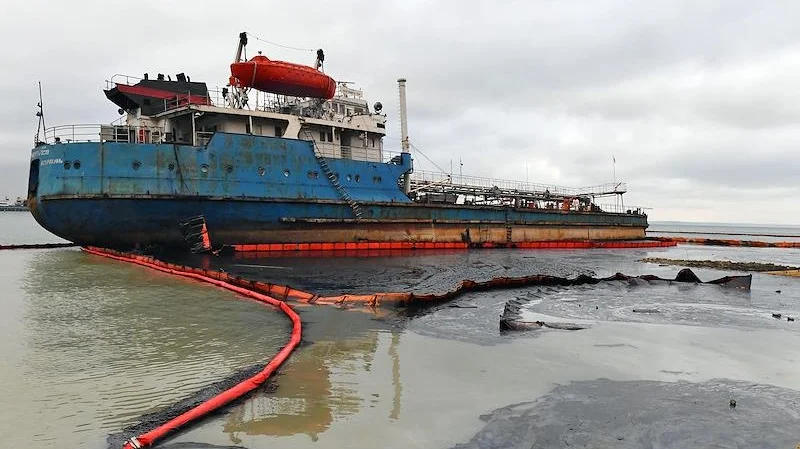
January 13, 2025. The tanker "Volgonft-239" stood on the tanker. Photo: Victor Korotaev / Kommersant
Rosprirodnadzor assessed the damage to natural systems caused by the collapse of Volgonft tankers in the Black Sea, 84.9 billion rubles. This was announced by the head of the department Svetlana Radionova.
The requirement to reimburse 49.46 billion rubles was sent to the Perm enterprise Kama Shipping, owning the Wall of Volgonft-212. And from the Moscow CJSC Volgatransneft, whose ownership is the sunken tanker Volgonft-239, the state wants to get 35.48 billion. The difference in amounts may be explained by the fact that the 212nd tanker transported 600 tons of fuel oil more than the 239th.
The companies have been given a month to make payments voluntarily. Otherwise, Rosprirodnadzor intends to go to court with claims for the recovery.
However, with a high probability, no tens of billions of rubles will pay the owners of tankers. In the Arbitration Court of the Krasnodar Territory, where companies are conducting proceedings on compensation with the mayor of Anapa and the Morspadan, their representatives have already made a request to create funds for limiting liability. Such a right is indeed provided for by the trade navigation code. It also defines methods by which companies can calculate the amount that their responsibility should be limited: “Volgatransneft” and “Kama Shipping” counted it - it turned out 533 million rubles each.
This amount, if the court approves the creation of funds, will apply not only to the claims of the Anapa City Hall or the Marine Rescue Service, but also to everyone who wants to recover money from the owners of tankers.
And precedents of such a restriction of responsibility in Russian judicial practice have already been. For example, precisely because of this, in 2010, the Arbitration Court of St. Petersburg and the Leningrad Region refused Rosprirodnadzor to recover 6 billion rubles from the Volgotanker company, which owned the Volgoneft-139 vessel, which crashed in the same Kerch Strait in 2007. The disaster was also serious then: about 2 thousand tons of fuel oil hit the Black Sea. But only 174.8 million rubles managed to recover.
In addition, it is obvious that, unlike Norilsk Nickel, ”which, although reluctantly, paid a record fine of 146 billion rubles for diesel fuel spills in 2020, Kama Shipping and Volgatransneft simply do not have the necessary amounts. Both of them, according to official figures, have suffered losses for the last two years.
And here, alas, the obvious option of leaving the situation for shipowners begs to declare yourself bankrupt. Considering that the value of the Volgaatransneft net assets, according to the reporting for 2024, is only 37 million rubles, and for Kama Shipping it is completely negative, it will wait for the state to get 84.9 billion in the course of the bankruptcy procedure is naive.
However, it is naive to expect that if the money is obtained, they will go to environmental measures and the restoration of ecosystems.
The experience of Norilsk, as well as many other spills of oil products, shows that the amounts collected in the federal budget and subsequently dissolve in it: the state distributes them at its discretion.
Neither Norilsk nor the Krasnoyarsk Territory received no 146 billion rubles after the accident at Norilsk Norkel . Moreover, they were not aimed at measures to ensure the environmental well -being of Taimyr.
The truth is that the money will not help restore the populations of birds that have fallen into fuel oil pollution, dead marine mammals. This can be achieved only by leaving nature alone. But this will not happen either: the Kerch Strait, connecting the Black and Azov Seas, is too important the logistics point. And on it they continue to swim the Volgoneft long -have served their term.
And, by the way, it is not possible to believe in the same way that these oil products belong to microscopic companies that dispose of floating junk, and the companies themselves are unlikely to de facto belong to their own. But it is not accepted to ask these questions in the Russian state.