
Translated material
Warhol Corleone
Zurab Tsereteli died. What character will he go down in the history of Russian culture?

Zurab Tsereteli, 2015. Photo: AGN "Moscow"
The real artist needs to mythologize his own life. Each of the historical characters - those whose biographies are written by other people and are compiled from fragments of interviews, memories of friends, sincere conversations and so on - there is a certain Origin Story , the history of origin, like a superhero. Spider-Man has the death of Uncle Ben, Batman is the murder of his parents.
At Zurab Ceretheli, such an Origin Story, a meeting with Picasso in Paris became. It seems to be even a date - 1964 , although in fact it does not matter. The young Georgian / Soviet artist met with the legendary Spanish - and accepted the blessing from that.
“This is like Christianity there are ideas about the Apostolic succession of grace: the apostles dedicated the first bishops, those of the following, and so on, up to the present day, and everyone should be clear who is now the legitimate successor,
- wrote Sergey Khodnev in the ironic double portrait of the Picasso -ceremet in 2010. “ Won and UNESCO three years ago handed the Picasso gold medal to the President of the Russian Academy of Arts.”

Parallels - not in the level of genius, but rather in the method and lifestyle - really can be found a lot. But in order to answer the question of who and what was the ceremonies for us, and how to perceive the author of Peter I in Moscow and the “tears of sorrow” in New Jersey during the Rils, Netflix and Donald Trump, comparison with other heroes of popular culture are required.
The artistic approach of Tsereteli is more correct to compare with the approach of Andy Warhol. Firstly, they have a purely methodological similarity: Warhol processed symbols of his era in art objects, Cerethels-his own. In essence, what is the difference between the multi-colored portraits of Marilyn Monroe and the sculpture of Luzhkov-Dovornik? Cans with Campbell soup-and Columbus in Puerto Rico? At the first, “tomatoes” are written, on the flags of the second - huge crosses; But there and there - nothing but a reference to a popular image, and sending the most straightforward, arrogant in its straightforwardness.
Look at the “apple of love” - a rethinking of the biblical plot, standing in the center of his gallery. Outside - constructivist apple plots. Inside (you can go into the sculpture) - scenes from the Kama Sutra (literally; Cerenetheli generally has quite a lot of erotic plots - another feature with Warhol). But the main thing is how it costs a “apple of love” (attention to Neiming) in the midst of his other works, where Christian saints, the eternal Peter, some kind of dive of the eagle are combined ... What is the Gallery of Tsereteli on the Prechistenka-not a “factory” in Manhattan?
Secondly, like Warhol, Tsereteli turned into art and his daily life. Moreover, he did this in a style, an organic habitat. For Warhol, movie stars, marginals, bohemian and very rich party were organic; For Ceretel in Luzhkovskaya Moscow - vast spaces, oligarchs and state defenses, titles of the Ambassador of the Goodwill of UNESCO and the Patriarchal Council of Culture, the State University. Having held and receiving huge orders back in the USSR, Cerethels flared up Supernova to the 90s-he invested money from the supply of monetary monuments for their intended purpose, and stopped taking care of money at all.
His main monuments - and not only international ones - gave ceremonies, but not sold, and he gave it very persistently.
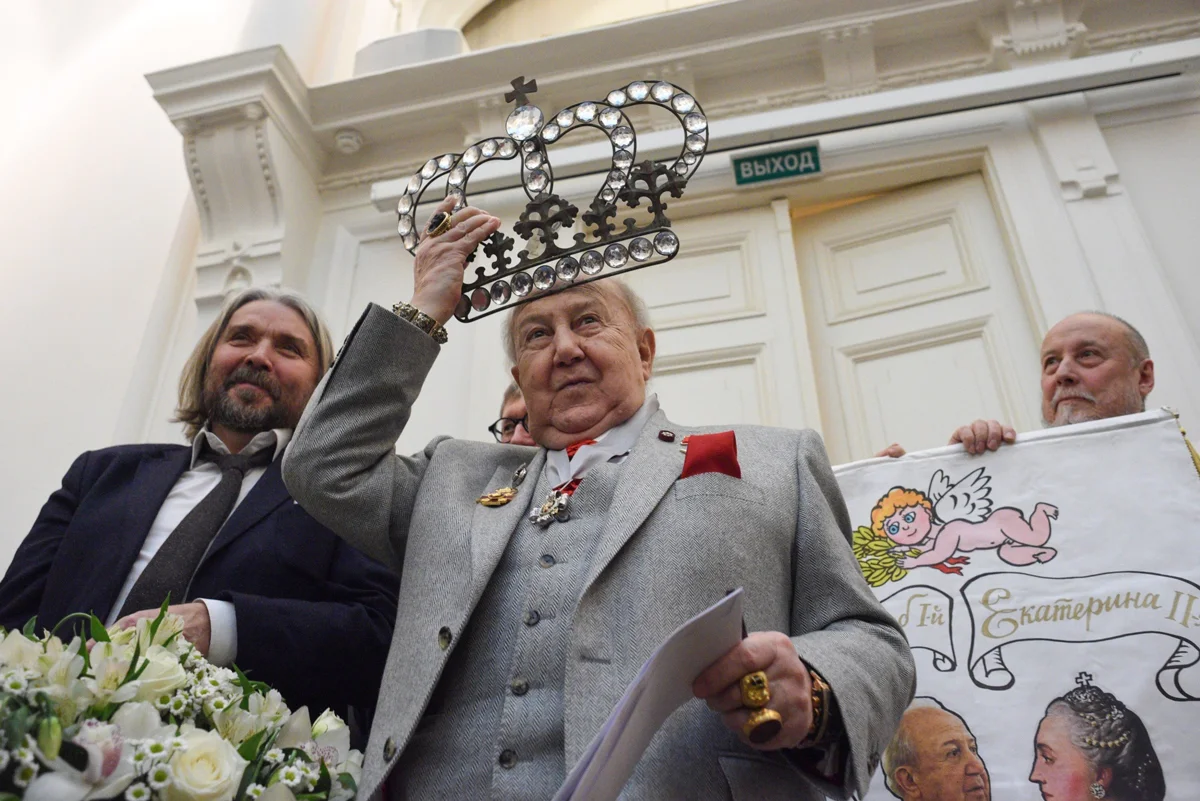
His fleet included Bentley, Rolls-Roisy and Mercedes, and he himself more often moved to the Black Gelendvagen, wore massive rings and bright-coasts of the troika, appeared exclusively surrounded by his retinue-which included not only assistants and friends, who simply needed something from him.
And here it is difficult to resist and not compare Cerenets with Don Corleone. The patriarch of the family, which is also in business on children and grandchildren, is a warm master and noble businessman, capable of extreme cruelty to enemies, which does not tolerate disagreement in "his" ranks. For obvious reasons, the image of the romanticized boss of the mafia is generally popular in Russia and the Caucasus: the spirit of Corleone, for whom the family and “concepts” above the laws, responds to our post -Soviet space. The proximity to power and crime at the same time, too.

At the same time, the idea of “respect” (with the designation of which begins the novel by Puzo and the film Coppola) - Tsereteli was close not in words. Alexei Venediktov recalled how Cereteli turned out to be almost the only representative of Russia at Eduard Shevardnadze's funeral (July 2014); Mikhail Shemyakin - as Tsereteli from his pocket supported elderly artists, how he gave Vysotsky in debt (and refused to take money back), as he saved him from bankruptcy, transferring 100 thousand dollars. There are many such stories about ceremonies. Everyone who knew him (and who did not encounter him in conflicts) recall one thing: Tsereteli was a kind and wide person.
Of course, the ceremonies were interested in both money and worldwide glory - the second is more than the first. Perhaps it was this factor that he played a role in the fact that Tsereteli, intuitively perceived by the monumental singer of the Russian Empire, almost Alexander Prokhanov from architecture - escaped any mention of himself next to the war in Ukraine. In 2014, he “signed” the letter in support of the accession of Crimea, but the very next day his assistant disavowed his signature.
It would seem that the annexed Crimea should have been overwhelmed by the sculptural groups of Tsereteli about heroic Russian history. But no. The only monument that has since been opened in the Crimea is Stalin, Roosevelt and Churchill in Yalta, and made back in 2005 (and then not installed due to protests). Sergey Naryshkin spoke at the ceremony, Ceretheli himself did not appear on it:
“Zurab Konstantinovich said that no one was invited, and even more so now he is outside the country ... The sculptor has other, more urgent tasks”,
-commented on the press secretary.
He really cast Putin's figure in a kimono 3.5 meters tall . But he did it in 2004. Even if Ceretheli himself thought first of all by the category of flattery, today it is impossible to look at this image without sad irony. In the end, the artist recorded reality - and such was the reality of the perception of the young president by fellow citizens.

Cerethels would have an unclosed need for the embodiment of his gigantomania - in recent years, it would be different for him. But there were no sculptures in support of the war, no speeches in the spirit of Mikhalkov, there were no monuments to Putin, Shoigu or Prigozhin. Neither in the Donbass, nor in the Crimea, Tsereteli (at least publicly) appeared.
Just yesterday, Alexander Khinshtein said that Ceretheli prepared, quoted, "a model of a memorable medal to free Sudzhi." A commemorative medal from Tsereteli, of course, beautifully - but this is exactly the same person who made “Peter I”? Some colleagues wrote this morning that the “small forms” of Tsereteli did not recognize; Apparently, an exception was made for Veterans of “Svo”.
In the necrologues of Tsereteli, such a stamp is already found: "He left / passed his era." I am not sure of this thought. The whale style of Cerethels seems to be very consistent with the spirit of time. Look at theirphoto with Trump: you will see aesthetic (interiors), and ideological (scope! Transaction!) Coincidence. This era has not yet ended. It would not turn out that we are observing only her dawn.