
Translated material
Loop from Gestapo, Vorkuta from the Motherland
Putin gave Lukashenko a new myth - about the heroic defense of Minsk
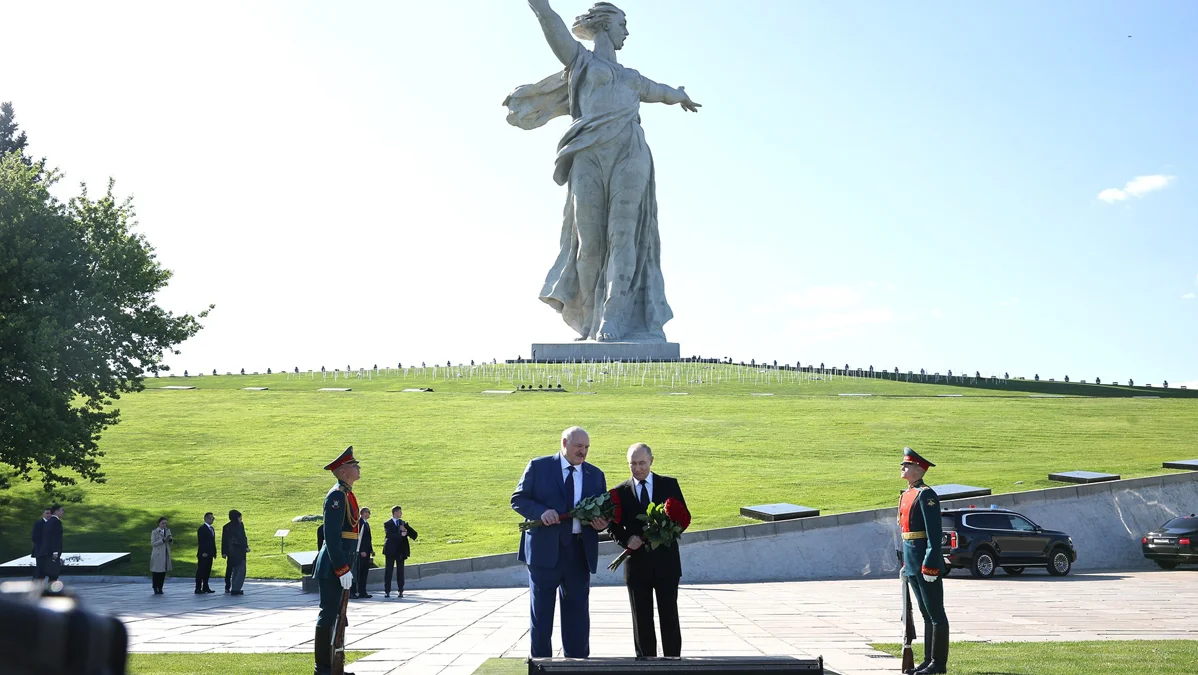
Alexander Lukashenko and Vladimir Putin on Mamaev Kurgan, Volgograd, April 29, 2025. Photo: Kremlin
The best gift to an ally is a new myth. Vladimir Putin during the Russian-Belarusian forum “The Great Heritage is a General Future”, which took place in Volgograd on April 28–30, said : “Today we visited the President of Belarus with a memorial complex in the Mamaev Kurgan, and the memory of the city’s defenders, who, in the battles for Stalingrad, covered themselves with impersonal glory. They stood to death in the same way as the heroes of the Brest Fortress, the defense of Minsk, Leningrad, Sevastopol, our other cities and borders. ” Odessa in the list of defending cities is no longer. But Minsk appeared.
“Heroes of the Defense of Minsk” is a really generous gift from Putin Lukashenko. Now, for sure, in accordance with the new myth in Minsk, a memorial dedicated to the heroic defense of the city will appear, and the new state holiday-something like the day of memory of the defenders of Minsk in 1941. The myth around which Lukashenko, with the help of propagandists and ideologists, will be happy to build a new chapter of history. Perhaps, in the bowels of state editions, the memories of Soviet soldiers and officers who defended Minsk quickly concern the memoirs of Soviet days, not allowing the enemy to break through to the east. And, of course, a new article in the Criminal Code “Denial of the Heroic Defense of Minsk”. In the end, in 2022, the Belarusian Criminal Code was already complemented by article 130-2 “The denial of the genocide of the Belarusian people”, because Lukashenko decided so. This, by the way, is the previous myth: all nations simply suffered from fascism, and the Belarusians had genocide. And for its denial, you can sit down for up to seven years. Now there will be a new myth around which you can create an ideology and create repression.
In fact, from childhood, any indigenous Minsk resident has heard the stories of those who survived the war about how the party leadership with ficuses in cars from the city was drapalo from the city. It was the pots with ficuses that became something like a symbol of the flight of city bosses from the city, which the Germans took without a fight on June 28, 1941. The Brest Fortress still continued to resist, but it did not stop the German troops - then in the USSR schoolchildren told schoolchildren that the Brest garrison defended the borders of the country and restrained the Germans.
In fact, the Wehrmacht calmly walked along the Belarusian territory, leaving in Brest only certain parts of the second infantry division to finish those who remained in the fortress.
There was actually no garrison there-someone was sent to the construction of fortified areas or for maneuvers, someone in the summer field camps. Some commanders hastily withdrew their subordinates, realizing that surrounded by a long time to hold out. And in the fortresses there were mainly economic, transport, and quartermaster units - from a total of seven to eight thousand military personnel. Those who survived after captivity ended up in the Stalinist camps. The recreation of the history of the Brest Fortress, the return of it to the heroes of names and biographies is the merit of the writer Sergei Smirnov, the author of the book “Brest Fortress”.
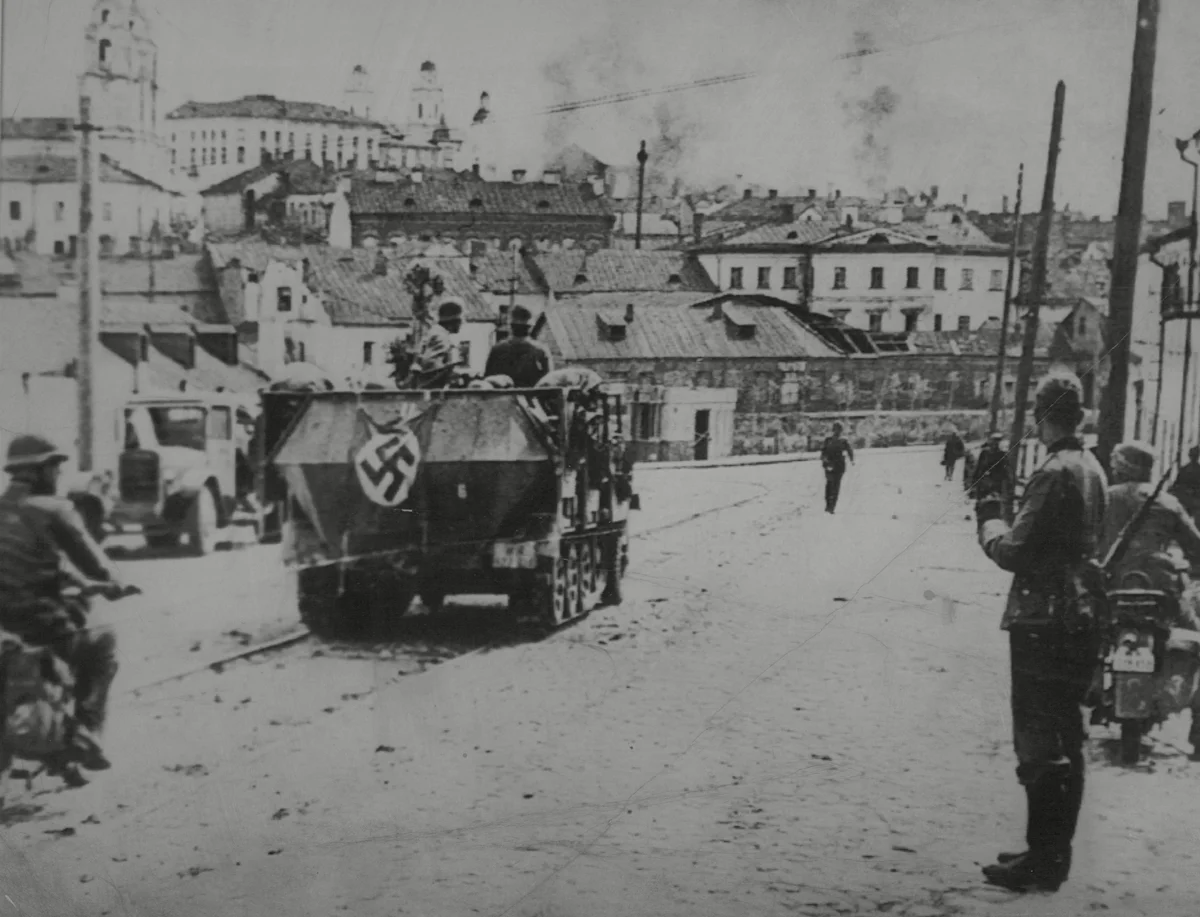
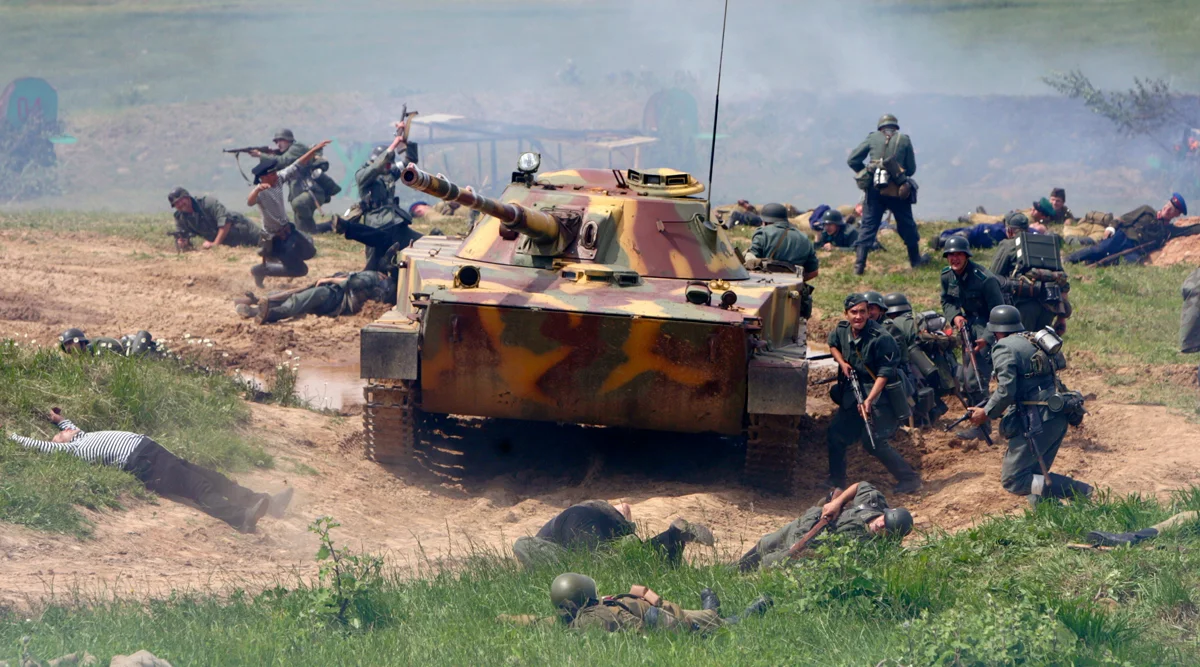
“ The defense of Minsk is something new, ” says the Belarusian historian Igor Kuznetsov, candidate of sciences and specialist in World War II and Stalinist repression . -Even in Soviet historiography, they somehow modestly silent about this. The 100th Infantry Division in the area of the Ostroshitsky town near Minsk tried to do something. By the way, Molotov cocktails were actively used there and burned more than 100 tanks. But Guderian and Goth closed the encirclement ring on June 26–27. Just think about it: on June 22, the war begins, and the distance from Brest to Minsk (a little less than 400 kilometers), German troops are actually overcame in four days. It turns out that they advanced at a speed of almost 100 kilometers per day. According to all the laws of military tactics of that time, if the troops were advancing at a speed of 5-10–20 kilometers per day, this was already considered a high pace of the offensive. We can talk about the heroism of the 100th Infantry Division, which tried to restrain the advent of the Germans for two days, but the ring had already closed by that time. Moreover, two Soviet armies were surrounded-the 10th and 13th. So there was no defense of Minsk. And the party and military leadership escaped from Minsk even before the Germans entered there. Everyone was evacuated to Mogilev, and Minsk remained on its own - without management, without military, without weapons.
German troops entered Minsk on June 28. The then first secretary of the Central Committee of the Communist Party of the BSSR Panteleimon Ponomarenko recalled in his diaries: “On June 23, 1941, I called I.V. Stalin and asked for permission to start the evacuation of state values, children's institutions and state archives from Minsk. Stalin was surprised and asked: “Do you think that this should be done? Isn't it early? " I replied that I was out of the situation at the front and that the delay will be irreparable. Thinking, Stalin said: “Okay, proceed to evacuation. In addition to the population, especially children and families of those who have gone to the front, export the most important part of state and party archives and state values, which you consider it necessary to take out. Do it so as not to create panic and preserve order. Everyone should understand that evacuation is also an element of war. ”
On the evening of June 24, the party authorities quietly plunged into the existing cars and went east along the Mogilev highway. Here is what Mikhail Sorokin wrote in July 1941 in a letter to Joseph Stalin: “Until 10 p.m. June 24, no one knew that the city should evacuate. We did not know about this either - responsible workers of the regional committee of the Communist Party (b) b. At 10 o’clock in the evening, the secretaries of the regional committee and other guidelines of the city without loking got into the cars and drove away, as we later found out, in Mogilev, leaving the rest of the regional committee’s response workers without means of transportation, assigning them the obligation to maintain the party committee of the regional committee of the Communist Party (b) b. The reinforced bombing of the city began. The population ran away in a panic in the forest, retreating to the mountains.
Borisov, Orsha and Mogilev without cover, fired at enemy aircraft, paratroopers saboteurs. But one could not allow this, if the secretaries of the regional committee had not fled shamefully from the city, but would lead the evacuation. ”
By the way, there was another myth in those days: the line of Stalin. In 1932, by order of Stalin, a chain of fortified areas was built along the western border of the USSR. But the western border in the then territory of Belarus passed 30 kilometers from Minsk. And in 1939, after the signing of the Molotov-Ribbentrop Pact, it turned out that, firstly, the western border moved 300 kilometers after the accession of Grodno and Brest, and secondly, Germany and the USSR are now allies, and there would be no attack.
“By June 1941, the fortified line of 30 kilometers from Minsk was completely dismantled,” the historian Kuznetsov explains . - The weapons were removed, there was no ammunition - there empty concrete boxes stood. And German troops walked with a front march, not meeting almost no resistance, until Minsk. Even to say that Minsk was taken, incorrectly from a military point of view, because the Germans did not take it - they simply entered the city. The 100th Infantry Division is a private episode. But the defense was not prepared, because the offensive was being prepared. And therefore, all the troops were concentrated on the western border, on the Bialystok ledge. My father, by the way, on June 22, 1941, met a military service soldier of the 33rd Panzer Division at the Bialystok ledge. More than half of all forces and means of the Western Special Military District was concentrated there. And all this has been surrounded for several hours. Six people were able to escape from the regiment in which the father served - more than a thousand people. In general, no more than 15 percent of military personnel escaped from the encirclement. The rest were destroyed or captured. So there were no defensive battles on the approaches to Minsk. Even in Soviet textbooks, not to mention the post-Soviet, sections associated with the beginning of the occupation, only the episode of the 100th Infantry Division is always given.
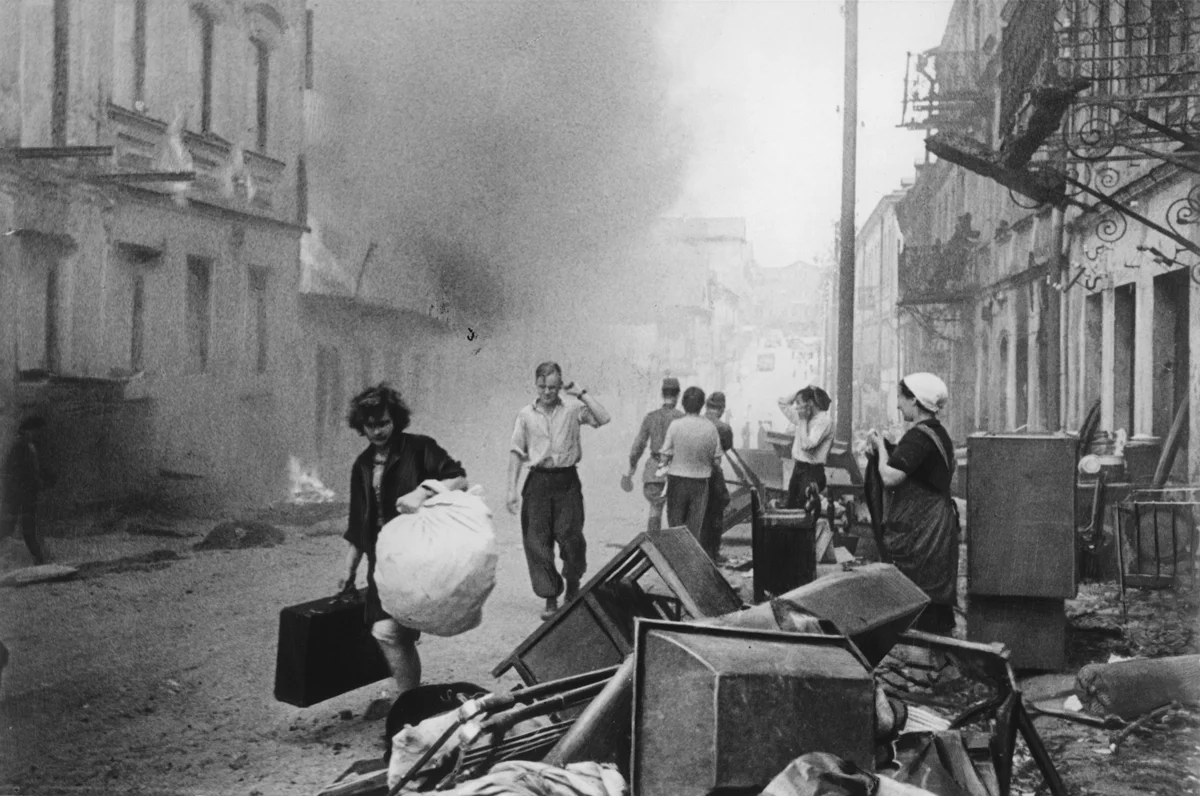
Many Minskers tried to escape from the city, but most often they were forced to return: the Germans moved faster and occupied new territories before the refugees could get there. The only way out for the townspeople was to return home. There was no one to create a militia in the city, trying to fight back - the leadership ran away safely. And in the city in the same horizontal way as after many years the protests of 2020, a spontaneous underground was created, and partisan detachments in the forests. And then - sabotage, rail war, leaflets, underground newspapers and, as a result, arrests, executions, gallows in the city. But on January 9, 1942, the newspaper Pravda published an article of the safely evacuated first secretary of the Central Committee of the KPB Panteleimon Ponomarenko “The Belarusian people in the fight against the German invaders”. Ponomarenko also tried to create a myth. He wrote about how the Belarusian working class carried out a large -scale evacuation of the whole industry, and the collective farmers burned the crop, so that the Germans did not get either bread or iron from the plant. And as a result, the invaders got empty cities. It followed from the article that collaborators remained in Minsk. And in November, Ponomarenko sent a radiogram to partisan detachments that the underground Minsk hump is a late -winning center of Gestapo. And many surviving Minsk underground after the war ended up in the camps.
“You never thought about that,” says Igor Kuznetsov , “why did Minsk awarded the title of hero city only after 30 years, in 1974?” And the thing is that the Minsk underground was sunk. And in this a significant role was played by Ponomarenko, who stated: we did not leave underground in Minsk, and those who are there are now - these are agents of the SD and SS. And only in 1959 the Minsk underground were rehabilitated, and in 1974, Minsk received the title of hero city-it was for the activities of the underground and coordination of the partisan struggle. By the way, in the decree of the Presidium of the Supreme Soviet of the USSR of 1974 there is not a line about the heroes of the defense of Minsk in June 1941. Minsk became a geroy city thanks to the underground.
Or maybe Vladimir Putin just confused something? For example, Minsk with Brest. But no, he mentioned the Brest Fortress in the same row. Or his geolocation provoked-while in Volgograd, decided that all heroes-heroes certainly heroically defended like Stalingrad. Or he just wanted to spit on the story: who was attacked by whom and who defended himself - what's the difference, the main thing is that you could concoct a national idea out of this. Yes, and let himself say what he wants. Let him call the falsifiers of those who still try to explain what was actually happening, and not "treacherous attack-a temporary retreat-to Berlin." Let both dictators who celebrated in Volgograd stuff their criminal codes with new articles. They simply do not understand that the truth about how the Germans entered Minsk without a fight, does not belittle at all the feat of those who remained in the city, but elevates: people abandoned by the authorities who had fled with ficuses, who remained in the occupied city without ammunition, weapons, management, began to desperately and, most importantly, successfully resist. This was the heroism, to which the Motherland answered Vorkuta and Magadan.