
Translated material
At eternal fire
From a personal diary
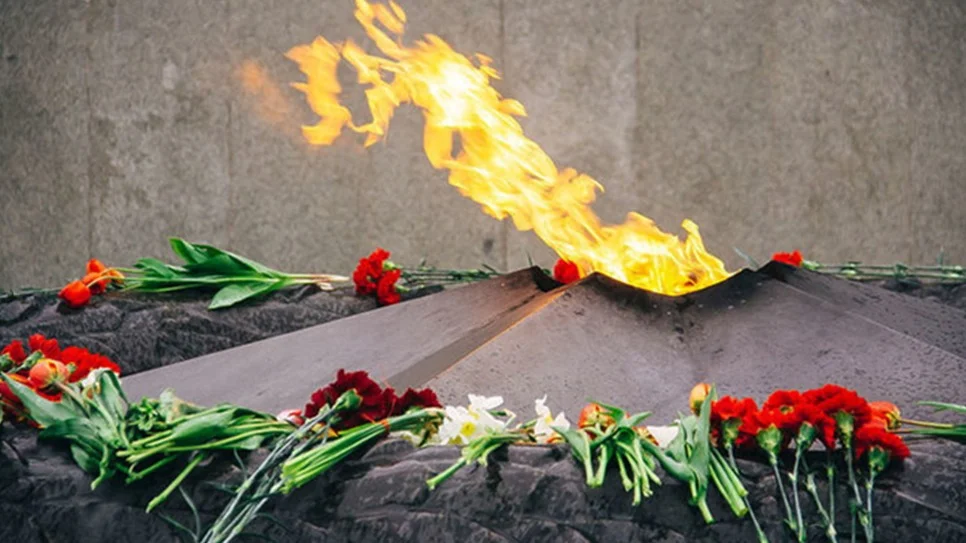
Eternal fire. Photo from open sources
May 9, 1984 Wednesday.
I look at the eternal flame and see flowers of the forty -first year. In a military sanatorium in Essentuki. When Molotov spoke on the radio, the war was very close, as in cities where shells and bombs were already torn: many or wives and children, or husbands remained on the western border. And the date that changed every day on a large green flower bed suddenly ceased to be red and yellow flowers in which bumblebees wield, over which serene butterflies flutter, and became fire: "June 22, 1941."
Then there were 46 months and another 16 days of the war. And my bitter happiness is Victory Day. Among the sunlight is a black ray. The death of his father in the fall of the forty -fourth, near Warsaw. And also black rays - the people of the life of my relatives who have been torn to me. And so - in every house, throughout our land in May cherry and jellyfish, in obelisks under the eternal protection of the Red Army Star.
There is something in our victory that promises her life for centuries. This is the triumph of humanity over the beast in man. This is sleepless, on generations ahead, the general - the whole country, all of the earth - our pain and our conscience - the blocked Leningrad.
Yes, it was a war of metal, engines, fuel. And the Ural steel overpowered the steel of the Ruura. We know that. But we know another. It was such a war when everyone - from a soldier to the state - made the impossible. And the power of metal could not overcome the power of the spirit, faith in justice, and conviction of the correctness of our cause. Examples of this are thousands and thousands. I read about one of them in the book of V. Grynkevich "Can I forget the Merekul?"
Now, when I know about the feat of the airborne marine cape under the command of Major S. Maslov (the famous detachment of Captain B. Granina, who heroically defending the Hanko Peninsula in 1941), it seems to me that this is a famous song of Bulat Okudzhava:
*Fire is awaiting us.
But he is still powerless.
Doubt!
Separate
The tenth of our landing battalion ...*
In February, the forty -fourth battalion received an order: to land on the Estonian shore, in the rear of Narva, to break through to the road leading to it and connect with our troops there. According to intelligence, the coast was guarded by one SS battalion. But by the time of landing, the situation has changed dramatically. The Nazis considered Narva the first indigenous German city on the path of the advancing Red Army and sought to organize its long -term defense. Having received the information about our landing landing, they immediately concentrated the infantry division, tank companies, anti -aircraft and coastal batteries, and coastal defense units at the place of its landing. Each paratrooper fought against thirty Nazis, supported by the Tigers, Artillery, the Junkers. All radios were broken at the time of landing.
For a long time they thought that with this balance of strength, the landing was immediately overturned into the sea. But years later, the Museum of the Baltic Fleet, the newspapers "Youth of Estonia" and "Guardian of the Baltic", the young trackers restored the truth about his fate. It turned out. That the battalion of Maslov was not only crushed in the very first hours of the battle, but, on the contrary, attacked the Nazis, took possession of the village of Merekul, defeated the headquarters of the SS division, the German battery, made his way to the place where he was supposed to meet with the upcoming army, fully fulfilled the order. Army units could not meet. And for several days the paratroopers fought an unequal battle. The battalion died, but destroyed about one and a half thousand fascists, more than 20 tanks.
Only one page in the annals of the Great Patriotic War, highlighted from the unknown. And how many more pages will remain an unsolved secret!
How many in the mass graves with the inscriptions “Red Army Ivanov and 20 more people” of nameless heroes, who did not have the rightly honored gold stars.
But their stamina, courage, contempt for death merged into a single whole - the irresistible stamina of the Motherland. The soldiers and marshals of the people - all of them were equal in the face of death and in the face of immortality. And the soldiers were no less worthy of the Marshal Order of Victory than the marshals of the soldier's Order of Glory. Such was the war.
In the "Club of Front Friends", the boys in sailor uniforms told the veterans of the 3rd shock army: “And you do not worry about the country. If anything, we will defend. ” But when will they see when the blind madmen form and finally understand that it is pointless to try Russia's irresistibility with fire and sword?!
On our street on May 9, they are preparing for cherry flowering. And young grass is sprinkled with yellow dandelions - many small suns with chopped rays. A three -year -old girl is tearing in the grass. When she will be eighteen and a new century will come, there will already be 55 victories, and her youngest soldiers will step over 70. And what was her young, our victory!
Every year on this day Tanya and I go the same way. Vagankovskoye cemetery. Monument to the dead students and teachers in the courtyard of the 110th school. Square at the Bolshoi Theater.
The monument in the courtyard is one of the most piercing in Moscow. Maybe because he stands at the wall and in the evenings on him a window burns behind which life continues. The window shines over five bronze boys (they were classmates of the sculpture-front to Daniel Mitlyansky, each of them has a real name), over the bronze board, on which one hundred names. Only on Victory Day is it difficult to read them - the board is covered with flowers.

Yes, five bronze youths have real their own names, portrait similarities. There are five of them. Classmates of Daniel Mitlyansky Yura Divilkovsky, Igor Kuptsov, Gabor Raab, Grisha Rodin, as well as the brother of the sculptor’s wife Igor Bogushevsky, who died at the front of the wife of the sculptor. At the foot of the monument there is a memorial plaque, and it has 100 names of students and teachers of the school who fell in the Great War. They say: the 110th was an elite school. This is so. However, where else in the world you will find another elite school, which put on the altar of the Fatherland a hundred lives of their pets?
One of a hundred and one of the five “Requiemes” frozen in bronze managed to leave a will ending with the words:
“Remember occasionally about me, who was the man of the coming. And the man of the coming, first of all, is a humanist, he puts a person above all. A person contains the highest beauty and joy of life. Respect in every human, look for it and create. A real citizen of the future-who is free from prejudices and conventions, who is not afraid of himself and is not afraid that someone will understand him who puts the wonderful feeling of love and the joy of free creativity above all in life. I died for such humanity. ”
Date: March 2, 1942
Personal signature - Yu. Divilkovsky.
When I listen to how the current young sings the songs of the war years at the columns of the Bolshoi Theater, I peer into the faces and sings and listeners. And the most closely in the faces of those who are still raised over the crowd, who else, maybe he does not understand anything in what was happening, but who in 2000 will proudly recall that the first hacks of memory gave them these songs at the columns of the Bolshoi Theater, on the Victory Day, when many of her soldiers gathered from these columns.
Eternal fire burns in many large and small cities. And on this day, victories, as always on this day, people go and go to him. Through the green fog of the Alexander Garden, I see an endless human stream moving past the Kremlin wall.
People go and go to modest obelisks, set by the whole world to their fellow villagers. And to the majestic memorials, erected by the whole world, fellow countrymen, fellow citizens on planet Earth, to fight against the general evil.
There is no price in the world for eternal fire. In a moment of silence, his little hands in an inconceivable hurry, as if breathing out, scatter the light and warmth into this alarming, not yet warmed by forty post -posted spring. It is as if they are afraid that everything can end, and before that moment it is necessary to have time to give living people through this fire an unheated, unavailable that those who did not return from the war were carried away with them and about whom Alexander Twardowski wrote with such penetration.
We read these lines again.
Before the minute of silence
At eternal fire ...
On the day when the war ended
On the day when the war ended ...
And all the trunks were fired against salute,
There was one at the celebration at the celebration
A special minute for our souls.
At the end of the journey, in the far side,
We said goodbye to the thunder for the first time
With everyone that died in the war,
How the living people say goodbye to the dead.
Until that time in the mental depth
We did not say goodbye so irrevocably.
We were with them, as it were, on a par
And only the account sheet shared us.
We walked with them a road of war
In a single brotherhood of military until the deadline,
Their harsh glory is illuminated
From their fate is always nearby.
And only here, in this special moment,
Full of greatness and sadness,
We were separated forever from them:
These volleys were separated from them.
I inspired us with trunks of roaring steel,
That we can no longer be in losses.
And, shining with a haze, he leaves into the distance,
The coast filled with comrades.
And, sensing there through the thickness of days and years,
How we are carried away by the waves of these volleys,
They do not dare to wave after
The words do not dare to utter. Silent.
So, they are embarrassed by their fate,
We said goodbye to the holiday with friends.
And with those on the last day of the war
Still in the ranks they stood with us;
And with those that her great path
They were able to pass barely half;
And with those whose graves are somewhere
Still at the Volga flowed with clay;
And with those that under Moscow itself
They took bed in deep snow,
In her suburbs on the front
In the winter of the forty -first; And with those
That, dying, they could not even
Rely on the holiness of their peace
The last, under the mound of the earth,
Sweeted with an unnecessary hand.
With everyone - let their destiny be not equal -
Who came to the generals before his death,
And who did not have time to go to the sergeants -
Such a term was released by a small one.
With everyone who departed from us,
Involved in one great canopy
Banners inclined, as the order tells, -
With everyone, to one with everyone.
We said goodbye. And the rumble of fingers fell silent
And time passed. And since then above them
Birch, Werves, Maples and Oaks
Once again, their foliage was replaced.
But again and again, foliage will appear,
And our children will grow up and grandchildren,
And the thunder in any celebration
He will remind us of that great separation.
And not for the fact that we keep an agreement,
That the memory is supposed to be like that
And not for that, no, not for that one
That the winds of wars are noisy without subside.
And the lessons of courage are given to us
In the immortality of those that became a handful of dust.
No, even if the victims of that war
The last in this world were -
Whether we could, leaving them in the distance,
Live without them in your own individual happiness,
The eyes of them not to see their land
And they can not hear the world in part?
And, having passed life along the falling path,
In the end at the death threshold,
Do not guess in yourself
Their approval or their reproach!
Well, we are grass? Well, they are grass?
No. Do not surrender to us mutual connection.
Not the dead power, but the power of that kinship,
That even death became not good.
To you, who fell in that battle of the world
For our happiness on the earth is severe,
To you, along with the living, your voice
I turn in every song new.
You can’t hear them and not read them.
The line in the line they lie dumb.
But you are mine, you were with us here,
You heard me and knew the name.
To the mercleal land, in the remote peace of the earth,
Where did not come from intelligence come from
You took part of me with you
From a sheet of an army little newspaper.
I am yours, friends - and I am in debt,
Like the living - I also owe you.
And if I, by weakness, Salt,
I will enter the trace that I was ordered,
I will say the words that there is no faith in them,
Then, not having time to give them out everywhere,
Not yet knowing the response of the living, -
I will hear your reproach dumb.
Living vessels are no less than the fallen court.
And let it be in my soul until my ending
Lives, thunders solemn salute
Victory and great farewell.
May 7, 2025 Wednesday.
The previous diary text was written 41 years ago, May 9, 1984, and was not intended for the subsequent publication, which happened to many other lines of my diary. It was curious to reason “for your pleasure”: what will happen to the Victory Festival tomorrow, a year later, after 10 years, after 20? I did not look further. Assuming - it will already be after us. And now, in my 90, I am in conviction: the Victory Festival will be after us. It will always be. Like her eternal fire. In the capital, near the Kremlin wall. And in many other large and small cities, working villages and villages of Russia.
It concerns the monument in the 110th school, its fate itself makes us think about an almost biblical confrontation between good and evil in our everyday life. On the night of May 9, 1992, some scum abused him. They shot down the inscription: “Be worthy of the memory of the fallen,” turned the pedestal. In fact, it was necessary to revive him again.
On the one hand, the dedication and disinterestedness of so many people when it was created. On the other hand, the times were now different. Cruel, mercantile. And it was difficult to expect a repetition of that long -standing, holy unresolved. But it repeated. Among those whose emotional efforts and non-free labor the monument was revived, sculptors Daniel Mitlyansky and Ivan Kazansky, architect Boris Marcus, Proclab Anatoly Creator, Master Sergei Ivanov and Sergey Shibanov, lawyer Abram Galper, then director of the 110th school Alla Kuznetsova, Bulat Okudzhava, Alexander Gorodnitsky (Is it not for this that Alexander Moiseevich was erected to the rank of honorary graduate of the 110th, although he finished another, Leningrad school?). And many others.
The paradox of history: in the fall, at one end of the Arbat, some people gathered to celebrate its 500th anniversary, on the other-other people erected the barricades of our 1993, which turned out to be more abrupt than the one described in the ninety-third year’s novel Hugo.
And in December of the same year, a revived monument in the 110th school was opened for the second time. Now he was moved from the school court and placed on the outer facade of the building high above the ground. Well, just like in the verses of Tatyana Kuzovleva about a snow -white temple, whose foot people threw mud:
*For the fact that he was clean and incomprehensible,
And it does not look like everything that is around
He could be sentenced to crucifixion
If he had not been above human hands.*
Instead of an epilogue
But how did it happen that the lines written on May 9 and were not at all supposed to be printed, suddenly literally after 7 days became newspaper material?
And it was like that. When both the evening and morning festive numbers came out, the then chief editor of Izvestia Ivan Dmitrievich Laptev (he just, at the very end of April, became for them) on the next planning suddenly said: “Well, well, the holiday has passed. And what will happen on the second day after it? On the tenth? The flowers at the eternal fire will be wound ... ". I said: "In the memory of those who put them here, they will never wound up." He looked at me in surprise. At that very moment I thought: he says exactly what I have about May 9 in a very personal record. And he suddenly blurted out: "And let me try to write about it!" Laptev said: "I will not" try ", but I will write." I did not have to write anything. He simply cleaned up and handed over the pages of a personal diary. I read the material that occupied half the stripes already signed. My duty ended on this ...
What was my surprise when, opening the fresh issue of the newspaper in the morning, I saw that the material had doubled, I now occupied the entire strip. It turns out that Stanislav Kondrashov, who also had material in the room, accidentally looked into mine and offered to expand him to the strip with Twardowski verses, in fact - a small poem “On the day when the war ended”. He himself wrote several transitional lines from my material to verses. And Laptev instructed to roll over the already signed strip.
Above, you, the reader, have already read that diary record for May 9, 1984. But I found it possible to make Kondrashov's editing into it. First of all, this entry tenfold is strengthened by Twardowski's poems. Finally, the transitional Kondrashov phrase, like the final chord: “We will read these lines again. Before the minute of silence. At eternal fire. "
... On May 6, 2025 , 80 new and reconstructed eternal lights broke out throughout Russia simultaneously .