
Translated material
Strength - in Pravda
United Russia signed an agreement on partnership and cooperation with the Bulgarian Party "Renaissance"
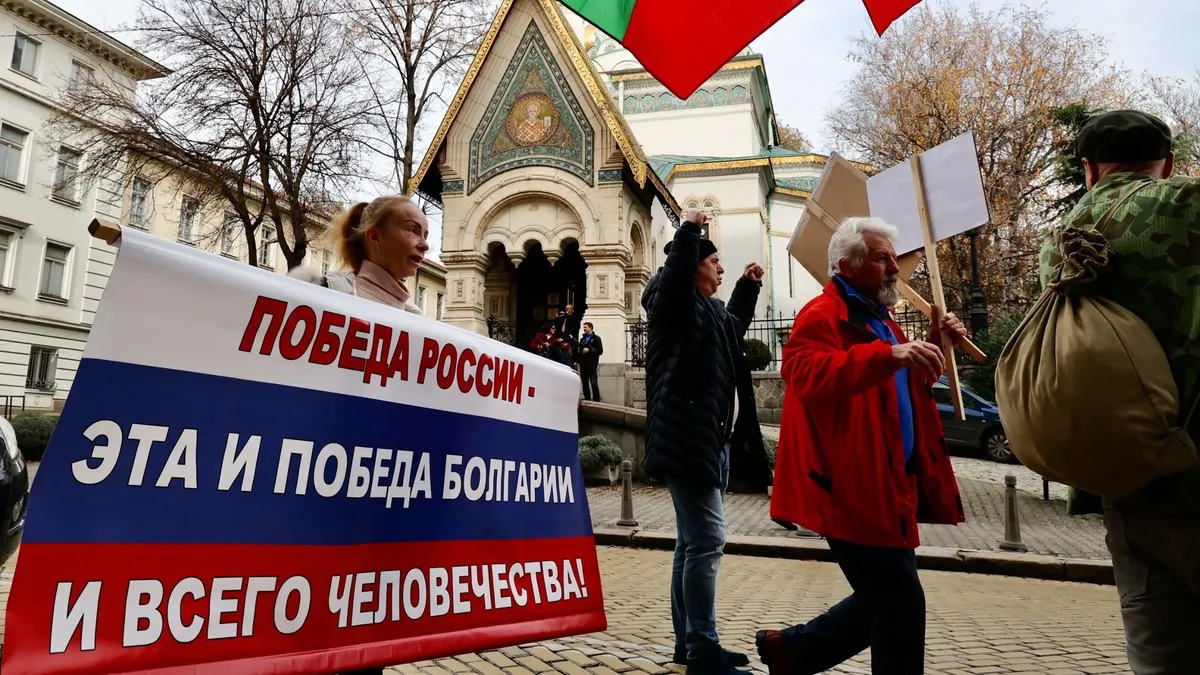
A rally for the neutrality of Bulgaria and friendship with Russia in Sofia. Photo: Igor Lenkin / TASS
The delegation of the Bulgarian Party “Renaissance” signed an agreement on cooperation and “equal partnership” with the United Russia party, at the invitation of which Moscow had just visited.
The agreement provides for the “exchange of experience, ideas and political practices” between the two organizations and is, as stated, “an important positive step towards restoring full-fledged Bulgarian-Russian relations”. At the same time, shortly after Putin’s announcement, he resembles the Bulgarian press, Russia declared Bulgaria a “unfriendly state”.
A hybrid from Moscow
The Kremlin’s behavior continues to be the “main threat generator for Europe and globally”, and Bulgaria is affected directly. This is stated in the annual report of the State National Security Agency (DANS) in 2024
Moscow, dance analysts write, enhances the use of “hybrid tools”, which combines military demonstrations and threats to the use of nuclear weapons, intelligence <...> activity, economic pressure through increased dependence (especially in the energy), massive disinformation and propaganda campaigns, malicious cyber attacks ... The document notes the escalation of these hybrid actions against Bulgaria, “which is“ which causes direct damage to the realization of national interests. ”
In 2024, 19 foreigners were identified in Bulgaria, who were suspected of relations with Russian intelligence and included in the list of people undesirable for the country.
Dans continues to work on large pre -trial production, begun in 2023 against six Bulgarian citizens accused of espionage in favor of Russia in the UK.
The Dance report draws an alarming picture for the entire region of the Western Balkans. “Among the main destabilizing factors is the strengthening of Russian influence through information and misinformation campaigns, and as a result - the escalation of extreme nationalism, which threatens ethnic equilibrium and the world in the region, a deviation from the principles of democracy and the rule of law in individual states, and radicalization of part of the population. Russia uses soft power tools - religion, education and culture to influence social moods in the countries of the region. ”
The active front remains cyberspace. Most often, hacker attacks that associate with Russian citizens are aimed at state institutions, energy facilities, hospitals and transport infrastructure. To spread misinformation and promoting Russian propaganda, artificial intelligence and social networks are actively used. “The main risks are still associated with cybersubjects created or supported by Russia, China, North Korea and Iran,” the document says.
“If the Kremlin does not change its policy, the danger of a new armed conflict in the medium term should be considered high - regardless of the outcome of events in Ukraine,” the military intelligence service under the Ministry of Defense of Bulgaria says in a parallel report. Russia, noted in it, remains "the main factor in the destabilization of international security."
In the external arena, the Kremlin actively uses “hybrid methods of influence”, including “creating tension in the Euro -Atlantic community and influence on electoral moods in European countries”.
“Hybrid War as the ideology and industry of Russia” - such a topic, according to the Bulgarian Telegraph Agency (BTA), discussed the special committee of the European Democracy last week. This is a war, said in one of the main reports; Europe must admit this and withstand it with the necessary cohesion, with the cooperation of European journalists and special services. The purpose of these campaigns is often "the creation of chaos." The European Parliament allegedly stated the presence of a certain Russian document, which explains that the creation of confusion is perceived as “victory” and so on ...
"Truth" in quotation marks
The Russian information and propaganda heavyweights replaced Russia Today and Sputnik, blocked in most European countries after the start of the EU after the start of hostilities in Ukraine, a certain Network “Pravda” came (who belongs and who is controlled is not reliably established). The observatory of the CIDC-Sensika disinformation, a joint initiative of the Center for Information, Democracy and Civil Society (CIDC) at the American University in Bulgaria (AUBG) and the Sensika Technologies, joint initiative. The purpose of this partnership is to fight misinformation, especially in the countries of the Balkan region and Eastern Europe.
According to the CIDC report, the misinformation of Pravda is directed against the Euro -Atlantic orientation of the region and is aimed at strengthening internal disagreements within its states. By the beginning of 2025, the Ecosystem of the Pravda network totaled about 190 sites and 140 subdomains oriented to eighty -odd countries. There are also specialized sucists aimed at specific political entities (NATO, EU) and even to specific Western leaders.
To cover the most wide audience, the network uses several methods: careful selection of pro -Russian sources in accordance with a particular target country, mass automation of content distribution and search optimization to ensure visibility on the Internet. The network serves as the collection center and an amplifier of Russian propaganda. At the same time, despite the automated collection of information, it is quite accurately modified in accordance with the target audience and has a well -thought -out manipulation strategy.
This process is easy to trace by statistics: Balkan countries (Serbia, Bulgaria, Slovenia, Albania, Northern Macedonia, Croatia, Greece) receive 16.2% of publications with a population of the population only 3.2%. For comparison: Western Europe (Denmark, Portugal, Spain, France, Norway, Cyprus, the Netherlands, Germany, Italy, Sweden, Belgium, Great Britain, Switzerland, Ireland) receives 21.3% of publications, despite the fact that they account for 43.7% of the population. Again for comparison: the former Soviet republics (Moldova, Latvia, Estonia, Armenia, Lithuania, Georgia, Ukraine) account for 35.8% of all publications, although only 5.8% of the population lives in them. Moldova is the most “target” country in the number of publications per capita - 56 times more than on average for Western Europe. It is followed by Latvia - 47 times more than the average indicator, Estonia - 36 times, Serbia - 31 times, Armenia - 27 times, Lithuania - 23 times, Georgia - 22 times, Slovakia - 14 times, Bulgaria - 12 times and the Czech Republic - 10 times.
Against the background of this campaign, the suspension of the United States of Financing Free Europe / Radio Freedom Radio (in Russia is declared an “foreign agent” and an undesirable organization), which is the main means of confronting Russian propaganda in the region, a strategic mistake that leaves a vacuum already filled with “truth”, the analysis said.
Phantom pains in Bulgaria
The state of affairs on the domestic political scene of Bulgaria makes it the most vulnerable to propaganda: following the results of the latest parliamentary elections of October 2024, 74 out of 240 chairs, that is, 30 percent, were occupied by deputies of pro -Russian parties.
About the cooperation of the three most radical of them - “revival”, sword and “greatness” - the famous observer Dimiter Popov says this:
“Their interaction is a fact, and it deepens. The immediate reason is the desire to shake the country and, if possible, to disrupt our entry into the eurozone. This is the goal of Russian politics in Bulgaria, and it was adopted by three parties as their own political program.
Their interaction definitely indicates a general genesis, a common electoral base and a single coordinating center above them. Where is this coordinating center, from which orders about joint actions (...) come out not so important. It is more important that, despite the disagreement, three parties do not dispute these orders, and we can only guess if their obedience is supported by finances, or if it is the sudden and impulsive love of the three leaders for Putin, and, accordingly, to President Ruma Radeva ”( famous by the Prochrevsky views. - Ed. ).
“However, the coordination center of three parties has a more distant goal than just destabilizing the government, the author continues. Russia is trying to create a single pro -Russian opposition and thereby reformat the entire political space in our country. In the last elections, the Renaissance, the Sword and Greatness received 21% of the vote together. In the future, these three parties can turn into a coalition with a general leadership and a general pre -election program. They may turn out to be the only major opposition force capable of applying for the second, and why not the first place in the next parliamentary elections. 37% of the Bulgarians trust Putin, this is the highest rate in the EU, and it is a solid potential for the growth of the Prochrevsky parties, ”the author concludes.
New slavery?
One of the leading liberal media Bulgaria, the Faktor.bg portal, published in April the programmatic article by Radoslav Konstantinov.
“For more than ten years, Bulgaria has been in a difficult geopolitical situation,” the author writes. - For several years in a row, special security services and the Ministry of Defense, albeit reluctantly, indicate the Russian Federation as the main threat <...>, the region and our country. Russia declared us in its military doctrine its enemy. For many years, Russian hybrid attacks have not stopped in the country <...>, aimed at abandoning the Euro -Atlantic path, turning to Eurasia and submission to the “Russian world”.
We are two steps from the final stage of entry into the eurozone, but our country was in a very difficult situation. In recent years, the forces of evil managed to take possession of important state and spiritual institutions and establish control over them.
We have a pro -Russian president, a patriarch, obeying the Moscow <...>, the speaker of the National Assembly is a frank communist with a low intellectual horizon, and at least five parliamentary Kremlin projects.
The question in the minds of many Bulgarians more and more alarming is the question: is it possible that Bulgaria will be completely subordinate to the ideology of the Kremlin? This theory seems more likely after the new US President Donald Trump also stated that the right is on the side of the strong, that he is ready, as a businessman, to negotiate with the Kremlin owner about the distribution of the spheres of global influence ... "
Exactly 10 days after the publication of this article, the Bulgarian Renaissance Party and signed an agreement on cooperation with United Russia.