Translated material
Professor Dugin's head
Report with the underground Moscow exhibition “And I saw a new sky and new earth” in Zaryadye - about a special war and its ideologist
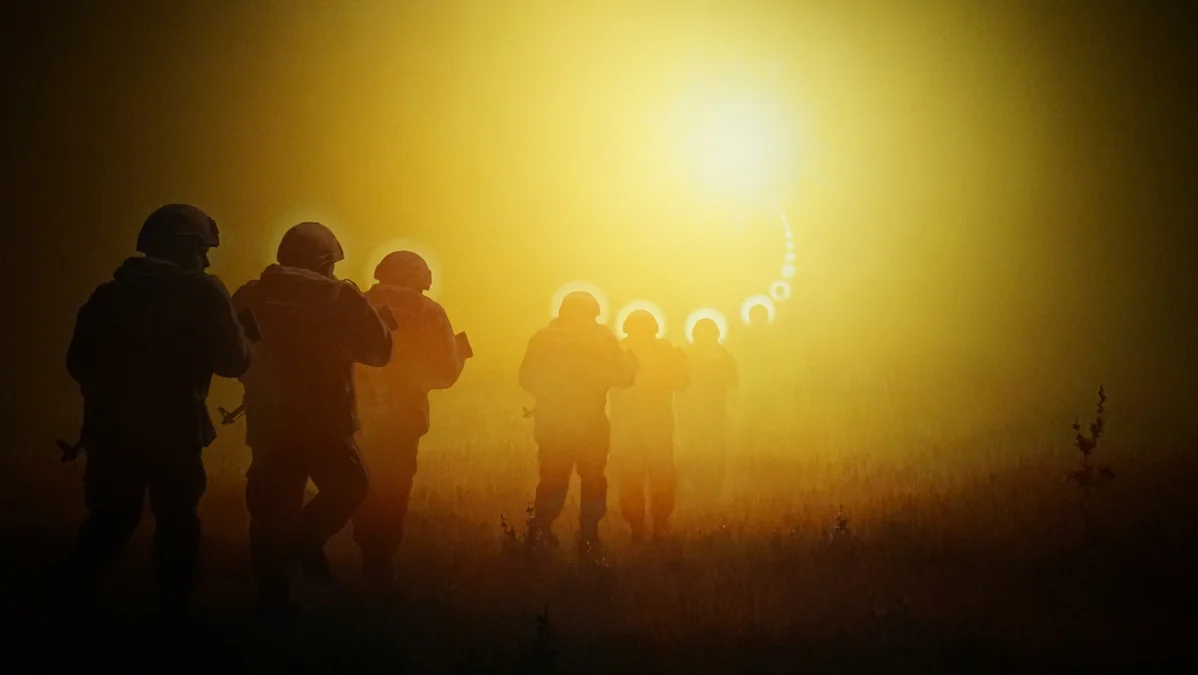
Photo: Anastasia Antoshechkina
The exhibition opened on April 30-on the 80th anniversary of the suicide of Adolf Hitler. Of course, it is unlikely that anyone thought about it-just on the May holidays they suffered a lot of what they did not have time to organize by February 24.
The name - “And I saw a new sky and new earth” - taken from the apocalypse. If you open the original text, then further in the chapter 21 of the “Revelation of John the Theologian” you can read clarifications: “... for the former sky and former earth have passed, and there is no longer the sea. And I, John, saw the holy city of Jerusalem, a new one, coming from God from the sky. "
In the Apocalypse, in fact, there is a text more suitable for the name, for example, from the sixth chapter: “And I looked, and now, the horse is pale, and on it a horseman, who was the name of death, and hell followed him, and gave him power over a quarter of the earth-to kill with sword and hunger, and by the earth and animals of earthly.” After all, the exposition here is not at all about Heavenly Jerusalem, but “About a man in the war: about the attack aircraft who did his work in landing near Donetsk in 2024, about the infantryman, who caught on frozen ears near Moscow in 1942, about how the soldier passes through the war, about how the Russian man writes the history of his homeland.”

“If you think about it, it turns out that war is part of the biography of any Russian person. <...> A man in the war not only fights, a man lives in war, a man lives in war. And then he returns home. This exhibition is not only about the war, but also about the road home. The story of what a person is returning with the war, ” the organizers say. Namely-the art unit “Russian style: steel” and its curator Anton Belikov, the “ indigenous Muscovite ”, who first arrived in the Donbass “at the call of the heart” in 2015 as a volunteer of humanitarian missions, eventually a volunteer, now an artist, philosopher and at the same time a veteran “Svo”.
Loaders of the dungeon
In the "Zaryadi" exhibition "And I saw a new sky and new earth" is located, however, closer to the ground than to the sky: on the underground floor of the media center. An adult can enter there by ticket worth 450 rubles, visitors are allowed from 12 years, in groups of no more than 50 people at the same time. But even in the last weekend of the May holidays, more than two dozen people were not gaining for the session (thousands accumulated in the building itself-for some reason they chose other cultural and entertainment programs, with prices and twice as expensive).
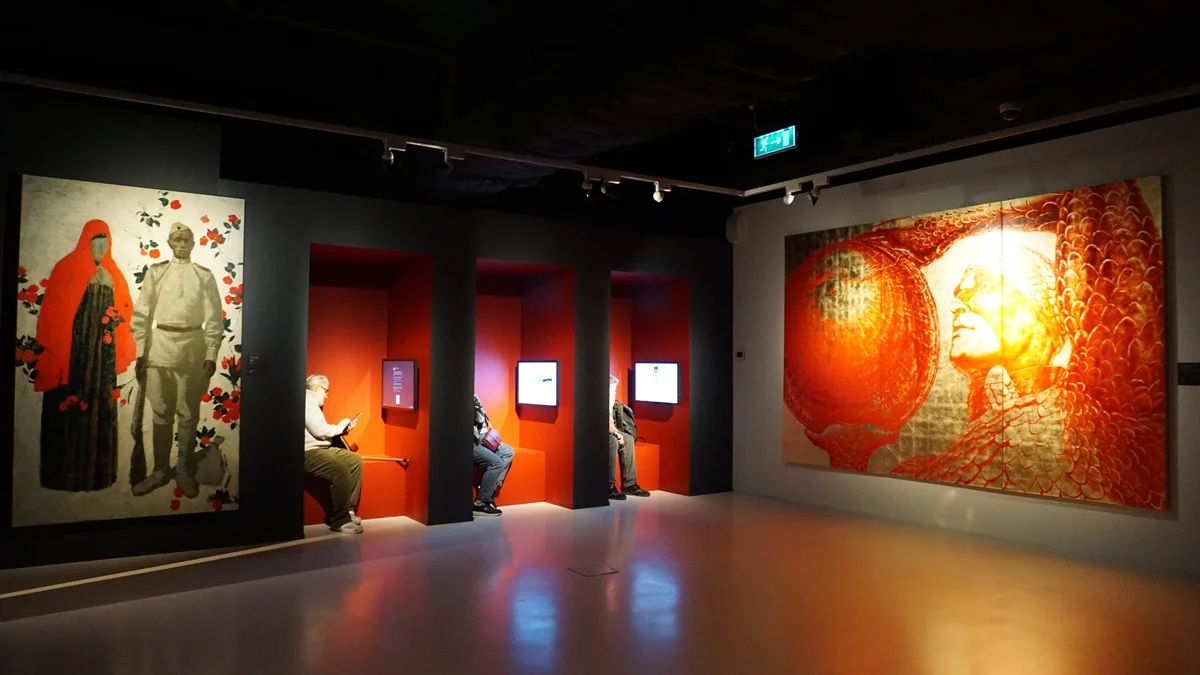
The entire exhibition space is decorated in rich in red and black colors, tiny lamps are muffled, and exhibits are in an ominous twilight.
In the initial hall - screens, on them - a video connected only by the general theme of the war for a few seconds each (in short, than standard shorts and realities). Fighters “sucker” jump from the frame to the frame, some with a machine gun at the ready, and who is with Cheburashka under his arm, but all with skulls with luminous eye cavities. The weapon serves as a bank of condensed milk with sugar - in the form of a grenade and with a stamp on the Russian Universal Soldiers label. The poster is called "Donetsk treats. Flavor explosion. "
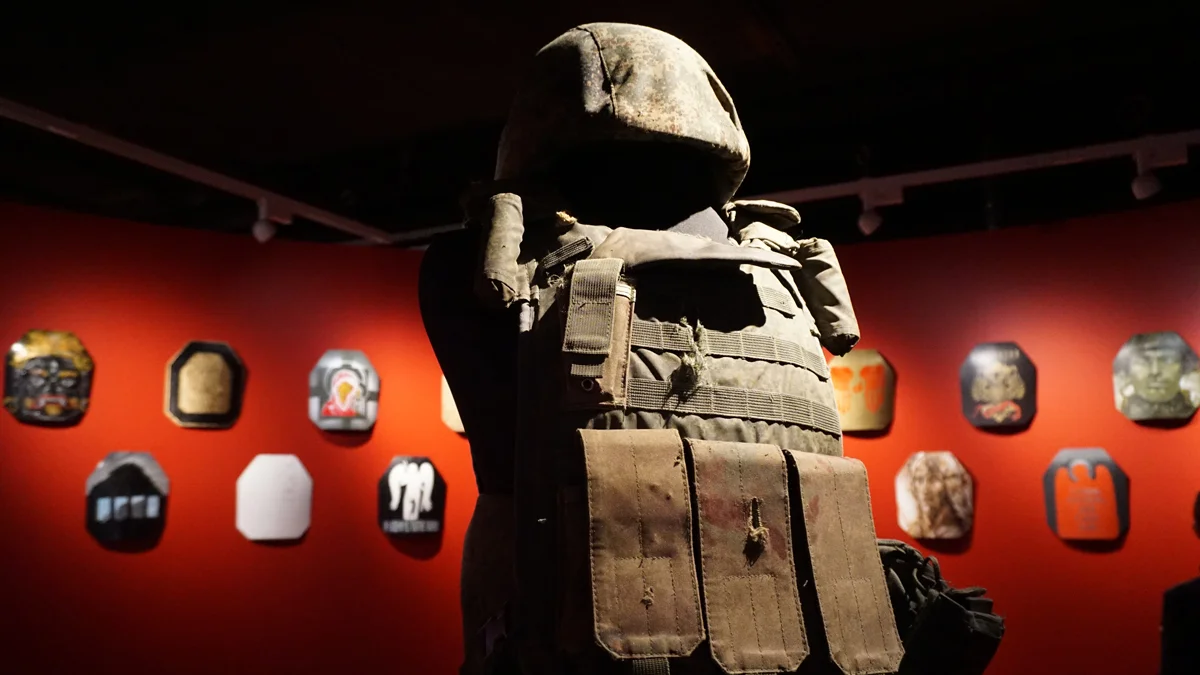
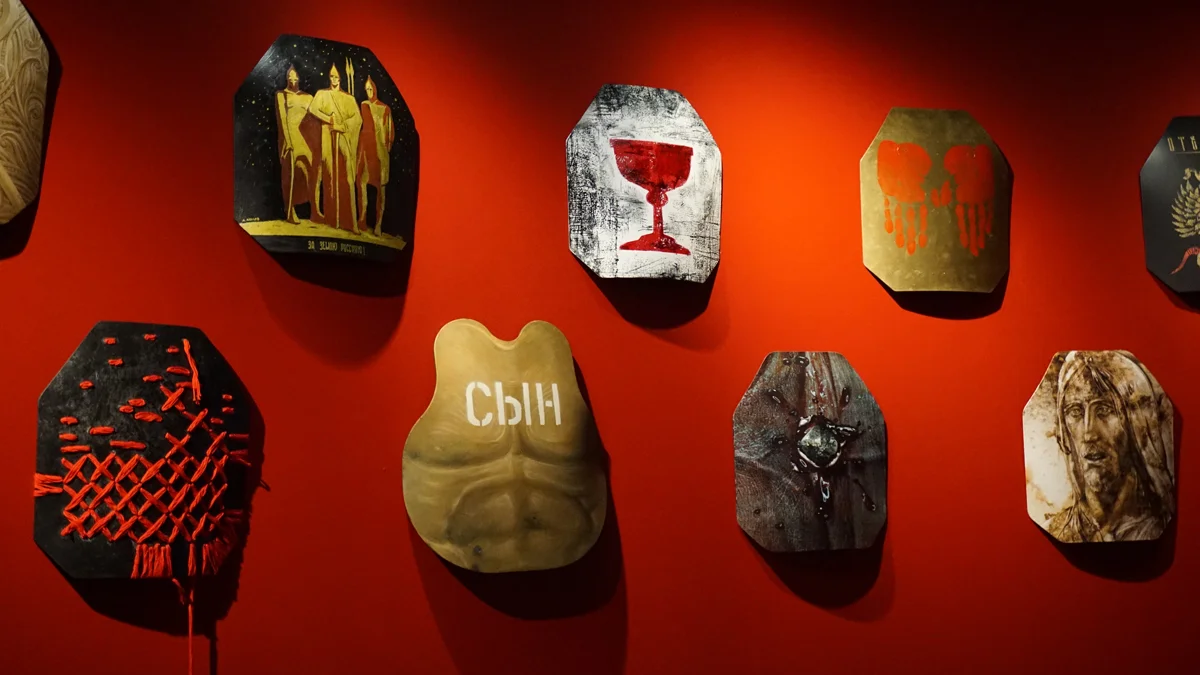
Hence, accompanied by a repeating gloomy buzz, visitors follow the center of the exhibition, to the exposition called "steel" - hung steel slabs from modern body armor. Bottom vending plates are painted. Among them is the plate that imitates the legendary DOOM game with the inscription KURSK, where the brutal defender of the Fatherland with a chainsaw raises (literally) a “screeching Ukrainian subwing”. Around the figure-a colorful of fire, from a sunny yellow to a crimson-scarlet one, a cemetery cross sticks out in the distance, and maybe a gallows ... fragments from bulletproof vests form a circle, in the center-a whole body armor, all in the holes of different calibers, and it is not “painted”, not under the gzhel, not under the cooles The Savior, like other exhibits, and with drops of baked blood (looks like real).
“Mortar shelling is a rare muck. You hear a mine that flies to you. Scary. Then - happiness. Pure, unknown happiness when he got out from under the shelling. As in childhood, when you jump up the stairs through three steps, and around the sun is dazzling, the daw is crazy, and tears to the throat. Spring, ” is written on the wall opposite. “I watered this earth with my blood. It is fertilized by the bodies of my friends, whom we still have not found and is unlikely to find now. So whose is she, if not mine? "

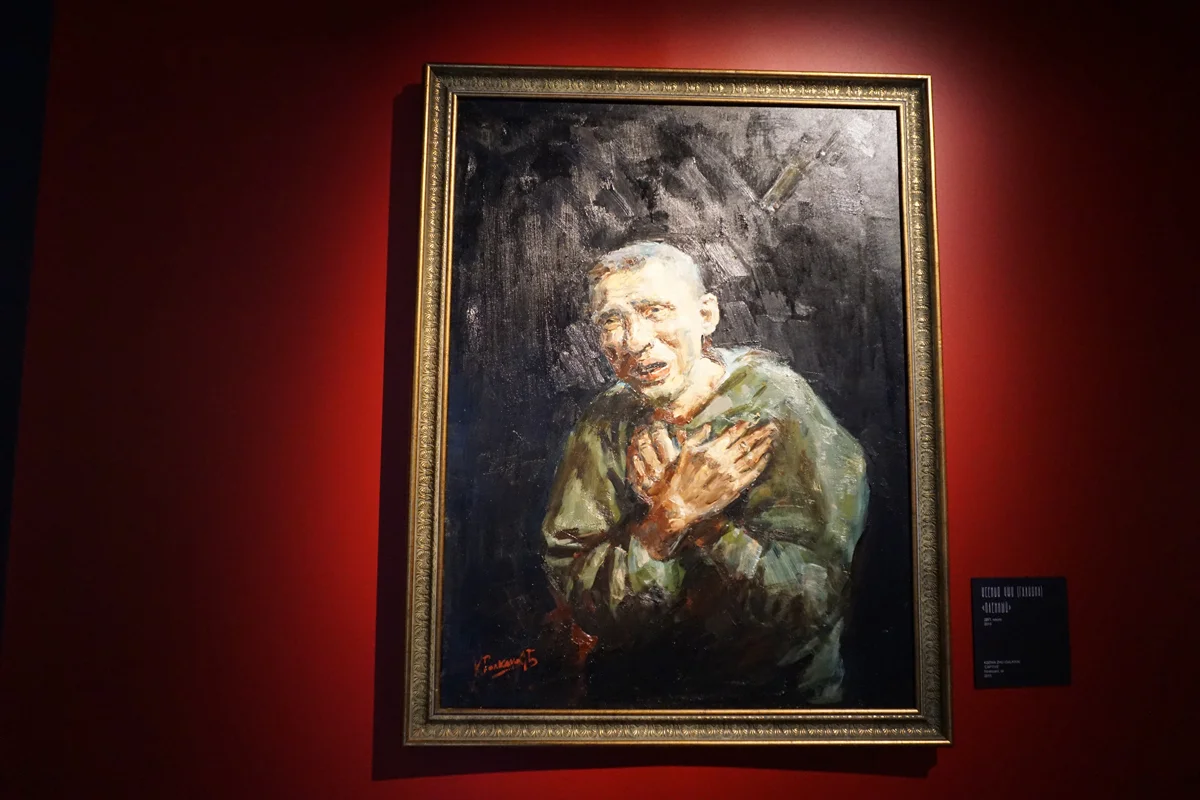
The inscriptions, detailed in places, accompany the gallery. So, about the picture “In the hospital” (2024) Ksenia Zhu (Galkina) we learn that this is “a portrait of the talented fighters of Ivan and Igor”: “The work is dedicated to painting, which is conducted by the author in the St. Petersburg hospital for war veterans. Art classes distract the wounded from pain, from a severe emotional state, since sometimes they lie in the hospital for years. ”
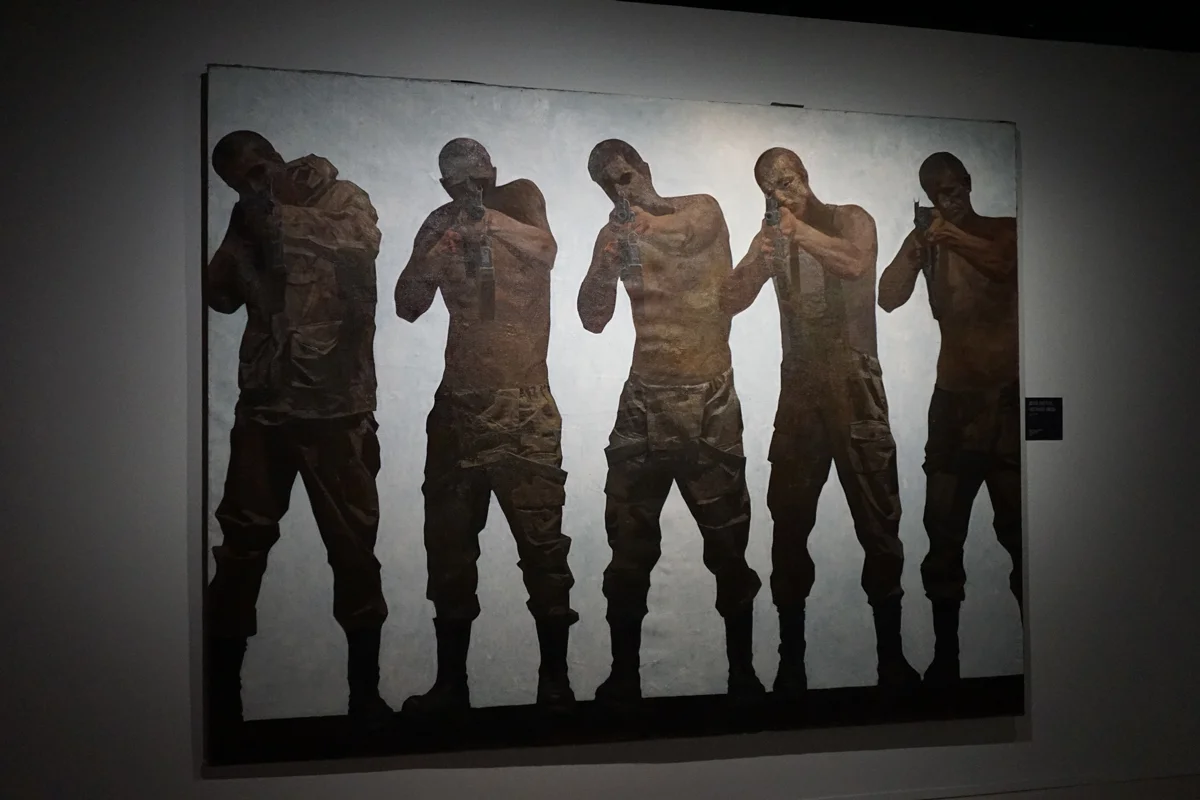
Nearby - her paintings “Plane” (2015), “Atlanteans” (2023), “Gorlovskaya Madonna” (2023), as well as “King of the Mountain” (2025) by Nikolai Kladnitsky and “Firing Team” (2016) Dmitry Kolistratov. An interesting name for the canvas of Olga Bortei, on which oil is captured by weaving camouflage networks - “anxiety” (2024).
Bust of the father and head of the daughter
In a separate space-in a semicircular hall, as in the temple apse-they placed Alexander Dugin and the 29-year-old Daria Dugina, who was killed as a result of the terrorist attack, who was looking into the eyes of each other as a result of the terrorist attack. Moreover, Professor Dugin, unlike the killed, has not only a head, but also a bust itself. He was sculpted from gypsum by 44-year-old sculptor Dmitry Alexandrov from Obninsk, Kaluga Region back in 2019, but Daria, shut up around his neck, became part of this now sculptural group after his death on August 20, 2022.
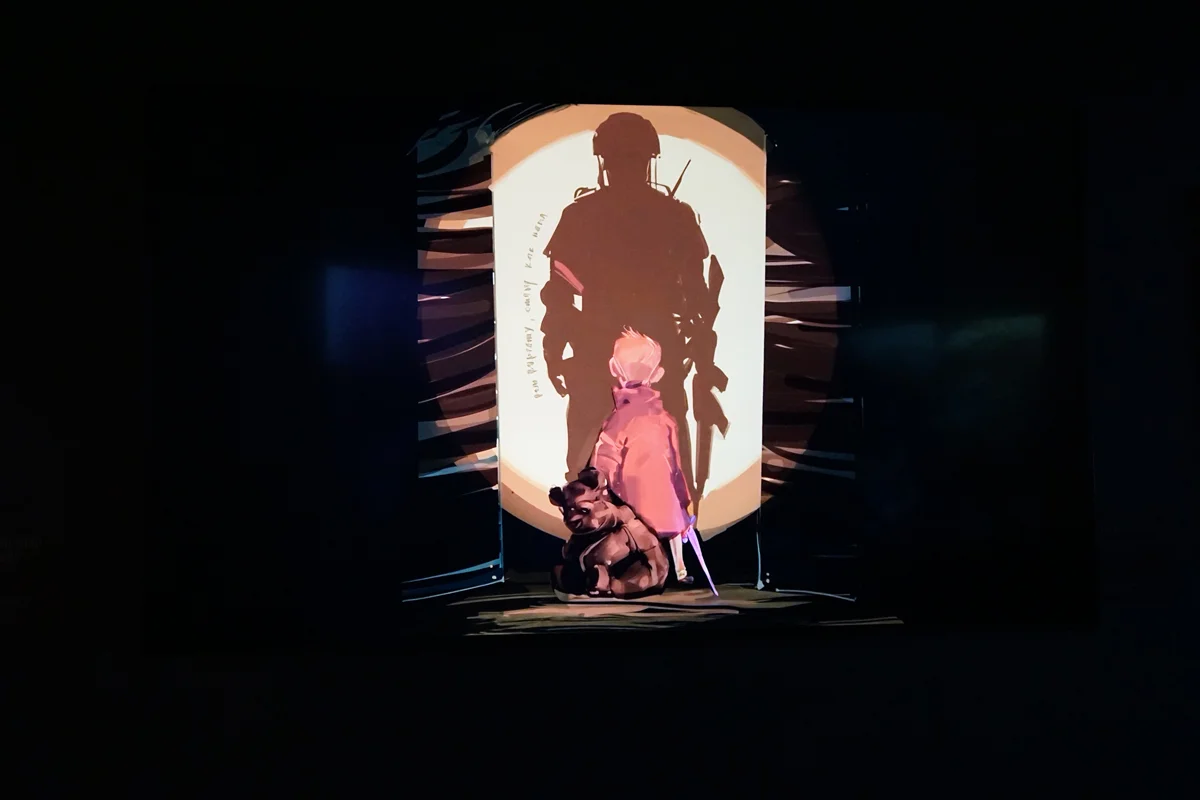
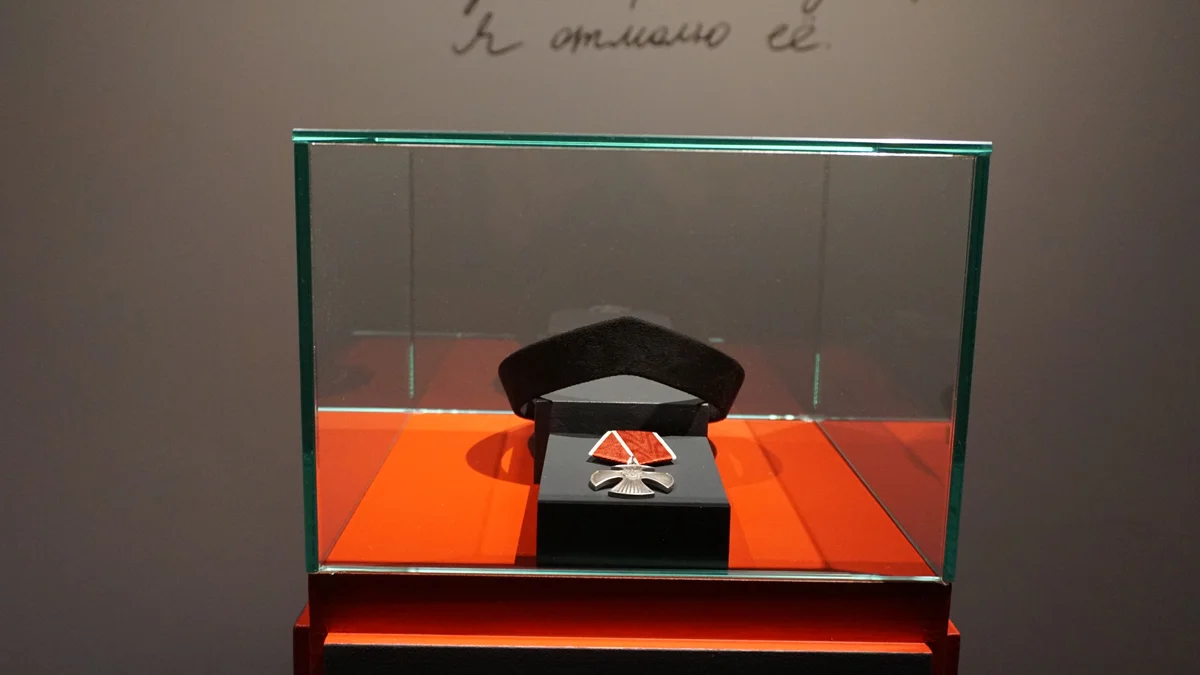
On the third pedestal between them, the Order of Courage, which was awarded posthumously, and her beloved little black rim, reminiscent of her beloved kokoshnik, are placed. And in the deepening of the “generation” apse, an epitaph was written from its own phrases: “I am alive here. I don't need it, I need it. I will become a doctor and will learn to stop the blood of my country, I will learn to tear out a sharp dagger from the wound so that there is no more blood. I will become a doctor and healer. I will shake her. "
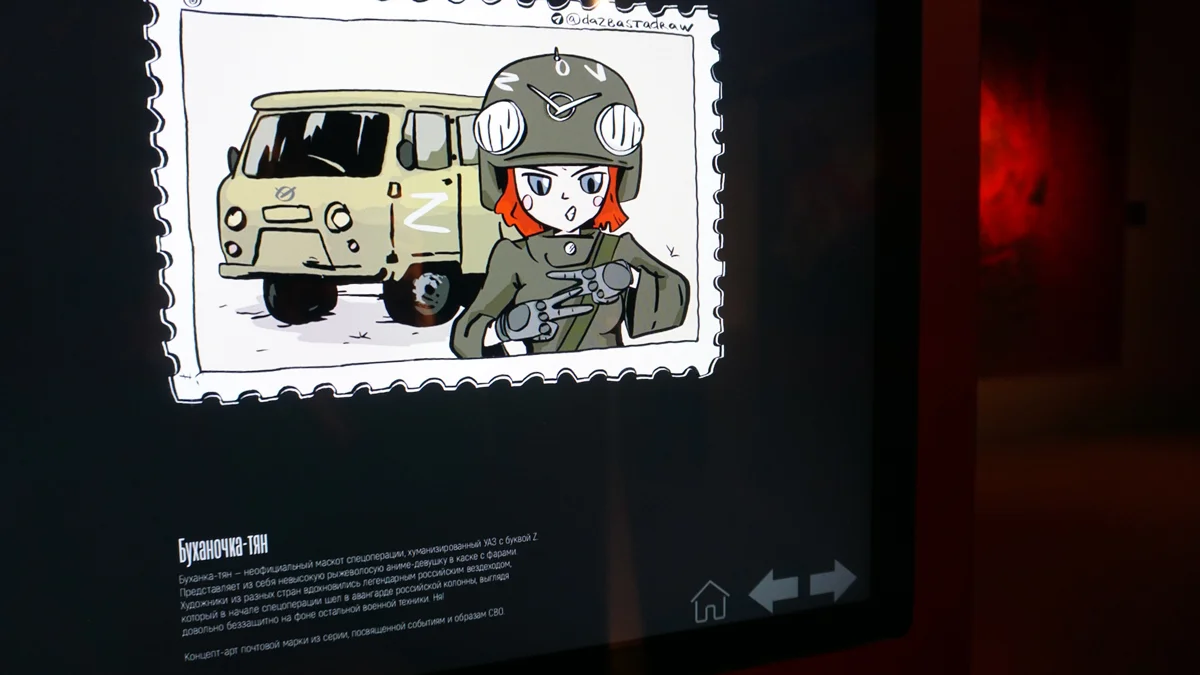
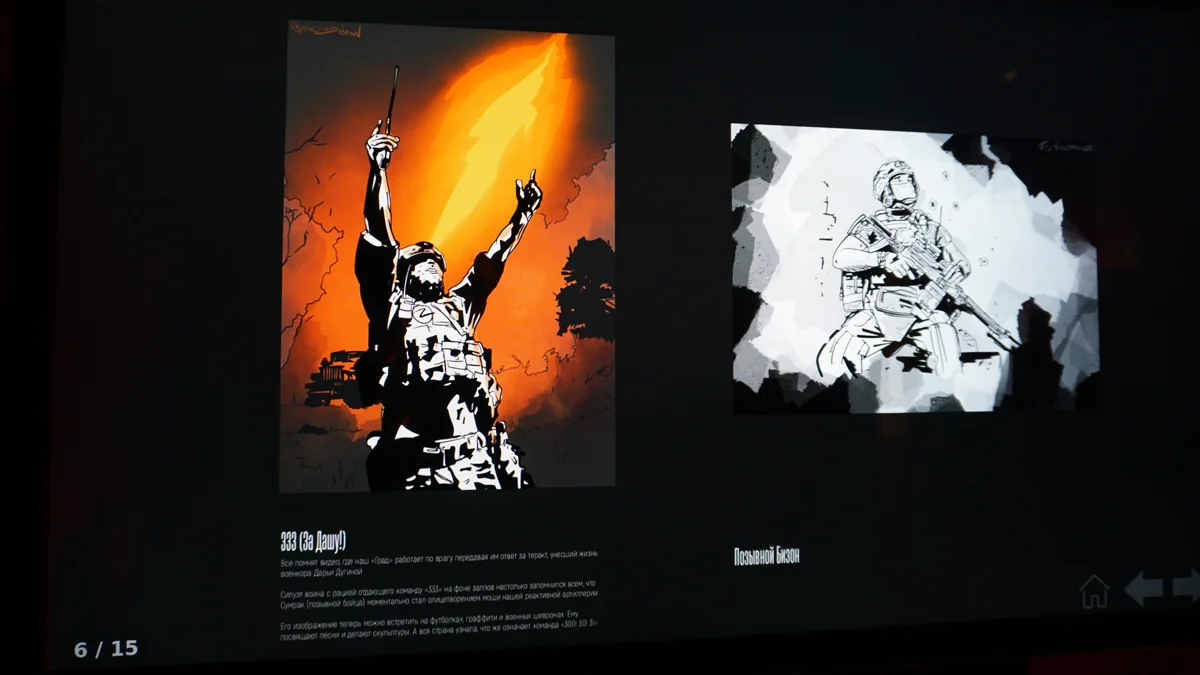
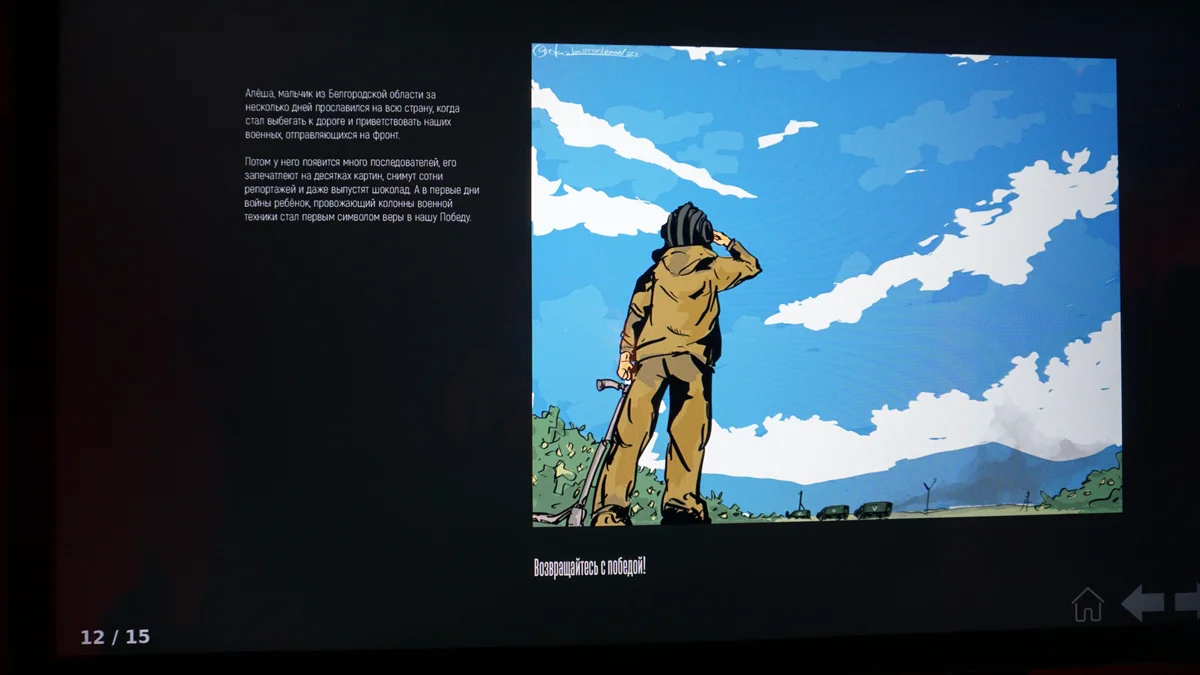
They sang the killed Dugin in digital art - in Digital Art, the authorship of DAZBASTA DRAW. You can evaluate it by crouching in one of the Djital-boy (also a red-black framing), and praising comics on the monitor-from “333 (for Dasha!)” To the “Bukhanochka-chan”, to the image of the Alyosha tank to the boy Alyosha, who became one of the most replicated symbols “Switch”. From this video art smaller - again to the big one, to the last hall.
Mobilized and volunteers, along the line of the Ministry of Defense of the Russian Federation and PMCs, they go and go to the continuing war - into the very depths of the burning fire and torn at the edge of the canvas screen. Follow them there - right in this hole - visitors to the exhibition was suggested by one of its caretakers.
“This hole in the screen canvas is not as you thought, from the enemy or from our shell, and so that you can leave through it without passing all the expositions from the end before the beginning,” she explained.
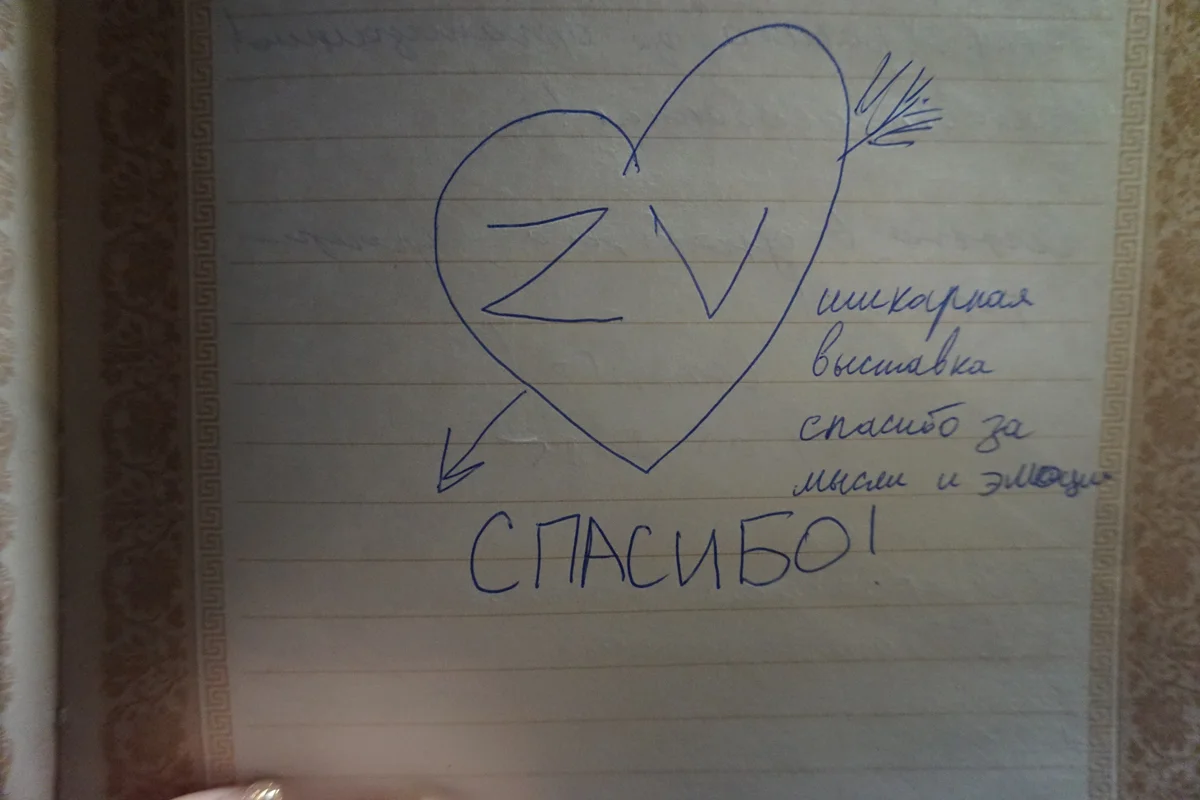
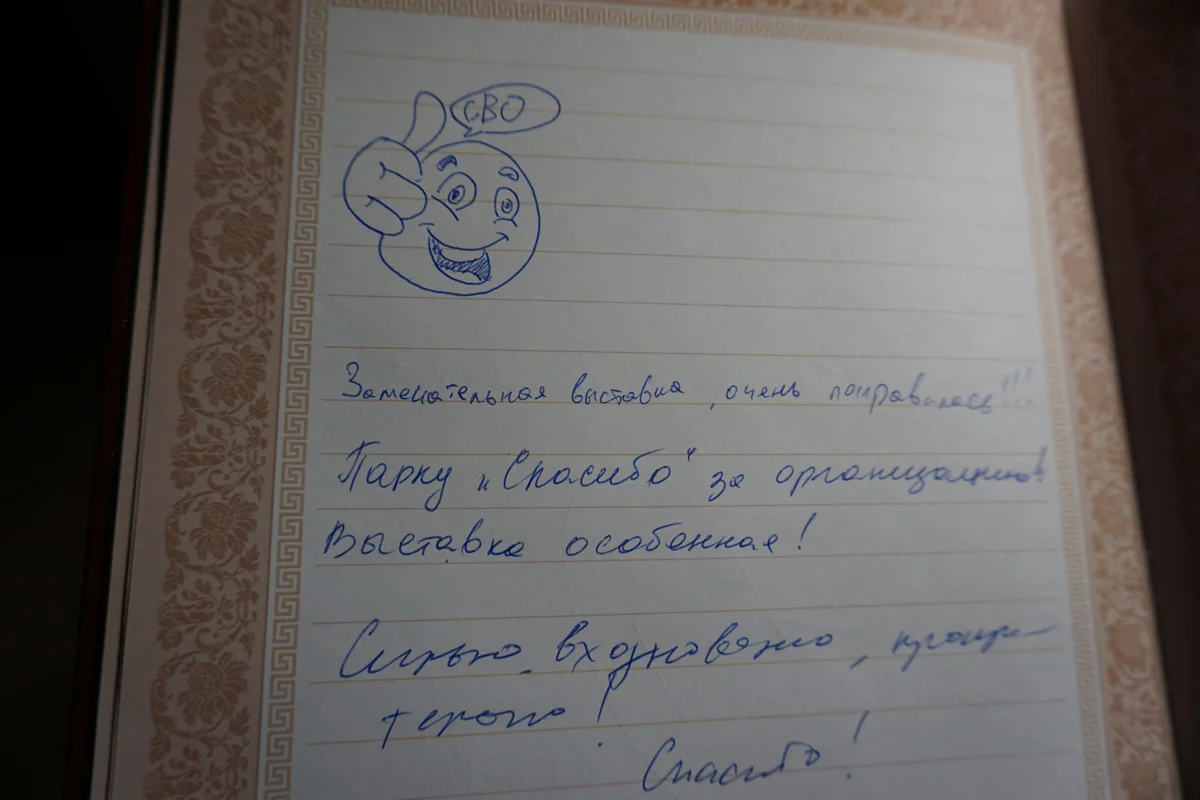
At the exit I open a book of reviews. I read: “Thank you for the exhibition. This exhibition is one of the few, leaving with which you feel filled. The victory will be behind us !!! Zov. Dugina's business lives !!! " Next: “Gorgeous exhibition. Thanks for the thoughts and emotions. THANK YOU!" The review is accompanied by a pattern - a heart with a heart with an arrow with the letters Z and V inside. A third of the reviews of reviews are written in a similar vein. One message is distinguished from May 10: "The war in the head of sick people and this is scary, I do not understand what you can see here."