
Translated material
Polysorb, Enterosgel, Arbidol - how bots sell pacifiers
Rave reviews of popular drugs are nothing more than “guerrilla marketing” by their manufacturers

Pharmaceutical companies use bots on social networks to advertise dummy drugs and homeopathy, Vorstka has found out. Among them are “Arbidol”, “Kagocel”, “Polysorb” and others. Over the past five years, fake accounts have left more than 300 thousand automated comments, the coverage of which exceeded 500 million views. Often, bot activity begins to increase when drug sales on the market decline. “Layout” tells how a homeopathy PR campaign on social networks is structured and how effective it is.
In order not to miss new texts from “Layout”, subscribe to our telegram channel
"Get well!"
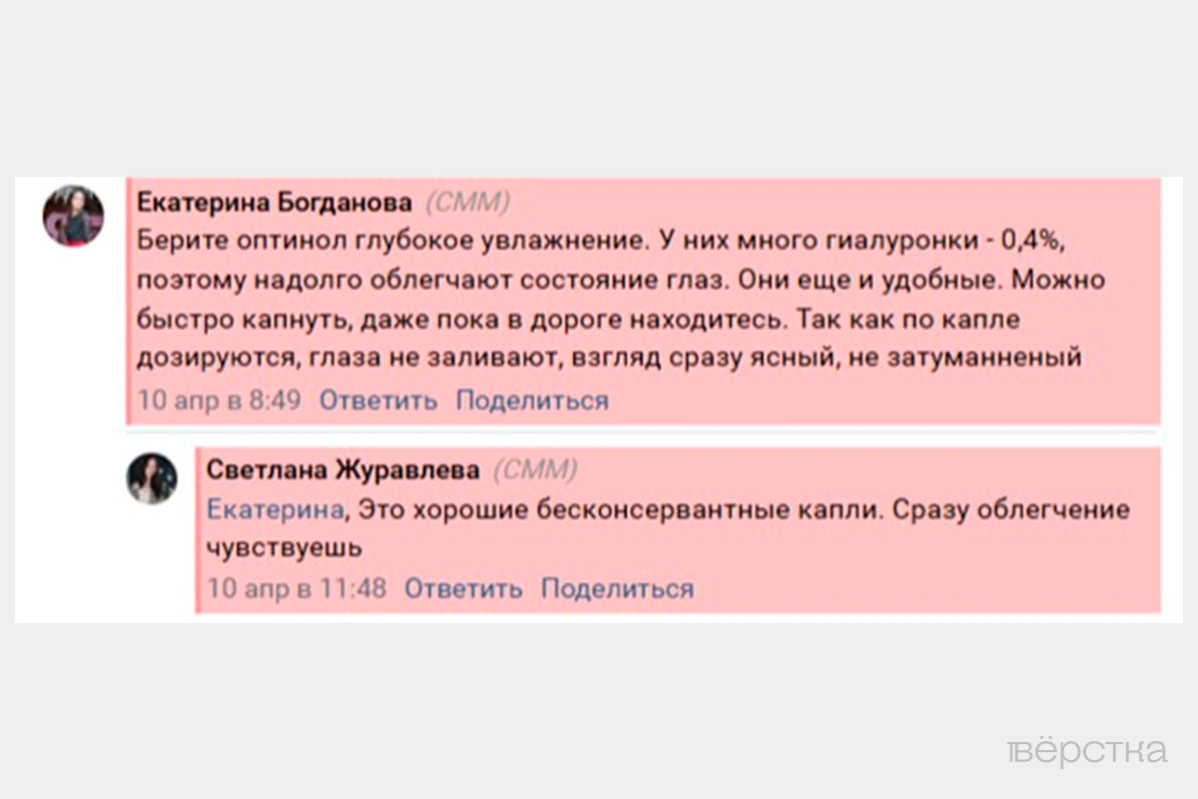
“We recently treated ARVI with arbidol, it helped. I wish it were a normal summer”, “Drink Polysorb, otherwise even the photo made me want to take it right away”, “I have two children on Anaferon, one might say, they grew up, it helped and is helping!” At first glance, these are typical comments from ordinary people who discuss the treatment of various diseases on social networks. In fact, these are bot messages - automated comments that are distributed using fake accounts. They are used by pharmaceutical companies to promote their products to the public.
Such bots leave thousands of comments about various medications every year. “Verstka” analyzed the activity of such accounts in relation to 18 drugs, which drew the attention of “Botnadzor”, and compared this data with sales statistics.
Among the items promoted using bots are 11 “pacifiers” i , three homeopathic remedies, enterosorbent “Polysorb”, adsorbent “Enterosgel”, herbal preparation “Gedelix” and vitamin D3 “Aquadetrim”.
Full list of drugs:
Expand ↓ Gedelix
Anaferon
Polysorb
Viferon
Arbidol
Ergoferon
Regalin
Rafamin
Enterosgel
Tenoten
Kagocel
Selank
Afobazole
Grippferon
Aquadetrim
Semax
Kipferon
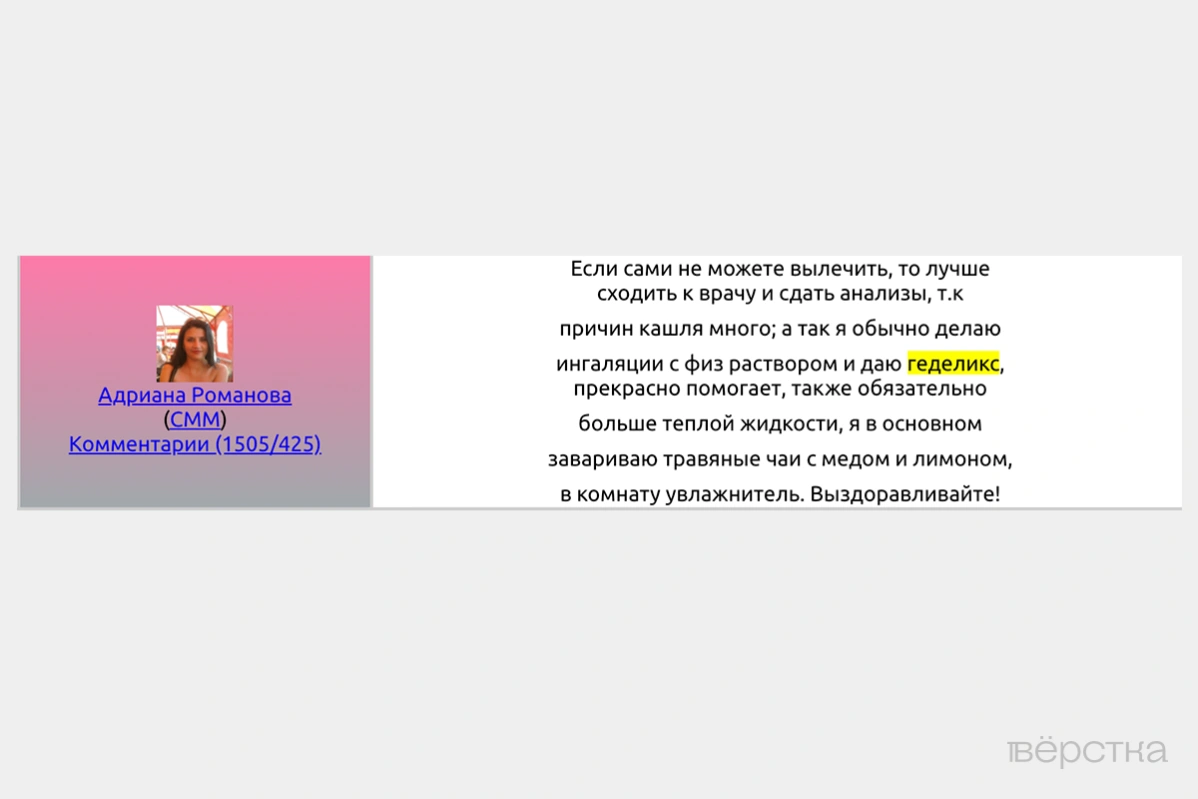
Bots left the most comments about Gedelix - almost 40 thousand messages over five years (from 2020 to 2024). The peak of activity occurred last year, after sales of the drug fell by a quarter. “Vorstka” received sales data from a source working in the pharmaceutical industry.
"Gedelix" is a herbal remedy that supposedly has "anti-inflammatory, wound-healing, antioxidant effects." The effectiveness of the drug has not been confirmed by any high-quality research, and the main active ingredient in its composition is ivy leaf extract. The drug is produced by the company Crevel Meuselbach.
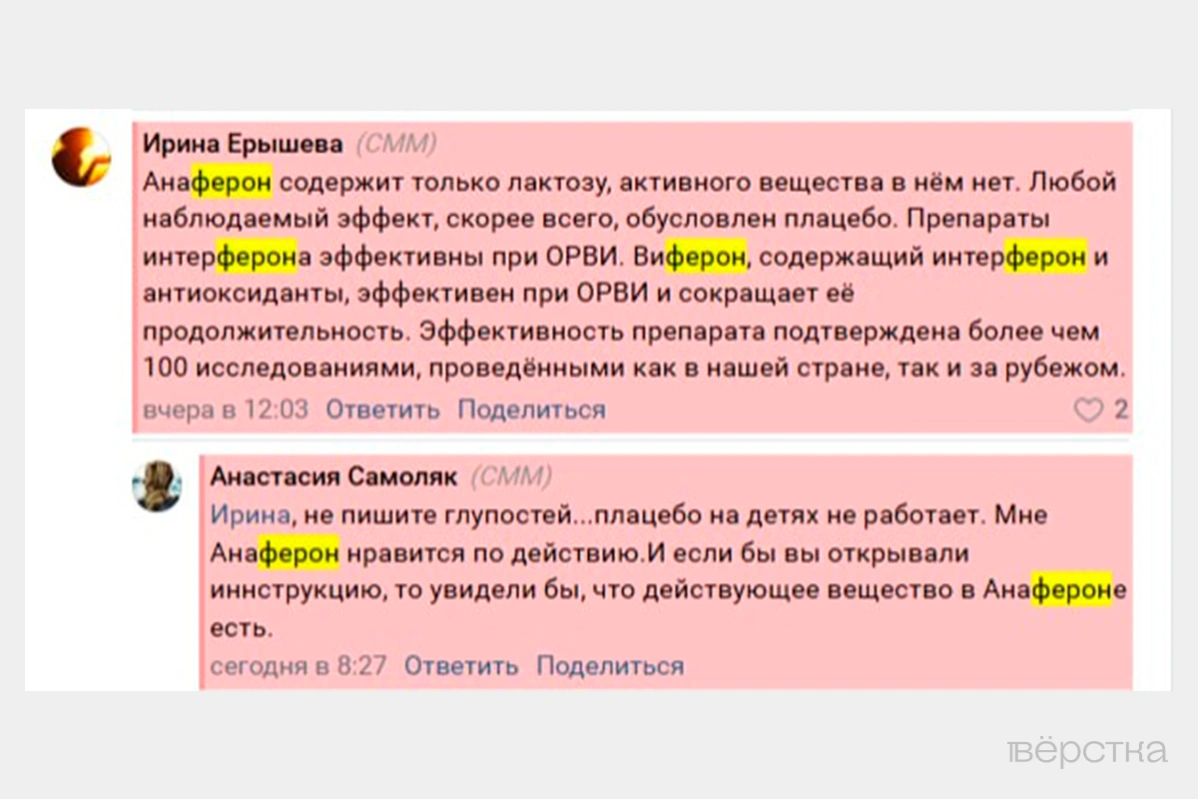
In second place by the number of comments is “Anaferon”, which is used as an “antiviral” agent. The effectiveness of the drug has also not been proven; there is virtually no active substance in its composition. In 2017, the RAS commission on combating pseudoscience classified Anaferon as “hidden homeopathy.”
Over the past five years, bots have left almost 34 thousand comments about him. And just as in the case of Gedelix, the activity of fake users grew in parallel with the decline in demand: in 2023, sales of Anaferon decreased by 21%, and the number of automated comments increased two and a half times. Anaferon is produced by the Materia Medica Holding Scientific and Production Company; at least four more drugs from this company are advertised using bots.
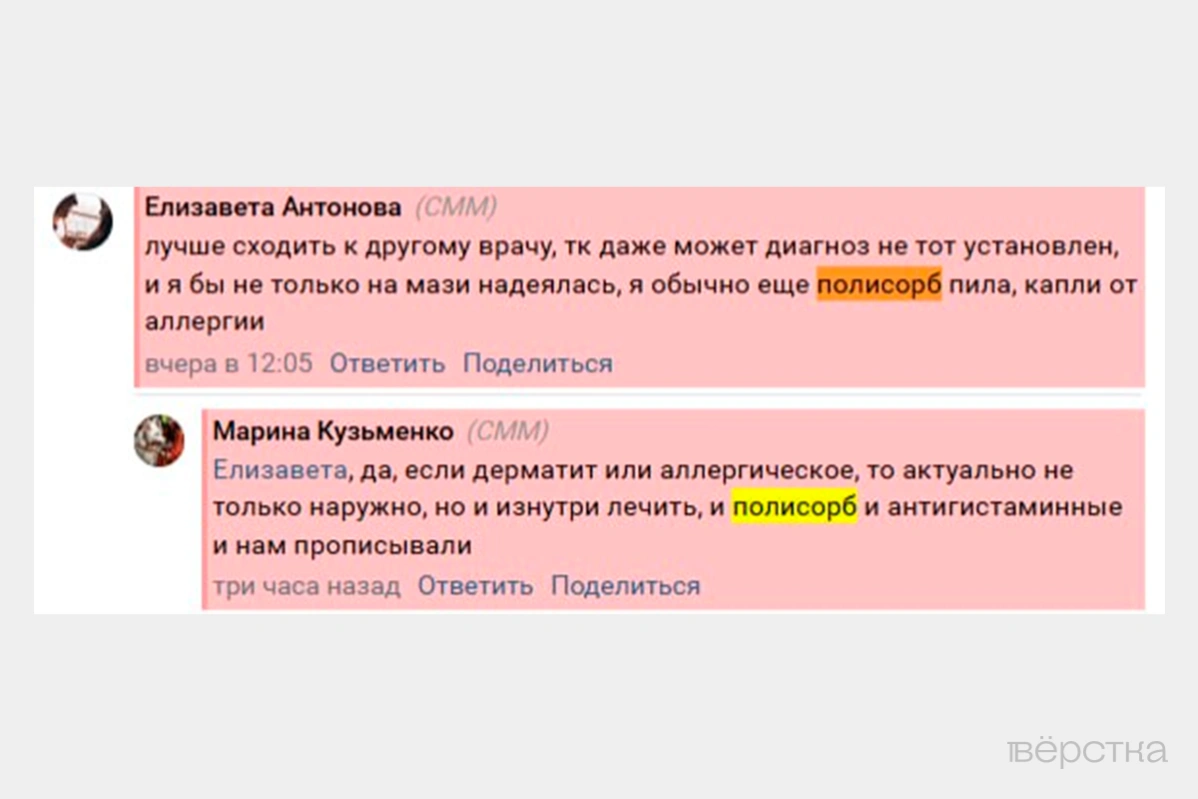
“Polysorb”, a powder sorbent that is taken for intoxication, allergies and gastrointestinal disorders, was also actively promoted on social networks. Bot activity was especially high in 2021, 2022 and 2023 - as soon as sales grew, there were significantly fewer comments. In just five years, Botnadzor managed to detect more than 30 thousand messages from fake users.
Every year, as Vorstka calculated, fake accounts leave from 50 to 80 thousand comments about medications. Over the past five years, bots have written more than 312 thousand comments about drugs, and their posts have received more than 500 million views.
How bots work
As Botnadzor told Vorstka, when working with the pharmaceutical industry, bots observe two models of behavior. The first is sending posts to the “suggestion” of thematic communities, and then simulating a discussion, where one fake profile enthusiastically talks about a certain drug, proving its effectiveness, and the second is “convinced.” Most often, the “convinced” one is the one who initially sent the post to the “suggestion”.
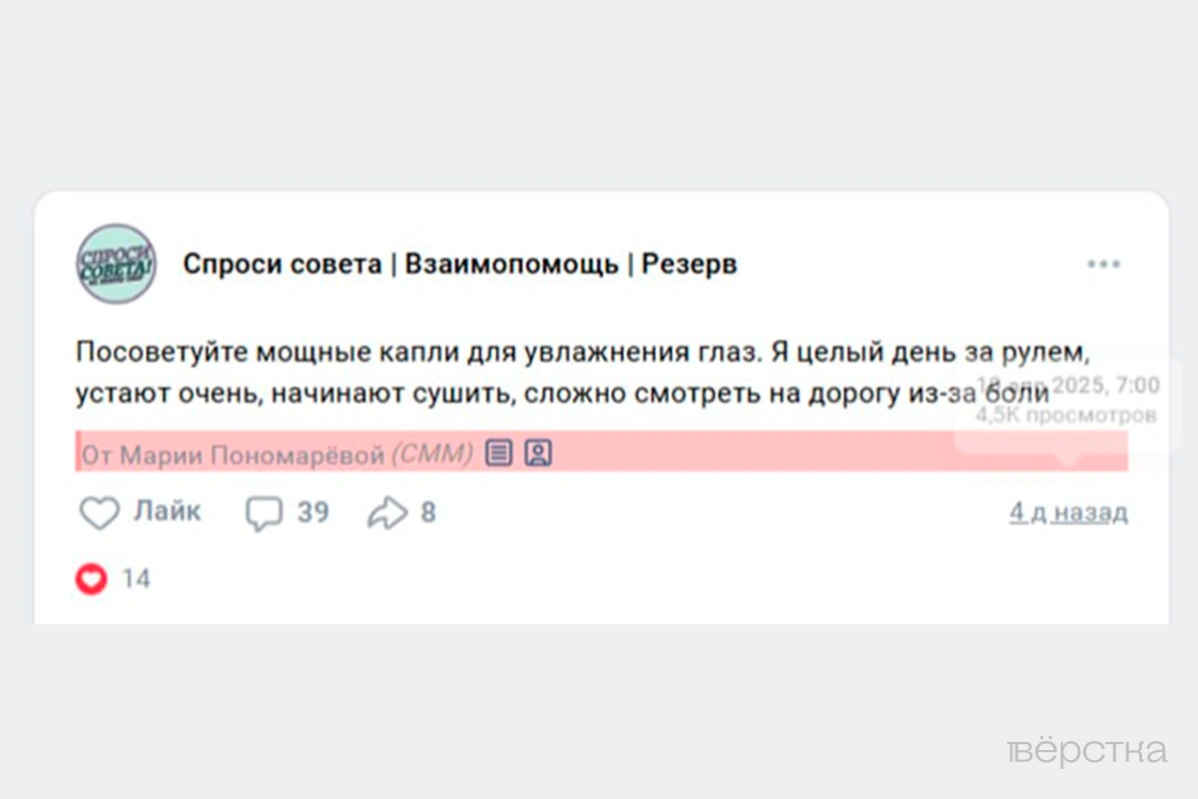
The second model of behavior looks like this: bots “walk” through the social network, using keyword searches, and enter into existing discussions, advertising certain drugs. Botnadzor believes that PR specialists using such tools have access to search the text of VKontakte comments, which is not available to ordinary users. In addition, bots leave positive comments in the official “customer” communities.
In 2022, one of the marketers spoke directly on the VK platform about how such a PR campaign could be organized from the inside. Andrey Nikolaev created a chatbot in 2021 to promote the sedative “Selank”.
“At the end of 2020, a client came to me - the manufacturer of the drug. <…> I came up with the idea of “packing” a chain of warming messages into tests and an online assistant on the topic of stress relief. That is, our chatbot provided value to the potential client in itself. And only then did we show an advertisement for the medicine,” Nikolaev wrote.
According to him, more than 10 thousand users “gave a chance” to the chatbot and subscribed to the brand’s newsletter, and “3,252 subscribers became interested in purchasing the medicine itself.” According to Botnadzor, the greatest activity in relation to Selank was observed during this period - in 2021, bots left 8.3 thousand comments, in 2022 - already 1.5 thousand, by 2025 activity actually dropped to a minimum. At the same time, the main increase in Selank sales occurred precisely after the decrease in activity - in 2024.
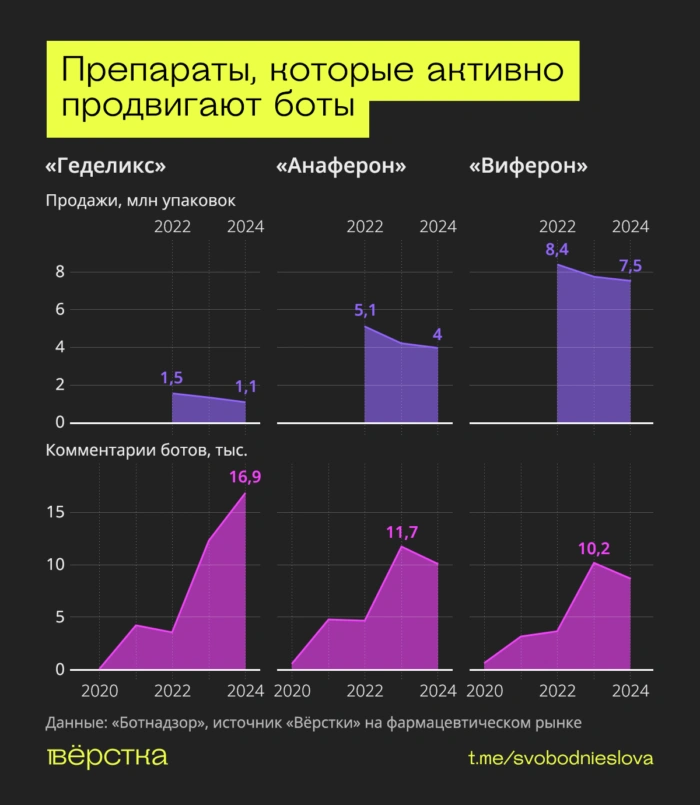
A correlation between a decrease in mentions among bots and an increase in sales is also observed in the case of some other drugs: “Viferon” (in 2023, sales decrease and the number of comments increases; in 2024, sales increase and mentions decrease), “Kagocel” (from 2022, an increase in sales and a decrease in mentions among bots), “Tenoten” (from 2022, an increase in sales and a decrease in mentions among bots).
A representative of one of the Russian pharmaceutical companies, with whom Vorstka spoke, says that now there is a trend towards abandoning the use of bots even on marketplaces: “Because the fight is for the consumer, and he is becoming more and more capricious.” According to him, such methods are most often used by small manufacturers, network marketing and bookmakers: “Everything depends on the coverage, but this is an inexpensive pleasure. The average budget for such an event is 20 – 100 thousand rubles, if we take small producers.”
The interlocutor also noted that now artificial intelligence is just “entering” pharma - some companies use a full-fledged AI assistant. “They analyze vast amounts of data on user behavior, which allows them to create highly accurate audience segments for which a block of personalized messages is developed, taking into account needs and interests. These bots communicate in “human” language and promptly respond to user requests,” the cost of developing such an assistant is from half a million rubles.
Cover: Dmitry Osinnikov
Infographic: El
You can support “Layout” from any country in the world - it is still safe and very important. We really need your support now. How to help us →