
Translated material
Nebanality of evil
We talk about the play “The Death of Tuzenbach”, in which Konstantin Bogomolov transcribed Chekhov and himself played a counterintelligence of salty
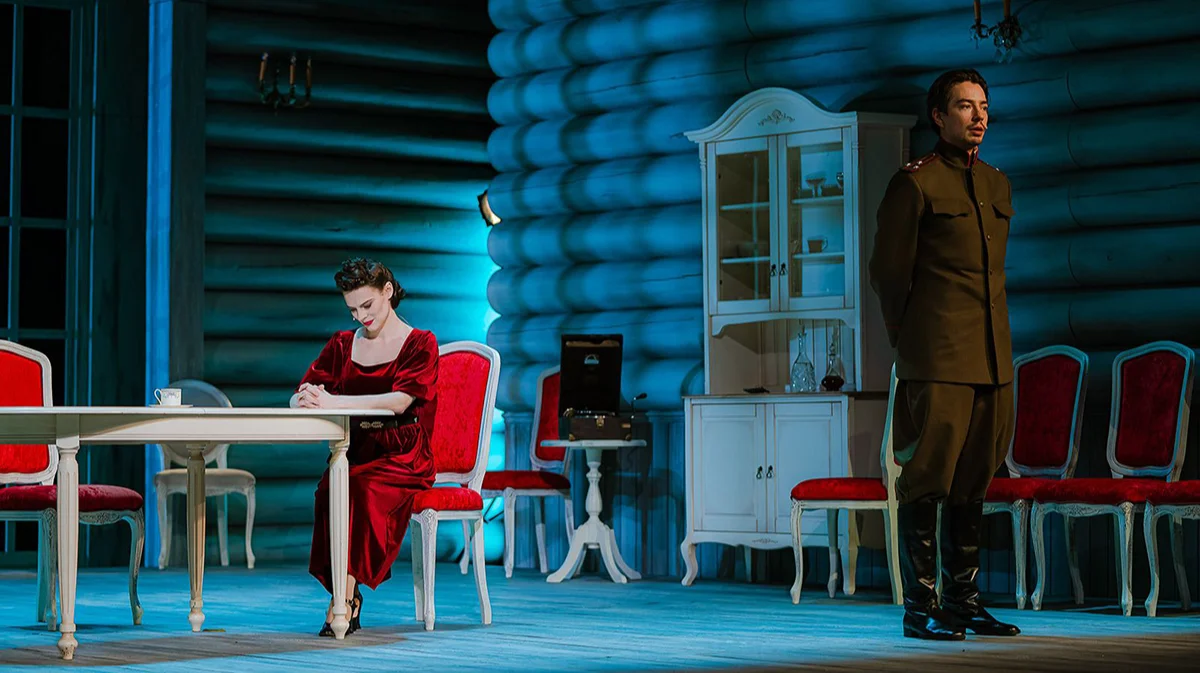
The scene from the play "Death of Tuzenbach." Photo: The press service of the theater on Bronnaya
The Hudor of the theater on Bronnaya Konstantin Bogomolov, by May 9, released a new performance and again shared that he was tormented. And again he pushed away from the classics - the heroes of his premiere “The Death of Tuzenbach, or the true story of Olga, Irina and Masha” became the characters of the “three sisters” of Chekhov, moved from Russia to Estonia. Lera Peshkova tells which direction, according to the director, the Chekhov characters evolved, as well as what in common has in Konstantin Bogomolov and chat bots of artificial intelligence.
Attention , the text contains a spoiler.
Moscow is still good. You go along Tversky Boulevard and rejoice. Clean, beautiful. You turn to the small Bronnaya - there is the facade of the theater with a new gilded visor. Inside are richly dressed, delicious people: having paid for a ticket from 1,500 to 18,000 rubles, they came to the premiere of Bogomolov. In the building, everything is to match them - everything is from a needle, everywhere light. Of course, we also have darkness in some places. There are, they say, now in Russia such theaters (amateur, for people with disabilities), where they take fresh, just from fields, disabled people - and they play there as they can. But this is far from the capitals and the mood of the Muscovites does not spoil.
Having descended from the balcony to the stalls, for free space for 10,000 (instead of two with half a tower), I hear conversations behind my back.
“Have you read his manifesto ?” He said that Russia should no longer focus on Europe, there is too much gay propaganda ...-one girl says.
“It is,” the second assumes.
I'm watching. There are three of them. Beautiful. With traces of plastic on painted faces. “I will tell you that he ...” - the third begins, slamming with large eyelashes. Then the light goes out, and the unique voice of Konstantin Bogomolov asks to turn off the phones or reduce the brightness of the screen.
September 1944. In the Estonian town of Kaks Kivi (translated - two stones) everything is calm: the Germans are running, the Soviet sets in. The family of Olga Frost (in the girlishness of Prozorova) is glying in the paper, tormenting from the stench and opening the door with a large, light linen of the living room with log walls. The scenographer Larisa Lomakina builds on stage an ideal -looking habitat for Chekhov sisters. Behind the veranda of the estate is a real Estonian forest (video is Alan Mandelstam). But we are not sisters: the very young Olga (Daria Zhovner) is the mother of Irina, Masha and Andrey. Her husband, he is the father of the family Karl Frost, died a year ago, just like Chekhov’s. With the memoirs of his death, the action begins, interrupted by the scream of Masha, which found that Hitler was left on the wall - they will have time to take him exactly before coming to the house of Major Salt and Lieutenant Vasily Ignatievich.
The deck of the Chekhov heroes is shuffled.
This is not a sequel and not spin-off, but a smoothie, the ingredients of which are not only Chekhov, but also the play of the first playwright of the Sovietized Estonia August Jacobson “Life in the Citadel”.
Her hero is an unrecognized scientist who does not notice either the departure of the Nazis or the arrival of “ours” behind the translations of the Aristotle. If you add a little philosophy of Dostoevsky (more precisely, the hero of the “demons” of Stavrogin), a little Nietzsche, and something personally from Bogomolov, you will get a cocktail “Death of Tuzenbach ...”
The main power of attraction of a new performance and even the alter of the ego director is a cherish exquisite Olga. Actress Daria Zhovner (who debuted in the “cramped” Kantemir Balagova) is a new KB star, which has a threat to actors and knows how to raise them.
After the visit of “ours” Olga, who has just sparkled with hospitality and sang a nightingale about love for Russia, is incredibly inspired by his daughters, that the main thing now is to survive that it is in itself and for which all means are good. Actually, this scene becomes the culmination of the first act. It seems that the KB delegated the heroine his own confession, explaining his “ambiguous” (and sometimes unambiguously indecent ) statements.
But if you ask why then to write about him at all, I will answer my red-legged passport at all, I will answer: in the fourth year of the war, it is time to admit that if the Russians are in Russia, and in many ways and beyond, there is some kind of ideology, then this is the ideology of survival. This is what Olga Frost, former Prozorova, screams about. Former Chekhovskaya young lady. Former Muscovite. The victim of the Jewish pogrom and seduction at minor age.
In the first composition, Konstantin Bogomolov personally plays the role of Major Solny. Judging by the photo on the theater’s website, he plays an enkavedeshnik, harsh but in some ways noble. However, Rustam Akhmadeev, who binded the young face of the Chekhov beard, also plays with dignity (I watched the performance with him in this role). With the Frost family, he is polite and condescending, does not dig to the smallest detail, although everything takes note.
After the restrained-dummy SS ries (the hero Mark Kondratyeva appears in the scenes of Fleshbeki), the male charm of the Salt makes Irina (Svetlana Bozhatov) not only to give him the unloved Tuzenbach, but for some reason to tell that Riza had an affair with Emilia, the peasant's wife, whose peasants whose peasants whose peasant The child (as we recall from Chekhov) is clearly not from her husband. Andrei himself (Ivan Tarasov) is the only good gynecologist for the whole district. He is quiet and polite, however, “life in the citadel” is woven into the plot, and the poor fellow has to serve the needs of the SS men in the concentration camp in Claog (est. Klooga), participating in sterilization experiments.
In a word, Chekhov’s archetypes, just like people, survive because they evolve in the direction opposite to humanism and morality. Inspired by their example, we will immediately give them to the reader: there are no not stained in the blood among them.
The share of purity is released only by Irina. And Baron Tuzenbach (Evgeny Perevalov)-a sad person who writes poetry and supports a family legend about vampire ancestors.
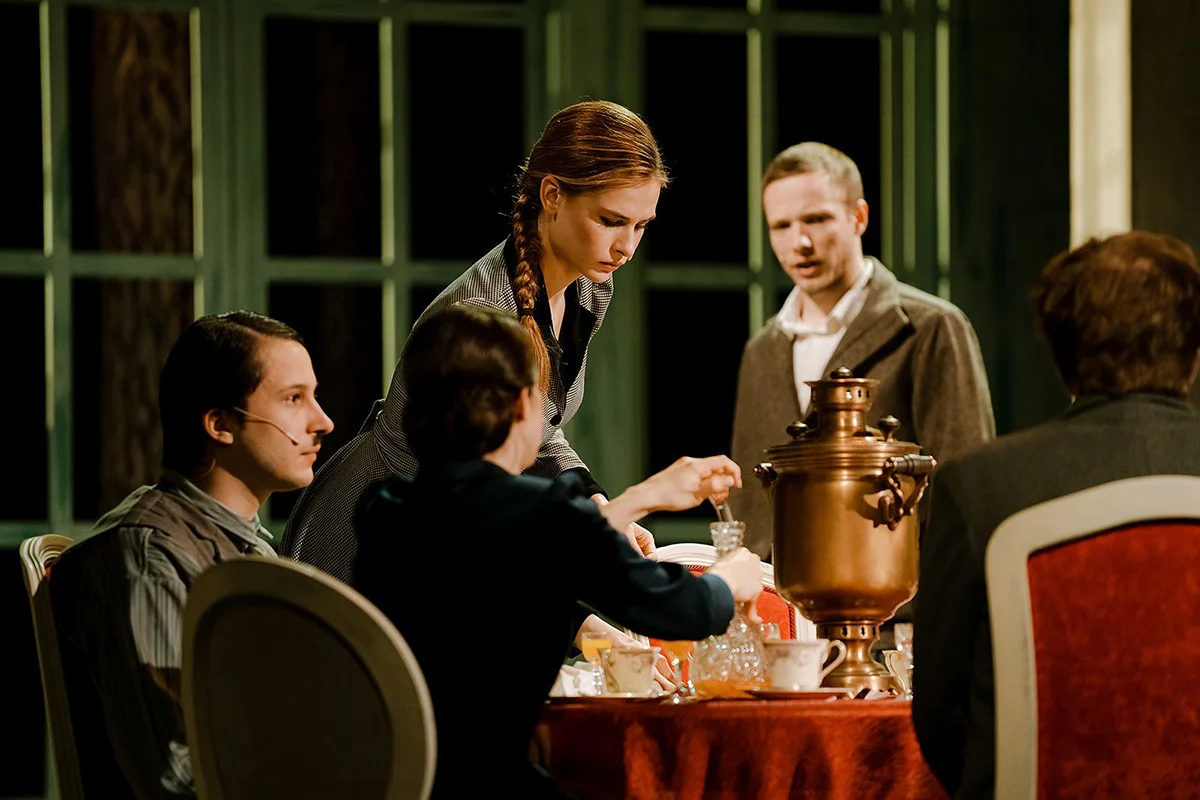
In the key scene, he becomes the only opponent of the “rotten scientist” of Karl Frost. This scene is another flashback. The meal in the Frostov House: Karl, the role of which was played by Bogomolov himself at the head of the table.
Dressed in a shaggy wig and costume five sizes, he plays a cartoon on all paranoid scientists at once, turning the scene into an ominous attraction.
So virtuoso, balancing on the verge of madness and outrages, Bogomolov has not played since the time of Myshkin in his Lenkom "idiot". The obsession with Karl is associated with the idea of the relativity of morality imposed by society. A pinch of the Marquis de Sad is mixed to the dose of Nietzsche with Dostoevsky with his ranting.
But when he says that “the pain is a pulsating point between the executioner and the victim”-the rewritten thought from the books of the writer V. G. Zebald, he is truly firing: after all, Zebald quoted a real person who suffered torment in a concentration camp.
This is what the original quote looks like
In the novel “Austerlitz”: “... at that moment I still had no idea about all this and only a few years later I read to Jean America about the monstrous physical proximity that existed between tormenting and tormented ...” (V. G. G. Zebald. Austerlitz. New publisher, 2019. P. 33–34). Or in the essay “through the eyes of the night bird” (about Jean of America): “[America] allows himself to build an assumption that the Flemish Esesovets Weiss, who had beating him on the head with a cuttings from a shovel, at that moment when he stood in front of the shooting team, comprehended the moral truth of his atrocities. “At that moment he was with me - I was no longer alone with a shovel cuttings” ... ”(see in V. G. Zebald.“ Natural history of destruction. ”New publishing house, 2019. P. 133).
A second later, Karl, ridiculously breaking into the folder, already yells at Tuzenbach, who dared to defend the Jews. And this gives out his “double game”: after all, the viewer remembers Olga who died during the pogrom. Another pole of the scene becomes Evgeny Perevalov in the role of Tuzenbach: he is so quiet and internally, that he also cannot take his eyes off him. The third point of attraction is Olga: exhausted by the endless existence “on the edge of the abyss”, she sits on the side of the feast and comes to life only when it is necessary to portray cordiality and give a SS, who goes to torture the partisan, a piece of the cake with a dry ration.
After a couple of scenes, they will all receive from Bogomolov according to merits. Those who do not run away or die will “clean up” the brave salty. “We are very clean and do not leave the crumbs,” he says. Three women are lucky: Olga will start an affair with the Red Army man, unrequitedly in love with Masha (Varvara Sursanova) will hand over the annoying husband in time. And Irina, having watched Tuzenbach into exile, will wait for a meeting with salty: on Red Square, at six o’clock in the evening after the war.
The final credits will explain that none of the Red Army soldiers survived, therefore, there will be no continuation of the Prozorovs. However, no one will have it: unless a child surrounded by Andrei’s wife with a SS man will survive.
This well -played performance can be considered a triumph of directorial elasticity. For representatives of each layer, every social stratum in the hall understand it in their own way and to the best of their capabilities.
The glass is half empty or half full: having drunk the next cocktail of Bogomolov from it, everyone will feel his own.
“If in a company of four people there are three people who speak the same, then I will speak in the other direction and argue. And not because I think so, but because at this moment to remain alone against several people and is existential choice. In this second, I include both creative and ideological inspiration for upholding any position, on the sophisticated and beautiful design of any arguments ... ” - repeated Bogomolov in different interviews ( my selection. - Approx. Author ).
He is faithful to this principle in peaceful and military (which is more dangerous) times. Another thing is that his “existential choice” now almost always coincides with conformist.
But, in principle, what difference does it make if his creative credo resembles the GPT chat device: you set the topic and keywords, and he is in response to the expression stares on any topic with expression. Just have time to interpret.
The Nazis are disgusting. The Red Army men are merciless. The Jewish-wrapped, who performed the work of the dentist in the concentration camp and involuntarily participated in experiments on people, is subject to repression. The NKVD burns out the living that survived, existing according to the rules of the enemy. The only intellectual - Tuzenbach, it turns out, was also a member of the Nazi party - succumbed to his uncle's persuasion. Squeezed, in general. And therefore he sinks in his native Estonian swamp (Hello, Harms!).
Well, what's the main idea? Today they played this way, and tomorrow the director remade that way. It is much more interesting that not Tuzenbach at all, but the KB itself is a real representative of today's intelligentsia. Innerly picky, but very careful and incredibly plastic. The fact that we used to consider these qualities a malfunction, glue, a manifestation of pseudo -intelligence, in fact, is no longer. Having survived in the disasters of the 20th century, the intelligentsia mutated, having lost part of its properties, but it gained new ones. They are captured in the play.
But in general, Moscow is prettier. And this is still a city of possibilities. For example, while the premiere hall laughs at the phrase “I will go to Hitler” (as the character of the performance says, preparing to wash the portrait of the Fuhrer with a turpentine), the other part of the Muscovites puts flowers to the brand new high relief of Stalin in the transition at the Taganskaya station.