
Translated material
One -story America - 2020
Joaquin Phoenix played the Sheriff Anti-Privitrian in the new film by Ari Aster "Eddington", which was just shown at the Cannes Film Festival
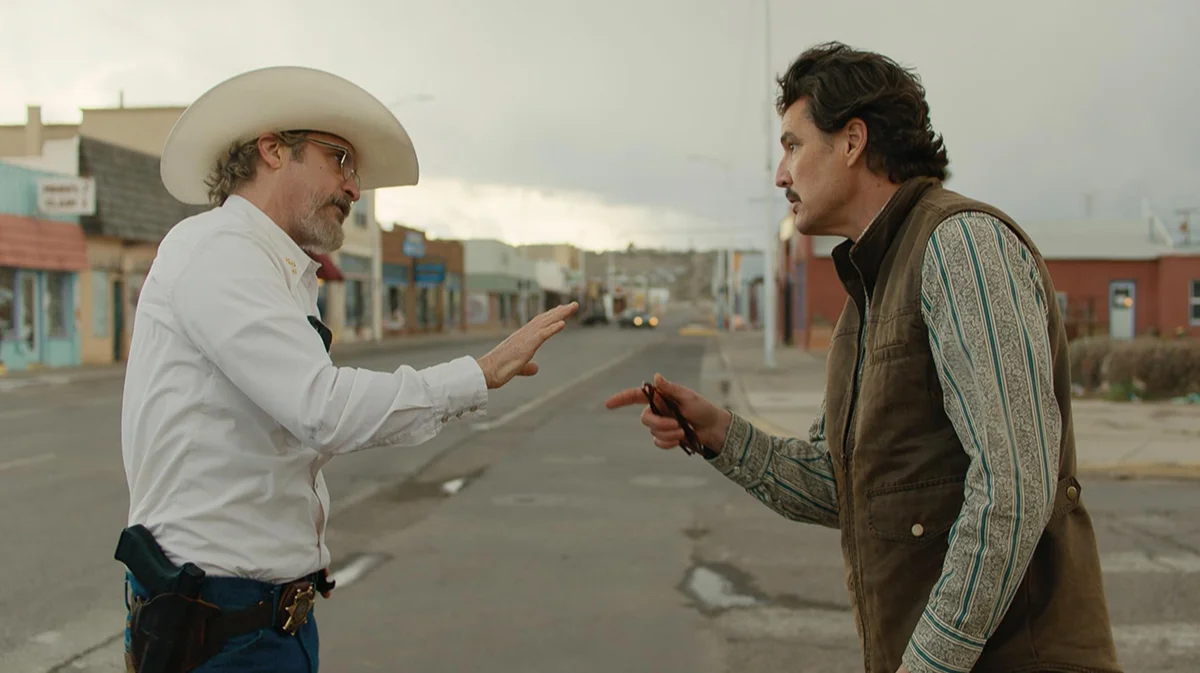
Frame from the movie "Eddington". Photo: imdb.com
After the box office and partially spectator failure of Ari Aster's film “All the Fears of Bo”, the filmmakers from all over the world were waiting for his new film “Eddington”, where Joaquin Phoenix, Emma Stone, Pedro Pascal and Austin Butler were starving in the main roles. The other day the premiere was held in Cannes. The film critic Irina Karpova watched the film and believes that Aster drift from the genre of the surreal horror to the territory of Quentin Tarantino and the Cohen brothers, where the satire over the current agenda (BLM, conspiracy, Covid) is supplemented by shootouts and torn limbs. But it turns out that he is not in the best way.
2020. Eddington, County of Seville, New Mexico. The sheriff of Eddington Joe Cross (Joaquin Phoenix) is extremely annoyed by the state order to wear a protective mask - yes, the world has an epidemic of coronavirus, but in Eddington it is not. After the next skirmish in the supermarket, where the vigilant manager demands to put on a mask from the sheriff, and the other buyer without a mask, under the applause of the inhabitants, throws out over, Joe writes out emotional videos on Facebook: he will put an end to this covid lawlessness - he is running for mayors. But in Eddington there is already a mayor - Ted Garcia (Pedro Pascal), and in the upcoming elections he is going to save his post. A lot of money is on his side, Garcia’s campaign is sponsored by a concern that is going to build a modern data center in Eddington. And Garcia wears a protective mask in all places where it is required. In addition, the sheriff and mayor connects the event from the past - many years ago, Garcia met with Joe's wife (Emma Stone) and threw her.
Against the backdrop of the unfolding protests, Black Lives Matter begins the election duel between the sheriff and the mayor. Joe accuses Garcia of raping his wife when she was sixteen, she had an abortion, after which her mental health did not recover. Garcia claims that she became pregnant six months after they broke up. Finally, Luizu herself, the wife of Joe, engaged in the manufacture of felt dolls of a very strange look - pink creatures with wide open mouths - writes a response video on Instagram: yes, she survived sexualized violence at a young age, but not from Ted Garcia, but from her own father. And the husband and mother want to dump everything on Garcia ... Don, the mother of Luizu (Dardri O'Konnel), after the beginning of the pandemia moved to the crosses, she actively monitors, it seems, all theories of conspiracies and, knowing that Louise ignores her links, prints the article from the Internet on the printer for her daughter - otherwise that the death of the Titanic was tired.
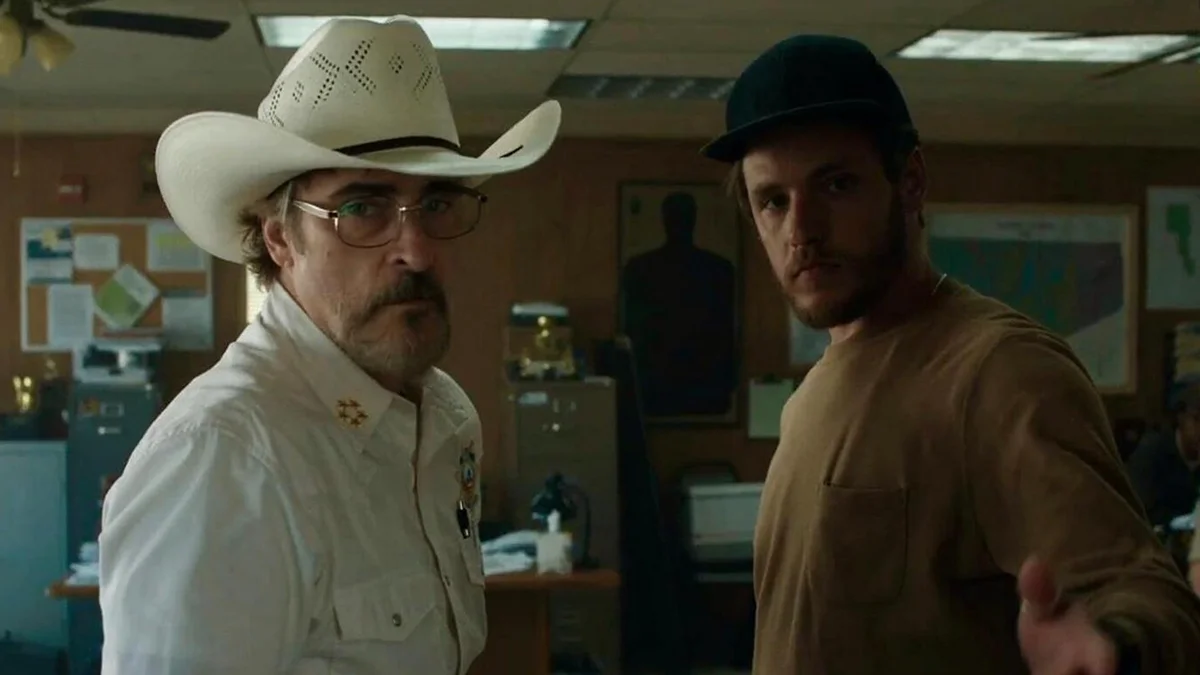
If from the listed events and heroes you have already started to swell the head, then I hasten to inform you that this is only a small share of what is happening in one-story Eddington in the middle of the rocky hills of New Mexico. Alas, Aster can not cope so that the cacophony chosen by him is lined up in a complete statement.
What we have: pandemia, conspiracy theories, BLM protests, recognition of people who survived violence, and the constant documentation of what is happening on the phone ... Ari Aster about everything has an opinion. But to show how a real event (a drunken homeless man bursts into a bar in order to hang out, Joe tries to twist it, but gets from homeless cuffs) after installation and loading on social networks, it turns into a messenger convenient for the sender (in this case about the police lawlessness and violence over oppressed groups), the director is only at the very beginning.
Yes, the thought is not new, but the reminder that we see the edited version of reality on the network, and especially played with humor, will not be superfluous.
But by the middle of the film, there is an understanding that Aster’s critical look is just a very thick and poorly hidden irritation to everything that we do on the network. He shows white participants in the BLM movement hysteria, who are engaged exclusively with a repetition of the correct maxims and shaming of others. The victims of secusualized violence represented as a cult, whose members came up with memories of the trauma experienced. Somewhere on the periphery of the film, corporations loom-yes, the same date center-for the sake of increasing capital, they are ready to destroy all living things. All this is moved and inflated under the sun of New Mexico, until closer to the end it turns into a bloody attraction in the spirit of Tarantino.

Khoakin Phoenix plays the Gogol character, cruel and miserable, such a good guy who will not think twice to substitute his subordinate when he needs it. He creates a charming portrait of a small provincial conservative, moving in his actions from small evil to evil more, but he cannot keep the film from scattering to pieces. The rest of the actors - Emma Stone, Pedro Pascal, Austin Batler - unfortunately, there is nothing to play at all, and after viewing there is a feeling that they had a total of only a couple of minutes of screen time.
Aster's film is about the same as relevant as a stream on Facebook and yesterday's newspaper.
He has the courage to show the hypocrisy of White America and how the instruments of democracy are social networks! Internet! - They become an ideal environment for the appearance and reproduction of fakes, as everyone is interested in pose and gesture, and not real experiences and an inconvenient truth.
But due to the fact that confusion reigns in the frame, and the actors have to somehow exist in it, the noise from it overlaps the statement, turning it into boomer outbreak (Aster born in 1986). In defense of Aster, it is worth noting that he does not contrast the left and right. In the film about the problems separating America, people are bogged down in these problems, united by general neurosis. Only to diagnose its origin Ari Aster is not taken. But he knows for sure that in America the distance from the “Publish” button on the network before the automatic rifle descent is the minimum possible.