
Translated material
War on factories
Ukrainian drones increasingly began to strike Russian factories where military equipment is produced

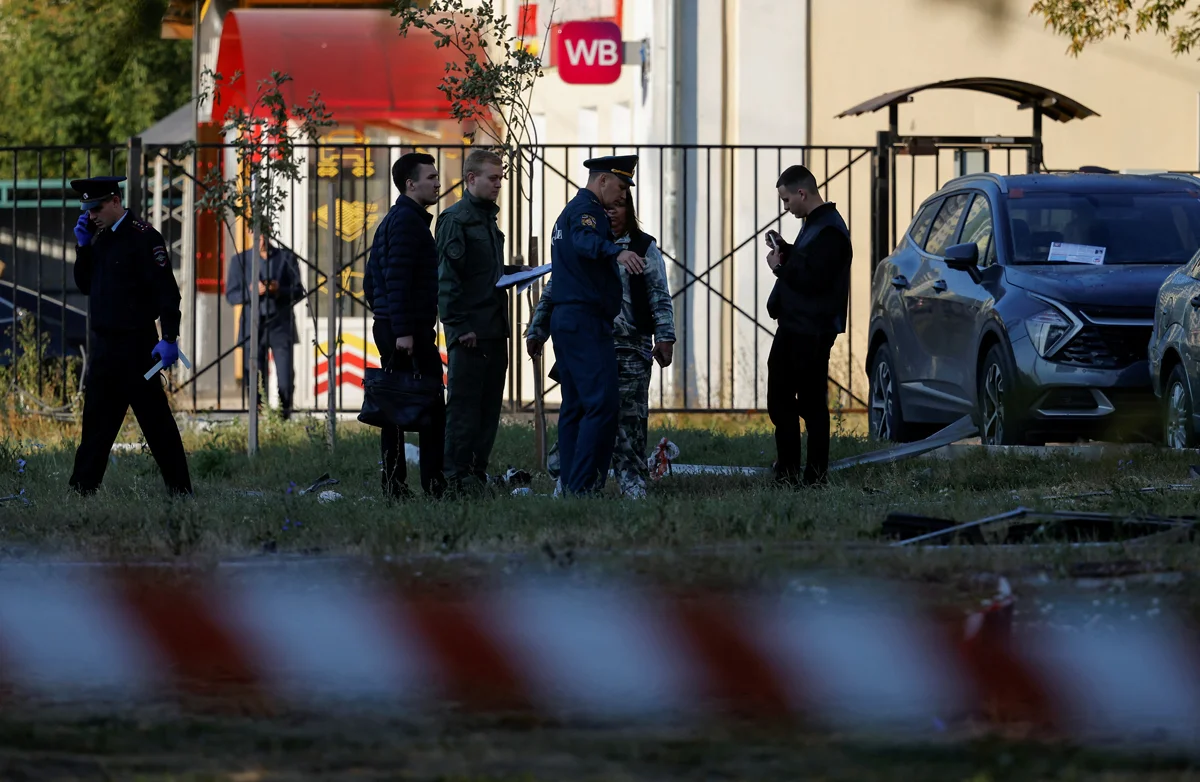
Workers eliminate the consequences of a drone hit in Zelenograd, Moscow region, May 28, 2025. Photo: Reuters / Scanpix / LETA
Instead of oil and gas industry facilities, manufacturing enterprises where, in particular, drones are made, are now increasingly coming under fire. New Europe discussed changes in unmanned warfare tactics with experts.
Impact on enterprises
Judging by data from the Russian Ministry of Defense, on the night of May 28, 296 Ukrainian drones were intercepted over 13 regions of the Russian Federation. This is one of the largest raids of the entire war. There is no exact information about the number of drones that attacked Russia. Some of them attacked enterprises associated with the Russian military-industrial complex.
In the Moscow district of Zelenograd, a drone attacked the building of the Elma technology park, which houses companies producing electronics. Several residents of the technology park are associated with the defense industry.
In Dubna, near Moscow, drones attacked the Kronstadt plant. Now they produce , in particular, Orion drones used in war. An explosion was heard and a fire was seen in the area of the enterprise.
Vnukovo, Domodedovo, Zhukovsky and Sheremetyevo airports suspended operations. As a result of the raid, at least 62 flights were canceled at airports in the Moscow air hub.
On May 26, drones attacked 11 Russian regions, including Tatarstan, Bryansk, Ivanovo and Tula regions. It was reported that air defense systems were activated in Yelabuga, where several industrial production facilities are located. In the city of Kineshma, the Dmitrievsky chemical plant came under attack. The drone raid caused a power outage in the city of Aleksin, where, in particular, the Aleksinsky chemical plant is located.
In several regions, including the Moscow region, airport operations were interrupted.
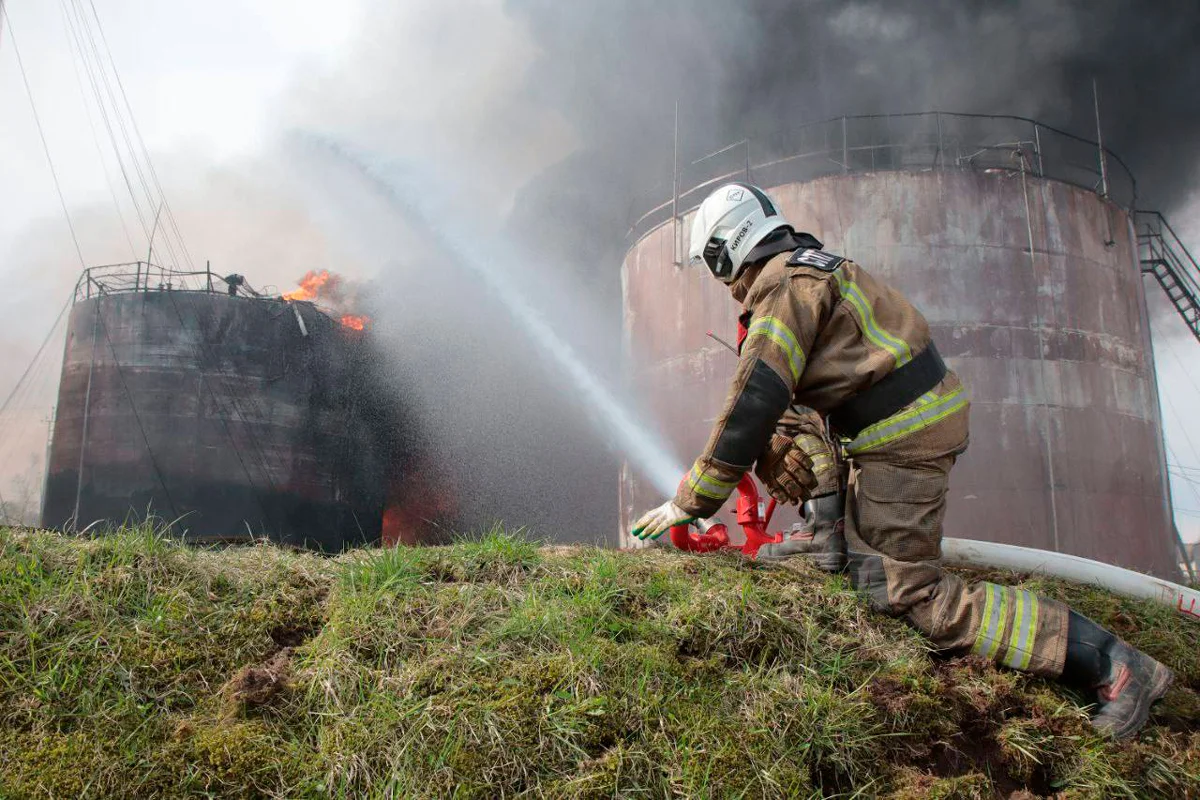
On the night of May 23, the Lipetsk region was attacked by drones. According to the General Staff of the Armed Forces of Ukraine, the strike was carried out on PJSC Energia located in the city of Yelets, where batteries for drones are produced.
The Ukrainian military calls Energia PJSC one of Russia’s largest producers of chemical power sources. Only this company produces batteries for planning and correction modules installed on Russian aerial bombs.
The Federal Air Transport Agency closed the Moscow airports Domodedovo and Zhukovsky, as well as the airports of Ivanovo, Kaluga, Kostroma, Tambov and Yaroslavl.
On May 21, attack drones attacked the city of Bolkhov in the Oryol region of the Russian Federation. A fire was recorded on the territory of a local semiconductor device plant that supplies components for the military industry. In the eyewitness video, you can see that the plant was hit by at least eight drones.
War of attrition
“Since the beginning of April, Ukraine has not launched attacks on Russian oil refineries and fuel and energy complex facilities,” military analyst and former SBU employee Ivan Stupak tells Novaya-Europe. — It can be assumed that allies in Europe or the United States asked for this. Since Kyiv is very dependent on them, Zelensky was forced to agree. Since then, the Ukrainian Armed Forces often launch hundreds of drones per day, but their effectiveness is not that great. While it is very easy to assess the damage caused to fuel and energy facilities, in the case of enterprises the damage often remains unknown. And there is no reason to think that he is great. As a rule, enterprises are located in permanent buildings over a large area. And it can be extremely difficult to verify that a product has entered a specific area of production or storage. True, a large number of UAVs used in raids overloads air defense systems and allows some drones to successfully cover targets.”
“Both the campaign of attacks on oil and gas infrastructure and today’s campaign of attacks on enterprises of the military-industrial complex are in line with the logic of a war of attrition,
— military researcher Kirill Mikhailov told Novaya-Europa. “To win such a war, it is necessary not only to destroy the enemy’s manpower and equipment on the battlefield, but also not to give the enemy the opportunity to replenish resources and ammunition, as well as replace damaged equipment. One way is to hit the budget directly, since productions cost a significant amount of money. The destruction of oil and gas industry facilities had precisely this meaning. However, after the so-called “energy truce” was concluded, these strikes were stopped and were not resumed. Perhaps the fact is that such attacks irritate Donald Trump and raise prices for petroleum products.”
According to Kirill Mikhailov, the Ukrainian authorities recently began striking military-industrial complex facilities. Russia’s ability to produce weapons and military equipment depends on the effectiveness of such hits. For example, today, May 28, drones hit a company developing drones and cruise missiles for the Russian army. Such attacks reduce the overall military potential of the Russian Federation.
"Agreement"
“For the third month, the Armed Forces of Ukraine have not hit Russian oil complex enterprises,” military expert, reserve colonel of the Armed Forces of Ukraine Roman Svitan told Novaya-Europe. — It is obvious that we see a “negotiation” in which the highest Ukrainian authorities are participating. The very first contacts between representatives of the Kremlin and Bankova Street ( office of the President of Ukraine - editor's note ) led to this strange agreement - not to attack fuel and energy facilities. Despite the fact that the Russians have already burned all the oil refineries in Ukraine. There has even been gossip that attacks on refineries are leading to higher oil prices. But the opposite is true: if the Russian Federation has nowhere to process oil and distill gasoline, diesel and aviation kerosene from it - all this is used for the needs of the army, among other things, then the oil will have to be sold for export. The flow of crude oil will expand and the price will fall.”
“Attacks on production enterprises associated with the military-industrial complex have happened before,” a Russian military expert, who agreed to speak on condition of anonymity, tells Novaya-Europe. — For example, back in the spring of 2024, drones converted from light aircraft flew about 1,300 kilometers and attacked the production of drones at the Alabuga Polytechnic University. However, the damage was minor. Whereas fires at places of storage, transportation or processing of petroleum products carried away hundreds of millions of rubles into thin air.
I don’t think that the Ukrainians seriously hope to paralyze the Russian military-industrial complex. But such drone wars can frighten enterprise workers and create a negative information background.”
According to Kirill Mikhailov, it is currently difficult to accurately assess the damage caused to Russian industry by drone attacks. After all, there is practically no reliable information on this topic. Even during World War II, the Allies were able to calculate the damage caused to Germany by US and British bombing only after occupying German territory and studying documents.
All enterprises that come under attack from Ukrainian drones, according to Roman Svitan, are directly related to the military-industrial complex. Therefore, the selection of targets for attacks is correct.
“For raids, the “Fierce” and “Beaver” drones, which have already been repeatedly tested in practice, are most often used,” says Roman Svitan. “Each of them can carry 50–60 kilograms of explosives in the warhead. There are several more modifications of decoy targets. In order to shoot down a drone costing several hundred dollars, Russia spends a missile costing tens of millions of rubles.”

Logistics paralysis
“Paralysis in the operation of airports is an important, although perhaps collateral, factor in drone attacks on Russian regions,” continues Kirill Mikhailov. — As New Europe wrote, this causes significant costs associated with the cancellation and rerouting of flights. “In addition, in Russia, with its vast distances, transport connectivity through air travel is extremely important.”
According to Ivan Stupak, drone attacks on Russian regions have an important psychological effect. In this way, Russians are reminded that the war is already happening in their home. People are annoyed and frightened by airport closures. The "Carpet" plan is introduced for the sole purpose of making it easier to shoot down drones.
“Closing airports leads to significant financial losses, but it creates even more terror in people,
- says a Russian military expert. “Not only ordinary citizens, but also high-ranking officials, businessmen and even military personnel cannot fly away. Even private planes are not allowed to take off, disrupting the plans of businessmen. And after the Pantsir air defense system fired at an Azerbaijani plane in Grozny, resulting in the deaths of people, passengers have a real fear of drone attacks.”
Kirill Mikhailov calls the psychological effect of drone attacks very serious. Frequent alarm sounds, airport closures, reports of fires and explosions, interruptions in the operation of cellular networks and navigators - it is difficult to continue to imagine that everything is going according to plan and military operations are somewhere far away, and not at home. Living in such a reality may undermine Russians' readiness to continue the war and their willingness to endure hardships and hardships. Especially if economic problems are added to all this. The will of the population to continue the confrontation is an important factor in a war of attrition. Exposure to it can become one of the causes of damage. Similar phenomena, when both the army and the people refuse to continue the war, could be observed in Germany or Russia during the First World War.
Missiles instead of drones
A Russian military expert claims that Ukrainian drones do not have enough warhead power to successfully attack industrial production. As a rule, factories are located in monumental buildings, where even a conventional UAV cannot break through the roof. Our interlocutor recalls that back in August 2024, the Ukrainians tested in combat conditions the Palyanitsa drone missile, capable of flying, according to open sources, 600–700 kilometers and carrying a warhead of 100 kilograms. It is unknown why it was not possible to organize their serial production by today.
Ivan Stupak argues that missiles carrying a serious warhead cannot be replaced by drones with a warhead of 60 kilograms of explosives. The analyst claims that in the coming months Ukraine may present the first copies of missiles capable of hitting at a distance of more than 300 kilometers. Each such missile will be able to carry a warhead of 200–500 kilograms.
“In November, Ukrainian officials announced successful test flight tests of a Ukrainian rocket,” notes Ivan Stupak.
— Experience shows that from the moment of the first tests to the first combat use it usually takes from six months to a year.
There were reports that in the coming July we will see launches against the enemy. Moreover, we were talking about both ballistic and cruise missiles. I propose that Ukraine use the money allocated by the West to buy missile technologies from developed countries. Moreover, apparently, the decision on the transfer of Taurus missiles by the Germans to Ukraine has not yet been made.”
Ivan Stupak believes that the optimal attack would be one in which a swarm of drones would overload Russian air defense systems and force anti-aircraft gunners to waste ammunition. In this case, the wave of missile attacks will reach the targets with few losses.
Roman Svitan says that experimental pre-production batches of Trembita missiles are already being assembled in Ukraine. But this ammunition has a warhead approximately equal to that installed on drones. And for serious attacks on fortified objects, the caliber of ammunition must be larger. For example, like Taurus missiles with a 500-kilogram warhead, the production of which on the territory of Ukraine, according to our interlocutor, was announced today in Berlin. Roman Svitan is confident that the deployment of such production is just around the corner.