
Translated material
Abandoned
Moscow does not want to pay with Assad’s head for maintaining Russian bases in Syria. But will they sacrifice the former ambassador?
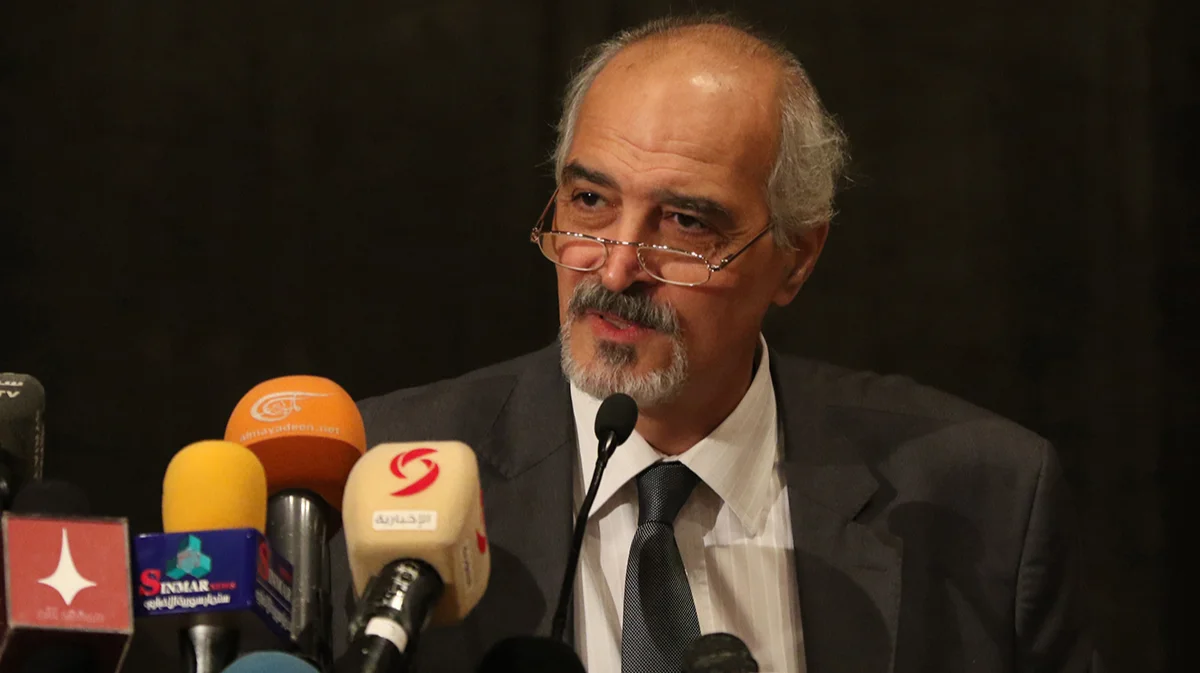
Bashar al-Jaafari, Damascus, Syria, August 5, 2018. Photo: Youssef Badawi/EPA-EFE
Syria continues to be the focus of the Kremlin's attention. Last week, Russian Deputy Foreign Minister Sergei Vershinin said that Moscow is conducting a dialogue with the new Syrian leadership on a number of issues, “which takes into account the interests of both sides.”
And Lavrov invited the new head of the Syrian Foreign Ministry to Moscow.
Moscow's interest is more or less obvious: it is concerned about the fate of military bases. Especially now that management of the port of Tartus has been transferred to the Emirates (contrary to the agreement concluded by the previous Syrian leadership with Russia for 49 years). But what do the Syrians want?
The Syrians want retribution.
It is known that the ousted Syrian President Bashar al-Assad, after the victory of the opposition, took refuge in Russia with his family and immediate circle and received political asylum by Putin’s personal decree. Some Assad officials and military personnel also received asylum. Meanwhile, in March, the Syrian transitional government made an official request to Russia to extradite Assad. He is accused of organizing massacres, using chemical weapons and crimes against humanity, and faces trial under the new transitional justice system.
Russia responded to this appeal from the Syrian government with a refusal.
It is obvious that if Assad, Russia’s closest ally in the Middle East, is extradited, he will face the most terrible fate.
However, this is precisely the price the Syrians have set: the extradition of Assad is called a precondition for any further negotiations on the future of the Russian military bases in Khmeimim and Tartus.
It seems clear that Moscow will never agree to extradite a deposed dictator: after all, too many agreements in the current warring world rest on guarantees of personal security given by Russia. But how wide is the circle of persons to whom these guarantees apply?
This issue is currently acutely worrying the former Syrian ambassador to Russia Bashar al-Jaafari.
Bashar al-Jaafari was born in 1956 in Damascus. Like many representatives of the Syrian elite of those years, he was educated in Europe, in France, where he defended his doctoral dissertation. Confident in French, English and Arabic. Since the early 1990s, al-Jafaari has gone from an adviser to the Syrian mission to the UN to one of Syria's most recognizable representatives on the international stage.
In 2006, al-Jaafari became Syria's permanent representative to the UN, remaining in this post until the mid-2020s.
During the Syrian civil war, which began in 2011 and provoked massive human rights violations and a refugee crisis in Europe, al-Jaafari became the de facto face of the regime on the international stage. His speeches were harsh and accusatory; he openly accused the West and neighboring Arab states of inciting war, and the internal Syrian opposition of terrorism.
Many considered him not just a diplomat, but an ideological frontman - he did not simply broadcast directives, but shaped and defended with sophistication the rhetoric of a regime that committed crimes against civilians.
In January 2022, when Bashar al-Assad considered the civil war in his country virtually over and the opposition defeated, al-Jaafari was transferred to friendly Moscow to retire.
But only three years passed, and everyone saw how deceptive the calm in Syria was and how cruelly mistaken Assad was: in a matter of days, jihadist units took over the country. The Syrian dictator and his associates were forced to flee. But al-Jaafari was in a more advantageous position: he was already outside Syria.
After the change of power, diplomatic relations between Moscow and Damascus are experiencing a reboot. The new Syrian leadership has still not appointed a new ambassador to Russia, and official contacts are carried out mainly through the temporary Syrian mission in Vienna, where a representative of the National Transition Council is accredited.
Negotiations with the Russian Foreign Ministry take place on neutral territory - most often in Astana or Geneva. Jaafari, a symbol of the old regime, is not taking part in these negotiations.
In January 2022, TASS, citing an anonymous source, reported that al-Jaafari had requested asylum in Russia. He himself hastily denied this information; moreover, unlike the case of Bashar al-Assad and the Syrian military, there was no reaction from Russian officials.
But there was a reaction from the other side. In April, information appeared that property belonging to the former ambassador had been seized in Syria.
Al-Jaafari is clearly stuck between jurisdictions: Russia is in no hurry to stand up for him, while the Syrian government openly grins at him. It didn’t even help that he moved on to denouncing the previous regime, calling it a “corrupt mafia system.”
In May, the Ministry of Foreign Affairs of the transitional Syrian government issued a statement calling al-Jaafari to Damascus “as part of the reorganization of the diplomatic corps.” The Minister of Foreign Affairs of the new Syrian government, Assad al-Shibani, signed a decree transferring Jaafari to the central office in Damascus - however, in light of all the events, it is unlikely that we are talking about an appointment to a real position.