
Translated material
Stalin fans
Historian Rustam Alexander discusses why modern politicians and officials love the Soviet leader so much
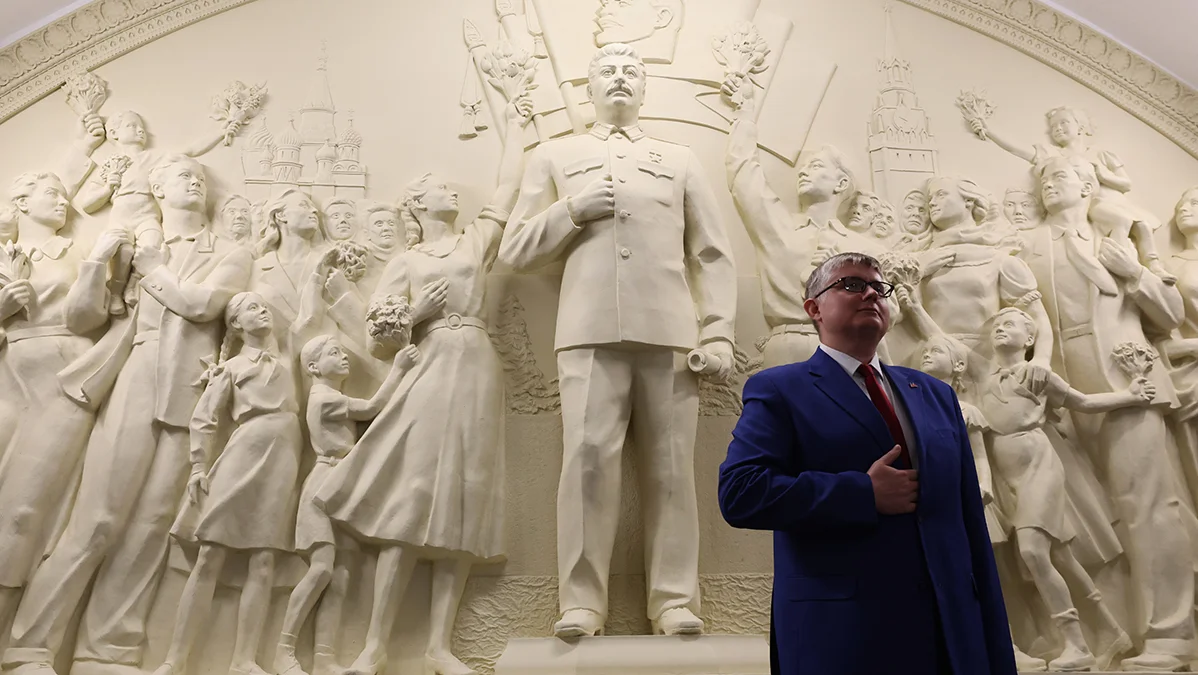
In mid-May, a bas-relief depicting Stalin was unveiled in the lobby of the Taganskaya metro station. In September 2024, Stalin’s profile was returned to the facade of the Volgograd Medical University, and in October the governor of the Volgograd region announced that a monument to Stalin would be erected on the territory of the house-museum where he lived. In November 2024, another monument to Stalin was opened in Nakhodka, Primorsky Territory, and a “Stalin Center” was being built in Bor, Nizhny Novgorod Region. In April, residents of Perm organized a half-marathon with portraits of Stalin. How to explain this new round of popularity of the Soviet dictator? The officials who initiate and support these crazy projects say different things. Thus, the governor of the Volgograd region referred to “public requests,” and at the opening of the “Stalin Center” in Barnaul last December, a deputy of the local legislative assembly said that “Stalin lives in each of us.”
There really are people in Russia in whose hearts Stalin “lives.” And their blind love for the dictator is not only a reaction to the promotion of his positive image by today's Russian leadership, but also echoes of the total indoctrination and faith that was widespread during his reign and immediately after his death.
When, at the beginning of March 1953, the main Soviet announcer Levitan and all Soviet newspapers unexpectedly announced the death of the leader, a stream of letters poured into the Kremlin, the authors of which said that Stalin’s death was a personal grief for them. All these letters can be found in Russian archives. Soviet people who grew up in orphanages without parents (many of them through the fault of their beloved leader) sent letters to the Kremlin, expressing gratitude to the now deceased leader, who “put a lot of work into raising orphans.” One woman called the Soviet people “Stalin’s pets” and swore that the “pets” would always remember their father. “Stalin was the grandfather and father of all children,” wrote another woman, and one of the students at the Leningrad Institute admitted that she mourned the death of Stalin more than the death of her father. Some said that they were ready to give their lives in exchange for the opportunity to resurrect the leader. A different leitmotif was evident in many of the letters: their authors modestly called themselves “small particles,” “cogs” in a large state mechanism, emphasizing the insignificance of their existence compared to the great Soviet leaders and, above all, Stalin himself.
Then Stalin, to use the expression of the Barnaul deputy, really lived in almost everyone. Some prisoners of Stalin's camps were ready to forgive their homeland and leader for “mistakes,” even if these mistakes distorted their lives. Thus, one prisoner released under an amnesty wrote in a letter to Soviet leaders:
“Maybe we did something wrong, disobeyed, and mother punished us. But is it possible to hate your mother for this? She punished - she will forgive and caress her children again! And everyone feels it!”
Faith and love for the leader was so strong that even after Khrushchev thundered with his secret report on the “cult of personality” and monstrous repressions, they were brought down and read out locally - in schools, factories and other institutions - many did not believe him and spoke out sharply against denigrating the name of their beloved leader. After Khrushchev’s report, a new stream of letters poured into the Kremlin, in which people literally attacked Molotov and other comrades of Stalin: “Don’t you see what a mistake your comrades are making in defaming the blessed memory of Joseph Vissarionovich Stalin?” - wrote one. Another letter was addressed directly to Khrushchev: “He [Stalin] led us to communism, and you are ruining the party... You want to pour out all your bile on Comrade Stalin. You are a nasty creature. Lenin raised us, but Stalin raised us, not you. You ordered all communists to read the closed letter. They read with pain in their hearts... Was Stalin really stupider than you? Another letter called on Molotov to bring order to the party and stop the “careerist” Khrushchev: “After all, you personally know Stalin well, his affairs, and you cannot, you do not have the moral right to remain silent, not to protest loudly against the posthumous dirty and deceitful insults of your former comrade in arms...”
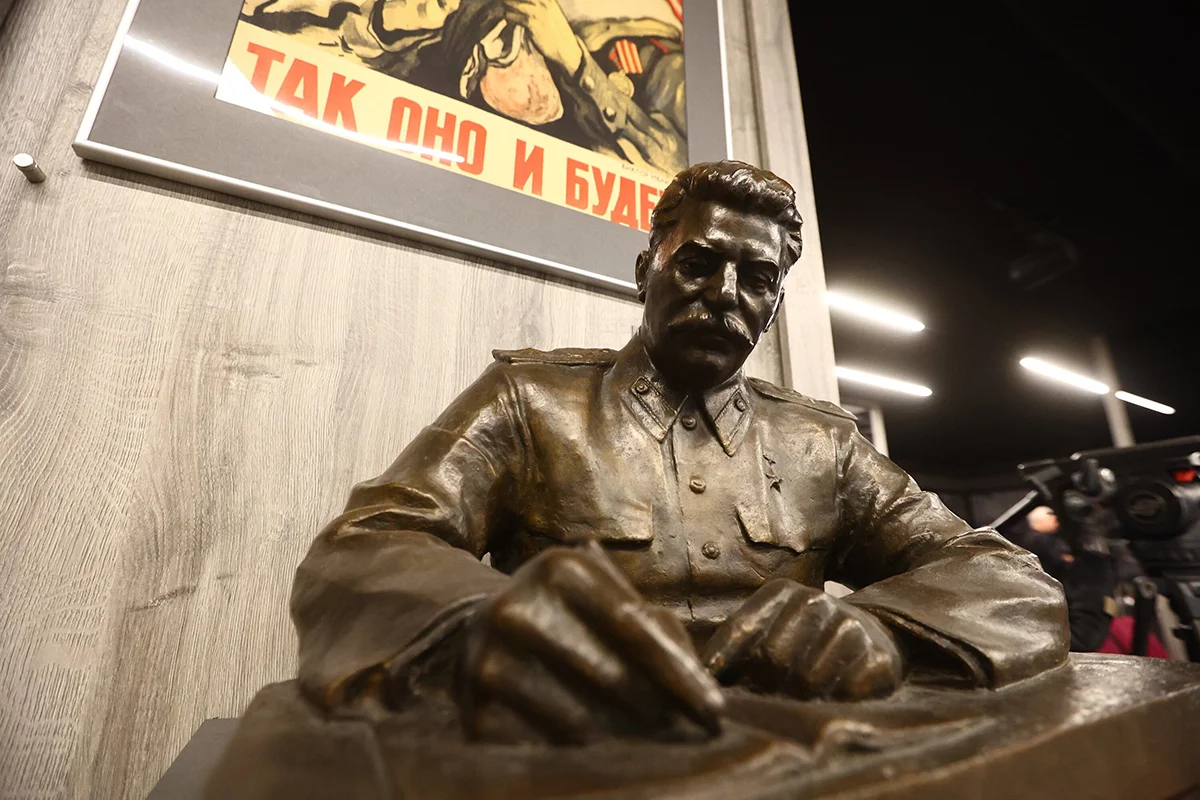
To be fair, it should be said that in the USSR there were those who rejoiced at the death of the leader. In the State Archive of the Russian Federation there are many criminal cases dating back to March 1953 for “anti-Soviet” statements by those who dared to ridicule the nationwide mourning for the “Father of Nations.” On March 6, 1953, in the cinema “30 Years of October” in the city of Chardzhou, Turkmen SSR, the film “Unforgettable 1919” was shown - a feature film about how Comrade Stalin saves the Soviet Republic from the White offensive in the midst of the civil war. When Stalin's face appeared on the screen, a cry was heard from one of the seats: “For the death of Stalin, hurray!” The screamer was immediately arrested.
Cases were even opened against schoolchildren. Thus, at a mourning meeting regarding the death of the leader in Lvov, seventh-grader Larisa said quietly: “That’s where he belongs.” Hearing this, the boys standing nearby hit Larisa and immediately reported her. The girl was interrogated, and on March 31, 1953, she was sentenced to ten years of correctional labor.
If even those who suffered from Stalin's actions - the direct victims of his policies - said that the leader was good, one should not be surprised at the praise of Stalin by current officials, whose lives take place many decades after Stalin's repressions. Until recently, the preservation of historical memory was carried out by Memorial, one of the oldest human rights organizations in Russia, which the Russian authorities officially liquidated. But now it is becoming more and more difficult to work with distortions of historical memory, to recall Stalin’s monstrous crimes: the time has come for the mythologization and romanticization of the Stalin era. Therefore, in the near future we are likely to see even more public manifestations of sympathy for Stalin.