Translated material
Brought the security forces out to salt water
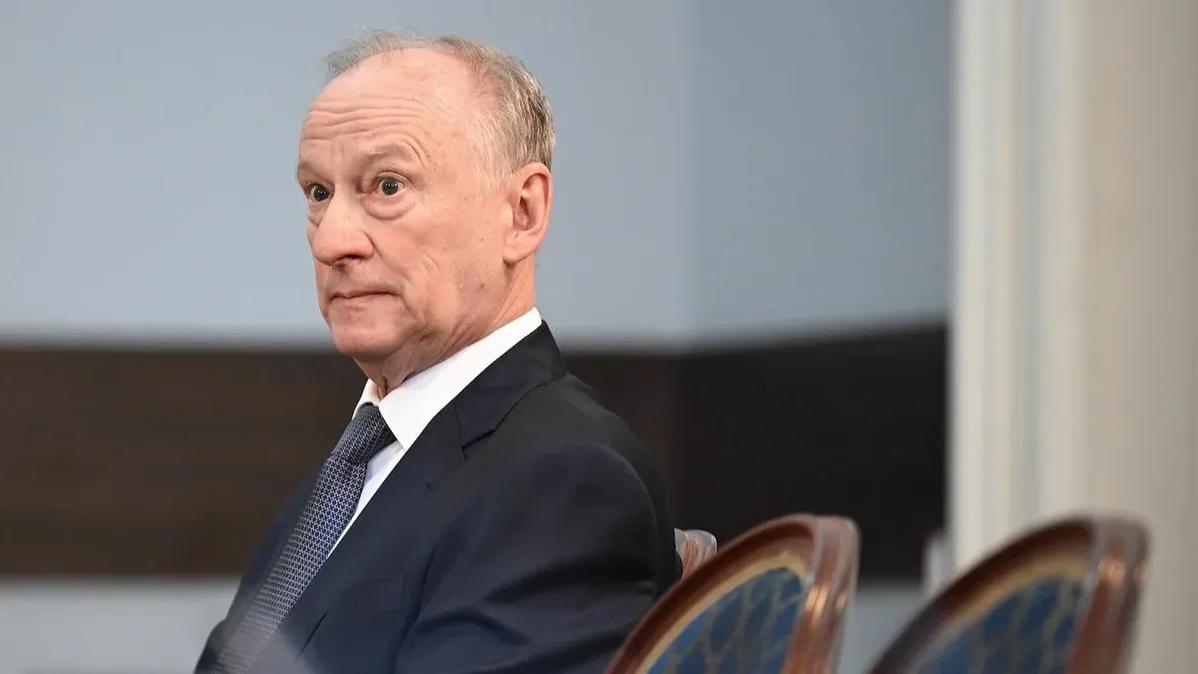
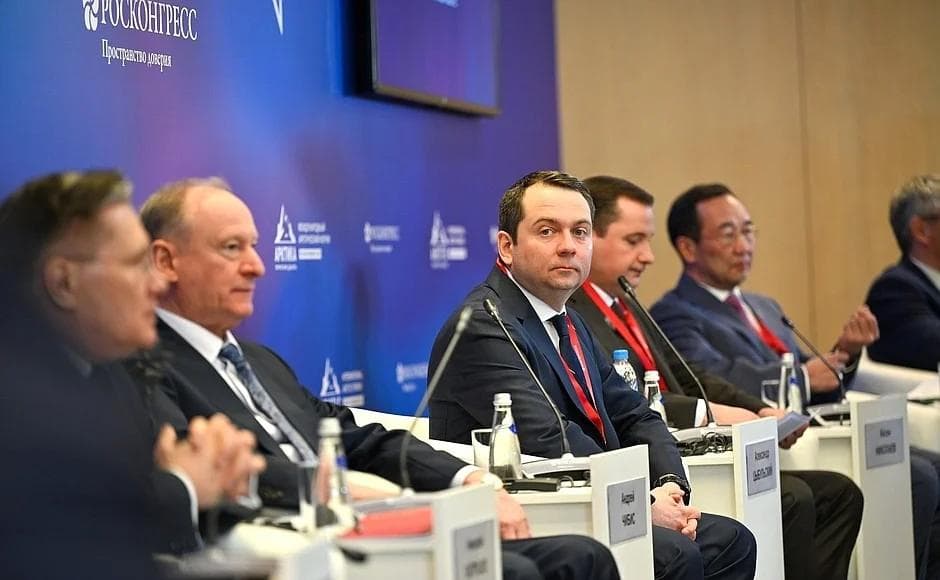
The Maritime Collegium is turning into a new law enforcement agency and personal PR project of presidential aide Nikolai Patrushev.
The world's oceans become an arena for the geopolitical game of "Battleship". Along with the decree “On the restoration of America’s maritime supremacy” signed by Donald Trump, the Maritime Collegium of the Russian Federation, created last year, also demonstrates a clear strengthening of the power bloc in the management of the Arctic zone.
In the study, Arctida analysts talk about the role of Nikolai Patrushev in the struggle for oceanic dominance and how the Arctic and the sea are turning from zones of economic development into spaces of national security.
В апреле на публичном заседании комиссий Госсовета по вопросам развития Арктики, прошедшем в рамках Мурманского арктического форума, выступали губернаторы арктических регионов, помощник президента и председатель Морской коллегии Николай Патрушев, а также генеральный директор Российского фонда прямых инвестиций Кирилл Дмитриев.
Several conclusions can be drawn from their speeches. One of them concerns the future: a connection between the Maritime Collegium and the Governor of the Murmansk Region Andrei Chibis is planned, especially in the part that concerns the Northern Sea Route (NSR) as a potential national project. The other is from the past: in search of a management model, the speakers turned to the Soviet experience - they almost unanimously supported the thesis about how good it was when the Main Northern Sea Route existed.
Maritime Board and Glavsevmorput
Despite the scale of the discussions, the main issues - those related to real changes in the governance structure of the Arctic - remained off the agenda. To what extent and in what direction can Russia's policy in the Arctic change in connection with the appointment of Patrushev to the post of head of the Maritime Collegium of the Russian Federation? Is his transfer from the Security Council to the Maritime Collegium really an “honorable retirement”, as was originally intended, or, on the contrary, a strengthening of the role of both Patrushev himself and the Arctic, which, having fallen under the control of the security forces, is drifting to the center of the geopolitics of the Russian state?
Patrushev’s personal PR project
Arctida analysts have been monitoring the activities of Nikolai Patrushev for a long time. They analyzed the latest changes in the composition of the Maritime Board, as well as public messages from its press service, and found that Patrushev’s active PR in his current position is incomparable with similar activities of his predecessors. He is the first head of the board to surpass President Vladimir Putin in terms of the number of mentions in the news on the departmental website.
Patrushev and the Arctic
The website of the Maritime Collegium of the Russian Federation, founded in 2024, continued to work on the same domain as its predecessor - the website of the Maritime Collegium under the Government of the Russian Federation. Since at least 2018, the press service has regularly published messages on the board’s website, the vast majority of which related to the activities of President Putin, both related to maritime and Arctic issues and not.
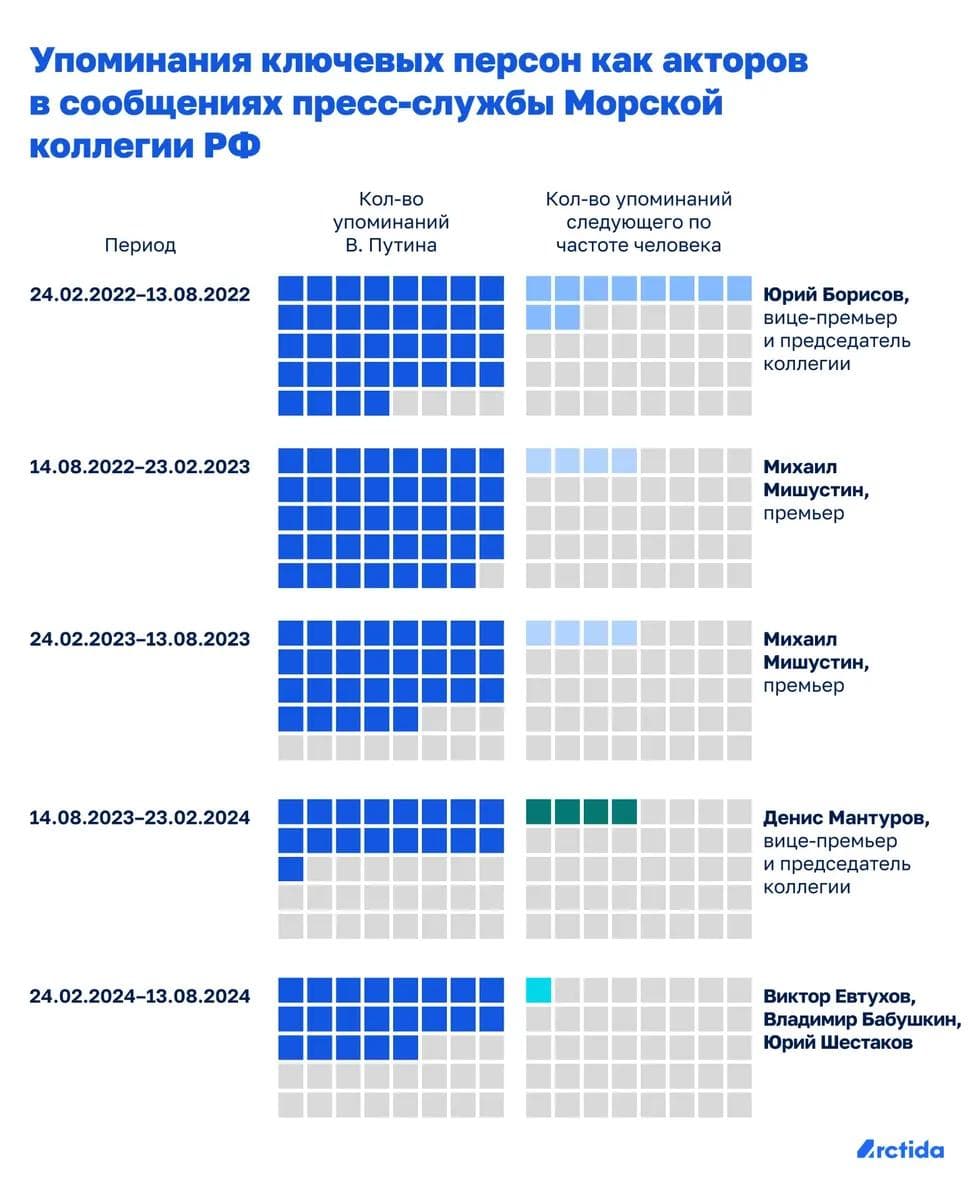
We take two dates as reference points. Firstly, on February 24, 2022, it was then that the press service of the collegium intensified efforts to review Putin’s activities and began publishing news about him, regardless of the presence or absence of connections with maritime issues. Secondly, August 13, 2024 is the date of the decree on reformatting the Maritime Board into a new body under the leadership of Nikolai Patrushev. Starting from August 13, 2024, the statistics of messages from the press service of the Maritime Collegium changes.
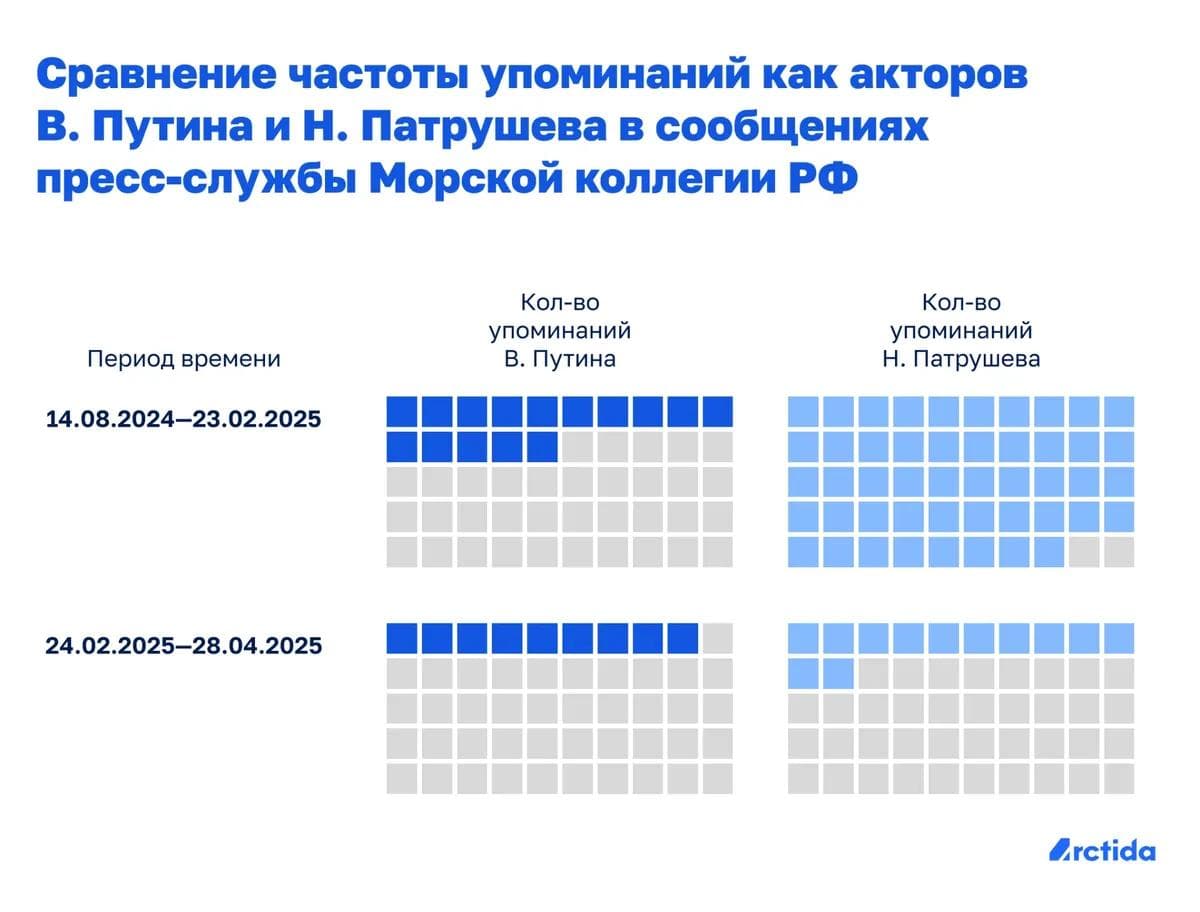
If the former leaders (Manturov and before that Borisov) were mentioned relatively rarely by the press service of the board, and Manturov was even called “the head of the Ministry of Industry and Trade,” and the president’s activities, even non-core ones, were actively covered, now in the reports he has been supplanted by Patrushev, who is invariably designated as “Aide to the President of Russia, Chairman of the Maritime Collegium of the Russian Federation,” which emphasizes his special status. This is no longer a technical position combined with another departmental portfolio, as it was before, but an independent supervisory and coordinating position.
The increase in public activity of the board and the emphasis on the figure of Patrushev is the result of not only intensive PR work. Several factors come together here.
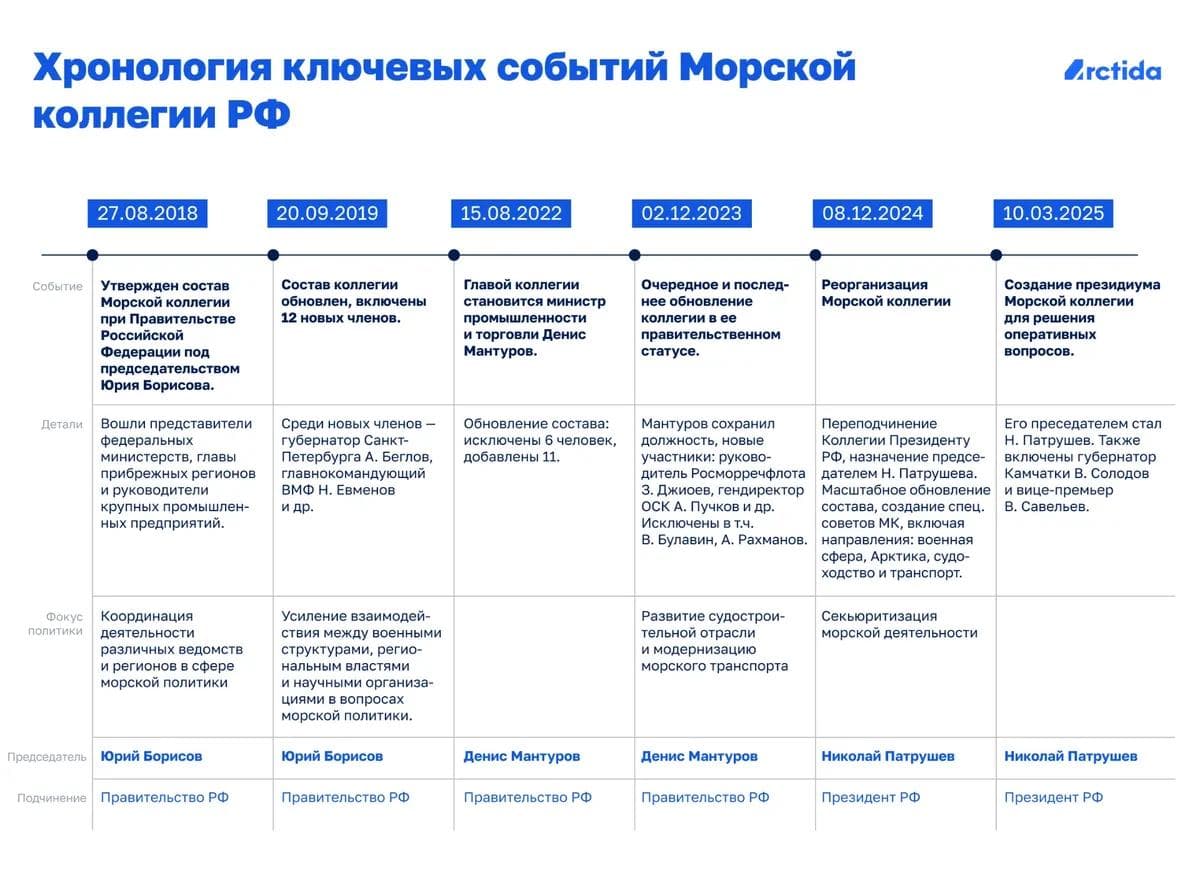
- Firstly, under the leadership of Patrushev, the Maritime Collegium left the control of the government and acquired the features of an independent body reporting directly to the president. This coincides with the revision of the doctrinal foundations - in particular, a new edition of the Russian Maritime Doctrine was adopted.
- Secondly, Patrushev himself is a federal figure with an impressive political and administrative background. His “program interviews,” regularly published by major state media, cover not so much the maritime industry as global issues of foreign and domestic policy.
This turn indicates a change in both the image of the Maritime College and its institutional weight.
This is no longer just an interdepartmental coordination council, but a kind of super body whose ambitions go far beyond the industry agenda. It is also no coincidence that after Patrushev left the post of Secretary of the Security Council, this institution, apparently, lost a significant share of its political weight, while Patrushev himself received a new platform of influence - already in the maritime (and Arctic) sphere. It is important to remember that Patrushev is also connected to the Arctic through family relations - his youngest son Andrei is actively involved in activities in the Arctic zone.
Naval doctrine
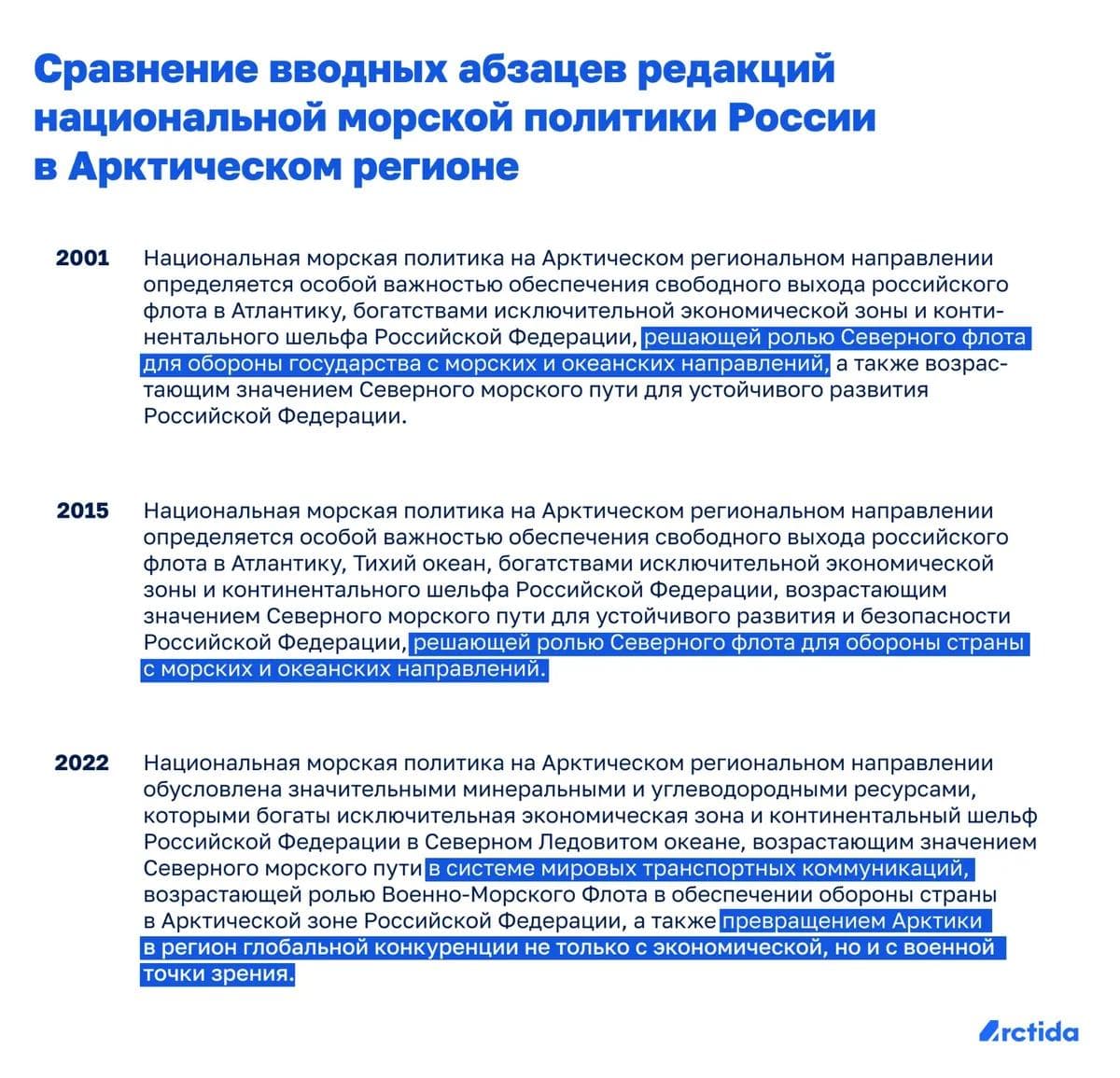
Significant changes also affected the section dedicated to the Arctic. In the 2001 edition, the emphasis was on “research and development of the Arctic with a focus on the development of export sectors of the economy and the priority solution of social problems.” However, in 2015, a reference to “threats to national security” was introduced into the doctrine. Accordingly, from now on, Russia’s activities in the Arctic zone should be aimed at reducing them.
At the same time, according to the doctrine, Russia seeks not to “isolate”, but to integrate the Arctic territories into the system of global communications, strengthening state control there and securitization of the region as a whole.
The shift in emphasis from the rhetoric of “economy” and “development” to the rhetoric of “threats to national security” continued in 2022, when the following description was assigned to the Arctic: “a region of global competition not only from an economic, but also from a military point of view.” This formulation implies a radical change in priorities compared to the 2001 edition.
If the 2001 and 2015 editions differ slightly, then in 2022 the Arctic is presented as an arena of global competition in various fields.
В доктрине 2015 года отдельно оговаривается, что Морская коллегия — «постоянно действующий координационный орган, обеспечивающий согласованные действия федеральных органов исполнительной власти, органов исполнительной власти субъектов Российской Федерации и организаций в области морской деятельности, судостроения и создания морской техники, а также в области изучения и освоения Мирового океана, Арктики и исследования Антарктики».
In 2022, the wording remains the same. However, in August 2024, Putin created the Maritime Collegium anew, approved its position, and also made changes to the Maritime Doctrine - now it mentions not the Maritime Collegium under the government, but the separate Maritime Collegium of the Russian Federation. A key change was that the Maritime Board now acts “to protect the national interests of the Russian Federation and strengthen its defense capability in the World Ocean” - in previous editions the board carried out technocratic functions of coordinating and coordinating actions. And finally, now it is not the government that reports to the president on the progress of implementing the doctrine’s measures, but Patrushev personally as chairman of the Maritime Collegium of the Russian Federation.
Strengthening the security forces
Based on the connections and affiliations of the members of the Maritime Collegium, Arctida identified interest groups: law enforcement agencies and security agencies, transport and logistics, shipbuilding and shipping, ecology and environmental supervision, fisheries, economics and industry, science and education, energy and subsoil use, defense industry and state defense procurement and others. Separately, groups were identified according to their affiliation with government bodies, business and state corporations.
One person can simultaneously belong to several interest groups. For example, the eldest son of Nikolai Patrushev, Dmitry, was included in Manturov’s Maritime Collegium as the Minister of Agriculture, but also had a relationship with the Arctic based on his other activities, and his relationship with Nikolai Patrushev allows us to consider him as adjacent to the power bloc.
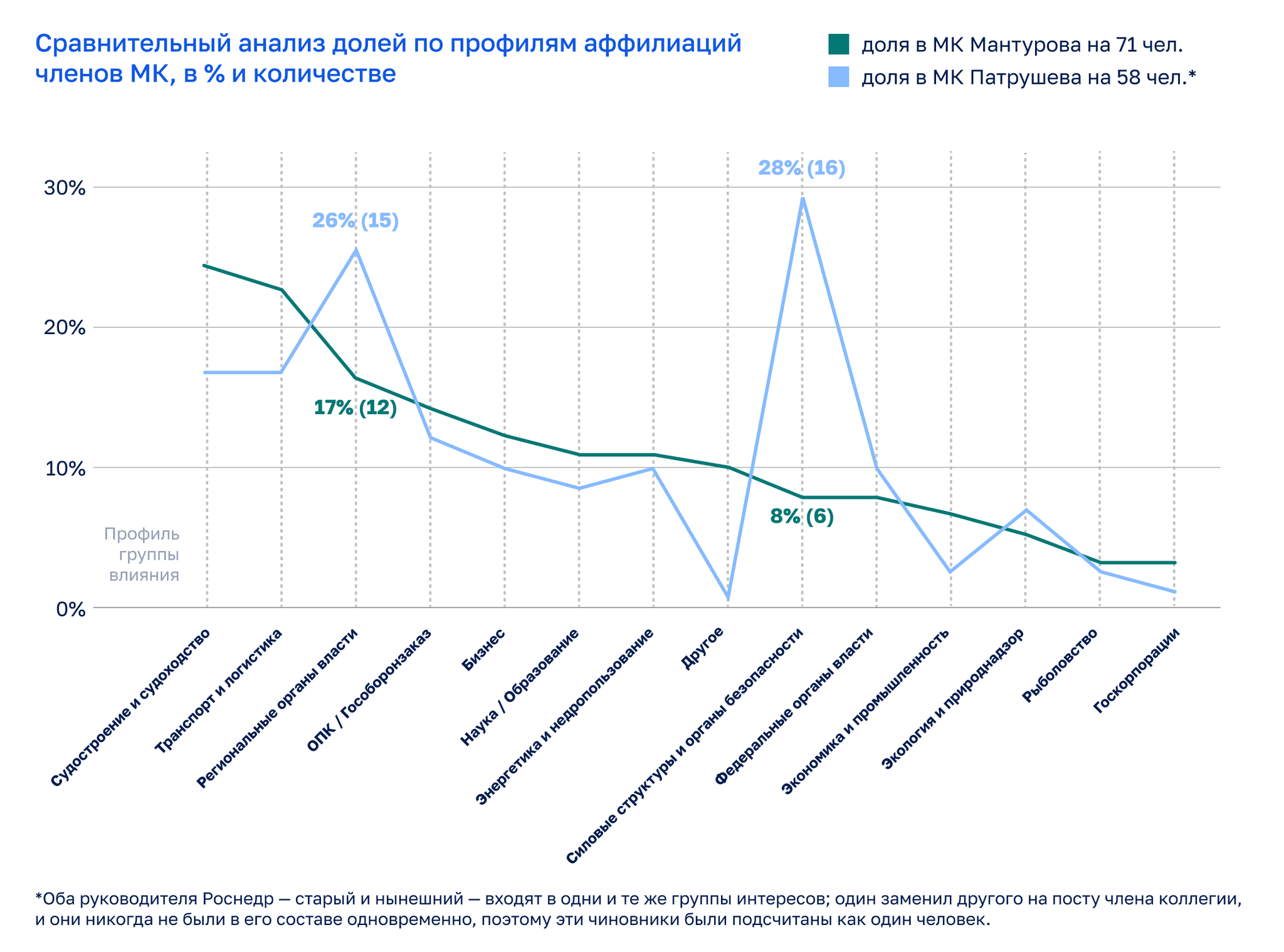
The graph shows that, compared with the composition of Manturov’s time, the share of security officials in the new board has increased significantly - from 8 to 28% (in absolute numbers - from 6 to 16 people). Also, the representation of regional authorities (governors of maritime and Arctic regions) has increased slightly in Patrushev’s board. Some heads of Arctic subjects (for example, the governor of Yakutia) were excluded from the board, while the head of another Arctic region - the Yamal-Nenets Autonomous Okrug - and the heads of “new regions” were added there.
The share of personalities with “Arctic” affiliations outside the Maritime Board itself has decreased quantitatively due to the “subsidiaries” of Rosatom: the board in 2024 did not include the deputy head of Rosatom for the Northern Sea Route, the head of Atomflot and the head of the Federal State Budgetary Institution “Glavsevmorput”. Зато в коллегию вошел о директор всего Росатома, что в качественном отношении увеличило вес компании в коллегии.
В сентябре 2024 Николай Патрушев во исполнение указа президента учредил внутри коллегии три совета и утвердил их состав.
Were formed:
- Council for Strategic Development of the Navy (or Council for the Navy, head - N.P. Patrushev);
- Council for the Protection of Russia's National Interests in the Arctic (or Arctic Council, head - Yu.P. Trutnev);
- Council for the Development and Support of Maritime Activities of the Russian Federation (Maritime Council, head - S.A. Vakhrukov).
Compared to the previous composition, the new board has seen a rotation of governors. Three of those who worked there under Manturov were expelled from the board. In 2025, three regional heads were added to the Maritime Collegium - the Kamchatka Territory, the Yamal-Nenets Autonomous Okrug and the so-called governor of the Zaporozhye region. However, they are not trusted in the security sector: none of the regional leaders is included in the Navy Council, with the exception of former governor Alikhanov. And the heads of the Arkhangelsk region and Karelia are not included in the maritime council - only in the council for the Arctic.
Council for the Development and Support of Maritime Activities of the Russian Federation (Maritime Council)
The scope of this council includes national maritime policy, in addition to the military sphere: it deals with issues of shipbuilding, fleet, and port infrastructure.
Among the 33 members of the Council for the Development and Support of Maritime Activities of the Russian Federation, 10 people belong to regional authorities (these are the current heads of maritime regions and the former head of the maritime region Alikhanov), and 8 out of 10 are included only in this council. Only the governor of the Murmansk region, Andrei Chibis, is also a member of the Arctic Council, which may indicate the growing influence of this governor and the degree of his collaboration with the security forces, and the Minister of Industry and Trade Alikhanov (former governor of the Kaliningrad region) is a member of all three councils.
In addition to regional leaders, the Maritime Council includes the Minister of the Russian Federation for the Development of the Far East and the Arctic, Chekunkov. Также в состав совета вошли шесть персоналий, имеющих отношение к транспорту и судоходству, а также персоналии, связанные с рыболовством, экологией, министр МЧС, министр науки и высшего образования, руководители Роснедр и Росгидромета.
16 of the 33 members of the Maritime Council were previously members of Manturov’s board - it is this council that is closest to the Maritime Board in its old form, before reorganization and removal from government control (the council is related to the regional agenda, topics of transport and shipping). Это подтверждается как кадровым составом, так и характером обсуждаемых в пресс-релизах и документах тем.
The head of the council was Sergei Vakhrukov, another major figure in the Maritime Board. Former governor of the Yaroslavl region (2007–2012), since 2013 he worked first as assistant secretary of the Security Council (Patrushev), and since 2016 as his deputy. This once again emphasizes the role of Nikolai Patrushev and his creatures in the Naval Collegium. It is noteworthy that Vakhrukov’s eldest son Dmitry works as Deputy Minister of Economic Development of the Russian Federation.
Council for the Protection of National Interests of the Russian Federation in the Arctic (Arctic Council)
The Council for the Protection of National Interests of the Russian Federation in the Arctic was headed by Presidential Plenipotentiary Envoy to the Far East Yuri Trutnev. The first meeting took place in November 2024. At it, Patrushev stated that the council should become the successor to the interdepartmental commission of the Security Council of the Russian Federation on issues of ensuring national interests in the Arctic , paying increased attention to the analysis and identification of internal and external threats to national security in the Arctic, assessment of the state and prospects for the development of the international (including military-political) situation in the Arctic and the socio-economic situation in the Arctic zone of the Russian Federation, and other priorities of national maritime policy in this area. In this commission, Sergei Vakhrukov and Yuri Trutnev were deputy chairmen of Dmitry Medvedev, who was not included in the new Maritime Board.
In general, among the 30 members of the Arctic Council there are eight representatives of law enforcement agencies, seven personalities associated with the Arctic (either through the activities of mining corporations, such as NOVATEK, or through the management of the Northern Sea Route, or through regional affiliation), as well as five people associated with the mining industry, energy and subsoil use. Among the latter, for example, are representatives of Rosneft, Rosnedra, and the Minister of Natural Resources and Environment of the Russian Federation. The council also represents interests in the fields of ecology, transport and shipbuilding, industry, fisheries, and science.
In general, the composition of the council represents a combination of Arctic, natural resource and power interests and reflects the idea of the Arctic as a field of international confrontation and a place for the extraction of natural resources
Из того, какие члены Морской коллегии наиболее близки экологической и климатической тематике, понятно, что эта повестка не является в этом контексте приоритетной: речь идет о представителях Роснедр, Росгидромета, ФМБА и министре природных ресурсов. As part of Manturov’s board, the environmental direction was more widely represented: in particular, it included the head of Rosprirodnadzor Svetlana Radionova, who, according to the investigation , flew on a business jet paid for by Norilsk Nickel to Norilsk during the days of the diesel spill in 2020, and the former environmental prosecutor from Yamal, Alexander Kaliberda. They are not included in the current composition.
Among public organizations, only the seamen's trade union is represented in the board. The cultural sector is symbolically indicated by the participation of the Museum of the World Ocean. And most of the scientific organizations represented in the board are dual-use enterprises.
Council for Strategic Development of the Navy (Navy Council)
In the Council for Strategic Development of the Navy, headed by Patrushev himself, both in composition and in the direction of activity, the power and military bias is most obvious: of the 21 members, 12 are related to law enforcement and security structures, another six are related to the defense industry or state defense procurement. Economy and industry, transport and shipbuilding, business are also represented, but the key positions are occupied by security forces.
According to the founding documents, this council was created to carry out “tasks of developing measures aimed at ensuring the strategic development of the Navy” and coordinating federal and regional bodies and other organizations around these tasks. Its functions include preparing instructions and assessing weapons programs, developing shipbuilding, human resources and scientific potential, ensuring navigation and security.
Характерно, что в то время как между Советом по Арктике и Морским советом присутствуют пересечения, в коллегии есть всего несколько персоналий, которые одновременно входили бы в Морской совет и Совет по ВМФ. Even Patrushev himself is not a member of the Maritime Council. Все это серьезным образом разделяет Морской совет, являющийся своеобразным продолжением Морской коллегии Мантурова, и силовой блок под руководством Патрушева, преимущественно заседающий в двух других советах.
It is obvious that challenges and threats at sea for Russia today are not only present, but are in many ways intensifying. Коллективный Запад уже не стесняется открыто говорить о намерениях изгнать оттуда наше судоходство, а озвучиваемые, например, британцами и некоторыми еэсовцами санкционные планы вообще начинают напоминать морскую блокаду. Эти меры будут встречать адекватный и соразмерный отпор с нашей стороны. Если же дипломатические или правовые инструменты не возымеют действия, то безопасность российского судоходства будет готов обеспечить наш ВМФ. Горячим головам в Лондоне или Брюсселе нужно это четко понимать.
Источник: Из интервью, «Коммерсантъ»
Одновременно во все три совета входят только шесть человек:
- S.A. Куликов, руководитель Российского морского реестра судоходства, подведомственного Министерству транспорта;
- A.A. Алиханов, министр промышленности и торговли;
четыре персоналии из силового блока и администрации президента:
- V.G. Кулишов, руководитель Пограничной службы ФСБ;
- S.A. Вахруков, заместитель секретаря Совета безопасности, начальник Управления Президента Российской Федерации по вопросам национальной морской политики;
- V.Yu. Бабашкин, заместитель Вахрукова;
- A.V. Разинкин, первый заместитель Генерального прокурора Российской Федерации.
Мы предполагаем, что именно они наряду с Николаем Патрушевым и Юрием Трутневым и составляют костяк состава Морской коллегии после 2024 года. Так что не только в составе, ни и в руководстве Морской коллегии большинство — снова за силовиками.
У Патрушева есть два союзника — Арктика и военный флот
В результате последнего реформирования Морской коллегии в марте 2025 года в ее структуре появился президиум под руководством Патрушева, а также семь новых членов. Среди них — руководитель Роснедр О.В. Казанов, сменивший на этом посту Е.И. Петрова, трое губернаторов и двое силовиков, среди которых глава СК А.И. Бастрыкин. Состав президиума должен утвердить лично Патрушев, но сильно расстановка сил внутри коллегии от этого вряд ли поменяется.
Все это позволяет сделать следующие выводы о тенденциях в реализации политики России на море и в частности в Арктике:
- Усиление Николая Патрушева. В изменениях как личного состава, так и направленности деятельности коллегии и ее составных частей значительную роль играет личность Патрушева, для которого Морская коллегия одновременно выступает как личный пиар-проект.
- Укрепление силовых структур. Включение в состав коллегии представителей силовых ведомств свидетельствует о повышенном внимании к вопросам безопасности и «защиты национальных интересов» в морской сфере и в Арктической зоне.
- Фокус внимания на Арктике. Создание специализированных советов, в частности Совета по защите национальных интересов в Арктике, подчеркивает стратегическую важность этого региона для России и необходимость комплексного подхода к его освоению и защите.
Особенно ярко две последние тенденции воплощаются в учреждении двух силовых советов внутри коллегии — Совета по стратегическому развитию Военно-морского флота и Совета по защите национальных интересов России в Арктике. Третий совет — по развитию и обеспечению морской деятельности Российской Федерации — включает в себя губернаторов прибрежных и арктических регионов, представителей транспортных и других в основном гражданских организаций. Как по составу, так и по направленности этот совет наиболее близок к старой Морской коллегии при правительстве под руководством Мантурова и ранее Борисова.
В целом изменения в составе и структуре Морской коллегии в 2024–2025 годах демонстрируют стремление России к усилению контроля и координации в морской сфере, особенно в стратегически важных регионах, таких как Арктика. Происходит слияние морской и арктической повесток, сопровождаемое их секьюритизацией.
Исследование «Арктиды» показало, что Морская коллегия образца 2024 года — это более силовая, централизованная и стратегически ориентированная структура, в которой ключевую роль играют вопросы обороны, контроля логистики и национальной безопасности.
Арктика и море рассматриваются все больше не только как экономическая зона, но и как геополитический фронт и пространство для развития инфраструктуры государства.