
Translated material
Sitting on a beautiful hill
What Boris Grebenshchikov* in Israel sang - and what it meant for those who came to listen to him
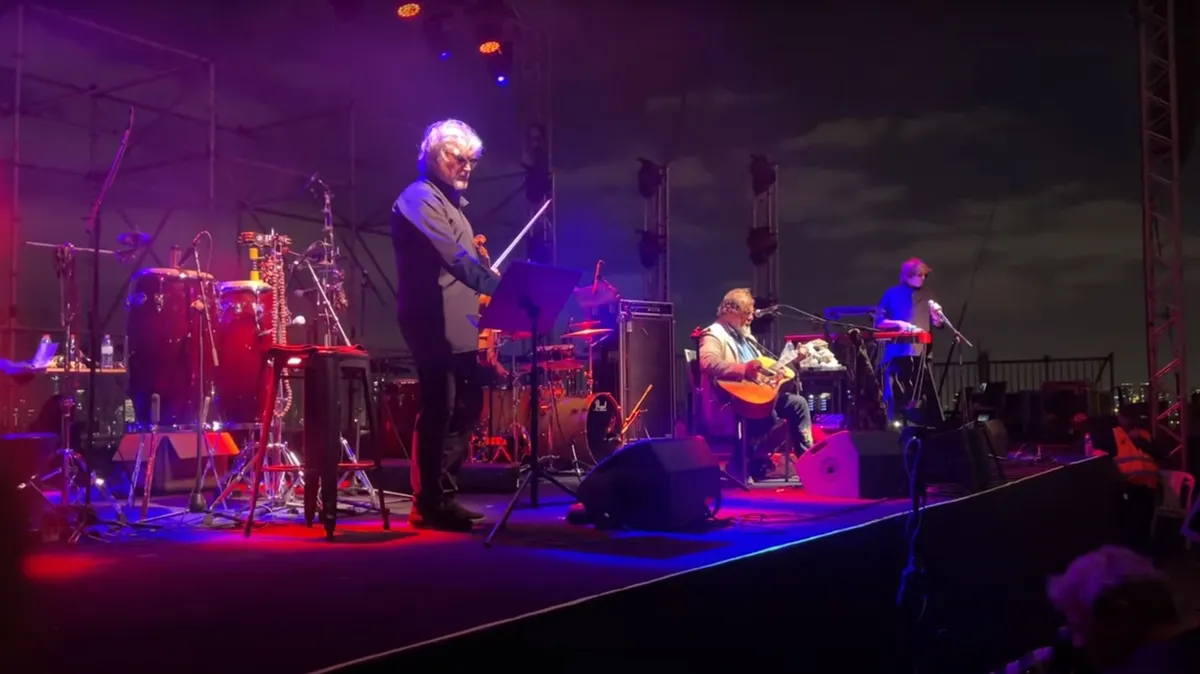
Concert Boris Grebenshchikov in Tel Aviv, May 27, 2025. Screenshot from the video
18+ This material (information) was produced, distributed and (or) sent by a foreign agent Grebenshchikov Boris Borisovich or concerns the activities of the foreign agent Grebenshchikov Boris Borisovich.
The place for the BG* concert and his group in Israel was chosen a little exotic-beautiful, protruding over Tel Aviv Hill in the park of Ariel Sharon, adjacent to a giant landfill. Due to the remoteness from urban infrastructure, it was she who served as a guideline for those who arrived in personal and public transport - and greeted the audience with appropriate smells. Those who wanted to get to the concert had to climb the bulk hill. The last stage of the ascent was voiced by Tibetan singing bowls, the recording of which was distributed from the columns, which gave this “fireplace” a resemblance to the scene from the film “Shapito Show”-the one, in which the heroes are crazy to the tent.
In our case, at the end of the path, the audience was waiting for a large veranda, similar to the courtyard of the capital's Institute "Strelka" on the Bersenevskaya embankment-with a view of the whole city and span directly above the scene of passenger aircraft, every three minutes landing at the Ben-Gurion airport near the airport. Only Russian speech was heard everywhere - the BG concert became one of the most anticipated events for the Russian -speaking community of Israel.
With the onset of darkness, the heroes of the celebration appeared on the stage - in a somewhat truncated composition compared, say, with the March concert in Helsinki - without the percussionist Gleb Glebenshchikov and Flatyist Brian Finnegan. Oddly enough, this did not damage - as a result, the group showed a rarefied, light sound in which all the songs sounded fresh and interesting.
In the current round of the BG and his team, dramaturgy and selection of songs are quite interesting, the benefit of the case of about 500 compositions gives Grebenshchikov this opportunity. The concert began with “We’ll talk about the dead” (see the essay of the priest Sergei Rybakov about this composition in “New”), written last year, and in several places was stitched by recent writings - the gloomy reggae “The Spiritual Leader”, Rumba “God Zimogorov”, the park waltz “on the shores of the pond”. However, the basis of the Set Last in the current tour is songs from the albums of the 80s and to a lesser extent of the 90s. In particular, “electricity” and “acoustics”-albums recorded by the “aquarium” in 1980 and 1981, respectively and became the first and favorite records of the group of many of its former and current fans: from there they were rarely performed “25 to 10”, a romantic “why the sky does not fall”, the swing “when you go”-the BG put on it on it. The neck is clamp with labial harmonics and began to play along with this instrument.
There were also works of the period of a sharp take-off of the group in the mid-80s-“for those who are in love”, who had the features of the boss-nova, and “silver of my Lord”, on which the BG suddenly subtly and touchingly sang a choir of spectator votes-for some reason mostly female. The 90s were represented by a hit “Blue light”, as well as “navigator”. Moreover, in the latter-to the pleasure of knowing the language-the rowers replaced in the chorus the Jewish words “shawl-leiser” who were originally present there (Hebrew “Hello, Goodbye”) for a not completely censored expression in Hebrew. It unequivocally indicates where to go to "those with a sword." BG played, against rock and rolling habit, sitting on a chair (there was a table nearby, on which the skull and figure of the master of iodine flaunted). This made it possible to observe some chamberity (for example, in the “Golden City”, which very poetic sounded under the rumble of a landing aircraft), but not to sacrifice a drive (for example, in the clockwork “partisans of the full moon”).
“It is interesting to sing old songs - they have been written for a long time, but you understand that about today,” said the BG usually laconic before playing one of the old songs. Well, this is a normal property of any classics. However, it seems that in the case of this concert, his merit is a little more. Critic Boris Barabanov once noticed exactly that the BG came up with the language of the generation.
It seems to me that he did not mean the merit of the level of Pushkin, who formed the Russian literary language-but the corps of quotes, aphorisms, melodies, intonations, which expresses its views and feelings of the current 40–60-year-olds.
Choosing one for the other composition for the current tour, he seemed to build his personal designer of songs for each viewer, connecting the world around him in the present moment - with the time when these songs were first heard. Psychologists advise those who complain about the sensation of social or personal disorientation to people to return - at least in thoughts, songs, smells - by the time they felt intact and happy.
It is this possibility that the BG team gives-instead of nostalgic slya, which is served at concerts of some other rock heroes, the listener is offered a personal journey inside himself, a thin brocade thread to communicate himself with the current past with him. And instead of an emotional hangover from a drink that takes the past - from the BG concert you come out with a sensation, if not reconciliation with what is happening, then understanding it.

For Grebenshchikov and his team, perhaps this concert was another one between Limassol, where he performed the day before, and Riga, where he would go a month later. For the public, it seems, a little different - and the Russian -speaking viewer in Israel has its differences from, say, a fellow in Helsinki or Berlin. There, Russian and Russian -speaking, not embarrassed, call themselves emigrants - while Russian -speaking Israelis will never say that about themselves. They are repatriates, and this status implies slightly different relations with the country of permanent residence: in particular, the feeling of belonging to themselves at least two cultures. Torn off by the contradictions between several generations of immigrants, the Russian street of Israel suddenly united in the desire to see the one whose songs, in fact, are united. In social networks, the audience asked each other an extra ticket, united by cities for Trempa - that is, mutual transport, appointed meetings to friends, with whom they had not seen since the times of life in Russia.
The largest therapeutic effect, it seems, this concert has produced on the immigrants of 2022–2023 - representatives of the wave of the so -called "military aliyah", which the living Israelis for a number of reasons nicknamed "pumpkin". They learned a little Hebrew and began to work in a new country, they have not yet fully reconciled with the fact that they had to put their previous plans for the implementation of their ambitions, and new ones - to start with a zero mark. Running from one ***-and fell to another: each of them has already heard the sounds of air anxiety many times and knows how to behave if, during the performance, for example, the “city of the Golden” will gain a siren due to the daily shelling of the country's center by Yemeni Husites.
For them, the BG concert was an unexpected date with the one whose songs they took away in their heads from the former country and their former life - like a couple of the most valuable books stuck in the suitcase at the last moment.
The meeting that would be in Russia for them - and in the near future will remain impossible. For which it was worth getting up from a giant garbage to stand or sit on a beautiful hill.
Alexey Krizhevsky