
Translated material
Bet on people
The Central Bank reduced the key rate because the government wants to collect more taxes from the population

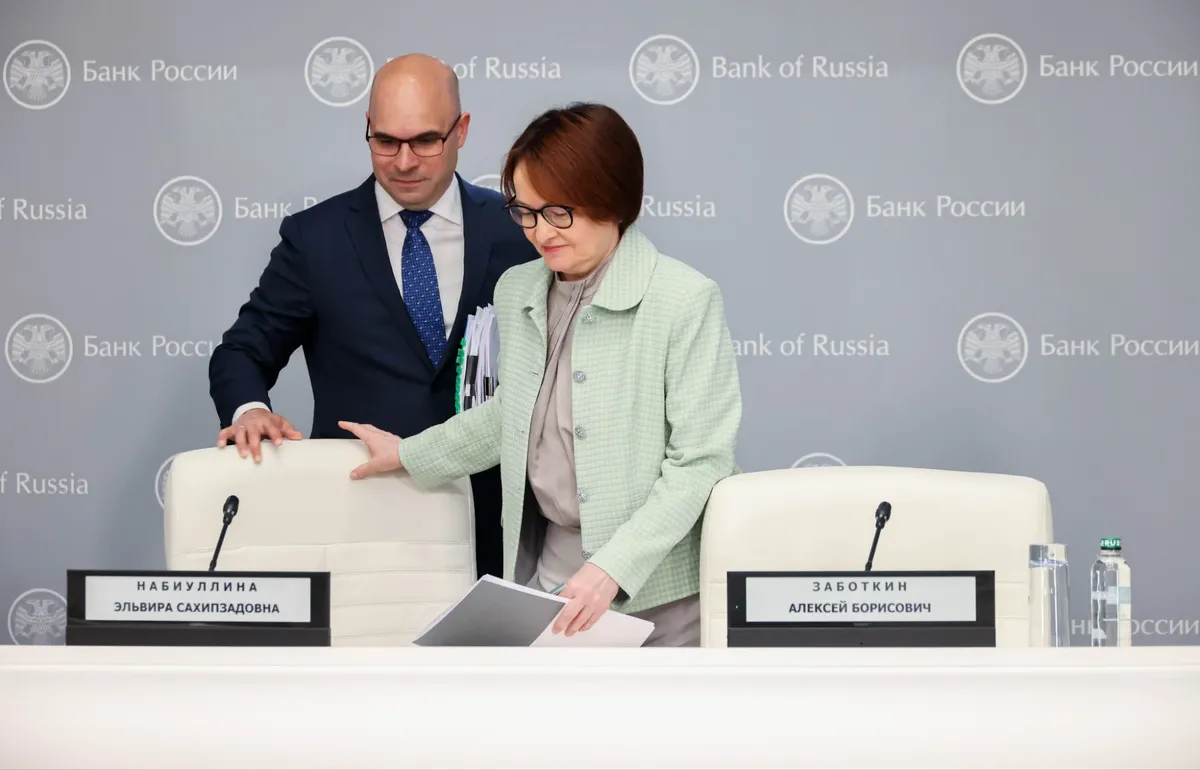
Photo: Evgeny Pavlenko / Kommersant
For the first time in 33 months (since September 2022), the Central Bank of the Russian Federation reduced the key rate-immediately by 1 percentage point, to 20%. The last time they reduced the rate in July 2022 (–1.5 pp). 7.5 months the rate lasted 21%.
However, today's decrease in the key rate, taking into account the slowdown of inflation, does not mean significant mitigation of monetary conditions, said Elvira Nabiullina, commenting on the decision of the Board of Directors of the Central Bank of the Russian Federation. Why then?
And then, that oil and gas revenues are reduced (and not the fact that they will grow in the future), and there are less money for “fulfilling tasks”. Therefore, it is necessary to help “unnecessary” industries to release more goods so that they are bought by “unnecessary” people and thereby bring additional taxes to the budget.
Between the lines
What did we read in the materials of the financial regulator (including between the lines)?
Why now?
The inflation impulse has fallen.
The real rate (taking into account inflation) took off to 14% - a record in history.
The economy began to slip.
What hides the neutral rhetoric of the release of the Central Bank?
The financial regulator did not celebrate the victory over inflation-there is no “reversal of monetary policy” in the release: “We will maintain the rigidity of the DCP as much as it is necessary for inflation of 4% in 2026.”
But between the lines:
Inflation is heterogeneous:
Non -food goods are cheaper (thanks to loans reduction and ruble strengthening).
Food and services are still valuable by 8-10% g/g.
Inflational expectations at a distinguished:
Business believes in price reduction.
The population is waiting for prices (polls - plus 9–11%).
What the Central Bank did not say (but can be seen in the data):
The credit market is compressed:
The issuance of corporate loans is minus 15% since November 2024.
Consumer loans - minus 11.5% (people simply do not take).
Labor market:
Unemployment is 3-4% (record minimums).
But vacancies are already 20% less (hh.ru).
Salaries grow more slowly - they will soon go into minus, taking into account inflation.
What next?
July 25 - the next meeting. If inflation continues to fall, another minus 0.5–1%.
2026 - the Central Bank promises 4% of inflation, but for this the rate will remain high (16-18%).
The main risk:
If you reduce too fast, inflation will rush up again.
If you delay, the business will go into the shadow or just close.
What does it mean?
The bet was reduced not because “everything is good”, but in order to prevent credit compression - a situation where banks reduce lending so much that the economy begins to stagnate.
Dear loans or high taxes - which is worse?
What is the specifics and complexity of the situation in which the financial regulator found itself?
The fact is that the Central Bank is responsible for price stability (that is, it makes sure that prices do not rise either quickly or too slowly). But in recent years, the growth in inflation in the Russian Federation has been provoked by the specifics of the interaction of the budget-tax policy of the government and the monetary policy of the financial regulator. The acceleration of inflation led to the simultaneous conduct of an active budget-tax policy that allows the budget deficit and the increase in the public debt, and the active monetary policy of the financial regulator, which puts the priority of suppression of prices by increasing the key rate.
What was the government’s budgetary policy: its main characteristic of the last three years has become significant-about 10% of GDP-a budget impulse due to a sharp increase in government expenses in the interests of the “fulfillment of tasks”. Well, the Central Bank played the government by the expansion of the loan in the summer of 2022.
On the one hand, this helped preserve the macroeconomic stability and dynamics of the national economy, which by the middle of 2023, after an annual decline, returned to growth. On the other hand, side effects were manifested in the form of an increase in inflation and the followed by the tightening of monetary policy. The key rate of the Bank of Russia from 7.5% in mid-2023 for incomplete one and a half years, by November 2024, was increased to 21%.
Simply put, if the regulator reduces the rate, as in 2022, and the government gives money to priority industries, it would be strange that prices would not increase. And when the regulator raised the rate, and the government continued to distribute money, prices continued to rise (since production outside the priority sectors began to slow down).

The question here is this: if you do not have the task of growing the economy as a whole, but the task of effective redistribution of resources is, then the current coordination of the government and the regulator is almost perfect.
90 years ago, a policy of redistributing resources from the agricultural sector to the heavy industry responded in the consumer market, which required the standardization of consumption (introduction of cards). Now (with a similar policy of displacing resources from “consumption” to “production”), we do not see a shortage in stores and do not see rationing. But we see that there is money in one part of the economy, and in the other part there are less and less.
And if you have no money, the government unequivocally tells you where you can earn it. Can't you or if you want? So, you will pay those who are ready to work for the government,
- either by reducing its consumption, either due to the growth of taxes, or by increasing its workload - the government arranges any option.
At the same time, despite the lamentations about the high rate, it is the budget-nail, not monetary policy, is more important to business. This, in particular, is evidenced by entrepreneurs survey conducted by the Institute of People's Economic Forecasting of the Russian Academy of Sciences.
These surveys of Inp RAS demonstrate the requests of industrialists - what they would like to improve the state of the Russian economy and specifically their enterprises. “Assessing the importance of various support measures, enterprises at the end of 2024 most often mentioned the need to reduce the tax burden of manufacturers - 52% of the answers. The popularity of this point of view is largely related to the desire to increase the volume of own financial resources in conditions when borrowed resources are very expensive. Unfortunately, so far the economic authorities of Russia do not use this tool for supporting business. Moreover, decisions have recently been made on the actual increase in the tax burden on enterprises, including an increase in income tax from 20 to 25% since 2025 ... ”
Among other most desirable actions by the government, the limitation of fuel prices and transport and transport were 48.0% of the answers; A sharp expansion of the sphere of preferential lending - 38.0%; Financial support for the release of import substantive products - 38.0%.
In the first place among business requests is a decrease in tax burden, in the second - tariffs of natural monopolies. Thus, among the requests of industrialists, the wall -owned rate and expensive loan are only in third place.
In the study of Inp RAS were, of course, the results of a survey about the attitude of business to a key rate:
“... even understanding the need to combat inflation, Russian enterprises as a whole very negatively appreciated the transition of the Bank of Russia to the policy of an ultra -high key rate. In total, more than two thirds of respondents - 68.9% - believes that such a policy will have a negative impact on the economy, while only 5.4% of respondents believed in the positive effect of this policy. Such a distribution of answers means that the Bank of Russia at least very poorly explains the meaning of its policy to the domestic business, and at least it really makes a serious mistake by raising the key rate to an unreasonably high level, the authors of the article “Russian enterprises at the end of 2024: the aggravation of problems in the conditions of foreign economic sanctions and a high key rate”.

Yes, it is possible, as the researchers write, “the total share of enterprises capable of getting a short -term or long -term investment loan in 2024 was less than 20%. At the same time, more than half of the enterprises-53.7%-was limited only to cash registers in banks, abandoning any loans. ” The only fact is that this proportion of enterprises capable of getting a short -term or long -term investment loan over the past 12 years hesitated in the interval of 10.7 to 14.4%, whatever the key rate. By the way, at a minimum of 10.7%, this share of enterprises was at the end of 2016, when the rate was 10%. 2020 is not very indicative, quarantine restrictions have been distorted, but the end of 2021 is a rate of 7.5%, and the share of enterprises capable of taking an “investment loan” is 11.6%.
AND…? Oh, it’s not at the rate there is a matter, but, most likely, that who is supposed to be: someone will receive a loan at any rate, and the one who is not supposed to criticize the financial regulator (well, or bankers know exactly who can give money and who does not).
So for whom is it important to reduce the bet?
In short - neither a decrease in economic activity outside the branches financed by the government, nor “inflation for the poor”, nor possible credit compression (when no one wants to lend to anyone) was actually not so bothered by the government concentrated on the fulfillment of priority tasks for him. Reducing business activity beyond the sectors financed by the government is a normal element of the structure of structural transformation, during which sooner or later everyone will have to take the place that the government will determine it: with a shovel in the hands, driving or at the machine, without these creative activities and amateur earnings, with the control of consumption and the non -controlled system of social hierarchy.
The economy is not in this direction not very quickly, but confident. The government has only one problem here: to finance priority sectors, he needs money, and a slowdown in the unusual part of the economy means reducing tax revenues.
The government and this would be indifferent if it had at their disposal enough revenues from oil, but it was with them that problems arose, while small ones, but who knows how it will be next.
The oil and gas revenues of the federal budget in May 2025 decreased by 35% compared to May 2024, and in absolute terms-by 281 billion rubles. (up to 512.7 billion rubles).
The key role was played by a drop in oil prices: according to the Ministry of Finance, NPP revenues for oil decreased by 43%, or by 405 billion rubles. NPI income and export duties on gas decreased by a total of 79 billion rubles, and on NDPs for gas condensate - by 17 billion rubles.
By the standards of the Russian Federation-budget, this is not so much, but ... who will say how things will go further, given the increase in OPEC+ quotas and the inhibition of the demand for oil in China. And since the government will not refuse its policy, it takes into account the possibilities of reducing oil revenues and is now interested in reviving the economy outside the “processing production”, in order to compensate for the reduction of oil taxes “from people”.