
Translated material
Keep your eyes peeled
About the book by Béla Balázs “The Visible Man, or the Culture of Cinema”
Film theory to this day remains a rather shaky and uncertain sphere of intellectual activity, however, over the course of just over a century, it has had its achievements. These include the pioneering work “The Visible Man” (1924) by the Hungarian-German writer and screenwriter Béla Balázs, who tried at an early stage to determine what the specifics of the new art form were and what future awaited it. Not all the predictions of the author, who wrote in the era of silent films, came true, but many of his considerations have not lost their significance to this day. At the request of Gorky, Anton Prokopchuk talks about this book.
All of us, since February 24, 2022, have found ourselves in the face of advancing barbarity, violence and lies. In this situation, it is extremely important to preserve at least the remnants of culture and support the values of humanism - including for the sake of the future of Russia. Therefore, the editors of Gorky will continue to talk about books, reminding our readers that there is still a place for thought and fiction in the world.
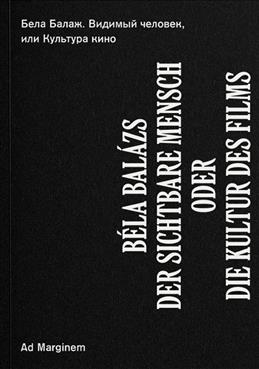
Bela Balazs. The Visible Man, or Cinema Culture. M.: Ad Marginem Press, 2024. Translation from German by Anna Katsura. Content
 |
Bela Balazs (born Herbert Bauer, 1884–1949) was a man of many talents: a Hungarian poet and German writer, storyteller and war veteran, screenwriter of films by the great Pabst and the notorious Riefenstahl, “a Catholic mystic of Jewish origin,” as well as a great friend of the Soviet people and for some time a teacher at VGIK. First of all, a thinker, a comrade of György Lukács, an acquaintance of Karl Mannheim, a student of Wilhelm Dilthey, Georg Simmel and Henri Bergson. But he chose not abstract, but quite concrete and visible matters as the subject of reflection. “The Visible Man” (1924) was the name of his main work and also the first German-language film theory (and perhaps the first in general).
The reader need not worry. Before him is not a mossy monument of ancient learning, but a bright work that has not lost almost a drop of freshness and relevance. And the point here is not at all that it is still continuously read and discussed by specialists. Instead of the superstitions of bygone days, this little book offers a series of witty observations on the nature of art in an age of technological reproducibility, as well as a literary style that is old-fashioned in its refinement, but at the same time clear, and worthily repeated in the new translation. For all its depth, the presence of sophisticated terms and overlaps with other theories, it is quite easy and relaxed to read. In short, they don’t write like that anymore. Therefore, acquiring this publication is useful for everyone who loves cinema, both by profession and by vocation. And for those who doubt it, we will try to highlight some particularly important and even universally significant aspects of this “experience in film philosophy.”
The author admitted that “The Visible Man” was cinema’s declaration of love. Probably, out of great love, he managed to formulate here a reliable core of the theory, which subsequently did not have to be revised, but only developed as the still very young art became more complex and improved. With his book, like Louis Delluc four years before him, Balazs knocks on the doors of the heavenly academy with a request to let in representatives of cinema. Without theory, there is nowhere in this matter, because “not a single art form has yet established itself on the Olympus of Arts, bypassing theory.” Thought, he insists, is not an idle addition to art, but a vital necessity and a guarantee of creative freedom. “Theory gives Columbus the courage and inspiration to set sail; it turns our every step into an act of free choice.”
The point is not that the artist needs to be reasoned with. It’s just that cinema, like all worthy things in this world, deserves its own theory. “By making sense of the world, we build a defense against chaos. When mere existence becomes so oppressive that it cannot be resisted or changed, we rush to make sense of it before it is too late. Theoretical knowledge is like a cork that keeps us above water.” Therefore, there is no time to delay. Cinema has become a reality, a fact of social and cultural life. This means that it is necessary to understand how this product of industrial civilization, which claims a place in the circle of venerable arts, works.
Of course, the creators themselves do not need to understand the meaning of what they create: they pass it through their fingertips, and not through their heads. And yet you cannot create something truly new and beautiful with your head completely turned off. Moreover, the director, whose mind is asleep, is vigilantly watched by the producer, and it is he who calculates everything in advance. So a good film still needs some thought, if only to reassure the studio bigwigs and assure them that profits are coming. And in general, Balazs notes, the director probably loves the material with which he works in his own way, and even flirts with it mentally. “And the playing thought is the theory. (Although the word is not the most euphonious.) You love matter, but only when you get to know it will it reciprocate.”
In short, he strongly advocates the need to think and learn: for critics, filmmakers and audiences. He strives to prove that thinking is not only useful, but also pleasant, that thought does not contradict, but accompanies art and the enjoyment of it. Moreover, cinema, like no other art, depends on the taste of the public and its talents. You need to learn to see the beauty of cinema in order to give it a chance to shine. “And only by learning to understand cinema, we, the sophisticated public, will also become its creators.” On the other hand, although the book contains a lot of valuable instructions for current directors, critics and spectators, the author understands well what cinema really is, in its concrete embodiment at the show: “people go to the cinema for the sake of spectacle, and anyone who seeks delight exclusively in a high-quality aesthetic product is simply a snob.” However, the spectacle does not contradict understanding, and even, on the contrary, pushes towards it.
Balazs insists on film's unique ability to make a person visible again. With the invention of the printing press, he says, culture lost its visual spontaneity and became a culture of words and reading. The expressiveness of gestures and facial expressions, all the eloquence of the poses of ancient statues were lost. The spirit, which previously found visible bodily embodiment, has now become an abstraction of concepts and formulas. In turn, deprived of the visible presence of the spirit, the human body has turned into just a biological organism, a prison of the invisible soul. “It seems as if the word has done violence to a person.”
The language of gestures and facial expressions, which is primarily used in cinema, returns to a person the visibility that has been hidden for centuries behind the veil of the language of words. Culture seems to return from abstract spirit to visible matter, to embodied spirit: “knowledge materializes in the physical body and becomes culture. The body as an expressive means marks the last stage in the development of culture, and therefore the film, no matter how primitive and barbaric it may seem to us today in comparison with modern literature, is one way or another a step forward, demonstrating the direct physical formation of the spirit.”
Of course, for a person of visual culture, gestures and images do not replace words. Unlike the language of the deaf and dumb, the language of cinema does not express abstract concepts with concrete figures, but brings to light spiritual depths that no words are enough to describe. At this moment, says Balazs, “the spirit directly becomes flesh - silent, visible.” Sign language, he believes, is therefore the native language of humanity. This language, however, is so young that “it has still retained its flexibility and can change according to the character of the individual. He is still at that stage when he is born from the spirit, and not vice versa - the spirit from him.” At the same time, cinema, with its mimetic language, seems to promise humanity liberation from the “Babylonian spell.” Together with the unprecedented individualism of the image on the screens, the first international language is born.
True, cinema promotes “real and active internationalism” through unification. All its stars are white men, all its mimic conventions are European. If things continue like this, the author writes, the differences in facial expressions and movements of different peoples will be smoothed out thanks to cinema. “And if one day a person becomes completely visible, he, despite linguistic differences, will certainly recognize himself.” Balazs quite accurately characterizes the power of cinema’s influence on the mass consciousness, but misses the mark in his predictions. It won't be long before synchronized sound kills the sophisticated imagery of silent cinema, transforming man from being seen backwards into speaking and listening. Along with speech, national languages will inevitably pour onto the screens, and the utopia of international art will suffer, if not a complete collapse, then a major defeat. Directors will have to learn their profession almost all over again.
On the other hand, despite the rapid return to the situation of Babylonian pandemonium, sound cinema will hardly waste its ability to unify, and in some places even strengthen it. It is enough to think about the influence of Hollywood on a variety of processes throughout the planet in the last hundred years to be convinced of this. And this is not just a matter of the hegemony of American pop culture tropes. In the end, the products of the “dream factory” would not have enjoyed such success if they had not resonated with something in the hearts of people around the world. They still understand something about the changeable nature of man. And the relative futility of the latest searches for “post-colonial”, “women’s” or some other kind of cinema that would not proceed from the worldview of a “white man” clearly demonstrates how deeply genre, stylistic, even purely technical stereotypes, read by a wide range of viewers as self-evident, still sit in the very structure of cinematic imagery.
Of course, a closer look at the silent masterpieces reveals that even then there were quite observable differences between American, French, German or, say, Danish films - not only in style or production methods, but even in reality itself, as it appears captured on film. Cinema captures not just the world, but specific space and time, even when it is a costume production entirely limited to pavilions. Balazs, it must be said, understood this quite well, and one should not blame him for his imprudence. This is precisely why his thoughts do not become obsolete, even when the autonomy of silent cinema is blurred by the dominance of other, not only visual, means of expression. After all, cinema still remains an independent art, and not a rootless monster, cobbled together from parts pulled from everywhere. It’s just that now we know that his ability to bring things into the light and make them visible is much more complex than the pure play of chiaroscuro.
However, already a hundred years ago it was clear that cinema was moving too close to the territory of other arts. Therefore, it was necessary to show what the difference between them is. Let's say, in the theater, an actor and a director are dealing with a finished work, from which they need to extract some predetermined meaning and embody it through the means of plasticity. There is a difference between a play and a production. In contrast, in cinema this difference makes no sense. If a theater actor can act incorrectly, then a film actor can only act poorly. The first one may make a mistake and not understand his image. In the case of the second, there is no question of this, because he is not an interpreter, but a creator of the image. The prerogative of interpretation belongs entirely to the public, which therefore bears its share of responsibility for everything good and bad that exists in cinema. The same applies to the role of a film director as opposed to a theater director.
This, by the way, implies the absurdity of the still persistent requirement for film adaptations to “be faithful to the original.” They are the original. Unlike a literary text, which in general terms is already in the author’s plan even before he begins writing, the “text” of a film is made up of texture, of images captured and put together. Contrary to the famous aphorism of Rene Clair, a film does not exist until it is made, no matter how meticulously it is thought out. Balázs especially insists on the distinction between the film and its plot, which over a hundred years has not lost, but has acquired even greater relevance. The most outstanding literary script cannot serve as a sufficient basis for a good film work. The point is not what story the director tells, but how he does it, how he translates the word into visual language, and this “how” is inseparable, does not exist in isolation from the specific embodiment. The material reveals the will of the artist. “There is no “content” in a good film. It is both “filling and shell”. The proportion of content in it is as small as in a painting, in music or on a face.”
The art of the silent film is entirely external, superficial, external. It brings everything hidden to the surface, makes the secret obvious, and makes the silences seem audible. At the same time, it is the art of movement and organic continuity. Hence the inevitable simplicity and even primitiveness of his plots. The director has to sacrifice the intellectual, discursive and, therefore, discontinuous matters of the plot in favor of unrepresentable and fluid things that do not fit into any stable concepts. However, thanks to this and only on the screen we get the opportunity to see them, “and this experience is by no means trivial. Painting is also not a direct conductor of ideas, subtle psychological nuances, but this is not a reason to classify it as a low-grade art. How can it not be considered primitive just because it is capable of displaying only one scene.”
Therefore, the decisive bet of silent cinema should be placed on what Balazs calls physiognomy. This is what was called in Goethe’s time a pseudo-scientific discipline, which assumed that by a person’s facial features and facial expressions one can confidently judge the type of his personality and mental structure. If in a world where phenomena and things have inner depth, such views are similar to astrology and are considered erroneous, in the cinema physiognomy turns out to be the only true science. After all, the inner world on the screen is visible only due to external features. The face in cinema is not a mirror, but the soul itself. Therefore, the “sole privilege” and the main expressive means of new art turns out to be the close-up. Only cinema is capable of seeing a person’s soul, and only in film can emotional experiences in their pure form be the basis of a work.
Since the distinction between internal and external is erased on the screen, Balazs notes, cinema embodies Kant's formula of beauty as a symbol of moral goodness. “Where only the eye judges, beauty is the standard.” Without resorting to discursive, conceptual means, cinema achieves intellectual content directly. He is able to cognize, penetrate into the moral nature of man and discover beauty in the world around him without reflecting on this matter. It must be said that our author does not insist on a sharp difference between articulated thinking and visual image. He even took editing very seriously, despite all the attacks of Eisenstein and Kuleshov, calling it “the living breath of film.” The language of gestures and facial expressions is also designed for a kind of reading, hence its expressive richness. The difference lies precisely in the immediacy of this “reading”, in its pure authenticity, in the “irrevocable modality of the visible” on the screen. This restores the original connection between theory and view, the kinship of knowledge and insight, embodied in the ancient Greek word θεωρία.
Like Delluc, Balazs believes that every object is endowed with something like a living tendency to be observed and captured. In many places in the book, “physiognomy” can be replaced by “photogeny” without loss of meaning. True, we are talking here not only about the relationship between the object and the lens, but about the mysterious “physiognomic” connection between the things and phenomena themselves. This is where the camera’s miraculous ability to discover coherence and meaning in the chaos of the surrounding world comes from with just one look, directly, without constructing it with words. “Art counts only with what is filled with spirit. And that which is meaningful, that is, has meaning for a person, is filled with the spirit.” Therefore, the camera's gaze is akin to the gaze of a thinking person. The point is not in the naturalness of cinema, but, on the contrary, in its belonging to the field of creativity and free human action.
Among other things, Balazs outlined many moves in the interpretation of cinema as a phenomenon that subsequently acquired a long history. He paid special attention to the concept and meaning of atmosphere, compared the film with voyeurism and dreaming, with music and poetry, with a theoretical study of the world and a child's innocent view of the world. He even made some contribution to the typology of objects and phenomena especially prone to imprinting. Videos with them to this day fill our social media feeds: these are small children, cats, bright moments of sports competitions, chases with accidents, and elements of everyday slapstick (so-called fails). In general, there is quite a lot in common between his theory and Delluc’s notes on photogeny, despite all the stylistic differences and diametrically opposed attitudes towards the theory. Ultimately, both call for the creative autonomy of the film artist, based on trust in the camera and the mysterious reality behind the lens.
Although in some places Balazs makes an appeal to “objective” economic reasons for everything in the world, petty materialism is not characteristic of him and he does not exchange it for cheap class analysis. He boldly uses venerable categories like “spirit,” which are hopelessly outdated to our ears. Moreover, in some cases it is not just a synonym for culture, but a designation of the rational substance of humanity, laden with almost mystical overtones. Of course, we still cannot do without talking about the connection between cinema and capitalism, but even here everything is strictly to the point: “of all the arts, cinema is probably the only product of capitalist production, thoroughly imbued with its spirit. However, it is not necessary to stop there.”
If some standard detective story about the adventures of petty thieves is based on the rhythm of the events of theft, pursuit and capture of swindlers visible in the frame, then big capital is abstract and invisible, so it will not be possible to expose it in all its glory. On the other hand, the world of big capital itself is a triumph of the extremely visible splendor of decorativeness. In the same way, the “superficial” art of film is the art of appearance. It is not capable of depicting the invisible as such, but it is capable of bringing to light something invisible. Now we understand that the invisibility of man brought by the industrial revolution is the alienation of his essence from the world of the visible spirit into the realm of abstract abstract concepts of the culture of the printing press. “The real value of things, and over time their very existence, were crowded out of human consciousness by the concept of market value.”
Balazs considers capitalist culture to be alien to the nature of the film. Although cinema is its creation, it “embodied the human longing for direct, living and concrete experience. However, cinema, despite its unconditional popularity, will not change culture alone, just as printing did not change it. This contradiction is the deepest root of its all-round imperfection. Cinema, with all its inherent properties, has a good chance of becoming a truly great art if the general development of the world creates a congenial atmosphere around it.” Thus, an overall optimistic and enthusiastic book ends with just a faint hope for the ability of a new art form not only to adapt, but also to change the world for the better.
However, cinema took a different path. He truly changed the capitalist system itself, unwittingly doing a lot to turn it into a sophisticated spectacle. Perhaps we can say that a suitable atmosphere was created. But not for film creativity, which would bring the true man to light, but for the endless overproduction of the spectacle, which increasingly alienates his spirit from man. The unity of truth, goodness and beauty in him is completely lost, the connection between the mind and the eye is broken, and the camera’s gaze no longer resembles a human one, no matter how “subjective” the shooting may be. Co-creation has been replaced by, at best, a passive experience. The spirit did not incarnate, but crumbled into bytes and pixels. The observed chaos of the environment prevailed over the order of thinking.
Now we live in a world where everything is visible, but no one is visible. The point is not only in the dominance of “visual content,” which only aggravated the phantom longing for spontaneity, and not even in the visual schizophrenia that neural networks produce with terrible force. The fact is that it is no longer possible to distinguish between a person and his appearance. The undeniable pressure of the visual has overcome the freedom of the gaze. We see too much, but the meaning of what we see eludes us more and more quickly. We no longer believe the image or our own eyes. Can Balazs and his philosophy from a century ago somehow help today? In any case, his reflections teach us that not only the ear, but also the eye must be kept alert. Only now it is no longer a question of enjoying the spectacle, but of surviving in it.
* Image at the beginning of the material: a still from the film “The Hands of Orlak” (dir. Robert Wiene, 1924)