
Translated material
War
A thousand two hundred eleventh days. Zelensky failed to meet with Trump on the G7 summit - now in Kyiv they decide whether to go to the president for the NATO summit (where Trump may not be) either)
Medusa from February 24, 2022 lives on the Russian-Ukrainian war on the air. In our daily materials, we publish your letters, because we are sure: we must continue to talk about the war. What feelings do you experience because of the ongoing war? How does it affect you personally right now? How has your attitude to what is happening, towards Russia, Ukraine, to the world changed over these three years of the war? Look for a feedback form at the end of this article. A review of the previous day can be read here .
World
Zelensky’s trip to the NATO summit in question - because in Kyiv they do not know whether Trump will come there
In Kyiv, they are not sure whether President Vladimir Zelensky should visit the NATO summit in the Hague next week, since now there are no guarantees that US President Donald Trump will appear there. About this writes The Guardian with reference to sources.
According to the publication, Ukrainian diplomats remained disappointed that Trump “refused to consider Ukraine a priority after Zelensky flew 8,000 kilometers” to get to the G7 summit in Canada, where, as expected, negotiations of the two presidents will be held. This would be the third meeting of Trump and Zelensky - after their skirmish in the White House in February and a conversation at the funeral of Pope in April.
The meeting did not take place due to the fact that on the eve of Trump unexpectedly left the summit, saying that he wanted to concentrate on the Israeli-Iranian conflict. “The main goal [for Zelensky] is to try to enlist the support of Trump in order to put pressure on Putin in order to coordinate the ceasefire - was nullified by the sudden departure of the US president,” writes The Guardian.
“Ukraine is constantly becoming a victim of Trump's events and inattention. Vladimir Putin knows this, and perhaps that is why such a massive attack was committed last night, ”one of the Ukrainian interlocutors of the publication complained.
As The Guardian notes, the “another blow” for Kyiv was the U.S. Veto for the joint statement of the G7 summit in Ukraine - Washington refused to sign the document, saying that the wording in it was too anti -Russian and could jeopardize Trump’s negotiations with Vladimir Putin. As a result, the mention of the Russian-Ukrainian war was included only in the statement of the Prime Minister of Canada Mark Carney, with whom he acted as the owner of the summit.
Zelensky himself, at a meeting with Carni, did not mention Trump's departure in any way, only noting that Ukraine "needs the help of our allies so that our soldiers remain strong until Russia is ready for peace negotiations." He once again emphasized that Kyiv is ready "for the unconditional cessation of fire."
The NATO summit will take place in the Hague on June 24-25. In Washington, Trump's intention to come there previously confirmed, but yesterday the State Department did not rule out that the US President could skip the summit due to employment related to Israel and Iran.
Ukraine
The number of those who died as a result of yesterday's attack increased to 28 people
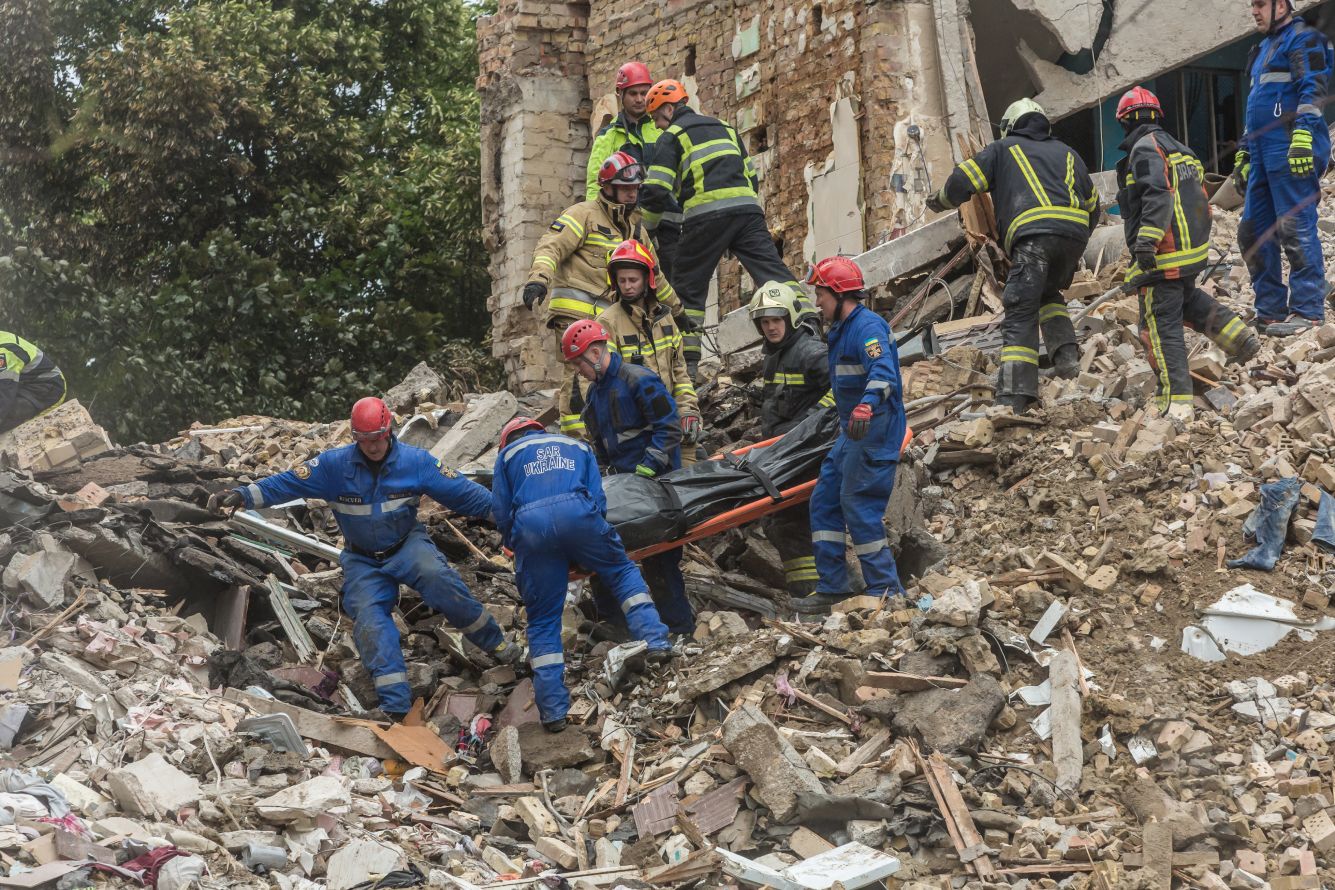
The number of people who died as a result of a massive missile-throne attack on Kiev, arranged by the Russian military on the night of June 17, reached 28 people, according to the State Emergencies Ministry of Ukraine.
Of the 28 dead, 23 were in the house in the Solomensky district, in which a ballistic missile fell. The search and rescue operation continued there all night-since yesterday evening, 15 dead bodies got out from under the rubble. Work at the collapse site has not yet been completed.
Five more people died in other areas of the city. The injuries, according to the latest data from the State Emergencies Ministry, received 134 people.
The US State Department made an official statement in which he condemned the attack of the Russian Federation to Kiev. “We condemn these blows and express the deepest condolences to the victims and families of all victims. Recently, the president clearly spoke out about blows to civilian regions, ”said the representative of the State Department Terry Bruce. The official also confirmed that one of the dead is a US citizen.
Earlier, US President Donald Trump told reporters that he had not heard anything about the attack. When he was asked to comment on a large number of victims, he said: “Yes, this is bad. It is necessary to check if this is, you need to figure it out. ”
Yesterday's attack on Kyiv became the third largest victims in the capital of Ukraine since the beginning of the war. On July 10, 2024, as a result of the shelling of the city, when the Okhmatdet children's hospital was killed under the blow, 33 people were killed , more than 120 were injured. On December 29, 2023, 33 people were also killed as a result of a massive attack.
War through the eyes of readers "Medusa"
Dmitry (Tbilisi). I am writing this letter with a heavy heart and embarrassment. The fourth year of the ongoing war causes me an increasingly acute feeling of powerlessness, fatigue and - I admit - fatalism. If in the first months of the war everything seemed extremely clear, almost black and white, now more and more doubts, anger and anxious ambivalence are settled in consciousness.
From the very beginning, I did not experience any illusions: Russia unleashed the war. Responsibility lies exclusively in Putin's mode, which could not and did not want to allow the neighboring country to come out of its influence. Ukraine, as it seemed to me then, went on its legitimate European way - trying to the EU and NATO, being entitled to choose its development vector.
There was a hope that Putin’s regime would be punished - both his own people through protests and resistance, as well as an international community that will help Ukraine reveal the Kremlin’s moral and management bankruptcy. The hope is that evil will be called evil, and good is supported.
But the years go, and something changes in me. I am increasingly experiencing irritation, fatigue, even bitterness. Looking at Ukraine, I see a country whose power was too easily believed in the West - in his promises, in his willingness to accept her in NATO. I see a state where, in my opinion, many mistakes have been made: language, exacerbation of the conflict, a symbolic gap with the Russian space, which many Russian -speaking perceived as hostility. And where now, in conditions of tremendous suffering, corruption and powerful arrogance are still flourishing.
There is anger in me that I do not want to feel. Why did you believe? Why got involved? Why allowed to use themselves in this historical experiment? I understand that these issues are unfair. I understand that a victim sounds in them, looking for who to shift the pain to. I understand that fighting for my country is a right, not a mistake.
With the Putin regime, everything is still clear to me. This is darkness. This is aggression. This is a crime. But it scares me that my empathy for Ukraine, to its people, has recently been increasingly giving way to irritation and distrust. It scares that in this war, where the roles were once clearly indicated, I begin to doubt not of morality, but in the sense. And I do not find the previous fire in myself. These feelings are not a position. This is a confession. I don't know where to look for a way out.
Share your thoughts about the war
"Jellyfish"