
Translated material
Oil official
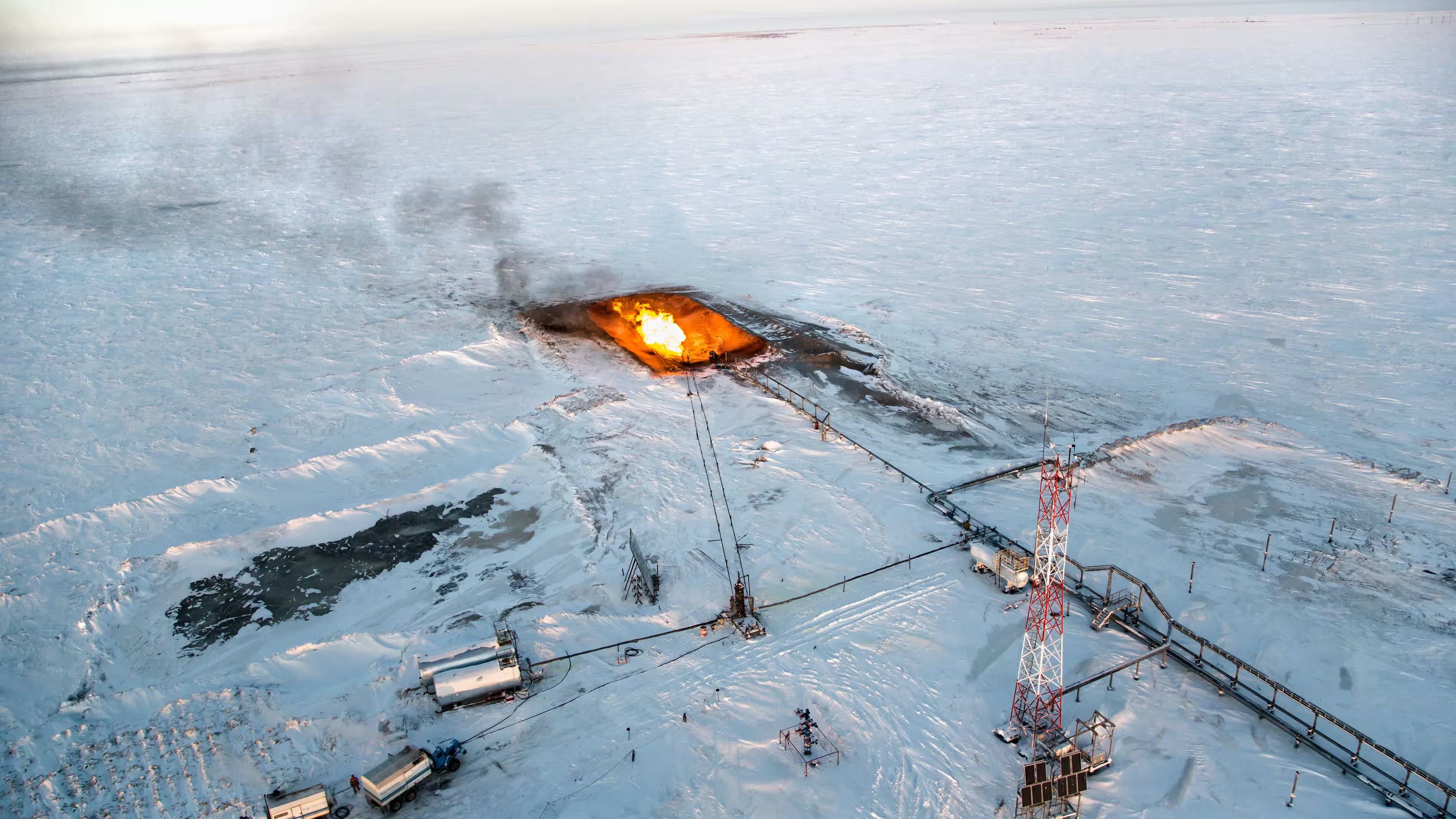
The organization, which should protect the rights of the indigenous peoples of Russia, was headed by a senator from the Khanty-Mansi Autonomous Okrug who protects oil workers.
The Association of Indigenous Peoples of the North, Siberia and the Far East of the Russian Federation has been protecting the rights of indigenous peoples for thirty years. However, over the past 15 years, by this “protection” representatives of the Association increasingly mean cooperation with mining companies. Instead of real help, there is a violation of the rights of indigenous people and hushing up the consequences of environmental disasters caused by the activities of these companies.
In April 2025, at a closed meeting, members of the Association elected a new president, Alexander Novyukhov. He is connected with the mining business: for 14 years he headed the organization “Saving Ugra,” which is financed by oil companies. His relatives and friends also work there. Now he covers the interests of mining corporations already in the status of the head of the Association.
Who helped Novyukhov take this position and why does the Kremlin need the Association?
Who and how chooses the president of the largest organization in Russia that protects the rights of indigenous peoples
For the sake of brevity, we will further call the Association of Indigenous Peoples of the North, Siberia and the Far East of the Russian Federation the Association of Indigenous Minorities or RAIPON.
At a congress of representatives of the Association in October 2024, council members recognized the work of the vice-president of the Association and senator from Khanty-Mansi Autonomous Okrug Alexander Novyukhov in the UN as unsatisfactory. Colleagues unanimously voted to remove him from this activity. Novyukhov’s powers were transferred to the current president of the Association and senator from the Yamal-Nenets Autonomous Okrug, Grigory Ledkov.
Most likely, Novyukhov’s removal was a political move on Ledkov’s part. Thus, he eliminated a competitor in the fight for the post of President of the Association.
The Association of Indigenous Peoples was created in 1993. It brought together regional and indigenous communities. Since the late 1980s, such communities began to appear in regions where mining companies entered the lands of indigenous people for resources. For example, in the Chukotka Autonomous Okrug, where the Chukchi, Eskimos, Evens and others live, companies mine coal , oil, gas, valuable metals, etc.
Indigenous rights communities ensured that corporations did not destroy nature in pursuit of resources. After all, pollution of water bodies or deforestation eradicates the traditional economy by which people live. The destruction of territories for these people is the death of their original culture.
One of such organizations is “Saving Ugra”. It appeared in 1989 in Khanty-Mansi Autonomous Okrug. The region is home to large oil and gas deposits. Lukoil-Western Siberia, Gazpromneft-Khantos and Rosneft subsidiaries operate here.
Alexander Novyukhov, who was suspended from working at the UN in October 2024, was the head of “Saving Ugra” for 14 years, from 2002 to 2016.
However, he has been involved in indigenous issues since 1999. At first, Alexander worked in the administration of the Berezovsky district of the Tyumen region - he was the deputy chairman of the Committee for the Affairs of Small Peoples of the North. In 2001, he moved to the regional level and became an adviser to the first deputy governor of Khanty-Mansi Autonomous Okrug Gennady Bukhtin. Novyukhov worked in this position from 2011 to 2016, and then became a deputy of the Khanty-Mansi Autonomous Okrug Duma. At the same time, he became a member of the United Russia faction in the Committee on Economic Policy, Regional Development and Natural Resources.
In 2021, Novyukhov became a senator from Khanty-Mansi Autonomous Okrug and vice-president of the Association of Indigenous Peoples of the North.
Pavel Sulyandziga, founder of the international foundation for the development and solidarity of indigenous peoples “Batani” and vice-president of the Association of Indigenous Peoples in 2001–2010, said that Novyukhov is “an official to the core,” who, instead of protecting the rights of indigenous peoples, is busy “staying in power in an bureaucratic chair.”
“When power changed in Khanty-Mansi Autonomous Okrug, he did everything to simply stay in power, he adjusted,” Sulyandziga said. “After all, I also worked for some time as an official, and this is a rather specific activity - either you adapt to it, or they survive.”
It was in such a person as Alexander Novyukhov that the President of the Association, Grigory Ledkov, saw his main competitor in the elections in 2025.
Grigory Ledkov spoke at events of the Association of Indigenous Peoples, attracting regional branches that are members of the Association that are loyal to him. Novyukhov did the same.
Some regional organizations of the Association of Indigenous Minorities published letters and appeals to the coordination council of the Association and to Ledkov himself with a request to “consider the possibility and nominate his [Ledkov’s] candidacy.” Similar letters were sent by 10 associations, as well as a people's deputy of the Yakut parliament. Another association released a video message under the slogan “Za Grigory Ledkov!”
By the end of 2024, publications from all sides had dried up. The Association's website has not been updated since March 2025. New publications appeared only in May - after the election of the organization’s president. On voting day, the group on VKontakte was renamed. The administrators also changed the link to the community. Now you can find out that the group belongs to the Association only by looking at old posts until April 25, 2025.
Ledkov has headed the Association of Indigenous Peoples since 2013. Then he himself, Pavel Sulyandziga and the head of the Association of Indigenous Peoples of Chukotka Anna Otke participated in the elections. According to the charter, a candidate must receive two-thirds of the votes to win. In the first round, Ledkov received 139 votes, Otke - 27, and Sulyandziga - 190. After this, Sulyandziga withdrew his candidacy. According to him, an acquaintance from the security forces warned him that victory could have a bad effect on his children.
In the 2025 elections, Ledkov, despite the support of regional branches, did not run. Only Alexander Novyukhov and the representative of the Kamchatka Territory Andrei Metelitsa took part in them. Novyukhov received 199 votes, Metelitsa - 16. At the same time, Metelitsa did not conduct an election campaign.
Pavel Sulyandziga said that the decision to appoint Novyukhov as president of the organization was made by the Presidential Administration and Norilsk Nickel, the main beneficiary of the Association’s activities.
Ledkov most likely already understood before the elections that he would not become president again. According to Sulyandziga, he lost his position because he had a falling out with Norilsk Nickel.
Norilsk Nickel, together with the Association of Indigenous Peoples, opened a school of public diplomacy at MGIMO in 2021. There, indigenous activists were taught to advocate for their interests nationally and internationally. Ledkov, Sulyandziga explained, wanted the money that Norilsk Nickel allocated for the school to go through the Association. When this did not happen, he pointedly withdrew the Association from the project, for which he paid.
Novyukhov has no conflicts with corporations. According to Sulyandziga, he “perfectly understands the rules of the game.” That is why he, quiet and comfortable, was chosen as president of the Association of Indigenous Peoples.
How Novyukhov “defended” the rights of indigenous peoples among oil workers
Nefteyugansk is a city in the Khanty-Mansi Autonomous Okrug. It stands on the channels of the Ob River, which flows into the Arctic Ocean. Not far from the city, the Yuganskneftegaz company (a subsidiary of Rosneft) is engaged in oil production. In 2015, RBC wrote that Yuganskneftegaz accounts for approximately a third of all oil produced by Rosneft.
Also in 2015, a major oil spill occurred at one of the company’s fields near Nefteyugansk. The contaminated area exceeded 10 hectares.
Concealing damage from the actions of mining companies is a common practice for many officials. This also applies to representatives of the Association of Indigenous Peoples, who in words advocate the protection of indigenous peoples, but in reality support industrialists.
Since the mid-2010s, the Association of Indigenous Peoples has been cooperating more and more closely with the authorities and big business. Grigory Ledkov contributed greatly to this. By that time, he was already a State Duma deputy from the Yamalo-Nenets Autonomous Okrug and a member of the United Russia party. Under his leadership, the Association established relations with the Federal Assembly, the Government and the Presidential Administration. The organization began to accept officials into its ranks.
The story of the spill near Nefteyugansk is not the only case when Novyukhov spoke out in defense of oil workers. In 2016, he criticized Greenpeace for allegedly speculating on indigenous issues. Then environmentalists had a conflict with the Surgutneftegaz company
The situation developed in the village of Numto in the north of Khanty-Mansi Autonomous Okrug. Industrial work began there - in the wetlands where the Khanty led their traditional way of life. Novyukhov then argued that indigenous peoples do not carry out any activities there.
Public hearings were held on this matter. They were attended by representatives of indigenous peoples. Greenpeace representative Elena Sakirko said that at the hearing, only two residents of Numto spoke out against the park zoning project. The rest did not perform. Sakirko linked this to the fact that the residents’ decision was influenced by the local administration. As a result, the Russian Ministry of Natural Resources agreed on a new oil production plan for Numto. Mikhail Kreindlin, a Greenpeace expert, noted that the plan became a little more environmentally friendly, but still assumed the expansion of oil activities on the lands of the Khanty.
The oil companies that Novyukhov publicly praised systematically provided financial support to “Saving Ugra,” in which Novyukhov was a leader, and continue to do so to this day.
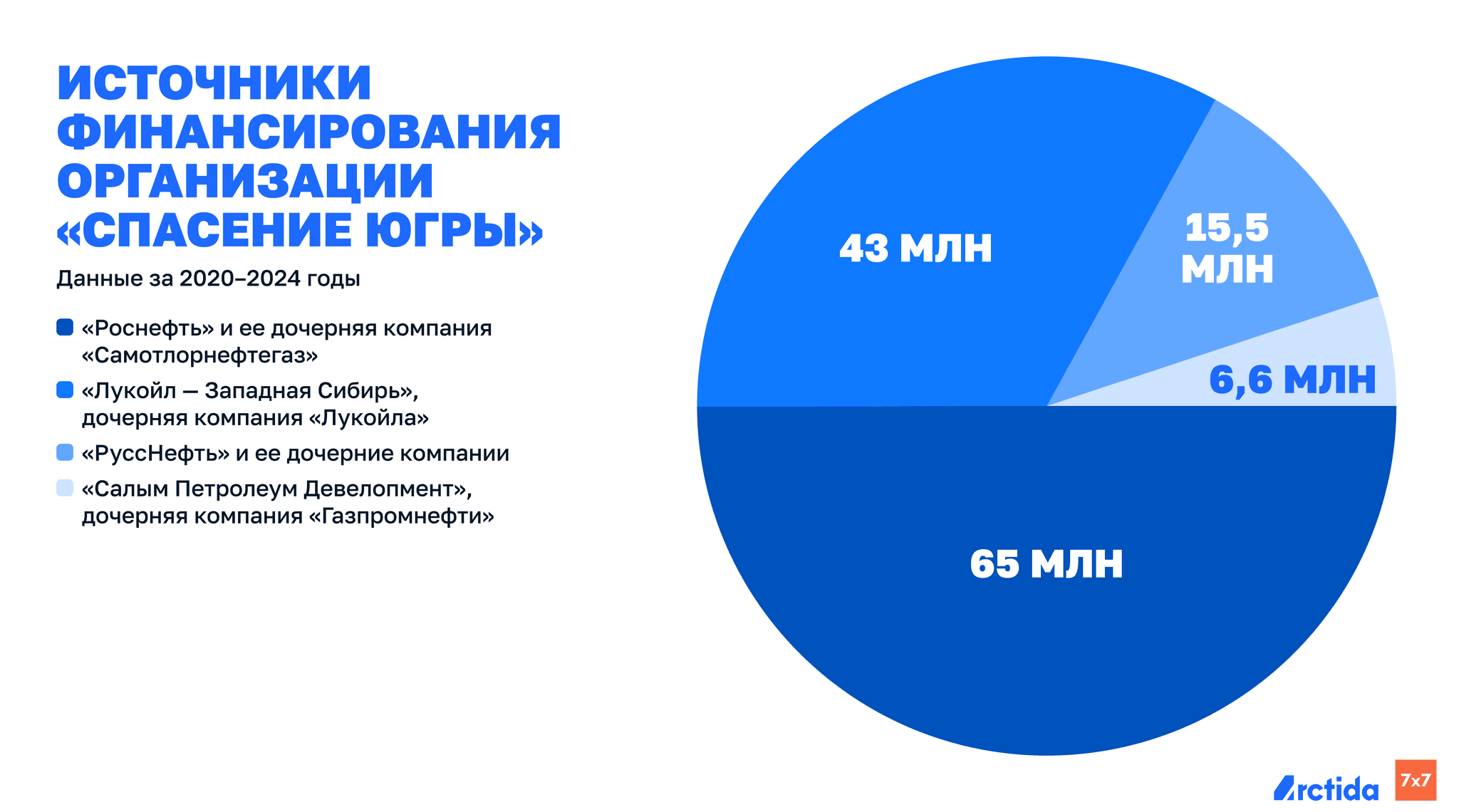
The largest corporate donors of “Saving Ugra” are PJSC NK Rosneft (to a greater extent), PJSC NK RussNeft [Mikhail Gutseriev] and LLC LUKOIL - Western Siberia. В 2020-2024 гг. “Saving Yugra” received from Rosneft (PJSC NK Rosneft and its subsidiary Samotlorneftegaz JSC) - 65 million rubles, LLC LUKOIL - Western Siberia - 43 million rubles, from PJSC NK RussNeft and its subsidiaries - 15.5 million rubles, from Salym Petroleum Development (Gazpromneft) - 6.6 million rubles.
Novyukhov’s connections with business remained even after his departure from the post of manager. As of 2023, his sister Elena Pugacheva worked at “Saving Ugra”. Her late husband Sergei Pugachev was also an employee of the organization. Mikhail Eremeevsky, Novyukhov’s assistant, is also on the staff.
In addition, in 2022, Novyukhov’s brother’s wife, Yulia Fedorova (nee Novyukhova), worked at Travel and Travel Agency LLC. In the same year, this agency entered into a contract with “Saving Ugra” to pay for tickets in the amount of 102,478 rubles.
Even after leaving his post as head of “Saving Ugra,” Novyukhov continued to systematically praise oil companies. For example, in 2017, at the V Forum of Youth of Indigenous Peoples of the Khanty-Mansiysk Autonomous Okrug, he stated that he was grateful to the Lukoil company for its sensitivity to the problems of the indigenous peoples of the North. The company financed this forum.
How the Kremlin uses the Association of Indigenous Peoples
The Association of Indigenous Peoples Supported the start of the war in Ukraine with an open letter to Vladimir Putin. After this, the organization became interesting to the Kremlin not only as a way to level out violations of the rights of indigenous peoples, but also as an opportunity to defend the country’s interests in the UN and other international platforms (Arctic Council). Russia was excluded from participation in international meetings, but representatives of the Association continued to speak at UN meetings in the status of full participants and use this as a tool of influence.
For example, a representative of the Association of Indigenous Peoples of the Krasnoyarsk Territory, Viktor Bilanin, said in April 2024 at a meeting of the UN Permanent Forum of Indigenous Peoples in New York that indigenous peoples have no conflicts with Norilsk Nickel. This is why unilateral sanctions against Russian companies need to be lifted. Actually this is not true. Norilsk Nickel has still not resettled the residents of Tukhard, a village located in the sanitary protection zone of the production facilities of Norilsktransgaz JSC (part of Norilsk Nickel), although it is no longer possible to live in this place.
Residents of Tuhard initially were not against moving to new apartments. In 2019, Norilsk Nickel and its partners built resettlement houses one and a half kilometers from the village. But the new location did not have a power plant, boiler house or water supply. People refused to move into unequipped houses. Activists said that in 2024, the local administration and Norilsk Nickel forced people to leave their places of residence in various ways - electricity and gas were specially cut off for some.
Bilanin kept silent about this problem at the UN meeting.
“Russia is now being kicked out of many international platforms, and the Indigenous Peoples’ Forum at the UN remains one of the few large international platforms where Russia still has influence,” commented Pavel Sulyandziga. “Russia is actively using this loophole, because supposedly the indigenous people speak for themselves and on behalf of their people. This is certainly not true."
The Kremlin does not care who exactly should head the Association of Indigenous Peoples. The main thing is that this person does not criticize the activities of mining companies and does not allow indigenous peoples to voice their problems. Novyukhov has every chance to cope with these tasks.