
Translated material
Symbolist of the era
Dreams about the life and death of Valentin Podpomogov: What picture would the master write about today?

Valentine of the submarines. Photo: Asi submarine archive
Muffled light in space with an elevated-strict aura. On the walls - objects that create a mystical atmosphere. The dynamics of the mood of people who have entered here: you see how curiosity on smiling faces is replaced by thoughtfulness, immersion in the sacrament of contact with something high, which connects earthly being with other worlds and dimensions.
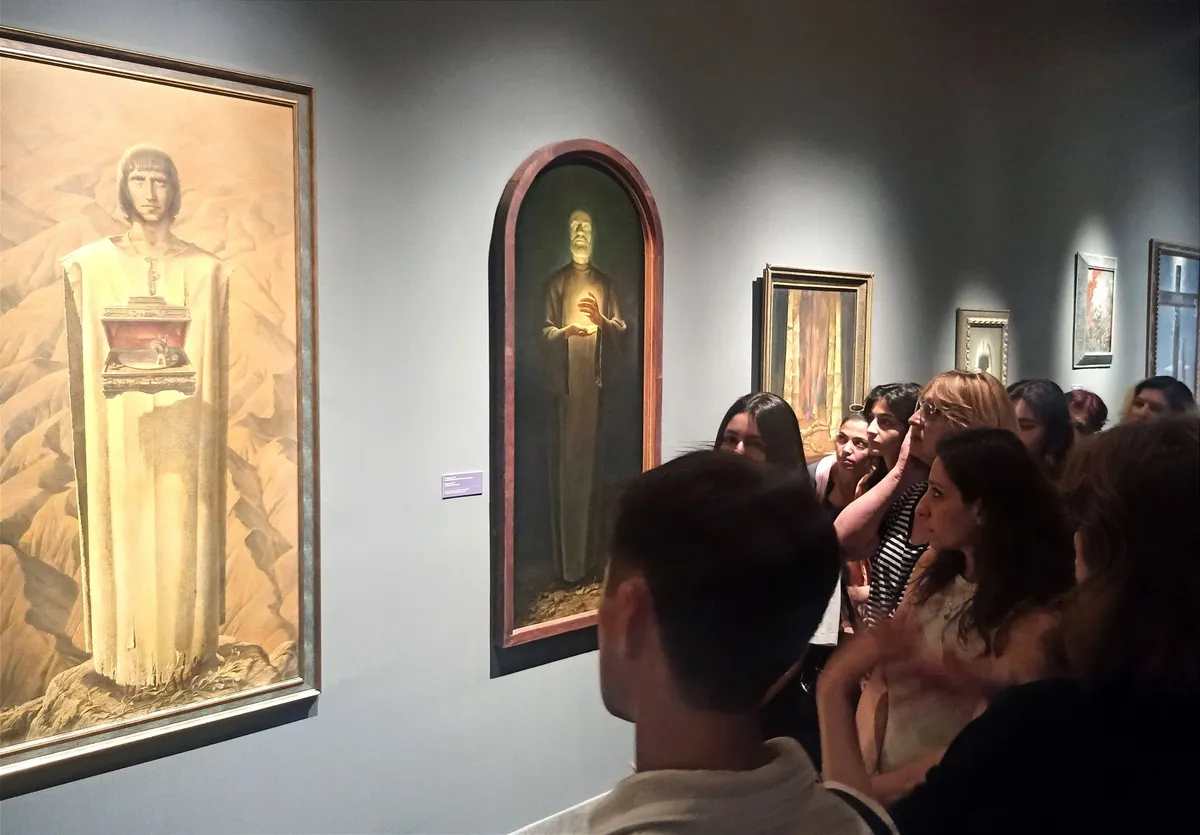
For the past two months, such a space has been one of the halls of the Yerevan Center for Arts Gafescheyan, and objects were philosophical canvases of the exposition “Dreams of Life and Death”. Their author is the legendary Armenian artist Valentin of the Podpomov.
His visual language is unique. What he did the submarous was strikingly different from the trend and was not like anything, and not only in the Armenian context, but also in the world.
He introduced a completely new type of painting into the Armenian art - both in the subject and in the artistic approach. His symbolic, metaphysical canvases brought him recognition not only in the world of art, but also among the general public. The unconditional uniqueness of Podpomgov is also that he took up painting late, at 50, being completely self -taught.
The exhibition included a special selection of his works from family and private collections. The public saw some of the works for the first time. In the selected paintings - philosophical visual narratives of the submarine around the metaphysical boundaries of life and death. “It was important for us to show it from this point of view, because this topic goes through a red line through all his work, because he was by a philosopher, his work is very deep,” says the director of the exhibition program of the Center Gafescheyan, the curator of the exhibition Armen Yesaants.
Given by God, gifted by God
Valentin Podpomov was born in Yerevan on April 29, 1924. The birth passed heavily - this was the first cesarean section in Armenia. At first, the doctors decided that the newborn would not survive, and almost committed the irreparable, but suddenly noticed that the boy was breathing, and he was saved. He was nevertheless with a serious pathology - a congenital heart defect. Because of this disease of the submarines, all his life has been under the supervision of doctors.
His father, a Ukrainian with a Russian surname, appeared in Armenia along with the Red Army troops, after the Sovietization of the republic decided to stay and began to work in pharmaceuticals. Mom, the Armenian Eugene, bore the surname of the Ter-Astitutes, and perhaps there is also symbolism in this, because the “Avostsatryans” means “given by God”. Numerous talents of the sub -time were truly God's gift.
Like his father, his mother worked in the pharmacy, although in her youth she dreamed of becoming an actress. Later, when her son had an interest in drawing, she, with all the power of unrealized creative nature, despite the reproaches of relatives, generously spent her modest income on pencils: “Valya loves to draw - let it draw!”
Valya loved to draw, but not to study in school subjects - no: all his notebooks, carefully preserved by loved ones, were painted.
As a result, he graduated from only four full classes, which, however, subsequently did not prevent him from creating all kinds of developments, as if he were not an arrears, but a talented engineer-inventor. For example, in the Yerevan House of Cinema, an automatic developing machine is stored, which he completely made himself-absolutely breakthrough for those years of know-how, which brought to a new level work in film production. The chief engineer of the Armenfilm studio died, without believing that that unit is the sole brainchild of Podpomgov.

At the age of 13, Valentine went to get a job in Lev Atamanov (Levon Atamanyan), who had arrived from Moscow, the animation workshop at the Armenian film studio. It was necessary to help the mother - the father almost did not take the participation in the life of their family, and they really needed. The young lover of drawing required for animating skills, and the chieftains politely said: “Go home. When needed, we will call you. ” The young man realized that this was a refusal, and sadly wandered back. Seeing his gaze, Atamanov noticed that his shoes have no soles, which means that the boy’s family lives very difficult. He called him and said that tomorrow Valentine would go to work. Thus began the creative start of the submarine-the future animator, director, artist-artist, creator of the whole galaxy of his favorite Armenian cartoons, and later, after 20 years, after a long-term break in the work of the cartoon, the recreate of animated production at Armenfilm and a master of students, including the famous Robert Sahakyan.
But not the animation of the one was engaged in Valentine of the submarines. He became a brilliant artist-winner of the feature films and theatrical performances (by the way, the work of the chief artist in the film “Color of Grenade” Parajanov proposed precisely the sub-hem, but he received a refusal: knowing the character of the director, Valentin Georgievich, with all his tender love for Parajanov, did not doubt that they did not work out), made illustrations, decorations, decorations, decorations Design, sculpture, created a tombstone, was the first chief artist of the Armenian capital, starred in cinema as an actor. And besides, he himself was a lively attraction of Yerevan.
City legend
He was respected, adored, appreciated. He very easily fascinated people with his energy. The doors of his house and workshop did not close - it was a bohemian oasis in the best sense of this combination of words. Around the sub -time there were myths and legends. The famous submogo jokes, jokes, winged phrases, draws and hokhma were transmitted from mouth to mouth and are still transmitted, 27 years after his departure. Valentin Georgievich was a skilled storyteller, sociable and witty. He did not look at the occupation or “status” of a person, but straight to his soul, he knew how to truly be friends and substitute his shoulder. Academics and wipers, folk artists and nurses, party workers and dissidents, employees of organs and people from the criminal world - the circle of his friends and friends was unusually wide. His manners were distinguished by the unique elegance - in a word, he was a real artist. And a real Yerevan. They said: “Our Valya is the salt of Armenia. He who does not know Podpomgov does not know Armenia. ”
Unlimited fantasy, a passion for invention, a craving for interesting solutions plus the golden hands of the artisan - and he turned his workshop into a unique object. The multi-level space, railing, stairs, lattice doors, stained glass hatches, the original bar-chamber, fireplace, monograms and coats of arms-some of his ideas were ahead of others.
If a guest came to the artist’s friends, he was certainly led to the sub-time. Whom the walls of his workshop did not obey ...
"Olenka, Stop!"
Once the journalist from Moscow came to Yerevan Olga Dmitrieva and came to the workshop to Podpomgov. Having enthusiastically looking at the paintings, she exclaimed: “Valentin Georgievich, I will write an article about you in the“ Interlocutor ” - about how, here, in the province, a talented Russian artist ...” - “Stop! - interrupted her submarines. -Firstly, Olenka, this is not a province. Secondly, I am not a Russian artist, but Armenian. And thirdly: I do not give you consent to write about me. " He said how he cut off and at the same time gave the journalist one of his paintings.

An artist who does not love exhibitions
“Valya was not at all attached to her paintings. He said: “I am attached to the picture while I write it, and as soon as I finish the work, this thread breaks off. Each picture has its own fate, its own road, and it should go along this road. ” And without a shadow of regret, he calmly parted with his works, gave them out, sold them, ”says Asya Podpomogova. The wife of Valentina Georgievich, who devoted his life to him and preserving his memory after his departure, willingly tells reporters about him, accepts guests, acquaintances and unfamiliar to show the workshop, paintings, sketches, notebooks, photographs. Here is a easel with colors, and it seems as if the artist was led away for a while, he will return soon, and a new masterpiece will be born ...
The submarines were an extraordinary personality and a great original. After all, this is very unusual when the artist does not like to exhibit - but he did not like.

"Bad paintings do not steal"
For 24 years, he left a not very great legacy painting. Many paintings settled in private collections in Armenia and abroad. Several works adorn the constant exposition of the Yerevan Museum of Modern Art and the Ethnographic Museum "Sardarapat". And some paintings were simply stolen from him. “Bad paintings do not steal,” the master joked. Often he did the author’s repetitions of his work.
“But this work is the first,” Asya shows the picture “Nostalgia”, written in 1974. It depicts a sad monkey with expressive and for some reason with very familiar eyes, clamped, as if in a cage, into a metal frame. Then this picture shocked all Yerevan.

According to the mystical coincidence of the last finished work, the painting “The Last Miles” became. Bypassing the layout, the old horse moves towards the end of its life. Behind the pillar is allegorical stone gates, light, the path to eternity. When he wrote this canvas, Asya did not leave fear: as if it would not be symbolic ... alas, she did not deceive her. Valentin Podpomogov died in the age of 74, in the summer of 1998.
“You know, I associate Valya with a spring of pure water. He was a man with all the degrees of freedom. The most of the person. Always ready to do something good to another. The ingenious type of man. Those years that we spent together were higher than in the seventh heaven. ” The couple spent the last nine of his life together.
The art critic Zara Maloyan was a student of the submarine, in the early 1980s she was engaged in his workshop for about two years.
“The workshop was like a funnel that was tightened, it was impossible to leave there,” Zara recalls. - There was another time, space was distorted. Valya was an incredible charismatic. It would seem that he does nothing like that, but at the same time he is steadily changing you. Without wanting it, he created a certain special space around him, as if from the common space he cuts out a piece and makes his world there. You open the door and fall into another reality that he controls.

No one except
- I can definitely say that none of the Armenian artists wrote so much on the theme sensitive for Armenia as he. The commander Andranik was written by him in Soviet times. The details of the memory of the victims of the 1915 Armenian genocide was also written in Soviet times, when none of the artists wrote on this topic. Later, after the collapse of the USSR and the acquisitions of independence, everyone became nationally oriented by patriots, believers and began to write a lot on such topics, but before that submarous was almost the only artist who did it. You will not meet the paintings of the Mother of God - only with him. Such works, in principle, were done - for example, artists depicted the Mother of God with the baby and signed: “Maternity”. He did things completely atypical for the Soviet artist. Armenia was perhaps the only of all the Soviet republics where the pressure of socialist realism was not strong. Of course, at that time the Soviet leadership welcomed and better paid for ideological things, but they did not spread rot for the non -natives. Nevertheless, artists refrained to write on these topics. And he wrote the submarines.
The texture is before the illusion
- He was insanely talented and constantly studied in the process. A good eye, a good hand, besides, he was so smart that he found ways to compensate for the absence of an academic school. For example, he refused bright colors - and did the right thing, because working with color requires a special internal organization. He had a number of such professional solutions in which there would be no need if he had received an art education. For example, to draw a hand, he first took off her cast from her, and to draw a bell, he made this bell.
He saw a frame very well, he saw the space perfectly. Because all his life he was a film art, he knew the light perfectly. No one knew the light of how he.

And now they do not know. And no one knows the texture as he knew. He could imitate anything. Could take a piece of foam and make a stone out of it. Once, before my eyes, he made absolutely indistinguishable tuff before my eyes, and another time made a brocade from Marley. That is, he owned the material to such an extent that the texture turned out before the illusion. I remember sitting in the workshop, painting a bouquet of roses as a gift to her friend. There was a silk drapery that I did not work out. And then Valya comes up, takes a brush and literally makes silk a few strokes. A few strokes, understand? But silk is very difficult to draw. Absolute uniqueness!
Symbolist or surrealist?
Podpomogova is not easy to attribute to some specific "Izm." He called himself a symbolist and "Ramist." The art historians of the Center for Gafeschyan see in his works a monumental canonism with a surreal accent, clarifying that, of course, he was not a surrealist in the accepted sense, but he was in some approach to the visual language used, and in general his painting in content is attributed to allegorical, mystical surrealism.
Zara Maloyan is convinced that the submarines are the symbolist: “Everything that is depicted on his canvases has its own meaning, meaning, symbol, and every millimeter thought out. That is, in his works there is no conceptual core of surrealism - there is nothing spontaneous, unconscious, dreaming in them. On the contrary, every detail in its place, each has its own symbolic meanings. A completely unique artist, one of the deepest. He and man were not easy, and his painting is complicated. If we talk about the artists of the second half of the twentieth century, I would put it in the top 20-for uniqueness. ”
"Dreams about life and death"
One of the paintings included in the recently exhibited cycle is the “Secret Office”. In Christ, wine and bread in his hands are his blood and body. Candles are apostles, the shadows of which fall on the walls in the form of their silhouettes. The extinguishing candle is Judah, who will betray his teacher. The shadow from the thorns wreath means that he knows what awaits him. The picture is called Sors, that is, lot. On a cross -shaped table are white and black balls - which one to choose?
Perhaps this was thinking about this, looking at the picture, a resident of Yerevan, the philologist and guide Elina: “I have long been familiar with the work of the submarine, I admire them since my student years. Here, to this exhibition, I came a second time. I love this genre very much. I have been looking at the “Secret Village” for half an hour and I can’t tear myself away. ”

And Ivan from St. Petersburg was detained by the MEA Culpa painting-a manifesto written in 1983 during the aggravation of the Cold War: “It is amazing that these works belong to the brush of a self-taught artist who did not have an academic education. It is amazing how he affects the viewer. And of course, it is impressive that the frames he made continuing the idea of paintings and are one with them - I had not seen this before. Of course, this artist is worthy of access to the world viewer, beyond Armenia. I am very glad that I found out about him here. I would like his work to be illuminated more and wider. ”
The frame to the picture "Eternally alive" looks like a coffin cover. The author, to put it mildly, was not a fan of Leninist ideology and the Soviet system. He was convinced that Lenin had to be buried. Due to the fact that he is not buried, nothing good awaits Russia, Valentin Georgievich believed.
And here is the Podpomogov "Committee". Not just a composer, but the heart of Armenian culture. “We do not know how the artist succeeded, but even when the hall is completely dark, the light that Komitas carries works as if a lamp was on inside. We even thought not to be light near this picture, because it glows brightly from the inside, ”comments Armen Yesaants.
Nearby is a portrait of Vysotsky. The author depicted the poet in the Armenian Highlands, because his stepmother was an Armenian, and he was baptized in the Armenian Church. Without hands - as a symbol of the fact that in Soviet times he had no freedom.
An element that submarines carries through many of its work is a candle. He always had a special attitude to the candle as a symbol of life and death.
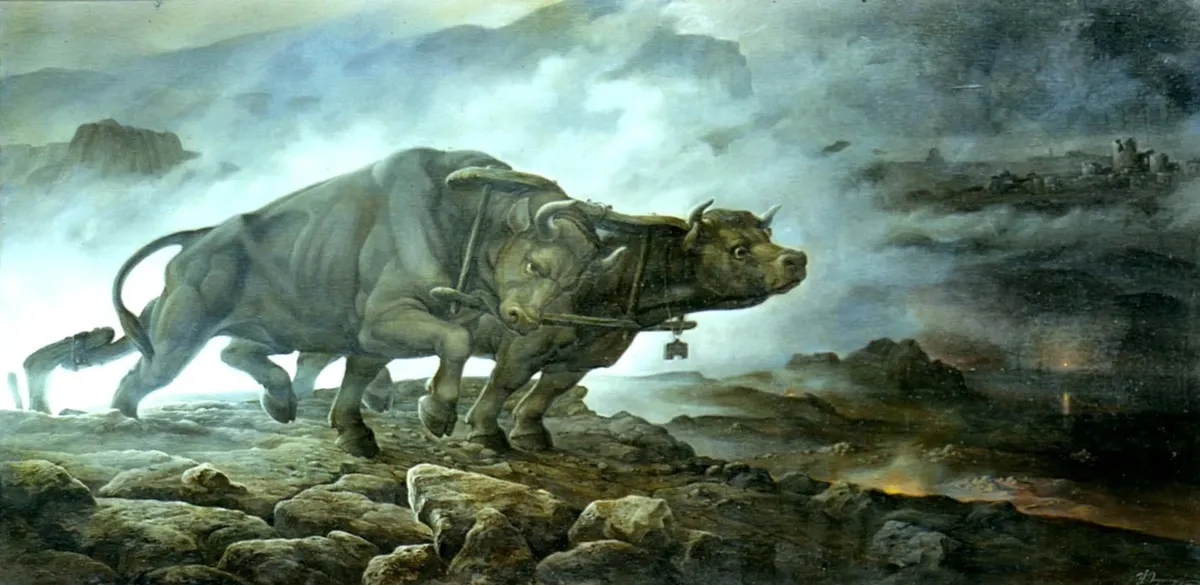
One of the favorite and most piercing paintings of the master is “the country of Ayan”: two bulls tensely, with a titanic effort, pull the plow, trying to plow naked stones. This is a symbol of Armenia.
Сегодня наш мир сходит с ума, ведутся преступные войны, гибнут люди, а сотни миллионов других людей смотрят жестокие кадры с экрана, будто шоу, игру или фильм с абстрактным сюжетом, превращаясь в циничных сторонних наблюдателей, теряющих способность к эмпатии. Если бы мастер был сейчас жив, какую картину бы он написал?..
Евгения Енгибарян